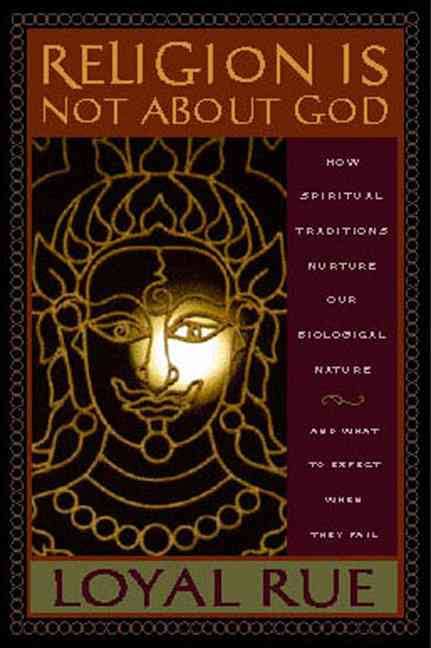
Taking the Super out of the Supernatural (or a Manifesto for a Latter-Day Pantheism).

Excerpt from a symposium on Loyal Rue’s Religion Is Not About God. Zygon: Journal of Religion and Science.

There’s something horribly plausible about Ralph’s arguments, religion arising out of man’s unique awareness of his own mortality. . . . In fact—when you think about it in this light—the story of Original Sin in Genesis could easily be a myth about the advent of self-consciousness in evolutionary history. Homo sapiens, by virtue of his sudden surge in brain-power, apprehends his own mortality, and is so appalled by the discovery that he makes up a story . . . a story about having offended some power greater than himself, who punished him with death for his transgression—and in later elaborations of the story, offered him a second chance of immortality. . . . In the myth, the forbidden tree is the tree of knowledge. . . . But perhaps in reality the knowledge was of death, and all the existential angst it brought in its train. The fall of man was a fall into self-consciousness, and God a compensatory fiction. (Lodge 2001, 107–8)

The existential angst that is a by-product of consciousness is as good a characterization of the human condition as one will find. Consciousness, one might say, is an encounter with eternity. With this angst comes epistemological and metaphysical musings about humankind’s place in the larger scheme of things. Epistemologically, humans as naturally disposed cause-seeking creatures hypostasize all manner of beliefs where explanation of a long as they enhance survival: “Religious traditions work like the bow of a violin, playing upon the strings of human nature to produce harmonious relations between individuals and their social and physical environments” (p. 1). Put another way, “religious traditions are primarily about manipulating aspects of our universal human nature for the sake of achieving the twin teloi of personal wholeness and social coherence, thereby to maximize the odds favoring human reproductive fitness” (p. 122). Hence, for Rue there is unquestionably an evolutionary story to be told about religion. Religion as an essentially adaptive cognitive phenomenon functional to the evolutionary impulse, is the presupposition that underwrites the explanatory dimension to Rue’s project. In this sense, Rue takes the super out of the supernatural and is what he means when he declares religion to be not about God but about us.

Rue writes that “there is much to be said for the thesis that all theological formulations are dubious for the simple reason that God is inscrutable” (p. 3). Epistemologically speaking, the concept of God does not achieve enough clarity and distinctness to be discussable. When we cite the divine attributes—omniscience, omnipotence, and so on—I do not think we have the least purchase on these ideas, which generate antinomies almost immediately. Such antinomies might well be what feed our conceptual alienation from the natural world, of which we are a part.

A standard objection to scientific inquiry into religion is that whatever scientific benefits accrue, humankind’s imaginative or religious sensibility will be correspondingly impoverished. Rue argues that notions of humility, awe, and delight are not necessarily alien to a scientific sensibility. Indeed, a naturalized religion will generate a new sense of mystery and awe, the object being Mother Nature (p. 17). I thus take Rue to be offering a deflationist metaphysic—that is, he considers the postulation of God to be redundant. Identification of the natural world and scientific method with a unity that may or may not be divine brings into focus some of the issues in the relationship between religion and science, which is known for generating more heat than light. It was with some apprehension, therefore, that I approached the so-called religion-science literature. It became apparent to me that this literature marks a deep philosophical question that in essence revolves around whether or not science is explanatorily closed. This question has a great deal of resonance within the philosophy of mind, my primary area of research. How are epiphenomenal phenomena—mental causation, intentionality, or consciousness—to be reconciled with physicalism? In philosophy of mind parlance, this debate is termed the “explanatory gap.”

Rue’s Feuerbachian slogan that religion is not about God but about us will no doubt alienate many who would be conceptually and perhaps emotionally bereft of the notion of the supernatural. So, before we examine Rue’s positive proposals, it will be useful to say what Rue is not doing. (Rue terms them disclaimers.)

1. Rue is not in the business of proving or disproving the epistemological and ontological claims of the various religious traditions. As a theorist guided by a strict scientific sensibility he can address only that which is open to falsification (pp. 316–18).

2. Rue has no axe to grind with a religious sensibility, the corollary in light of (1) being that neither is Rue an apologist for religion.

3. Rue’s environmentalism cuts across the Left-Right ideological spectrum (p. 355). Environmentalism certainly can be classed as a political ideology. Indeed, it offers no less than a substantive theory of the human good (p. 363).

The ground for any intellectual reconciliation between science and religion is the acknowledgment that there is an evolutionary story to be told about the rise of religion, a story that congeals around three inextricably linked theses:

A. There is such a thing as human nature, a nature whose outline sharpens through the lens of evolutionary theory.

B. Religious traditions are best understood as nurturing cognitive and emotional systems, conduits to personal and social well-being (hence the book’s subtitle “How spiritual traditions nurture our biological nature and what to expect when they fail”).

C. Because religion has lost the intellectual credibility and moral relevance that it once commanded, it is no longer able to attend to B, with the consequence that humanity, behaviorally adrift, has set the conditions for global environmental catastrophe.

Items A and B constitute Rue’s naturalistic explanation. Item C, as already indicated, constitutes Rue’s diagnosis. A diagnosis presupposes a remedy, but for some reason Rue defers an extended discussion to the end of his book.

What does Rue’s conciliatory overture mean? Where on the religion-science axis can we locate him? To answer this question is to work through the details of his position. His conciliatory steps take place against a background that typically has considered religion and science as incongruent, a fault line that gets definition partly through an ahistorical approach to the study of science and philosophy. I offer a brief and highly selective historical outline. We have the Romantics’ rejection of the notions of progress and rationality embodied in the universalizing tendencies of the scientific revolution and the Enlightenment. With the rise of postmodernism in the twentieth century, the leitmotif was again the rejection of objective truth and scientific rationality. Mid-century saw the two-cultures debate and the mid-1990s the debate ignited by the Sokal hoax. Currently, there is a debate between Intelligent Design theorists and the scientific establishment. Against this broad background, Ian Barbour’s fourfold religion-science categorization structures Rue’s discussion (Rue 2005, 319–24). Barbour’s classification, which I reconstruct via Rue, is as follows:

1. Conflict—profoundly different evidential requirements

2. Independence—modal incompatibility

3. Dialogue—there are metaphysical touchstones of shared interest

4. Integration i. scientific order is evidence of a creator ii. science offers resources to reconstruct extant myths iii. science and value achieve a synthesis in a metaphysic

Barbour’s classification is, I believe, pretty exhaustive, but I want to supplement it by emphasizing the morphological possibilities more, a conceptual leakage that would inform the unity Rue is positing: (a) religion as a “form of life” has prioricity; (b) scientific success underwrites its epistemological monopoly; (c) religion is sui generis; (d) science is sui generis; (e) religion and science are conversable.

Note that (b), (c) and (d) are not necessarily conceptually hostile to the religious viewpoint, and (a) is not necessarily conceptually hostile to the scientific viewpoint. For Rue, mythic traditions can foster attitudes toward the natural world in ways that are beneficial to the advancement of science (p. 322) and the corollary “science qua science presents no obstacle to theistic belief ” (pp. 316–17). If by scientism we mean a dilettantish engagement with science, an uncritical ebullience, for Rue scientism is inherently imperialistic—this would constitute a vulgar reading of (b). The conversability of (e) only acknowledges the de facto existence of different idioms of apprehending truth claims, idioms that may or may not agree. It certainly is not being suggested that they should agree given that each idiom has the inherent tendency toward superbia.

However one carves up the religion-science possibilities, many theorists have carelessly generated epistemological infelicities—disjunctions of irrelevance that cannot and should not be resolved within the sociopolitical sphere. This position is not to be taken as approximating Stephen Jay Gould’s widely cited modal view of science and religion as “non-overlapping magisteria” (Rue 2005, 320–21).

Because of Rue’s naturalistic credentials, he has to reject the hermeneutic contention that religious phenomena are culturally specific (p. 5). A diversity of myths may have democratic appeal, but religious pluralism is socially destabilizing (p. 325). No doubt many will take this as a provocation, but Rue is just making the sociological point that the preconditions to social peace tend to be conceptually tied to a culturally homogenized phenomenon is not forthcoming. The religious imagination is preeminent in its ability to consider things not immediately present to the senses and things that do not have a correlate in reality. Metaphysically speaking, philosophical, religious, and scientific thinking has sought to understand the relationship between the material and the nonmaterial (mind or soul). The philosophical, religious, and scientific are all in some sense refracted through the Gordian knot that is consciousness. For some this puzzle, pregnant with meaning, informs a religious or transcendentalist sensibility in that our senses of self and value are intimately tied up with consciousness. For others, a naturalized study of religious phenomena is a study of some important aspect of cognition and is derivative of the larger project of explaining consciousness. For both groups, the final frontier is not deep space but the perplexing universe bounded by our cranium.

Given that evolutionary accounts of consciousness are now legion and that notions such as the “God gene” have of late entered popular discourse, what is distinctive about Loyal Rue’s Religion Is Not About God (2005)? Rue offers a discussion that is as much a sociopolitical diagnostic as it is a scientific explanation; indeed, these are inextricably linked. It is a diagnostic in the sense that humanity is living under an ecological sword of Damocles. The prospect of global environmental catastrophe is tied to an unrelenting danse macabre of wants and satisfactions characteristic of the prevailing consumerist culture. Because environmental problems are for the most part self-inflicted, it stands to reason that the resources to address the problem lie with us as well. Any solution that forestalls or ameliorates global warming and related environmental problems lies with humanity, and this requires a life-affirming religious sensibility to be in tune with scientific insight. Rue’s recommendation therefore requires that the diverse mythic traditions converge on one, if not new, perhaps dormant, myth—a myth that is ecocentric and consonant with natural reality, a pantheistic religious naturalism that has nature as the sacred object of humanity’s ultimate concern (Rue 2005, 366).

To achieve this goal one has to appreciate the evolutionary development of religion. This explanatory dimension to Rue’s discussion is embodied in his proposals for a general naturalistic theory of religion, which lays bare the structural and functional features of religious phenomena as the critical first step on the road to a badly needed intellectual realignment. Such a realignment would facilitate a global response to a global problem—the environmental imperative. For Rue, the intellectual reconciliation between science and religion turns on the perceived plausibility of a given myth’s root metaphor. Science is in the business of plausibility; the seeds of this plausibility may already have been assimilated, to a greater or lesser extent, by some societies (p. 318). Religious traditions maintain plausibility so society. Whatever diverse “adaptive meanings” there are have been underwritten by natural selection. Rue subscribes to a brand of materialism that accepts the notion of the unity of science, even if the relevant bridging laws are currently unknown. The unity of science that he is proposing is not the ebullient positivistic version of seventy years ago in which reduction entailed reduction to physics. For Rue, the absence of such laws does not undermine the generality of scientific materialism; the various domains of science (physics, biophysics, psychology, sociology) offer fully valid levels of description, each running on different methodologies (p. 39). Whatever behavior might be, it is ontologically dependent on some biological materiality (p. 29). Taking inspiration from E. O. Wilson’s Consilience: The Unity of Knowledge (1998), Rue terms this brand of materialism consilient scientific materialism (2005, 14). Because all epistemological and ontological domains jointly and severally constitute an all-encompassing domain, call it Mother Nature, they are in principle part of a metaphysical unity. Rue’s monistic (materialist) or scientific pantheism is the conceptual solvent to the religion-science polarity. Clearly he does not subscribe to a reductive physicalism, a materialism that eliminates or discounts emergent nonphysical properties found at a high levels of description. Insofar as psychological phenomena are concerned, it would seem that Rue’s materialism would have to be a claim for supervenience—the idea, roughly speaking, that causal efficacy and explanatory relevance of mental phenomena are transmitted across levels of description, the mental being supervenient upon the physical.
images

Extremely flammable, please create with care

This is, without doubt, the best Canuck tipple that I’ve had. It may well be the best vodka I’ve ever had. I can’t imagine a serious mixologist not having this as the essential base for mixing vodka-based classics or as the ideal canvas against which to create some new cocktails. Just a smidgeon warms the cockles of the heart but beware: smooth as this is, you don’t want to pickle your innards. If a bottle of Scotch at 40% or 43% abv can power a car (yes, I’ve done this), then can you can imagine what Elixir could do. For some more info on the long overdue Liquor Law Reform in Canada see here. And who better than W. C. Fields for amusing alcohol jokes: “Always carry a flagon of whiskey in case of snakebite and furthermore always carry a small snake”.

1494718399416-1

Biographia Literaria

At a guess I’d say this would be in my top dozen all time favourite books. Thank you for making it freely available Project Gutenberg.

Samuel_Taylor_Coleridge

The Dupe Army or the True Taste Restaurant

In the past I’ve sung the praises of Eric Weinstein’s quality of mind, i.e. his intellectual honesty and rigor pervading eclectic interests that are never monomaniacal. Though its always a pleasure to listen to Eric talk on any topic I want to direct your attention to the Cartesian graph he first mentioned about a year ago on Sam Harris’ show. The explication begins at 1:03:12 and runs to 1:14:18. Eric’s idea gives credence to Michael Freeden’s idea of ideological morphology: that is, there is a great deal of fluidity within and between ideologies and thinkers can and do pass through one ideology to another.

Are you seeing the same craziness as I am?

Screen Shot 2017-07-14 at 3.30.11 PM

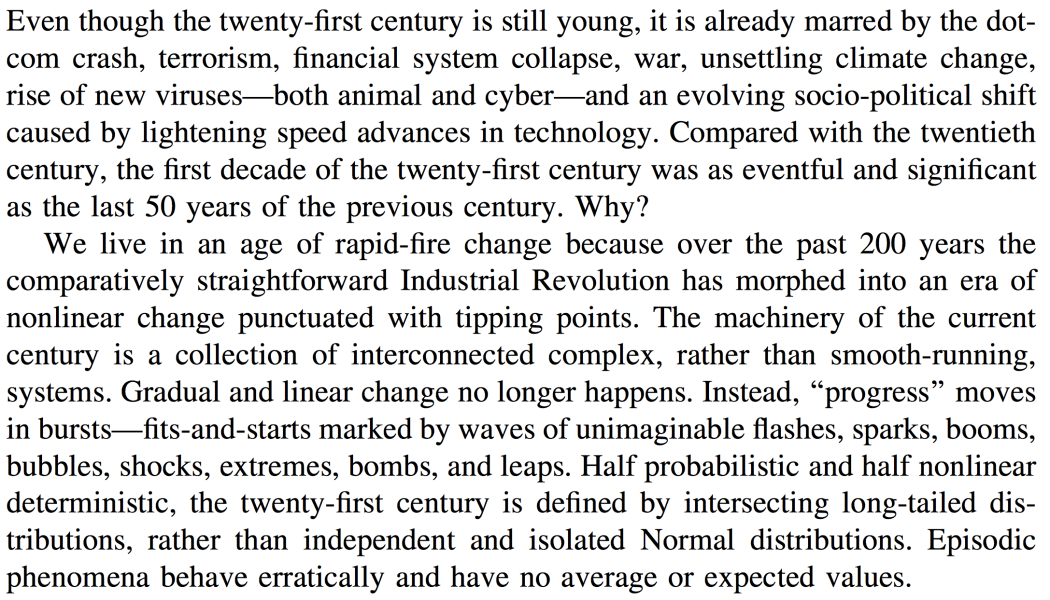
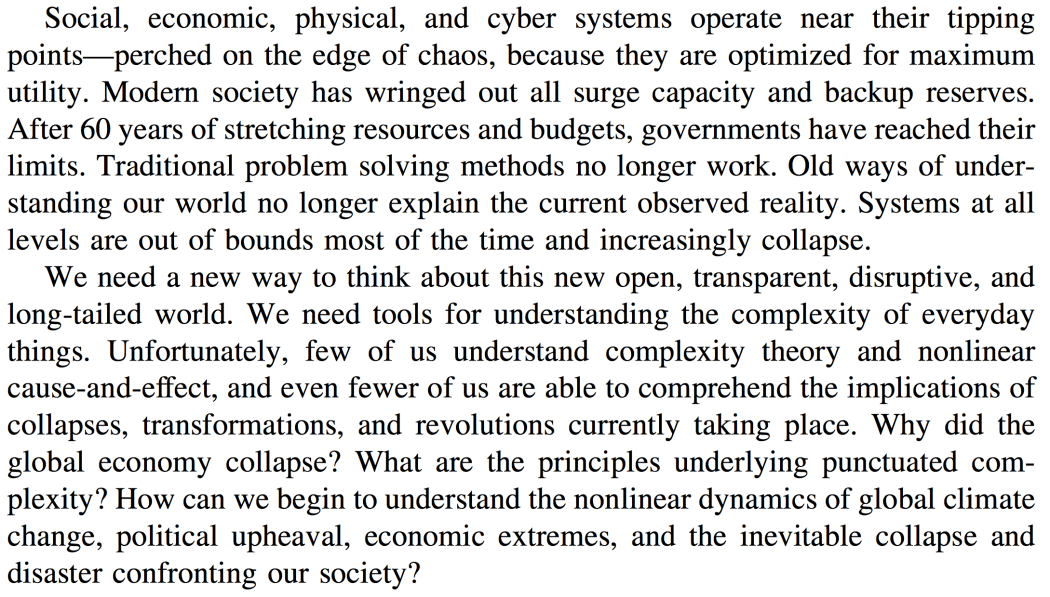
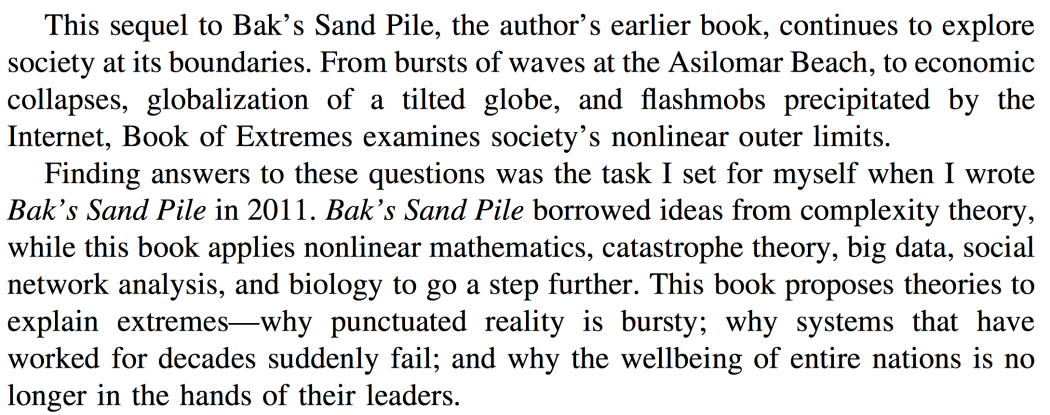
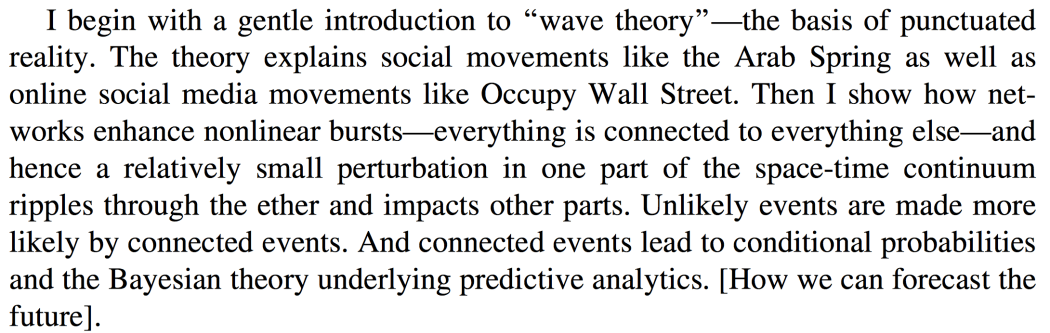
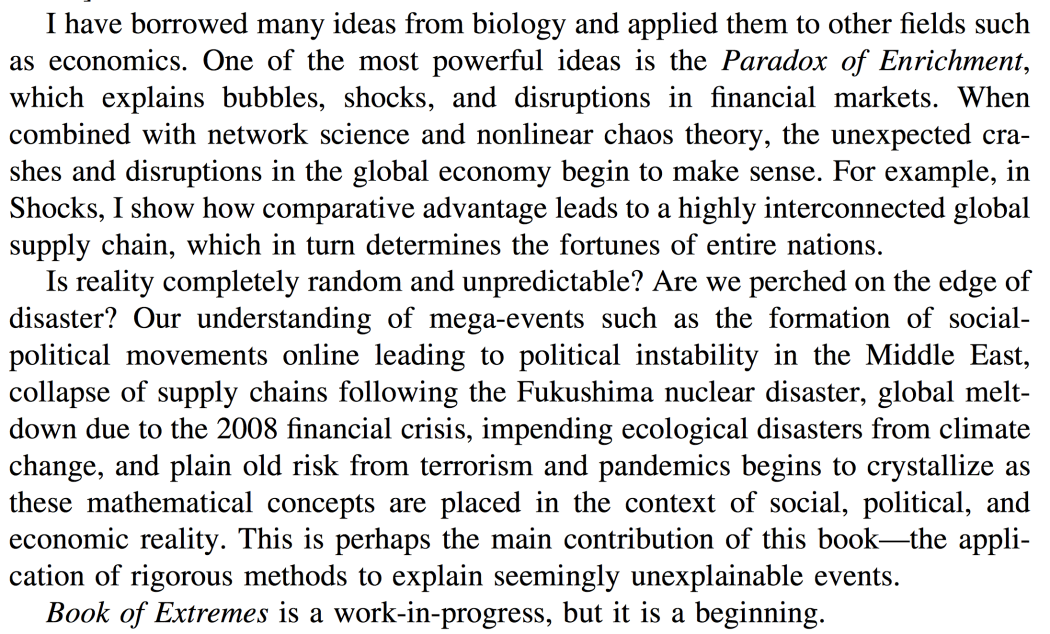
Book of Extremes: Why the 21st Century Isn’t Like the 20th Century

I want to bring your attention to a collaborator of mine’s book which though very salient some three years ago, has in light of events in the interim, a more heightened sense of urgency.

Screen Shot 2017-07-13 at 1.40.15 PM

Screen Shot 2017-07-13 at 1.41.12 PM

Screen Shot 2017-07-13 at 1.42.09 PM

Screen Shot 2017-07-13 at 1.42.49 PM

Screen Shot 2017-07-13 at 1.43.36 PM

David Bowie: Transience and Potentiality

This is one of the better and more interesting academic pieces I’ve come across on Bowie: I suspect there is a cottage industry in the making (I’m currently reading this). In another journal of psychology (I won’t mention the name) a writer offers up the crassest of virtue-signaling tendencies by linking Bowie’s character Thomas Jerome Newton in Nicolas Roeg’s The Man Who Fell to Earth as “speaking to the millions of migrant aliens currently seeking a home away from their own dying homelands”. Anyway, the author of this piece is clearly onto something as anyone who is familiar with the existentialist bent of both Walker Percy and Bowie would easily grasp. I confess that I haven’t listened to Blackstar yet: from the snippets of video that I have seen, the sound and vision really creeps me out.

Existentialists—of which Bowie was clearly a refined and commendable one—do not waver on concepts such as death or decay.

Transcendence, freedom, character, godliness, and absurdity are not states of being, but requirements for being itself.

man1976_bw_neg_str_856

First Church of Intersectionality

The always insightful and elegant Elizabeth Corey in First Things.

Individuality is secondary to group identity.

Soon the church-like atmosphere evolved into a political rally.

Intersectional scholars are, by definition, unhappy with their situations in life.

Gender, sexuality, family, ­hierarchy, capitalism, and, most of all, the university and its “pretense” to objective knowledge must be destroyed and reconstituted. Scholarship is secondary. Activism is what matters most.

Intersectionality is, then, a quasi-religious gnostic movement, which appeals to people for precisely the reasons that all religions do: It gives an account of our brokenness, an explanation of the reasons for pain, a saving story accompanied by strong ethical imperatives, and hope for the future. In short, it gives life meaning.

power-circle-en


Walker Percy Wednesday 144 (Or Why Writers Drink)

percycovercroppea

Why Writers Drink

He is marooned in his cortex. Therefore it is his cortex he must assault. Worse, actually. He, his self, is marooned in his left cortex, locus of consciousness according to Eccles. Yet his work, if he is any good, comes from listening to his right brain, locus of the unconscious knowledge of the fit and form of things. So, unlike the artist who can fool and cajole his right brain and get it going by messing in paints and clay and stone, the natural playground of the dreaming child self, there sits the poor writer, rigid as a stick, pencil poised, with no choice but to wait in fear and trembling until the spark jumps the commissure. Hence his notorious penchant for superstition* and small obsessive and compulsive acts such as lining up paper exactly foursquare with desk. Then, failing in these frantic invocations and after the right brain falls as silent as the sphinx—what else can it do?—nothing remains, if the right won’t talk, but to assault the left with alcohol, which of course is a depressant and which does of course knock out that grim angel guarding the gate of Paradise and let the poor half-brained writer in and a good deal else besides. But by now the writer is drunk, his presiding left-brained craftsman-consciousness laid out flat, trampled by the rampant imagery from the right and a horde of reptilian demons from below.
(3) Reentry accomplished by travel (geographical). The self leaves home because home has been evacuated, not bombed out, but emptied out by the self itself. That is, home, family, neighborhood, and town have been engulfed by the vacuole of self, ingested and rendered excreta. What writer can stay in Oak Park, Illinois? One leaves for another place, but soon it too is ingested and digested. One keeps moving: from Illinois to Minnesota to Paris to Italy to Paris to Spain to Paris to Africa to Paris to Key West to Cuba to Idaho. From Nottinghamshire to Australia to Mexico to Taos to France. If one can keep moving and if the places retain sufficient form and decor, the places may not run out before one’s life runs out. Hemingway ran out of places. Lawrence did not.
An extreme case of a frantic and failed attempt to enter a habitable world, only to consume it and move on, is Kerouac in On the Road. In the course of one book he careens back and forth between New York and California six times—with one Mexican detour.
The road is better than the inn, Cervantes said. True, but he did not reckon with ghostly travelers like the Flying Dutchman.
Note, however, that reentry by travel and also exile (see below) nearly always takes place in a motion from a northern place to a southern place, generally a Mediterranean or Hispanic-American place, from a Protestant or post-Protestant place stripped by religion of sacrament and stripped by the self of all else, to a Catholic or Catholic-pagan place, a culture exotic but not too exotic (Bali wouldn’t work), vividly informed by rite, fiesta, ceremony, quaint custom, manners, and the like. This is by no means a Counter-Reformation victory because the attraction is not the Catholic faith— which is absolutely the last thing the autonomous self wants—but the decor and artifact of Catholic belief: the Pamplona festival, the Taxco cathedral, Mardi Gras, and such.
The attraction between the noughted self and the fiesta (quite literally a feast for the starved vacuole of self) exists on a continuum of affinities: at one end, say, the serious yet finally hopeless nostalgia of Henry Adams at Mont-Saint-Michel, at the other the more commonplace delectation of, say, Oppenheimer and Lawrence at a Pueblo festival in New Mexico which, with its outlandish admixture of Catholic and pagan rites, allows the self the best, it thinks, of both worlds: to keep its distance and at the same time savor the esthetic of the spectacle.*
(4) Reentry by travel (sexual). One has a succession of lovers of the opposite sex, the same sex, or both. It is difficult to imagine the self of the autonomous artist in his singular and godlike abstraction from the ordinary world of men settling down with a wife and family any more than Jove settling down with Juno. Juno—yuck! Wife, children, home, fireside, TV, patio, Medicare in Florida, growing old together, John Anderson, my jo, John—yuck! Better to grow old alone in the desert, sit on a rock like a Navajo. But how lovely are the daughters of men! Indeed, heterosexual inter course is the very paradigm of the reentry of the ghost-self back into the incarnate world whence it came. Not cogito ergo sum—God, how sick is the self of three hundred years of that cogitation, a very bad French connection—but rather: If I enter you, I am alive, even human.
Further exercises: Why are so many artist-writers homosexual? Because the estrangement of the self can be so extreme that not even the welcoming woman can be used as a portal of reentry—on the contrary, she becomes the voracious vagina, the pure negativity which, risking nothing, maliciously requires performance and therefore threatens to expose one’s noughtness. If so, better to cast one’s lot with one’s own kind, own sex.
And why are artist-writers more promiscuous than scientists? Because science works better, this is the age of science, scientists are the princes of the age, while artist-writers are the frantic Lazaruses at the feast, hungering for crumbs like the dogs, the while scratching and screwing around under the table.
(5) Reentry by return. The options of travel and exile may be exhausted, yet instead of despairing, the traveler may hit upon one last alternative: the return. Why not go back to the very place one left, as a kind of deliberate exercise of freedom? Not only is it not the case that you can’t go home again, you may have to—back to the evacuated, bombed-out homeplace, a ruin which by the very fact of its abandonment has in the long interval of one’s absence magically acquired a certain solidity and integrity of its own. The Southern writer who put Valdosta behind him as fast and far as Doc Holliday and roamed the world from Martha’s Vineyard to Cuernavaca now at last gets a hankering for home. And goes home—for a while. It’s one thing to develop a nostalgia for home while you’re boozing with Yankee writers in Martha’s Vineyard or being chased by the bulls in Pamplona. It’s something else to go home and visit with the folks in Reed’s drugstore on the square and actually listen to them. The reason you can’t go home again is not because the down-home folks are mad at you—they’re not, don’t flatter yourself, they couldn’t care less—but because once you’re in orbit and you return to Reed’s drugstore on the square, you can stand no more than fifteen minutes of the conversation before you head for the woods, head for the liquor store, or head back to Martha’s Vineyard, where at least you can put a tolerable and saving distance between you and home. Home may be where the heart is but it’s no place to spend Wednesday afternoon.
(6) Reentry by disguise. The writer-artist cloaks his noughted self not by wrapping himself in bandages like H. G. Wells’s invisible man but by donning the persona-plus-costume worn by those persons who strike him as having most successfully entered the world—or never left it. A more respectable word for such a disguise is role-playing. A hundred years ago, artists, would-be artists, writer-types on the Left Bank wore workers’ smocks and berets. More recently, it is jeans, beards, bandit mustaches, denim jackets, tank tops, longhorn belt buckles, and such. But what to do if the crassest members of the marketplace, car salesman, account executive, go cowboy? That is to say, what to do if one’s chosen mode of reentry has been co-opted by those very persons who had driven one into outer space to begin with?
The disguise may be behavioral as well as sartorial. Not celebrated in past times for their pugnacity or womanizing, American writers have turned into real cutups, the Southern subspecies often taking the old-fashioned form of the hell-raising passed-out-drunk-in-the-whorehouse good-ol’-boy, the Northern more political: the cocktail-party nose-to-nose you’re-deep-down-a-fascist-son-of-a-bitch confrontation, or throwing a punch at the critic who bad-mouthed you in Time—though seldom with much effect—or beating up your wife in the kitchen. Poets from all over feel obliged to become more florid sexually. Straight poets on the lecture circuit exchange a black book listing the best lays in the universities where they read. Other poets (male) are noted for flashing and feeling up male graduate students. No more shy Swinburnes or pale Dante Gabriel Rossettis or closet Housmans.
The main difference between latter-day Southern writers and latter-day Northern writers: both are aware of the necessity to shock the reader out of self-unawareness and into recognition of the advanced derangement of the world, but the Southern writer does it by having a character offend against a decayed but still extant ethos—a twin ethos, the Biblical tradition and the honor code. That is, he sins, usually sexually, or commits a Gothic atrocity against a backdrop of faded Jeffersonian splendor—and sometimes does both at once, like Temple Drake getting corncobbed by Popeye at the old Frenchman place in Faulkner’s Sanctuary. The latter-day Northern writer, lacking either tradition and having nothing to offend against, must rely on an act of gratuitous and comedic violence—like Michael Milton getting his penis bitten off by Helen Garp in Irving’s The World According to Garp.
An observation about disguises: The New Orleans French Quarter has long attracted artists and writers and homosexuals for the good and understandable reasons given above: Latinity, quaintness, moderate exoticness, Mardi Gras, the usual para-Catholic aura—and the easiest way to get out of Mississippi and Ohio. But it is also a para-creative aura. Just as the denizens of the Vieux Carré live in the penumbra of the cathedral, they also live in the penumbra of art. Surprisingly little first-class art has come out of the French Quarter, even though it rather self-consciously imitates the decor of the Left Bank, habitat of many great artists years ago. This life style, as it is called, reminds one of the urban cowboy who secretly believes that if he dresses and walks like a cowboy, he may be a cowboy. Faulkner, never one to do things halfway, made extravagant use of standard modes of reentry in New Orleans, not merely geographical and perhaps sexual modes, not merely alcohol, but also a regular repertory of disguises. In the Vieux Carré he made appearances as a wounded veteran with swagger stick and a bogus steel plate in his head, a hard-drinking pre-hippie vagrant Left-Bank type—and wrote Mosquitoes, a not very good novel. It took the ultimate reentry, the return—he had to go home—to write The Sound and the Fury. Even then, he had to “be” a farmer on the side. Later he made the grandest Southern reentry of all, as a Virginia horseman.
A prediction: What with artist types and writer types and homosexuals (who must be applauded for their good taste in cities: New Orleans, San Francisco, Key West) taking over such places as the French Quarter, and business types and lawyer types going cowboy, I predict that working artists and writers will revert to the vacated places. In fact, they’re already turning up in ordinary houses and ordinary streets long since abandoned by the Hemingways and Agees. Soon they’ll be wearing ordinary shirts and pants and Thorn McAn shoes, not altogether unconsciously, but as a kind of exercise in the ordinary. What else? Where would you rather be if you were James Agee now and alive and well: stumbling around Greenwich Village boozed to the gills, or sitting on the front porch of a house on a summer evening in Knoxville?
(7) Reentry by Eastern window. Angle of reentry too shallow, skip back into space, out of singular self in a singular place back into Cosmic Self, and out of linear time and into the cycles of reincarnation and the Eternal Return. Comet orbit.
The self escapes the burden of itself and achieves satori through the negating of self, the atman, with the Cosmic Self, the Brahman of Hinduism.
Such a disposal of the self was ever an attractive option, what with the perennial inability of the self to perceive itself, but in this age is more attractive than ever as a consequence of the modern historical predicament of the self. The movement of science tends to abstract the self from the world both for the scientist and for the layman, who is willy-nilly abstracted by the triumphant spirit of science without, however, being compensated by the joy of the practice of science. The movement of art is toward the isolation and sequestering of the artist as individual in pursuit of art.
Hence the openness of the Eastern window, particularly in California, where the options of reentry often make their first appearance.
There are characteristic affinities between the mode of reentry by the Eastern window and certain other modes of reentry, e.g., the travel and exile modes, often with a dash of science for seasoning.
Examples: English writers in Hollywood—Huxley, Isherwood, et al. Reentry by travel (geographical) plus travel (homosexual) plus Eastern window, the multiple reentry mode underwritten by science (mind-altering drugs opening the doors of perception and assisting the self in its escape from itself).
It is no accident that the post-Protestant English in the van of the scientific and industrial revolution for two centuries were also the discoverers and masters of characteristic reentry modes, especially travel (geographical and sexual) and disguises. It is no coincidence that the English are not only the best actors in the world but the best spies. The modern Englishman can become anyone else. The prototypical Englishman of the twentieth century is not John Bull or Colonel Blimp but Lawrence in Arabia, Olivier in The Entertainer, Maugham in the Secret Service.
Do you think it is an accident that all the best writers of spy novels are English?
(8) Refusal of reentry and exitus forever into deep space, which is to say, suicide. Suicide, strangely enough, though the direst of options, is often the most honest, in the sense that the suicide may have run out of the other options and found them lacking. Suicide, that is to say, is arguably a more logical option than a constant recycling of past options—from booze to Spain to broads and back, from booze to Spain and so on; from cruising Buena Vista Park for the five hundredth fellatio.
(9) Reentry deferred: Self on indefinite hold in orbit. That is to say, the withdrawal of the artist. E.g., Salinger in the woods, Proust in the cork-lined room. Thus, there is no a priori semiotic reason, after all, why the self must reenter the world. It can simply maintain the artistic posture throughout the day, at four o’clock in the afternoon, and have no more to do with the world than a Carthusian monk who receives his food through a turnstile.
(10) Reentry under the direct sponsorship of God. It is theoretically possible, if practically extremely difficult, to reenter the world and become an intact self through the reentry mode Kierkegaard described when he noted that “the self can only become itself if it does so transparently before God.” This is in fact, according to both Kierkegaard and Pascal, the only viable mode of reentry, the others being snares and delusions.
There are at least two reasons, having to do with the nature of the age, why this option is so difficult.
One is that from the abstracted perspective of the sciences and arts—an attitude of self-effacing objectivity which through the spectacular triumph of science has become the natural stance of the educated man—God, if he is taken to exist at all, is perforce understood as simply another item in the world which one duly observes, takes note of, and stands over against.
The other reason is that the God-party, at least those who say “Lord Lord” most often, are so ignorant and obnoxious that most educated people want no part of them. If they’re for it, then I can’t go far wrong in being against it.
It is true that both St. Paul and God are on record as preferring simple folk to the overeducated, especially philosophers. But media preachers have little reason to take comfort. Being uneducated is no guarantee against being obnoxious.
Question: Who is the most obnoxious, Protestants, Catholics, or Jews?
Answer: It depends on where you are and who you are talking to—though it is hard to conceive any one of the three consistently outdoing the other two in obnoxiousness. Yet, as obnoxious as are all three, none is as murderous as the autonomous self who, believing in nothing, can fall prey to ideology and kill millions of people—unwanted people, old people, sick people, useless people, unborn people, enemies of the state—and do so reasonably, without passion, even decently, certainly without the least obnoxiousness.
Religion, at any rate, has been having a bad time of it lately, perhaps for good and sufficient reason. By and large, scientists and artists and the autonomous self have gotten rid of God, whether or not for good reason, whether or not with catastrophic consequences, remains to be seen.
In any case, reentry into ordinary life, into concrete place and time, from the strange abstractions of the twentieth century, the reentry undertaken under the direct sponsorship of God, is a difficult if not nigh-impossible task. Yet there have existed, so I have heard, a few writers even in this day and age who have become themselves transparently before God and managed to live intact through difficult lives, e.g., Simone Weil, Martin Buber, Dietrich Bonhoeffer. Some have even outdone Kierkegaard and seen both creation and art as the Chartres sculptor did, as both dense and mysterious, gratuitous, anagogic, and sacramental, e.g., Flannery O’Connor.
(11) Reentry by assault. The writer-artist makes sure that he is in the world and that he is real by taking on the world, usually by political action and, more often than not, revolutionary. Even if one is imprisoned by the state—especially if one is imprisoned—one can be certain of being human. Ghosts can’t be imprisoned. This stratagem is more available to European writers, who are taken more seriously than American writers. The secret envy of American writers: Alexander Solzhenitsyn. Despite their most violent attacks on the state and the establishment, nobody pays much attention to American writers, least of all the state. To have taken on the state and defeated it, like Solzhenitsyn, is beyond the wildest dreams of the American writer. Because the state doesn’t care. This indifference leads to ever more frantic attempts to attract attention, like an ignored child, even to the point of depicting President Johnson and Lady Bird plotting the assassination of Kennedy in Barbara Garson’s MacBird!, or President Nixon having sex with Ethel Rosenberg and being buggered by Uncle Sam in Times Square in Robert Coover’s The Public Burning.
Still, no one pays attention.
A paradigm of this generally failed reentry option: a lonely “radical” American writer standing outside the White House gate, screaming obscenities about this fascist state, dictatorship, exploitation of minorities, suppression of freedom of speech, and so on and on—all the while being ignored by President, police, and passersby.
There are worse things than the Gulag.

Notes

* Graham Greene, albeit a Christian, was observed by Evelyn Waugh to perform a curious rite before he could get to work. He went out to the street and watched the stream of traffic. When asked what he was doing, he replied that he was waiting for a particular combination of numbers to turn up on a license plate—777. When it did, he went cheerfully to his writing desk.

* It is a nice ambiguity that Catholics have the least use for the very thing, if not the only thing, for which they are admired, the artifacts, the accidentals, of Catholicism, e.g., the buildings, folkways, music, and so on. Thus, a trivial by-product of New Orleans Catholicism, Mardi Gras, has been seized on by tourists, appropriated by local Protestants, promoted by the Chamber of Commerce, as the major cultural attraction. Nice ambiguity, I say, because each party is content to have it so. Nobody is offended.
The Catholic is content to practice his faith in a dumpy church in York, while the tourists gape at the great nacreous pile of the York minster, an artifact of a former Catholic culture, as beautiful as the shell of a chambered nautilus and as empty. It is not argumentative, I think, to note the niceness of the ambiguity because, if the Catholic is content to have it so, so is the unbeliever. Thus, the esthetic delight of, say, Hemingway in the Catholic decor of Pamplona would perhaps be matched by his contempt for actual Catholic practice in Oak Park, Illinois. It is an ambiguity because it can be given two equally plausible interpretations, Catholic and non-Catholic. The Catholic: what matters to me is faith and practice; the cathedrals and fiestas are incidental. The non-Catholic: what is attractive to me is the Catholic decor, cathedrals, and fiestas; what I want no part of is the belief and practice, which is often in bad taste, if not vulgar. Both are right. Catholic practice is often drab or outlandish, drab in Oak Park, Illinois, outlandish in Chichicastanango. And yet the beautiful York minster is empty. It is a nice ambiguity because each party is content that the other have it his own way.

9780312253998_custom-879fe996d0c45da2a69a358283ae164595a77f96-s6-c30

Super Fly

Forty-five years ago this masterpiece soundtrack was released — AllMusic assessment.

We’re all built up with progress
But sometimes I must confess
We can deal with rockets and dreams
But reality, what does it mean

v1.bTsxMTI5MTAwMDtqOzE3NDYwOzIwNDg7MTUzNjsyMDQ4

The Night They Drove Old Dixie Down

Check out this close-grained discussion and analysis of this most unusual masterpiece (in subject matter at least) by Peter Viney but before one gets to it see this background article.

The_Band_(1969)