The Advocate — NOLA.com — 4WWL — Gambit

H/T to Stephen Hicks. Write-up in Research Frontiers.

Peirce believed that there are two kinds of natural phenomena. First there are those events which involve “dyadic relations,” such as obtain in the “physical forces . . . between pairs of particles.” The other kind of event entails “triadic relations”:
All dynamical action, or action of brute force, physical or psychical, either takes place between two subjects . . . or at any rate is a resultant of such action between pairs. But by “semiosis” I mean, on the contrary, an action, or influence, which is, or involves, a cooperation of three subjects, such as a sign, its object, and its interpretant, this tri-relative influence not being in any way resolvable into actions between pairs.
If A throws B away and B hits C in the eye, this event may be understood in terms of two dyadic relations, one between A and B, the other between B and C. But if A gives B to C, a genuine triadic relation exists. “Every genuine triadic relation involves meaning. “An index sign is part of a dyadic relation. An index refers to the object it denotes by virtue of really being affected by that object. Examples of indexes: a low barometer as an index of rain , the cry of warning of a driver to a pedestrian. A symbol, however, is something which stands to somebody for something in some respect or capacity. “The index is physically connected with its object . . . but the symbol is connected with its object by virtue of . . . the symbol-using mind.”
Dyadic events are, presumably, those energy exchanges conventionally studied by the natural sciences: subatomic particles colliding, chemical reactions, actions of force-fields on bodies, physical and chemical transactions across biological membranes, neuron discharges, etc.
Triadic events, on the other hand, characteristically involve symbols and symbol users. Moreover, a genuine triadic relation cannot be reduced to a series of dyadic relations. Peirce seems to be saying that when a symbol user receives a symbol as “meaning” such and such an object, we may not understand this event as a sequence of dyadic events or energy exchanges even though dyadic events and energy exchanges are involved: sound waves in air, excitation of sensory end-organ, afferent nerve impulse, electro colloidal synaptic event, efferent nerve impulse, muscle contraction, or glandular secretion.
Peirce’s distinction between dyadic and triadic behavior has been noted before, but so pervasive has been the influence of what might be called dyadic behaviorism that Peirce’s “triadic relation” has been recognized only to the degree that it can be set forth as a congeries of dyads. Morris, for example, interprets Peirce’s triad as implying that in addition to response and stimulus there is a third factor, a “reinforcing” state of affairs. This is like saying that Einstein’s special theory will be accepted only to the degree that it can be verified by Newtonian mechanics. Like Newtonian mechanics, dyadic theory can account for perhaps 98 per cent of natural phenomena. Unfortunately the phenomenon of talking-and-listening falls in the remaining 2 per cent.
What would happen if we took Peirce seriously? That is to say, if we retain the posture of behavioral science which interests itself only in the overt behavior of other organisms, what are we to make of observable behavior which cannot be understood as a series of dyadic energy transactions? What has happened in the past is that we have admitted of course that there is such a thing as symbol mongering, as naming things, as uttering sentences which are true or false, as “rules” by which names are assigned and sentences formed. We have admitted that such activity is a natural phenomenon and as such is open to scientific investigation. But what kind of scientific investigation? We have gotten around the difficulty by treating the products of symbol-mongering formally, by what Carnap calls the formal sciences (logic, mathematics, syntax), while assigning the activity itself to a factual science, in this case learning theory, which has not, however, been able to give an account of it. It is no secret that learning theorists will have no truck with symbols and meaning. Most textbooks of psychology do not list the word symbol in their indexes. Indeed, how can learning theory, as we know it, give an account of symbolic activity? If we are to believe Peirce, it cannot. For the empirical laws of learning theory are formulations of dyadic events of the form R = f(O), in which R = response variables and 0 = stimulus variables. *
* Actually the dyads should be segmented in some such order as 0 = f(S), in which 0 = the organic variables and S = the stimulus variables; lb = f(Ia), in which I = the intervening neurophysiological variables within the organism; and R = f(O), in which R = response variables, or measurement of behavior properties.
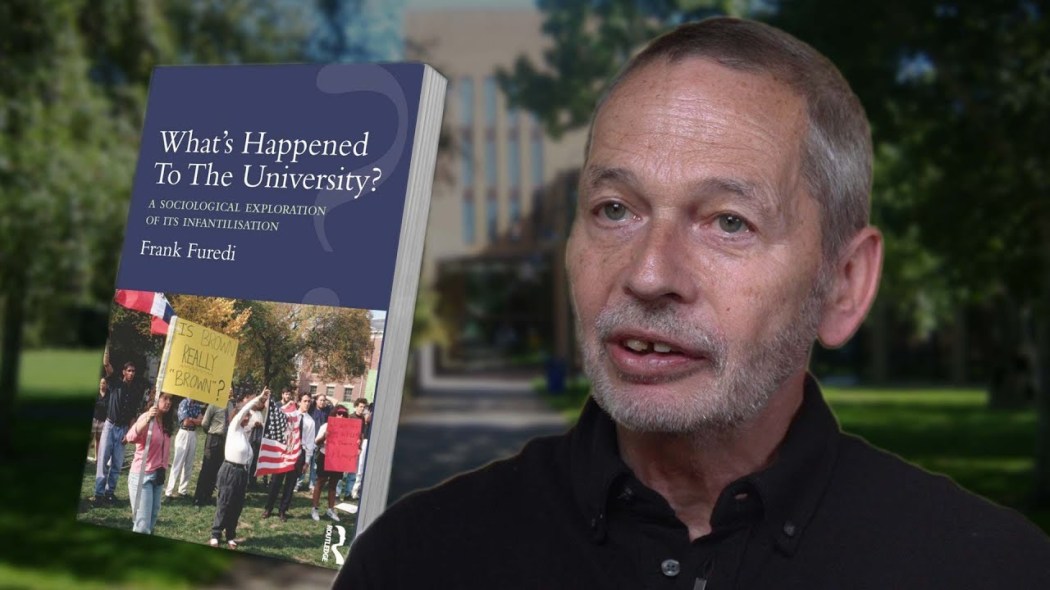
Here’s the very excellent Frank Furedi who has this new piece in First Things and who, is of course, a regular contributor to the ecumenical and well-named Spiked. Now what is especially interesting about Frank is that he reminds me a great deal of Paul Hirst and another decent chap, Jerry Cohen. As the Guardian obituary says of Paul, he was “an evangelist of honesty and the enemy of cant”, especially towards that emanating from those ostensibly sharing his ideological outlook, i.e. the “regressive” Left. This is true of Frank as well: long may he continue.
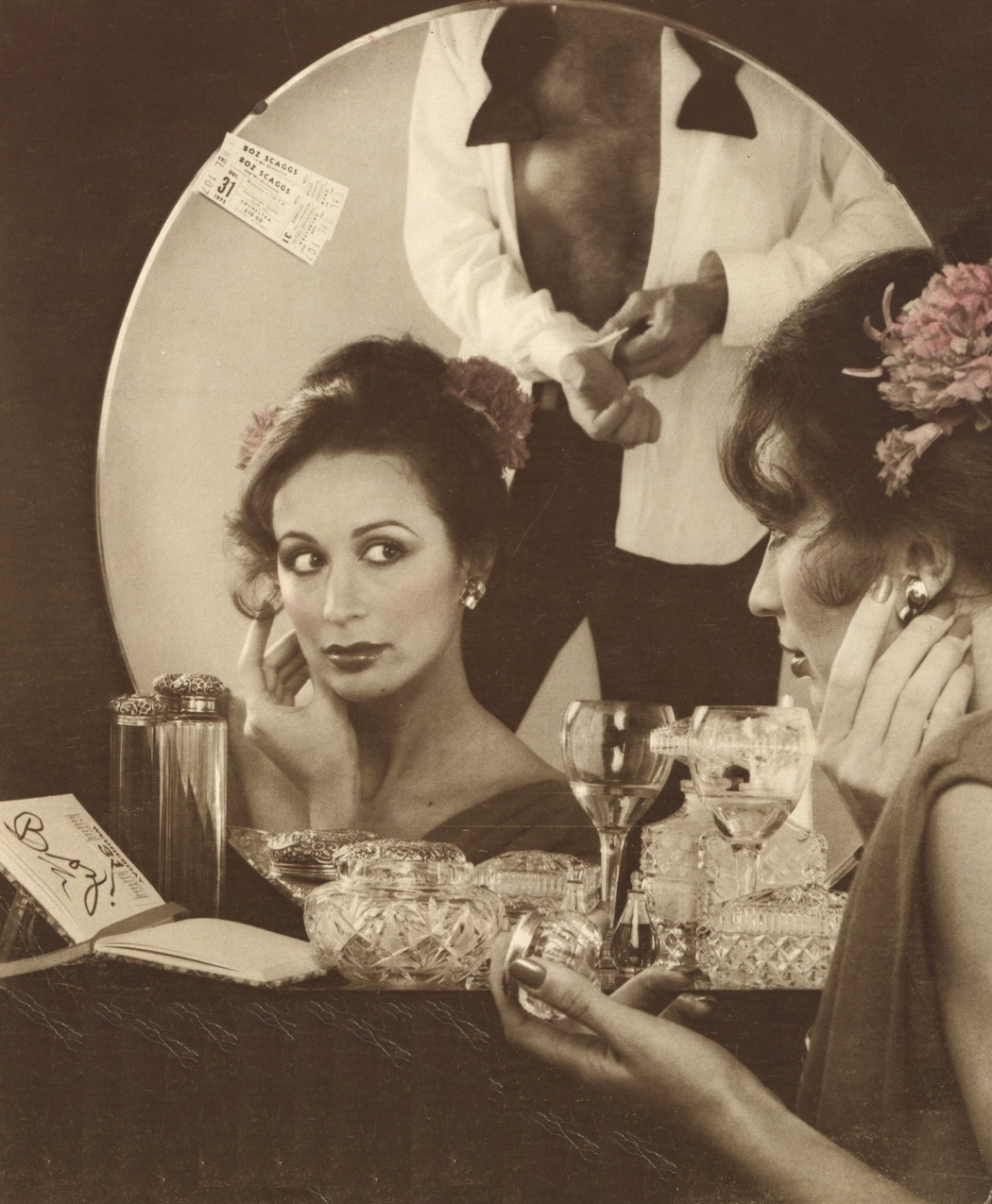
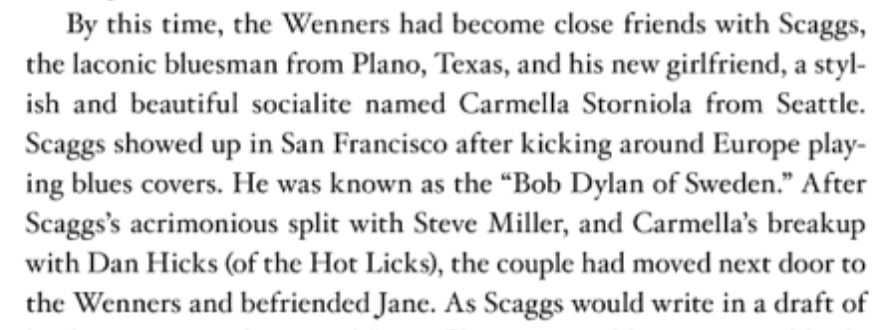
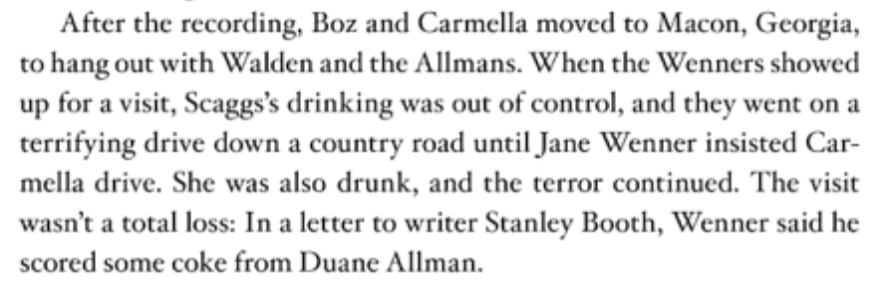
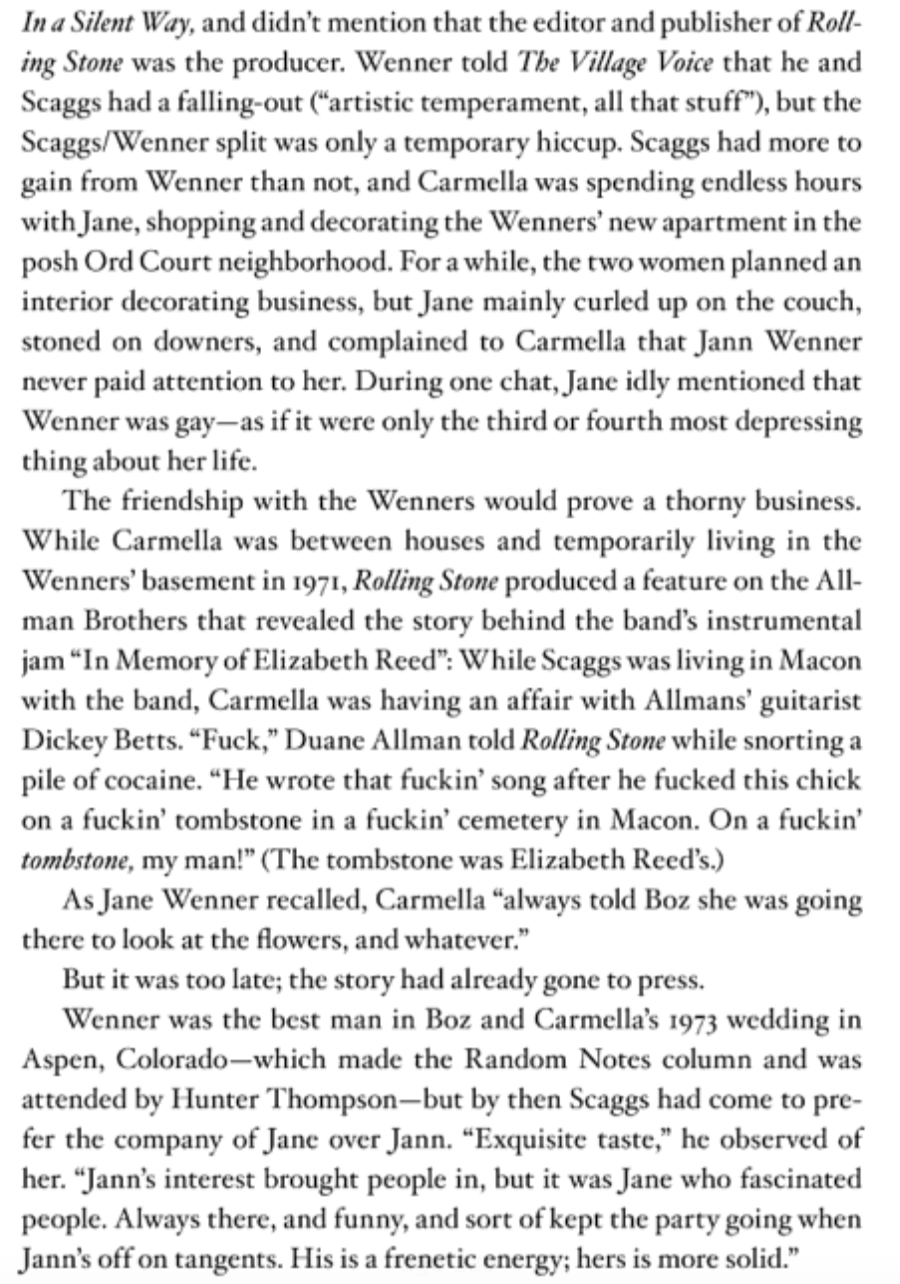
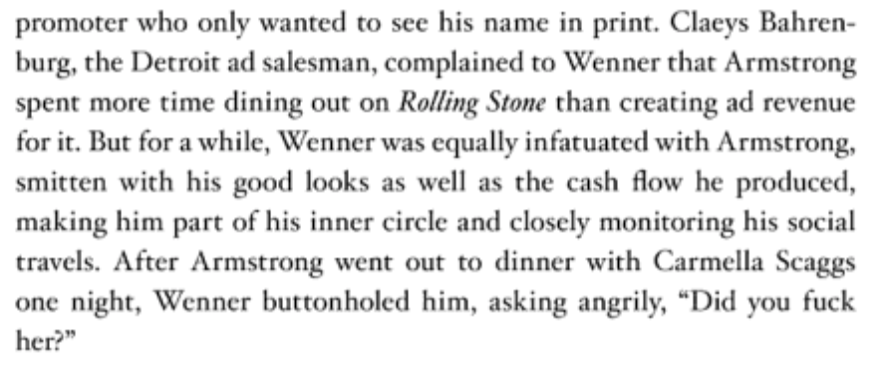
A year ago I was informed of the loss of my friend Carmella: “we spoke of was and when” . . . and then she was gone. Here is the only obituary I could find. For a little glimpse into the wild rock ‘n roll world that Carmella inhabited in the glory days of Boz’ career see some extracts (below) from the recent Jann Wenner bio. Carmella’s last twenty years were (after her profound loss) very much more sedate, highly sensitive to the demands of friendships, her son and grandchildren. We have the fondest memories of us glugging champers on a hot evening on the patio of her glorious Russian Hill house, and then heading down to the bowels of the house, the kitchen, where the food and booze kept on flowing. Carmella’s house was the epitome of good taste with the most imaginably fine attention to detail in domestic decor that I’ve ever seen. And the amazing thing was that it was still very homey and not at all “museumy”. Carmella had an incredibly attuned cultural-artistic bandwidth and could speak authoritatively on classical art as well as the moderns and, of course, popular culture. I loved the way she took to the streets of San Francisco in her Mercedes, driving as if she owned the city, offering up the most scathing of commentary as we past some of the compounds of the political and showbiz denizens of Pacific Heights. She knew them all and had an endless supply of delicious stories especially concerning the heyday of Haight-Ashbury. Through the lens of Carmella’s fine aesthetic sensibility, one could see why she thought that San Francisco and Seattle had gone to seed: indeed she seemed quite angry about it. Carmella loved her food and wine and was a most generous hostess. She took us to some of her favourite SF haunts: when Carmella turned up to a restaurant, the maître d’hôtel ushered us into the standby “VIP” booth/table. Thanks for the trust and friendship dearest Carmella.
Here’s a valentine for the group-think regressives.
Damn it man, you say as much — so why mention it? Anyway, at least the “reporter” rightly commemorates this timeless album. Television, along with the Talking Heads, are the only North American talents that could consistently approximate the “philosophical musicality” (for want of a better phrase) of what Bowie was up to at the time (made crystal clear in Scary Monsters).
But 40 years later, Marquee Moon remains a singular achievement that transcends the “punk” label and still sounds fresh. It’s a classic from start to finish.