Here’s a batch review by the very excellent Rob Rupert of three books that have been out for a while.

Here’s a batch review by the very excellent Rob Rupert of three books that have been out for a while.
In popular culture, and especially in music, the days of the week of particular significance are Mondays and Fridays. The former has downbeat, dread-like connotations, as in “Blue Monday” (Dave Bartholomew, performed by Fats Domino) and “I Don’t Like Mondays” (Bob Geldof, performed by The Boomtown Rats). In contrast, Friday has an air of promise and optimism, as suggested by the song “Friday on My Mind” (George Young and Harry Vanda, performed by The Easybeats). Walker Percy well understood the social significance of these bookends (Monday and Friday) to our routinized, alienated condition. But what about the ordinary day, a day that isn’t typically associated with either the corrosiveness of a Monday or the hopefulness of a Friday? For Percy Wednesday was totemic of a nondescript day, the greater part of our experience (Not to be taken literally. Dread or hope can be associated with any day). As he so starkly put it in The Last Gentleman:
Where he probably goes wrong, mused the engineer sleepily, is in the extremity of his alternatives: God and not-God, getting under women’s dresses and blowing your brains out. Whereas and in fact my problem is how to live from one ordinary minute to the next on a Wednesday afternoon. Has not this been the case with all “religious” people?
A recent study has reported that the incidence of suicide is significantly highest on Wednesdays (Augustine J. Kposowa and Stephanie D’Auria, 2010. Association of temporal factors and suicides in the United States, 2000–2004. Social Psychiatry and Psychiatric Epidemiology. Volume 45, Issue 4, pp. 433-445.) Regardless of the empirical evidence, Percy was certainly onto something. He had as his philosophical quarry a deeper, more subtle existential question of meaning and significance of the ordinary, the banal, the undramatic and the ubiquitous. The problem of “Wednesday” exercised Percy from The Last Gentleman (1966) through to Lost in the Cosmos: The Last Self-Help Book (1983) and was mentioned in several interviews.
I’ve been viewing the highly amusing series Grumpy Old Men again. First off, the title is ill-chosen. The target group is not necessarily composed of the aged and decrepit; neither are they grumpy as such. Regarding the former, they probably are upwards of 45-50 years old (adjusting for the fact that the series was first broadcast in 2003); regarding the latter, the sentiment is one more of marginalization and attendant despair in a humourless world of uncritical super-spin and over-sensitivity. The collecting feature for this group cuts across political commitments and class: what they take issue with is the moronization of culture, now efficiently disseminated by “device induced autism”; a lack of manners (and etiquette); cannon-fodder for the most fickle of consumerism; an uncritical faith in technology and politics; namby-pamby PC absolutism; and the infantilization of our beautiful language (airline speak for instance, prefacing each unnecessary and incessant instruction with “at this time”), and so on and so forth. Of course, there has always been a significant constituency, technically termed “fuckwits”, but now they are emboldened and are licensed by the prevailing uncritical and illiberal techno-political establishment. For me the funniest of the grumps is Arthur Smith who so neatly captured our generation’s most profound disappoint. He says:
“As a teenager I anticipated no life at all other than continuing to drink, chase women and take drugs for the rest of my life.”
As ’70s boys we were willing and able to make good on the Wilsonian slogan “white heat of technological progress,” all in the service of free-living, free-love, good quality and legally available chemical enhancements, unfettered individuality, etc. etc. Now whatever the sartorial inadequacies of many of the group, their spirit is recognizably Chappist. Among the those that I find particularly amusing are Bob Geldof, John Humphrys, Tony Hawks, Rory McGrath, Bill Nighy, Matthew Parris, John Peel, Will Self, Rick Stein, and Rick Wakeman (there are others). The narrator is the wonderfully dry and dignified Geoffrey Palmer, Reggie Perrin’s brother-in-law.
In addition to checking out the Walker Percy documentary if you are a fan of the great man, please consider making a contribution to this project — all is explained in the video. This project expires today — it would be a crying shame if it doesn’t come to fruition. Come on folks — surely there are 100 hundred passionate Percy fans out there that could come up with, on average $197 each, to make this project happen.

“This seems a bit far afield from your work with mental health and the foundations.”
“Everything is interdisciplinary now, Doc. As well as being third-generational. You understand.”
. . .
I don’t pay much attention to left or right.
Students are, if the truth be known, a bad lot. En masse they’re as fickle as a mob, manipulable by any professor who’ll stoop to it. They have, moreover, an infinite capacity for repeating dull truths and old lies with all the insistence of self-discovery. Nothing is drearier than the ideology of students, left or right. Half the students here revere Dr. Spiro T. Agnew, elder statesman and honorary president of the American Christian Proctological Society; the other half admire Hermann Hesse, Dr. B. F. Skinner, inventor of the Skinner conditioning box, and the late Justice William O. Douglas, a famous qualitarian who improved the quality of life in India by serving as adviser in a successful program of 100,000,000 abortions and an equal number of painless “terminations” of miserable and unproductive old folk.
People talk a lot about how great “the kids” are, compared to kids in the past. The only difference in my opinion is that kids now don’t have sense enough to know what they don’t know.
On the other hand, my generation is an even bigger pain.
It seems today in The Pit I am favored by the Christian Knothead anti-euthanasic faction, but I’m not sure I like them any better than the Hesse-Skinner-Douglas qualitarians.
But I do not, on the whole, feel bad. My large bowel is clear as a bell, my coeliac plexus is full of blood. Anxiety flickers over my sacrum but it is not the Terror, rather a useful and commensurate edginess. What I fear is not nothing, which is the Terror, but something, namely, getting beat by Buddy Brown in front of Moira. Otherwise I feel fine: my heart is full of love, my mind is like a meat grinder ready to receive the raw stuff of experience and turn out neat pattycake principles.
Please join my very excellent contributors Mark Pringle @markpingle (Boundedly Rational Decision-Making under Certainty and Uncertainty: Some Reflections on Herbert Simon), Marco Novarese @mmarconov ((Simon’s (Lost?) Legacy in Agent-Based Computational Economics)), and myself @M_W_Q for a live Twitter chat about Herb Simon — to be conducted by @PalgraveEcon taking place on the 15th Feb at 8am PST & 4pm GMT.

. . . and hanging around in Nashville. It was 40 years ago (crikey!) that the early stirrings of Frampton Comes Alive! began it’s juggernaut domination of the charts. Thoroughly underrated (tarnished by the teen idol label) people seem to overlook that along with Jimmy Page, PF at 14 was possibly the youngest working serious musician on the scene. Part of the appeal of Frampton was I think that his music was upbeat and he was just a very assessible geezer whose success we were happy for. Somehow he lost his mojo symbolised by the parting of his beloved guitar, amazingly rescued from the wreck of a plane crash with which he was only reunited after 31 years — see last clip. And yes, PF is still up to the task of making good music — notably his last outing Thank You Mr. Churchill. And let’s not forget that it was his school chum a one Dave Jones that reinvogorated PF’s career as guitarist albeit on that immensely crap Glass Spider tour. And yes, Peter there are many of us who support your policy of keeping phone photos/recording fuckery to the first three songs — and that’s two songs too much.

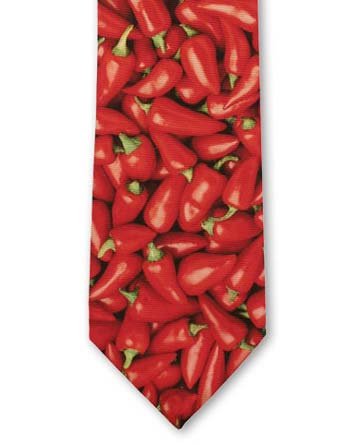
Another notable birth (at least to me) on this date is Wilbur Scoville, the patron saint of chilli heads such as myself. Pleasantly surprised that Google is marking Wilbur’s birth: The Telegraph picks up from Google. Below is my 15 year old Robert Charles Chilli tie. I think I’ll have an extra lashing of Endorphin Rush (my daily) and some of my Dave’s Private Reserve 2000 (500,000 to 750,000 Scoville units).

Commemorating the Centennial of the Birth of Herbert Simon — published today.