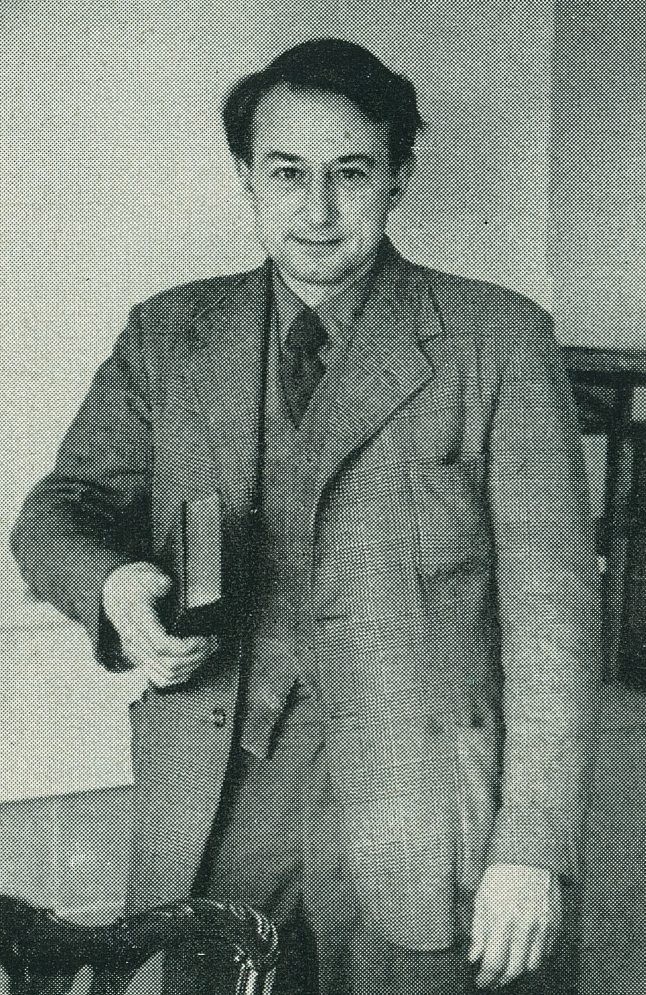
Of Love and Politics

Aurelian Craiutu reviews Oakeshott’s Notebooks, 1922-86. I don’t share the view that:

If Oakeshott were alive today, he would welcome the fact that “the politics of faith” against which he wrote memorable pages seem to have lost some of its appeal.

I think that the centre has not held at all and is at its narrowest band in at least a hundred years. The politics of faith still animates pretty much everything politically and much else besides, so easily promulgated in this hyper networked age.

oakeshott


Herbert Simon, the Man

The first in a series of excerpts from Minds, Models and Milieux: Commemorating the Centennial of the Birth of Herbert Simon.

Katherine Simon Frank

How many children are conscious of their parents as different from their friends’ parents? How many understand what it means to have a parent who is known to others via newspaper accounts and television appearances? Would a child sense how a “famous” parent could be different from other parents? From my experience and observation growing up as the eldest of three of Herbert Simon’s children, my answer to those questions is: zero, none, and no.

That is, those would be my answers until people started asking questions and pointing out the differences. Why was your father in the newspaper? Why aren’t your parents moving to another house now that your father has won the Nobel Prize? What was it like growing up with a famous father?

HS_POSTER

Walker Percy Wednesday 70

percycovercroppea

“Dr. More is going to diagnose me. Why not? He is going to measure, not my blood alcohol, but my metaphysical status. The device he holds there—correct me if I’m wrong, Doctor—is the More Quantitative-Qualitative Ontological Lapsometer.”

. . .

The students, spiritual pimps that they are, reassured that things are back on the track and that laughter is in order, laugh.

. . .

Students are a shaky dogmatic lot. And the “freer” they are, the more dogmatic. At heart they’re totalitarians: they want either total dogmatic freedom or total dogmatic unfreedom, and the one thing that makes them unhappy is something in between.

Walker Percy at the Bogue Falaya River in Covington, LA

The Extended Mind and Religious Cognition

New paper from the very excellent Joel Krueger. See also Joel’s Empathy and the Extended Mind paper from a few years back along with other papers discussing this topic.

One of the primary functions of religious texts — along with the different rituals and forms of worship constructed with them — is, precisely, to take over part of the remembering process for the believer. Like Otto’s notebook-bound belief that MoMA is on 53rd street, so, too, are some of the faithful’s dispositional beliefs housed in frequently consulted devotional texts. Many people carry analogue (printed) or digital (in tablets or smartphones) versions of theses texts constantly, making them accessible on a moment’s notice. From the perspective of ExM, relying on these texts — as well as manipulating other objects such as a Catholic rosary or Hindu Japa Mala prayer beads — ought to count as a part of the physical process comprising the individual’s faithful disposition or religious sentiment.

religion-praying

Some Bernard Williams Quotes

bernard-williams-008

Talent is a flame. Genius is a fire.

Utilitarians are often immensely conscientious people, who work for humanity and give up meat for the sake of the animals. They think this is what they morally ought to do and feel guilty if they do not live up to their own standard. They do not, and perhaps could not, ask: How useful is it that I think and feel like this?

That an action would be cowardly is not often found by an agent to be a consideration in its favor, but it could be, and in a counter ethical way, ministering to a masochism of shame.

People who say, ‘Let the chips fall where they may,’ usually figure they will not be hit by a chip.

It may be that considerations of justice are a central element of ethical thought that transcends the relativism of distance. Perhaps this, too, comes from a feature of the modern world. We have various conceptions of social justice, with different political consequences; each has comprehensible roots in the past and in our sentiments. Since we know that we do not accept their past legitimations, but otherwise are not sure how to read them, we are disposed to see past conceptions of justice as embodiments of ideas that still have a claim on modern people. To this extent, we see them as in real confrontation with each other and with modern ideas.

So far I have not said much about objectivity, though earlier chapters have had a good deal to do with it. If an Archimedean point could be found and practical reason, or human interests, could be shown to involve a determinate ethical outlook, then ethical thought would be objective, in the sense that it would have been given an objective foundation. Those are possibilities—or they might have turned out to be possibilities—within the perspective of practical reason. Very often, however, discussions of objectivity come into moral philosophy from a different starting point, from an interest in comparing ethical beliefs with knowledge and claims to truth of other kinds, for instance with scientific beliefs. Here a rather different conception of objectivity is involved. It is naturally associated with such questions as what can make ethical beliefs true, and whether there is any ethical knowledge. It is in this field of comparisons that various distinctions between fact and value are located.

What will the professor’s justification do, when they break down the door, smash his spectacles, take him away?

Those who say that all historical accounts are ideological constructs (which is one version of the idea that there is really no historical truth) rely on some story which must itself claim historical truth. They show that supposedly “objective” historians have tendentiously told their stories from some particular perspective; they describe, for example, the biasses that have gone into constructing various histories of the United States. Such an account, as a particular piece of history, may very well be true, but truth is a virtue that is embarrassingly unhelpful to a critic who wants not just to unmask past historians of America but to tell us that at the end of the line there is no historical truth. It is remarkable how complacent some “deconstructive” histories are about the status of the history that they deploy themselves.

A further turn is to be found in some “unmasking” accounts of natural science, which aim to show that its pretensions to deliver the truth are unfounded, because of social forces that control its activities. Unlike the case of history, these do not use truths of the same kind; they do not apply science to the criticism of science. They apply the social sciences, and typically depend on the remarkable assumption that the sociology of knowledge is in a better position to deliver truth about science than science is to deliver truth about the world.

If the passion for truthfulness is merely controlled and stilled without being satisfied, it will kill the activities it is supposed to support. This may be one of the reasons why, at the present time, the study of the humanities runs a risk of sliding from professional seriousness, through professionalization, to a finally disenchanted careerism.

Deniers do not get their views just from simple mistakes about language and truth. Rather, they believe that there is something to worry about in important areas of our thought and in traditional interpretations of those areas; they sense that it has something to do with truth; and (no doubt driven by the familiar desire to say something at once hugely general, deeply important, and reassuringly simple) they extend their worry to the notion of truth itself.

Positivism … implies the double falsehood that no interpretation is needed, and that it is not needed because the story which the positivist writer tells, such as it is, is obvious. The story he or she tells is usually a bad one, and its being obvious only means that it is familiar.
As Roland Barthes said, those who do not re-read condemn themselves to reading the same story everywhere: “they recognize what they already think and know.

There continue to be complex debates about what Nietzsche understood truth to be. Quite certainly, he did not think, in pragmatist spirit, that beliefs are true if they serve our interests or welfare: we have just seen some of his repeated denials of this idea. The more recently fashionable view is that he was the first of the deniers, thinking that there is no such thing as truth, or that truth is what anyone thinks it is, or that it is a boring category that we can do without. This is also wrong, and more deeply so. Nietzsche did not think that the ideal of truthfulness went into retirement when its metaphysical origins were discovered, and he did not suppose, either, that truthfulness could be detached from a concern for the truth. Truthfulness as an ideal retains its power, and so far from his seeing truth as dispensable or malleable, his main question is how it can be made bearable.

Nietzsche … did not settle for a demure civic conversation in the style of Richard Rorty’s ironist, or saunter off with the smug nod that registers a deconstructive job neatly done. He was aware that his own criticisms and exposures owed both their motivation and their effect to the spirit of truthfulness. His aim was to see how far the values of truth could be revalued, how they might be understood in a perspective quite different from the Platonic and Christian metaphysics which had provided their principal source in the West up to now.

. . . [today] we accept, indeed regard as a platitude, an idea that Aristotle rejected, that someone can have one virtue while lacking others . For Aristotle, as for Socrates, practical reason required the dispositions of action and feeling to be harmonized; if any disposition was properly to count as a virtue, it had to be part of a rational structure that included all the virtues. This is quite different from our assumption [in the modern world] that these kinds of virtuous disposition are enough like other psychological characteristics to explain how one person can, so to speak, do better in one area than another . . . [today] we do not believe in the unity of the virtues.

The most primitive experiences of shame are connected with sight and being seen, but it has been interestingly suggested that guilt is rooted in hearing, the sound in oneself of the voice of judgment; it is the moral sentiment of the word.

For various reasons, education is being driven towards an increasing concentration on the technical and the commercial, to a point at which any more reflective enquiry may come to seem unnecessary and archaic, something that at best is preserved as part of the heritage industry.

In my experience of shame, the other sees all of me and all through me, even if the occasion of shame is on my surface — for instance, in my appearance; and the expression of shame, in general, as well as in the particular form of it that is embarrassment, is not just the desire to hide, or to hide my face, but the desire to disappear, not to be there. It is not even the wish, as people say, to sink through the floor, but rather the wish that the space occupied by me should be instantaneously empty. With guilt it is not like this. I am more dominated by the thought that even if I disappeared, it would come with me.

Enactive View of Cognition

Here’s a batch review by the very excellent Rob Rupert of three books that have been out for a while.

global-intelligence1

Friday on my Mind

In popular culture, and especially in music, the days of the week of particular significance are Mondays and Fridays. The former has downbeat, dread-like connotations, as in “Blue Monday” (Dave Bartholomew, performed by Fats Domino) and “I Don’t Like Mondays” (Bob Geldof, performed by The Boomtown Rats). In contrast, Friday has an air of promise and optimism, as suggested by the song “Friday on My Mind” (George Young and Harry Vanda, performed by The Easybeats). Walker Percy well understood the social significance of these bookends (Monday and Friday) to our routinized, alienated condition. But what about the ordinary day, a day that isn’t typically associated with either the corrosiveness of a Monday or the hopefulness of a Friday? For Percy Wednesday was totemic of a nondescript day, the greater part of our experience (Not to be taken literally. Dread or hope can be associated with any day). As he so starkly put it in The Last Gentleman:

Where he probably goes wrong, mused the engineer sleepily, is in the extremity of his alternatives: God and not-God, getting under women’s dresses and blowing your brains out. Whereas and in fact my problem is how to live from one ordinary minute to the next on a Wednesday afternoon. Has not this been the case with all “religious” people?

A recent study has reported that the incidence of suicide is significantly highest on Wednesdays (Augustine J. Kposowa and Stephanie D’Auria, 2010. Association of temporal factors and suicides in the United States, 2000–2004. Social Psychiatry and Psychiatric Epidemiology. Volume 45, Issue 4, pp. 433-445.) Regardless of the empirical evidence, Percy was certainly onto something. He had as his philosophical quarry a deeper, more subtle existential question of meaning and significance of the ordinary, the banal, the undramatic and the ubiquitous. The problem of “Wednesday” exercised Percy from The Last Gentleman (1966) through to Lost in the Cosmos: The Last Self-Help Book (1983) and was mentioned in several interviews.

Grumpy Old Men

I’ve been viewing the highly amusing series Grumpy Old Men again. First off, the title is ill-chosen. The target group is not necessarily composed of the aged and decrepit; neither are they grumpy as such. Regarding the former, they probably are upwards of 45-50 years old (adjusting for the fact that the series was first broadcast in 2003); regarding the latter, the sentiment is one more of marginalization and attendant despair in a humourless world of uncritical super-spin and over-sensitivity. The collecting feature for this group cuts across political commitments and class: what they take issue with is the moronization of culture, now efficiently disseminated by “device induced autism”; a lack of manners (and etiquette); cannon-fodder for the most fickle of consumerism; an uncritical faith in technology and politics; namby-pamby PC absolutism; and the infantilization of our beautiful language (airline speak for instance, prefacing each unnecessary and incessant instruction with “at this time”), and so on and so forth. Of course, there has always been a significant constituency, technically termed “fuckwits”, but now they are emboldened and are licensed by the prevailing uncritical and illiberal techno-political establishment. For me the funniest of the grumps is Arthur Smith who so neatly captured our generation’s most profound disappoint. He says:

“As a teenager I anticipated no life at all other than continuing to drink, chase women and take drugs for the rest of my life.”

As ’70s boys we were willing and able to make good on the Wilsonian slogan “white heat of technological progress,” all in the service of free-living, free-love, good quality and legally available chemical enhancements, unfettered individuality, etc. etc. Now whatever the sartorial inadequacies of many of the group, their spirit is recognizably Chappist. Among the those that I find particularly amusing are Bob Geldof, John Humphrys, Tony Hawks, Rory McGrath, Bill Nighy, Matthew Parris, John Peel, Will Self, Rick Stein, and Rick Wakeman (there are others). The narrator is the wonderfully dry and dignified Geoffrey Palmer, Reggie Perrin’s brother-in-law.

Walker Percy Wednesday 69

In addition to checking out the Walker Percy documentary if you are a fan of the great man, please consider making a contribution to this project — all is explained in the video. This project expires today — it would be a crying shame if it doesn’t come to fruition. Come on folks — surely there are 100 hundred passionate Percy fans out there that could come up with, on average $197 each, to make this project happen.

percycovercroppea

“This seems a bit far afield from your work with mental health and the foundations.”
“Everything is interdisciplinary now, Doc. As well as being third-generational. You understand.”

. . .

I don’t pay much attention to left or right.
Students are, if the truth be known, a bad lot. En masse they’re as fickle as a mob, manipulable by any professor who’ll stoop to it. They have, moreover, an infinite capacity for repeating dull truths and old lies with all the insistence of self-discovery. Nothing is drearier than the ideology of students, left or right. Half the students here revere Dr. Spiro T. Agnew, elder statesman and honorary president of the American Christian Proctological Society; the other half admire Hermann Hesse, Dr. B. F. Skinner, inventor of the Skinner conditioning box, and the late Justice William O. Douglas, a famous qualitarian who improved the quality of life in India by serving as adviser in a successful program of 100,000,000 abortions and an equal number of painless “terminations” of miserable and unproductive old folk.
People talk a lot about how great “the kids” are, compared to kids in the past. The only difference in my opinion is that kids now don’t have sense enough to know what they don’t know.
On the other hand, my generation is an even bigger pain.

It seems today in The Pit I am favored by the Christian Knothead anti-euthanasic faction, but I’m not sure I like them any better than the Hesse-Skinner-Douglas qualitarians.
But I do not, on the whole, feel bad. My large bowel is clear as a bell, my coeliac plexus is full of blood. Anxiety flickers over my sacrum but it is not the Terror, rather a useful and commensurate edginess. What I fear is not nothing, which is the Terror, but something, namely, getting beat by Buddy Brown in front of Moira. Otherwise I feel fine: my heart is full of love, my mind is like a meat grinder ready to receive the raw stuff of experience and turn out neat pattycake principles.