Hilary Putnam 1926-2016

It is notable that the so-called “new atheists” never did take on Putnam. Shows how lily-livered they really are, picking on the usual easy targets. Ditto for his critique of scientism. Putnam’s Mind, Language and Reality. Philosophical Papers, vol. 2. remains one of my favorite books. The Guardian obit. Martha Nussbaum on Putnam.

hilary-putnam_Mrq1f

Soul and skin in the game

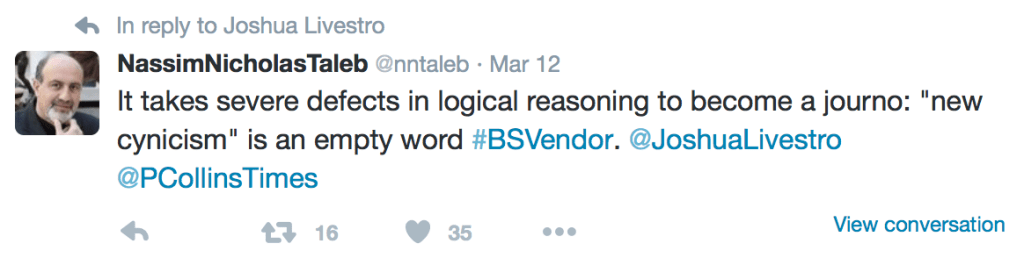
In a world overpopulated with nth rate punditry (i.e. bad faith public intellectuals) I am of the view that one of the very few who rises above the crowd is Nassim Nicholas Taleb. He is truly independent-minded, not in any ideological or financial pocket, has theoretic/practical credibility and is the most cultivated of men. He cuts so much deeper in his analyses of what’s going on and doesn’t pull his punches. He punctures a raft of self-serving smug echo chambers — long may this continue. Check out the two books of his that I have read — The Black Swan: The Impact of the Highly Improbable and Antifragile: Things That Gain from Disorder.  Against the white noise of Twit-erdom NTB offers substantive and entertaining comment, below are some recent prime cuts:

Screen Shot 2016-03-13 at 1.53.49 PM

Screen Shot 2016-03-13 at 11.21.39 AMScreen Shot 2016-03-13 at 11.33.04 AMScreen Shot 2016-03-13 at 11.22.39 AMScreen Shot 2016-03-13 at 1.56.51 PM

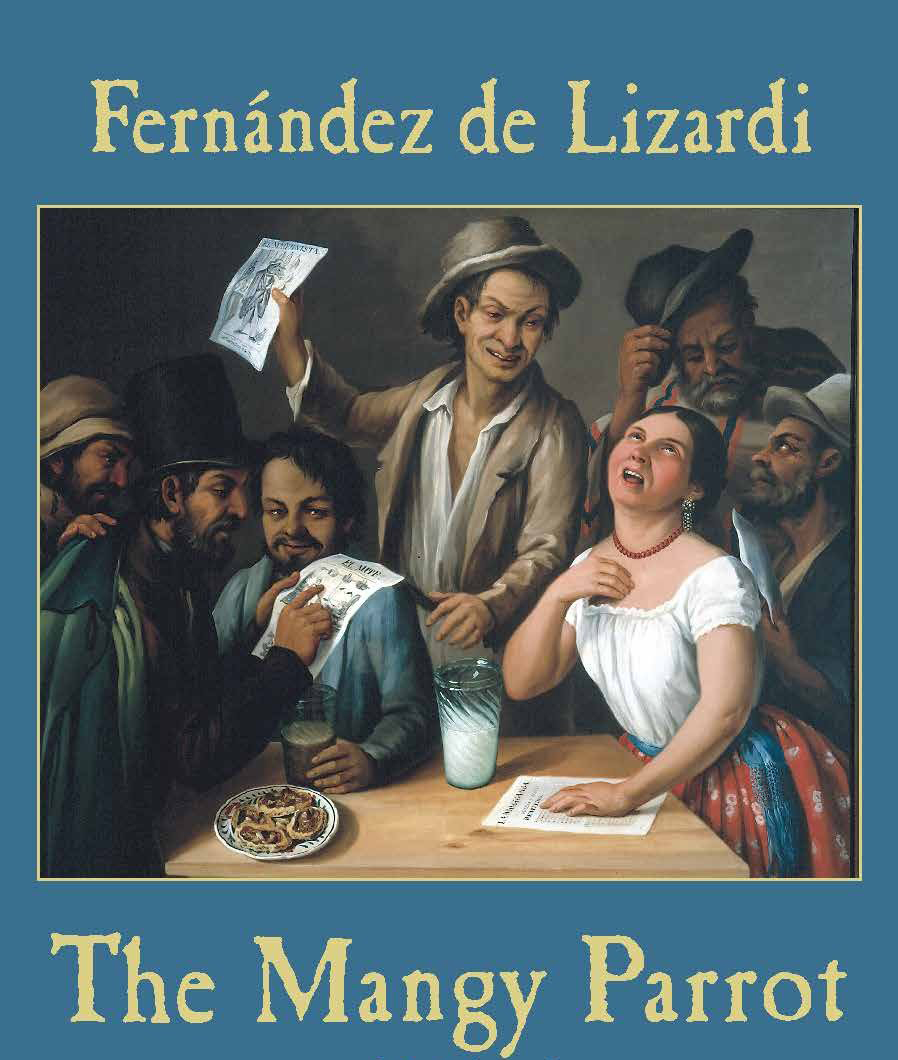
The Mangy Parrot 6

We entered the house, I picked out a good seat by the sitting room, for I never liked leaving the company of skirts for long . . .

*****

It all seems fine to me in its own fashion; and so, in the countryside I am happy in a country way, and in the city I am entertained in a city way.” They celebrated my answer as if it were a pronouncement worthy of Cato, and the lady continued the praise, saying, “Yes, indeed, the college boy is talented, though it would be more seemly if he weren’t so mischievous, from what Januario has told us.” Januario was a young man of eighteen or nineteen years—the lady’s nephew, my own classmate, and a great friend. I turned out as I did because he was such a joker and a tremendous rogue, and I never fell out of step with him, nor did I neglect to learn from his every lesson.

*****

But after all, he was my teacher and my most constant friend; and in carrying out these sacred duties, he did not neglect two things that concerned me deeply and that stood me in good stead throughout my life, and these were: to inspire me with his bad habits; and to divulge my gifts and my sobriquet, Periquillo Sarniento, the Mangy Parrot, everywhere; so that, thanks to his loving and active diligence, I have kept it through grammar school, through my study of philosophy, and into public life whenever possible. Tell me, my children, if it would not be ungrateful for me, in my life story, to neglect to name and profusely thank such a useful friend, such an effective teacher, the public crier of my glorious deeds; for all these titles were faithfully fulfilled by the great and meritorious Juan Largo.

*****

The reason we don’t always see them is that God keeps them far away, and only lets them into our sights when they need to portend the death of some king or other, the birth of some saint, or peace or war in some city, and that’s why we don’t see them every day; because God doesn’t make miracles unnecessarily.

*****

I was easily tamed by reason, for in reality the truth is sometimes so penetrating and well demonstrated that it gets into our heads despite our self-love. What poor wretches are those whose minds are so obtuse that they cannot grasp the most obvious truths! And even more wretched, those who are so obstinate that they close their eyes to keep from seeing the light! How little hope either type has of ever being tamed by reason!

*****

Here’s the thing: I got a bachelor’s degree in philosophy, so I’m a physicist. I detest my physics and all the physicists in the world, if they’re as pinheaded as I am. Damn my sins!

Mangy_Parrot

Michael Oakeshott Entry in the Stanford Encyclopedia of Philosophy

Long overdue! Here’s the entry written by Terry Nardin.

Screen Shot 2016-03-10 at 5.50.02 PM

Boundedly Rational Decision-Making under Certainty and Uncertainty: Some Reflections on Herbert Simon

The sixth in a series of excerpts from Minds, Models and Milieux: Commemorating the Centennial of the Birth of Herbert Simon.

Mark Pingle

Introduction

Our collective rationality became more bounded on February 9, 2001. Herbert Simon emphasized we humans are cognitively constrained, and those constraints impact our decisions. Yet, Herbert Simon’s mind was less constrained than most of our minds. Because of his exceptional thinking and writing, the constraints binding many disciplines have been relaxed. Consequently, those disciplines have become more rational, and less. The purpose of this essay is to recognize how our collective rationality has been enhanced by the work of Herbert Simon, and related work, on decision making.

Decision-Making as a Processes

Our rationality is bounded by our limited cognitive capacities. This readily recognizable fact should make a theorist uncomfortable about assuming unbounded rationality. It made Herbert Simon uncomfortable. “The expressed purpose of Friedman’s principle of unreality (or as-if hypothesis),” Herbert Simon said, “is to save Classical theory in the face of the patent invalidity of the assumption that people have the cognitive capacity to find a maximum” (Archibald, Simon, and Samuelson, 1963). “The unreality of premises,” Simon continued, “is not a virtue in scientific theory but a necessary evil—a concession to the finite computing capacity of the scientist.”

Ignoring the bounds to rationality is convenient because it allows a decision problem to be specified as a mathematical optimization problem. Environmental factors can be parameterized using variables, so a change in one of the environmental variables will change the set of alternatives available to the decision maker. One can then delineate cause and effect relationships between elements of the decision environment and the optimal decision.

Herbert Simon’s critique of unbounded rationality was twofold. First, while all theories are abstractions, the explanatory power of a theory will tend to decrease as the premises of the theory are less representative of reality. Second, we should not just care about the ability of a theory to predict. The assumptions which underlie our theory are part of our explanation of how the world works, so our explanation lacks credibility to the extent that our assumptions lack realism. Simon (1955, p. 99) sought to “replace the global rationality of economic man with a kind of rational behavior that is compatible with the access to information and computational capacities that are actually possessed”

One of his important insights was that real world decision processes will tend to involve sequential search and adaptation. Search theory (e.g., Wilde, 1964) informs us that sequential search has a fitness advantage over the simultaneous sampling of alternatives because the knowledge obtained from the current search choice can be used to more effectively select the location of the next alternative. Simon’s (1955) bounded rationality model combines a sequential examination of alternatives with a predetermined “satisficing” goal for deciding when to stop incurring deliberation cost and accept an alternative as a choice.

If decision makers understand cognitive limitations imply deliberation costs bind them from achieving what Simon (1976) called “substantive rationality” (i.e., optimality), then they should also understand that no particular decision procedure will be best for all contexts. “Procedurally rationality” (Simon, 1976) involves coping with cognitive limitations and their implied deliberation costs, within a specific environment, by applying reason in some way. What is reasonable, or procedurally rational, can vary by decision maker and by context.

Under bounded rationality, then, understanding choice is not just a matter of relating changes in the decision environment to changes in the location of the optimal choice. It is involves relating changes in the decision environment to the decision maker’s cognitive abilities and to the decision maker’s available set of decision heuristics or processes. Because the choice is the outcome of the decision process selected, procedural rationality is reasoning applied at the level of selecting the decision method more so than reasoning applied to making the choice itself (Barros, 2010).

HS_POSTER

Deltaphonic

If your taste falls within the Creedence–Little Feat–Lil’ Band O’ Gold-ZZ Top–Gatemouth Brown–The Band realm with a dash of Zappa and Black Sabbath (and much more besides), all wrapped up in a highly delectable super gritty melodious acid driving funk groove — then you won’t be disappointed with Deltaphonic’s album Texas, Texas. They defy dumb music award categories that are for the most part dominated by non-entities, cheap sentiment and vested interests. Deltaphonic’s musicality, philosophical wistfulness, earthiness and tongue-in-cheek lyrics are a world away from inaneness that dominates the biz. Were this the early seventies, Deltaphonic would be one of the biggest bands on the planet. Take a listen here: crank it up though some decent speakers. And the good news is that Deltaphonic are back in the studio. Whoo hoo!

a1835622600_10

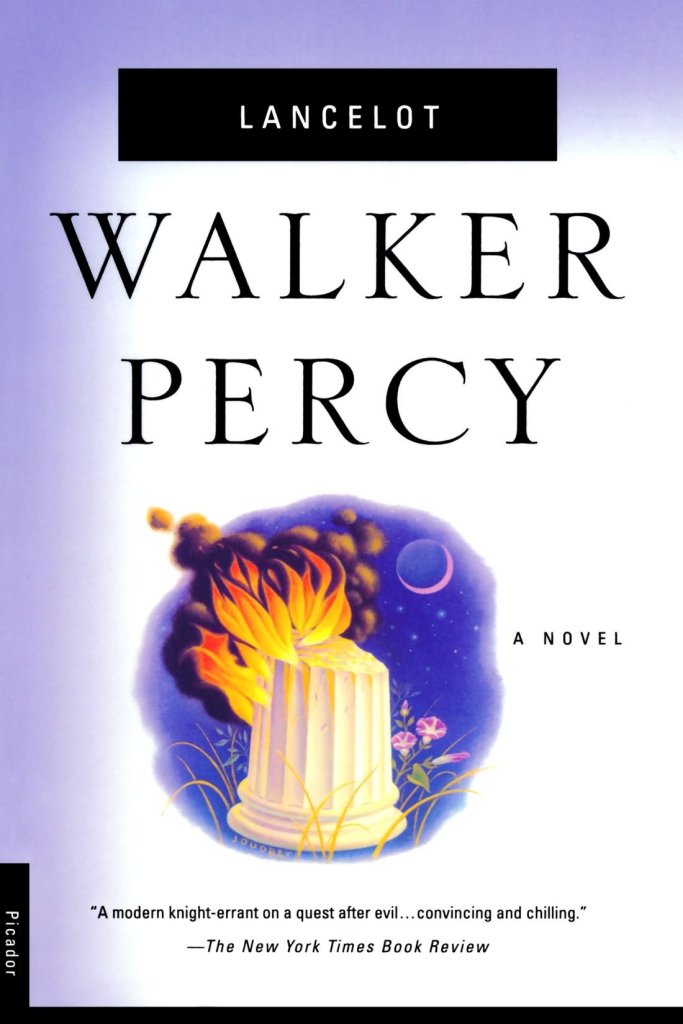
Walker Percy Wednesday 75

percycovercroppea

Catastrophe then—yes, I am sure of it—whether it has happened or not; whether by war, bomb, fire, or just decline and fall. Most people will die or exist as the living dead. Everything will go back to the desert.

*****

Can good come from evil? Have you ever considered the possibility that one might undertake a search not for God but for evil? You people may have been on the wrong track all these years with all that talk about God and signs of his existence, the order and beauty of the universe—that’s all washed up and you know it. The more we know about the beauty and order of the universe, the less God has to do with it. I mean, who cares about such things as the Great Watchmaker?

But what if you could show me a sin? a purely evil deed, an intolerable deed for which there is no explanation? Now there’s a mystery. People would sit up and take notice. I would be impressed. You could almost make a believer out of me.

In times when nobody is interested in God, what would happen if you could prove the existence of sin, pure and simple? Wouldn’t that be a windfall for you? A new proof of God’s existence! If there is such a thing as sin, evil, a living malignant force, there must be a God!

*****

During the sixties I was a liberal. In those days one could say “I was such and such.” Categories made sense—now it is impossible to complete the sentence: I am a—what? Certainly not a liberal. A conservative? What is that? But then it was a pleasure to take the blacks’ side: one had the best of two worlds: the blacks were right and I wanted to be unpopular with the whites. It was a question of boredom. Nothing had happened since I ran 110 yards against Alabama—we lived for great deeds, you remember, unlike the Creoles, who have a gift for the trivial, for making money, for scrubbing tombs, for Mardi Gras. The sixties were a godsend to me. The blacks after all were right, the whites were wrong, and it was a pleasure to tell them so. I became unpopular. There are worse things than being disliked: it keeps one alive and alert. But in the seventies the liberals had nothing more to do. They were finished. I can’t decide whether we won or lost. In any case, in the seventies ordinary whites and blacks both turned against the liberals. Perhaps they were right. In the end, liberals become a pain in the ass even to themselves. At any rate, the happy strife of the sixties was all over. The other day I ran into a black man with whom I had once stood shoulder to shoulder defying angry whites. We hardly recognized each other. We eyed each other uneasily. There was nothing to say. He told me had had a slight stroke, nothing serious. We had won. So he bought a color TV, took up golf, and developed hypertension. I became an idler.

Stigmergy as a Universal Coordination Mechanism I: Definition and Components

The first in a series of abstracts from this special Human-Human Stigmergy issue. First up is Francis Heylighen.

The concept of stigmergy was proposed by the French entomologist Pierre-Paul Grassé (Grassé, 1959) to describe a mechanism of coordination used by insects. The principle is that work performed by an agent leaves a trace in the environment that stimulates the performance of subsequent work—by the same or other agents. This mediation via the environment ensures that tasks are executed in the right order, without any need for planning, control, or direct interaction between the agents. The notion of stigmergy allowed Grassé to solve the “coordination paradox” (Theraulaz and Bonabeau, 1999), i.e. the question of how insects of very limited intelligence, without apparent communication, manage to collaboratively tackle complex projects, such as building a nest.

            The insight came from Grassé’s observation of how termites repair their nest. He noted that initially termites wander around more or less randomly, carrying mud and depositing it here or there. However, the deposits that are created in this haphazard way then stimulate the insects to add more mud in the same place. Thus, the small heaps quickly grow into columns that eventually come together to form an intricate cathedral of interlocking arches. The only communication between the termites is indirect: the partially executed work of the ones provides information to the others about where to make their own contribution.

            Another classic example of stigmergy can be found in the pheromone trails left by ants that come back from a food source (Sumpter and Beekman, 2003). The pheromone stimulates other ants to follow the same path. When they find food, they too will reinforce the pheromone trail while following the trail back to the nest. This mechanism leads to the emergence of an efficient network of trails connecting the nest via the shortest routes to all the major food sources.

            Up to about 1990, the notion of stigmergy appears to have remained limited to a small circle of researchers studying the behavior of social insects. However, one of these insect specialists, Jean-Louis Deneubourg, was also a member of the “Brussels School” of complex systems, headed by the late Nobel Prize in chemistry, Ilya Prigogine. In this interdisciplinary environment, it became clear that stigmergy was a prime example of spontaneous ordering or self-organization (Camazine et al., 2003; Deneubourg, 1977) and as such potentially applicable to complex systems other than insect societies.

            With the advent of the agent-based paradigm in computer simulation, insect societies were conceptualized as swarms of simple agents that are able to perform complex tasks using various forms of self-organization and especially stigmergy (Deneubourg, Theraulaz and Beckers, 1992). The general ability to tackle complex problems exhibited by such self-organizing multi-agent collectives became known as swarm intelligence (Bonabeau, Dorigo and Theraulaz, 1999; Kennedy, 2006). One class of stigmergic mechanisms in particular, so-called ant algorithms, turned out to be surprisingly powerful in tackling a variety of computational problems, including the notorious traveling salesman problem (Dorigo, Bonabeau and Theraulaz, 2000) and the optimization of packet routing along communication networks (Kassabalidis et al., 2001).

Screen Shot 2016-02-16 at 10.44.42 AM