Walker Percy Wednesday 91

percycovercroppea

Like many rich women, she loved a bargain.

*****

Right: you said I will not put up with a life which is not life or death. I don’t have to and I won’t.

*****

Is there another way? People either believe everything or they believe nothing. People like the Christians or Californians believe anything, everything. People like you and Lewis Peckham and the professors and scientists believe nothing. Is there another way?

*****

Strange that he, my father, often spoke of the Ardennes and the Rhine and Weimar but never mentioned Buchenwald, which was only four miles from Weimar and which Patton took three weeks later, never mentioned that the horrified Patton paraded fifteen hundred of Weimar’s best humanistic Germans right down the middle of Buchenwald to see the sights, Patton of all people, no Goethe he who said to the fifteen hundred not look you sons of Goethe but look you sons of bitches (is not this in fact, Father, where your humanism ends in the end?).

*****

You loved only death because for you what passed for life was really a death-in-life, which has no name and so is worse than death.

71x7p-XhQGL

Identity, Individuation and Substance

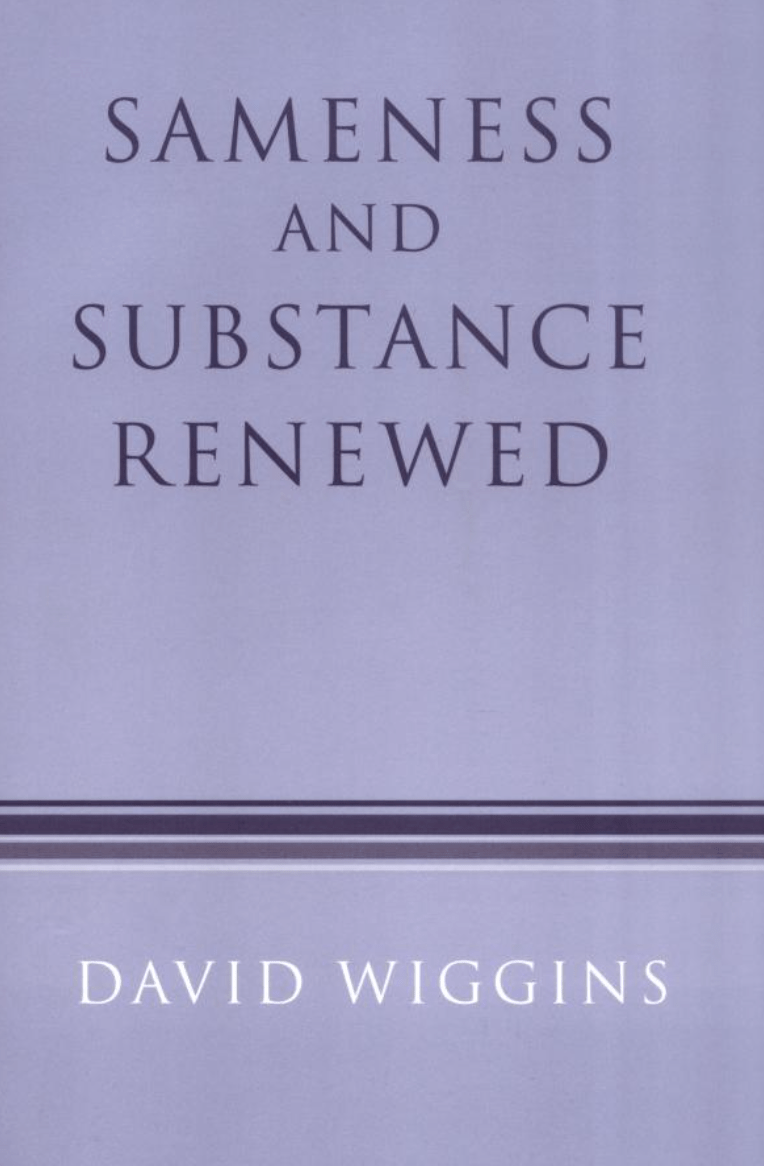
After a long break from writing on metaphysics the wonderful David Wiggins has a freely available paper published in the European Journal of Philosophy. Sameness and Substance remains one of the most satisfying  (and most difficult) reads I’ve ever experienced.

Screen Shot 2016-07-04 at 5.45.06 PM

Forty four years ago I published a short monograph called Identity and Spatio-Temporal Continuity, henceforth ISTC (Wiggins 1967). Once I saw it in print, I started putting one or two things right. From this process arose Sameness and Substance, henceforth S&S, (Wiggins 1980) and later Sameness and Substance Renewed, henceforth S&SR (Wiggins 2001). Ten years further on, noting the virtual disappearance of the sortalist view of identity from present day discussions, I wonder sometimes whether the third of these efforts was found to be unreadable. What I know for certain is that, over the passage of time, the philosophical scene has changed. It is no longer wise to assume, as I was apt to do, that everyone with a serious interest in the metaphysics of identity will know Aristotle’s distinction between what a thing is (i.e. what fundamental kind of thing it is) and what the thing is like, or be eager to read such texts as Categories, Chapters 1–5. Nor can the other Aristotelian resonances by which I once set such store be relied upon any longer to enlighten or remind. If they have any effect, it is rather to discredit the claim to have arrived at a perfectly general account—an account not at odds with anything that modern science reveals to us—of the identity and individuation of objects which are extended in space and persist through time.

The Radical Individualism of David Bowie

And my brother’s back at home with his Beatles and his Stones
We never got it off on that revolution stuff
What a drag, too many snags
Now I’ve drunk a lot of wine and I’m feeling fine
Got to race some cat to bed
Oh is that concrete all around
Or is it in my head?

— All the Young Dudes

Though Lurie is on the right track I’m not at all convinced as this piece stands. Yes, Bowie is the most naturally philosophical and literate of song-writers (i.e. not of the sloganeering Lennonesque variety) but the philosophical explication on offer here seems very slight to me. It’s trying way too hard to find stuff to support the individualism thesis (which as I’ve indicated is there in Bowie). No conceptual distinction is drawn between individualism and individuality as well as the notion that the individual vs. collective is not as stark a contrast as inferred — the individual and the group are in some sense ontologically on a par and of course the relationship is complex and in tension. When Lurie writes: “To assist with this endeavor I have enlisted a number of fellow writers and artists across the ideological spectrum to weigh in on the hidden meanings of these gems” (emphasis added) — I get worried. Maybe Lurie’s book We Can Be Heroes: The Radical Individualism of David Bowie does delve into these issues and maybe he does present a compelling case for Bowie’s so-called “social-libertarian proclivities”. What’s the approach? Unearthing “hidden meanings” via a Freudo-Marxist, hermeneutic, semiotic analyses . . . or just by wishful thinking? In any event I’d caution that if art is to maintain its authenticity, it should not be subject to propositional incursions. Second, as an experience of delight it does not involve the bifurcation of first the experience and contemplation thereof, followed by a rendering (expressed, conveyed, mimicked, copied, reproduced, exhibited): there is no undifferentiated poetic imagination, never mere entertainment nor merely the conveyor of wisdom.

For those who want to nerd out on Bowie, I suggest a two-fold approach: Simon Critchley’s book (the philosophical) and Tony Visconti’s autobiography (the practical).

RZ-BowieSuit-ORIGINAL

Proceedings of the Artificial Life Conference 2016

Available for free download here. The special theme of the conference: How can the synthetic study of living systems contribute to societies: scientifically, technically, and culturally? The goal of the conference theme is to better understand societies with the purpose of using this understanding for a more efficient management and development of social systems.

Proceeding_Artificial_Life_XV_Cover_1_low

Intellectual Yet Idiot

Nassim Nicholas Taleb gives the Platonic rationalist “elites” a mega bitch slap (Original source here). Supplemented by the recent lunacy as per below, I suspect that though philosophers (rightly so) got their knickers in a twist a couple of years ago when deGrasse Tyson slammed the value of philosophy, they’d be well on board with this latest bit of fuckwittery twittery.

Screen Shot 2016-06-30 at 6.37.13 PM

Screen Shot 2016-07-02 at 10.58.11 AM

The Myths and Legends of King Arthur

Supposedly being released today. I still adore the original album, the apotheosis of what was often disparagingly referred to as “progrock”. Aside from his obvious virtuosity, Rick could never be accused of having his head up his own arse. Rick saw (at the time) the excesses of the prevailing ’70s music scene; he doesn’t play the celebrity virtue-signaling game; and has always been in tune with the grumpy swell of opinion that cuts across political lines and that the ruling Platonic rationalists have been ignoring or shitting on. Stay grumpy Rick — you’re a great Briton and mensch!

The new recordings will be free of the studio limitations and single disc duration of the original and the new record will be a double album as it was originally intended to be.

Rick

Freak Out!

Released 50 years ago. Frank would roll in his grave knowing that the Brain Police are their most powerful right now. In the ’80s they were primarily daft pearl-clutching Washington Wives (abetted by the so-called “Moral Majority”/ in the UK we had Mary Whitehouse). But thanks to Frank we had some push back because these pearl-clutchers weren’t the sharpest pencils in the box. But the baton was passed on to a much more intellectually savvy, ambitious and infinitely more disingenuous younger generation, operating within a highly camouflaged and widely distributed institution — the academy. This time they had highly sophisticated techniques at their disposal (indoctrination posing as inquiry) along with institutionalized protection that the wider world took little notice of. Trained up in their totalitarian theology, they crushed dissent at every turn (late ’90s) and then reemerged as the regressive Left or the central scrutinizers with allies in the political class and canon-fodder recruits (students) to do their bidding. If we break them now, they will be broken at the height of their power and as such they will not blight our liberal beautiful inheritance for a generation. But they will be back . . . authoritarianism lurks in the hearts and the minds of these self-styled Platonic sophisticates and are closer to their bête noire (of their own making mind you) then they care to acknowledge.

01_freakout

This is the CENTRAL SCRUTINIZER…it is my responsibility to enforce all the laws
that haven’t been passed yet. It is also my responsibility to alert each and every one of
you to the potential consequences of various ordinary everyday activities you might be
performing which could eventually lead to The Death Penalty (or affect your parents’
credit rating). Our criminal institutions are full of little creeps like you who do wrong things…
and many of them were driven to these crimes by a horrible force called MUSIC! Our studies
have shown that this horrible force is so dangerous to society at large that laws are being
drawn up at this very moment to stop it forever! Cruel and inhuman punishments are
being carefully described in tiny paragraphs so they won’t conflict with the Constitution
(which, itself, is being modified in order to accommodate THE FUTURE).

Walker Percy Wednesday 90

percycovercroppea

The only time I knew what to do was when something bad happened to somebody. Disaster gave me leave to act. Between times I didn’t know what to do. Now I know.

*****

How did it happen that now for the first time in his life he could see everything so clearly? Something had given him leave to live in the present. Not once in his entire life had he allowed himself to come to rest in the quiet center of himself but had forever cast himself forward from some dark past he could not remember to a future which did not exist. Not once had he been present for his life. So his life had passed like a dream.
Is it possible for people to miss their lives in the same way one misses a plane? And how is it that death, the nearness of death, can restore a missed life?

*****

“The trouble is,” the man said, “there is no word for this.”
“For what?”
“This.” He held both arms out to the town, to the wide world. “It’s not war and it’s not peace. It’s not death and it’s not life. What is it? What do you call it?”
“I don’t know.”
“There is life and there is death. Life is better than death but there are worse things than death.”
“What?”
“There is no word for it. Maybe it never happened before and so there is not yet a word for it. What is the word for a state which is not life and not death, a death in life?”
“I don’t know.”
“I wonder if it ever happened in history before?”
“I don’t know.” Where is the word, the girl in the greenhouse would say, and look around.

71x7p-XhQGL

Meaningful Diversity

Is a group a bland puree unless it includes a “critical mass” of the targeted minorities?

Peter Minowitz’ newly published and freely available paper in Perspectives on Political Science.

. . . as if colorful skin guarantees colorful thinking and white skin precludes it . . .

Identity politics and affirmative action may well have met a vital need since there was undeniably a correlation with lived experience but now it has morphed into precisely the racist essentialism that we liberals sought to reject. Out of touch campus commissars and politicos are so wedded to this shallow notion of identity that they don’t realize (and are not interested) as to how profoundly condescending, disrespectful and insulting they are to “those of color” who want to be judged by their ideas, intellect, character, talents and insights. Instead they unforgivably hector, smear and shame those who dare stray from this oppressive ideological plantation.

Much of this state of affairs is a consequence of making the university crudely functional to the market, with academics and (the naturally inclined) statist administrators/bureaucraps in cahoots with each other. The simplistic socio-political “promise” that a university education was/is the fastest and most effective track to career success was promoted, as least in the UK, by the Right in the ’80s. This was a terrific opportunity for the “regressive left” (who already had a substantial beach-head) to quickly step in — and what we got was an uncritical proliferation of the university, filled by activism masquerading as inquiry. The upshot is that genuine liberal education, the idea to think critically and be intellectually and socially experimental, the understanding of the postulates of our beautiful liberal achievement, has been profoundly corroded. And beyond the intrinsic loss, there is the unintended consequence of pseudo-inquiry being of little instrumental value to a full range of professions, callings, occupations and trades (i.e. the market). It should be no surprise then that so many PhDs have been and are hustling to get a job in the safe space called the academy (where supply outstrips demand), and in the service of this understandably have to be parti pris, suffocating intellectual dissent (assuming they ever entertained any). Of course, there is a social status side to those who seek to enter the high church of activism in the academy. They typically view themselves as the Platonic high priests of reason and rationality in all matters (especially as it relates to the demos): this despite the overwhelming empirical literature showing this to be the grossest of psychological fantasies. But then these people are not in the knowledge business, they are in the self-preservation business — no wonder they and their canon-fodder acolytes behave as stressed bull terriers. The regressive Left and the fundamentalist Right have been complicitous in this state of affairs.