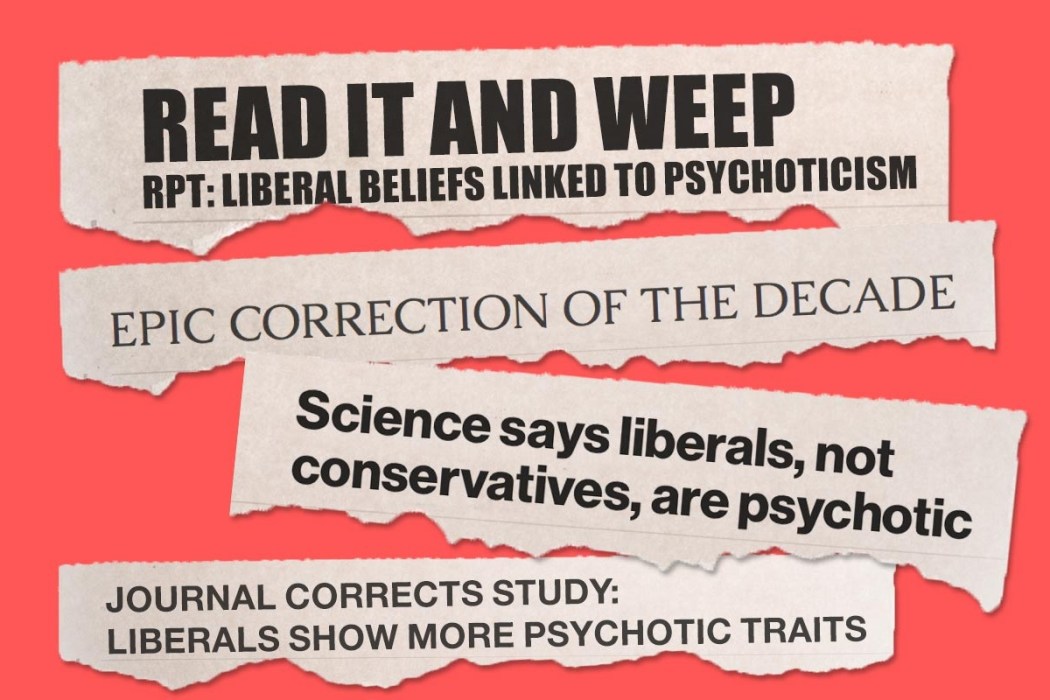
Why It Took Social Science Years to Correct a Simple Error About ‘Psychoticism’

Causality questions aside, you’re still arguing that according to your data impulsive people who dislike rules are more conservative.

Full write up here. (An aside: when the target article was first published, so many of my “sophisticate and rational” friends and academic colleagues predictably revealed their crude confirmation biases via their social media virtue-signaling).

14-study-correction-headlines.w710.h473.2x

Chef’s Table: Season Two

Some seven months ago I noted my appreciation of the first season of Chef’s Table. Having just binged out on the second season I’m pleased to report that the standard of outrageous talent and the commitment of the chefs is as high as the first batch. Jointly and severally, the chefs featured in both seasons are a wonderful expression in the most meaningful sense of socio-cultural diversity: bound together by the honest pursuit of excellence, a road paved with profound doubt and significant setbacks, perseverance, of course luck — but most of all, being very much culturally situated beings — their innovation driven by intimations from the past and by entering into a flow of sympathy from the past into the future. Yet another beautiful instantiation of particularism clearly showing up globalist ideologues as no more than vessels of bloodless rationalism, especially when taken on as an article of faith as is typically the case. Even the hollow marketing speak “The World’s Local Bank” (p. 4) has been dumped.

Three philosophers on Brexit

BBC’s A Point of View with Onora O’Neill, Roger Scruton and John Gray. Roger also in Prospect Magazine with “Who are we?

leviathan

Evolving Norms: Cognitive Perspectives in Economics

This book presents institutional evolution and individual choice as codependent results of behavioral patterns. Drawing on F.A. Hayek’s concepts of cognition and cultural evolution, Teraji demonstrates how the relationship between the sensory and social orders can allow economists to track social norms and their effects on the global economy. He redirects attention from the conventional focus on what an individual chooses to the changing social order that determines how an individual chooses. Cultural shifts provide the environmental feedback that challenges the mental models governing individual choice, creating a cycle of coevolution. Teraji develops a general framework from which to examine this symbiotic relationship in order to identify predictive patterns. Not just for behavioral economists, this book will also appeal to those who specialize in institutional economics, the philosophy of economics, and economic sociology. — Palgrave

Screen Shot 2016-07-13 at 1.48.22 PM

Walker Percy Wednesday 92

percycovercroppea

What to make, reader, of a rich middle-aged American sitting in a German car, holding a German pistol with which he will in all probability blow out his brains, smiling to himself and looking around old Carolina for the Jews whom he imagined had all disappeared?

*****

“Marion thought the Jews, the strange history of the Jews, was a sign of God’s existence. What do you think?”
“Oh wow. With all due respect to Marion, God rest her soul, hopefully we’ve gotten past the idea that God keeps the Jews around suffering to avenge Christ’s death.”

*****

When you leave a house for the last time and take one last look around before closing the door, it is as if you were seeing the house again for the first time. What happened to the five thousand times between?

*****

Was it love or failure of love?
And how did you miss yourself?

*****

Yes, given an ordinary need for death. But not if it’s a love of death. In the case of love, more is better than less, two twice as good as one, and most is best of all. And if the aim is the ecstasy of love, two is closer to infinity than one, especially when the two are twelve-gauge Super-X number-eight shot. And what samurai self-love of death, let alone the little death of everyday fuck-you love, can match the double Winchester come of taking oneself into oneself, the cold-steel extension of oneself into mouth, yes, for you, for me, for us, the logical and ultimate act of fuck-you love fuck-off world, the penetration and union of perfect cold gunmetal into warm quailing mortal flesh, the coming to end all coming, brain cells which together faltered and fell short, now flowered and flew apart, flung like stars around the whole dark world.

71x7p-XhQGL

Commemorating the Centennial of Herbert Simon’s birth

As many Simon aficionado’s will know, this year sees several conferences and publications marking the centenary of his birth. So on this note, yet another plug for Minds, Models and Milieux Commemorating the Centennial of the Birth of Herbert Simon but also to mention some upcoming Herbert Simon Society events (it’s somewhat reassuring given the disrepair of the delusional EU that so much interest in HS (and Hayek) emanates from Italy):

HERBERT SIMON: THE GENIUS OF SIMPLICITY AND BOUNDEDNESS
Turin, 14th October 2016
Download Tentative Programme
International Workshop

BEHAVIORAL ECONOMICS NUDGES AND HEURISTICS FOR PUBLIC POLICIES
Turin, 15th October 2016
Download Call for Paper

herb-simon

Reverend Charlie Jackson

. . . the inseparable connection between the sinning music of Saturday night and the sanctified music of Sunday morning . . .

Perfectly expressed by Thom Jurek discussing my latest acquisition recommended to me by someone at the  wonderful Louisiana Music Factory.

This man’s holy blues sounds more punk than Hillsong, but no matter your beliefs, hearing his music is a religious experience.

Nice article here by Dan Condon.

MI0001494488

Hang in there Rick

All the best to Rick. It has always amazed me that Quo never really broke the US: their brand of basic intense and melodic boogie I’d have thought would have had wide and loyal support as in Europe. My three favorite albums Quo, On the Level and Live. I guess the essence of Quo is Down Down.

Before that, the band managed to reach number 12 in the U.S. with the psychedelic classic “Pictures of Matchstick Men” (a Top Ten hit in the U.K.). Following that single, the band suffered a lean period for the next few years, before the bandmembers decided to refashion themselves as a hard rock boogie band in 1970 with their Ma Kelly’s Greasy Spoon album. The Quo have basically recycled the same simple boogie on each successive album and single, yet their popularity has never waned in Britain. If anything, their very predictability has ensured the group a large following.

AllMusic

Rick-Parfitt

Herbert Simon – a Hedgehog and a Fox

The seventeenth in a series of excerpts from Minds, Models and Milieux: Commemorating the Centennial of the Birth of Herbert Simon.

Roger Frantz and Leslie Marsh

A Quality of Mind

If as Archilochus’ famous fragment goes “The fox knows many things, but the hedgehog knows one big thing” then Herbert Simon is, at face value, a star example of a fox. Popularized by Isaiah Berlin (1978), the fox-hedgehog distinction has been interpreted (overly simplistically as Berlin acknowledged) as mutually exclusive or ideal types. Hedgehog-type intelligences are motivated by an overarching grand idea or scheme that they then apply to- or through which filter- all else. By contrast, fox-type intelligences are highly adaptive and come up new ideas more suited to a specific situation or context. We are of the view that the supposed hedgehog-fox dichotomy is way too trite and onedimensional an assessment of Simon. Without any fear of paradox Herbert Simon, we contend, was both a hedgehog and a fox.

Ascriptions of “polymath” and “Renaissance man” to Simon are legion and, while not without merit, they gloss over the distinctive quality of such a mind. The late Carl Djerassi was concerned that these days polymaths are viewed synonymously with “dabblers,” the implication being one of dilettantism (Barth, 2011, p. 96). In an age of hyper-specialization, a tacit resentment in some academic circles can be detected, a resentment that has substantive form (ideological and/or methodological) or plain old professional sour grapes infused by misguided protectionist intent.

Hayek, whose mind perhaps comes closest to Simon’s in both substance and style and whom Simon held in the highest regard understood that: . . . exclusive concentration on a speciality has a peculiarly baneful effect: it will not merely prevent us from being attractive company or good citizens but may impair our competence in our proper field . . . (Hayek, 1967, pp. 123; 127) This was echoed by G. L. S. Shackle who suggested that:

To be a complete economist, a man need only be a mathematician, a philosopher, a psychologist, an anthropologist, a historian, a geographer, and a student of politics; a master of prose exposition; a man of the world with the experience of practical business and finance, an understanding of the problems of administration, and a good knowledge of four or five languages. All this in addition, of course, to familiarity with the economics literature itself (Shackle, 2010, p. 241).

Simon embodied these virtues in spades. Curiously much criticism that followed his award of the Nobel Prize in 1978 was because he wasn’t an “economist”! There can be no doubt that Simon’s polymathic motivations were driven by genuine curiosity, a curiosity inextricably linked to intellectual honesty not withstanding of course endowed with natural ability and life opportunities. As we well know, Simon made significant contributions to political science, epistemology, sociology, cognitive science, philosophy, public administration, organization theory and complexity studies, diverse disciplines that were not conventionally discontinuous for Simon but merely different lenses through which Simon approached his central lifelong concern – the theorizing of human behavior, or rationality, or decision-making in complex social environments. The hedgehog-fox distinction dissolves for as Herb Simon’s daughter Kathie, citing Edward Feigenbaum, has already indicated in the Foreword to this collection:

… in awe of his enormous knowledge and the range of his contributions, I once asked him to explain his mastery of so many fields. His unforgettable answer was, ‘I am a monomaniac. What I am a monomaniac about is decision-making.’

This is borne out by Simon again:

. . . the “Renaissance Mind is not broader than other intelligent minds but happens to cover a narrow swathe across the multi-dimensional space of knowledge that happens to cut across many disciplines which have divided up the space in other ways. My own narrow swathe happens to be the process of human problem solving and decision making, and almost everything I have done lies in that quite narrow band (cited in Subrata, 2003, p. 686).

We are in full accord with Subrata’s contention that a multidisciplinary creative mind such as Simon’s is neither a “flitterer” nor merely a modal patchwork of ideas but an emergent distinctive “cognitive style” the likes of which is mitigated in the prevailing culture of hyper-specialization. A good teacher should insist that his or her students should not merely seek to have their intellectual prejudices validated but that they should approach a given thinker for their quality of mind – and Simon would be a perfect instantiation.

HS_POSTER

Free Will Revisited: Dennett and Harris in Conversation

Check out this excellent discussion between Dan Dennett and Sam Harris. Both shine since I think they have raised each other’s game; this despite being recorded after an already long day. As Sam rightly says, since so much gets lost and/or miscognized in writing it is thus vital to listen to the first 8 or so minutes where Sam gives us the backstory. Bravo to both for having the courage to try again and especially to Sam for having the intellectual and moral gumption to do what he does sans the virtue-signaling that typically motivates so many wanna-be public intellectuals. I suspect that the unlikely location for the recording (a pub) and the fact of only having one mic, has made for Sam’s best podcast yet. The upshot: the listener literally eavesdropping on a real conversation rather than the leadenness that tends to infuse recordings made in studios or from Skyping. Crikey, has it really been 25 years since Consciousness Explained? This podcast offers so much food for thought, much more than you ever will from a pat classroom talk or a lecture.

Worth noting is Dennett’s distillation of Rapoport’s rules:

  • You should attempt to re-express your target’s position so clearly, vividly, and fairly that your target says, “Thanks, I wish I’d thought of putting it that way.
  • You should list any points of agreement (especially if they are not matters of general or widespread agreement).
  • You should mention anything you have learned from your target.
  • Only then are you permitted to say so much as a word of rebuttal or criticism.

dennett-harris