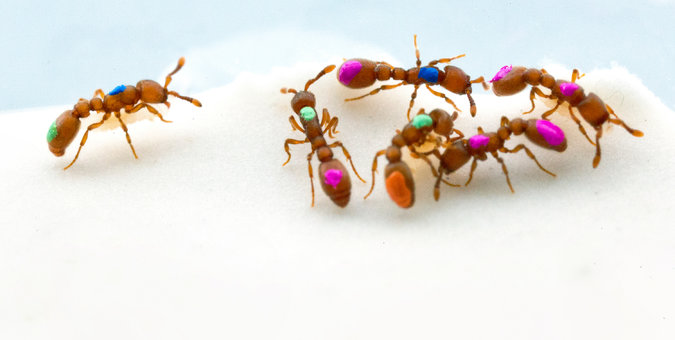
Gene-Modified Ants Shed Light on How Societies Are Organized

This from the New York Times (H/T Shannon Selin)

“Our ultimate goal is to have a fundamental understanding of how a complex biological system works,” Dr. Kronauer said. “I use ants as a model to do this.” As he sees it, ants in a colony are like cells in a multicellular organism, or like neurons in the brain: their fates joined, their labor synchronized, the whole an emergent force to be reckoned with.

24antsjp2-master675

Dreaming the future

We all want a better world, and we seemingly make progress, with more technology and less prejudice. Yet ideals and utopias are strangely difficult to imagine, let alone achieve. Is it that we just lack imagination or are leaders inherently corrupt? Or is there something impossible in the very idea?

screen-shot-2017-01-23-at-4-25-51-pm

Academic Hacks

The pun of the headline was unintended. Anyway, here is a short interview with Susan in Psychology Today — BTW, I highly recommend her Manifesto of a Passionate Moderate. The quote below captures the bind that befalls many humanities academics and is therefore a major driver of their hackery — ostrich-ism:

So, in the crudest career terms, yes, I suppose it would be more prudent to conform to the accepted academic pieties and hypocrisies or to avoid touchy topics altogether. And many professors seem to manage that quite well and even to thrive in the atmosphere of “lying and self-laudatory hallucination” that pervades universities today. But I simply couldn’t conduct my intellectual life that way, and to conduct my professional life like that would be just horrible.

In short, I’d much rather face the professional risks than sacrifice my independence. That’s why, when I was putting together Manifesto of a Passionate Moderate and a friend asked me: “Don’t you have enough enemies already?” I gave the answer you find in the introduction to the book: “Better ostracism than ostrich-ism.”

6a010535ce1cf6970c01b7c6e475e9970b

Islam and the Future of Tolerance: The Movie

If you are one of those anti-liberal sheep-like incoherent intersectional fuckwits who participated in- or uncritically supported- a mass march co-organized by a pro-Hamas Sharia law enthusiast, then this project won’t be for you. On the other hand if you are genuinely committed to liberalism (and women’s rights) please consider supporting this film.

1277

Pete Overend Watts

God knows why we influenced all these people. Sometimes I can’t see what all the fuss is about. Maybe it’s that bit of magic. Maybe Mott The Hoople had that, I don’t know if it did or not. If people say they love Mott, I just can’t see it, I don’t know why. But it’s nice to think people really liked what we did. It’s also funny to think that people are probably as mad on Mott The Hoople as I am on The Monks and The West Coast Pop Art Experimental Band. Poor devils!

R.I.P. Overend Watts Of Mott The Hoople 1947-2017

3984553331_a622fd2821_b

Bernard Williams on living long and living well

David Galloway in Journal of Evaluation in Clinical Practice

The ‘tedium of immortality’

growing-old-no-longer-has-to-mean-illness-physical-decline

Microaggression and “I smell the blood of les tricoteuses”

Check out this symposium on microaggression featuring Scott Lilienfeld, Jonathan Haidt, Derald Wing Sue, and others in Perspectives on Psychological Science (all the papers are open access). While on a psychology note, the funniest and sadly, the most insightful tweet on this day in my feed, is from the Gadfather — shades of Trigglypuff Mk2? Aside from Gad, other notable voices of sanity that caught my eye:

I’ll make you a deal, like any other candidate

We’ll pretend we’re walking home ’cause your future’s at stake
My set is amazing, it even smells like a street
There’s a bar at the end where I can meet you and your friend
Someone scrawled on the wall “I smell the blood of les tricoteuses”
Who wrote up scandals in other bars

I’m having so much fun with the poisonous people
Spreading rumours and lies and stories they made up

. . .

With you by my side, it should be fine
We’ll buy some drugs and watch a band
Then jump in the river holding hands

Surfing Uncertainty: Prediction, Action, and the Embodied Mind

Publisher’s blurb: “How is it that thoroughly physical material beings such as ourselves can think, dream, feel, create and understand ideas, theories and concepts? How does mere matter give rise to all these non-material mental states, including consciousness itself? An answer to this central question of our existence is emerging at the busy intersection of neuroscience, psychology, artificial intelligence, and robotics. In this groundbreaking work, philosopher and cognitive scientist Andy Clark explores exciting new theories from these fields that reveal minds like ours to be prediction machines – devices that have evolved to anticipate the incoming streams of sensory stimulation before they arrive. These predictions then initiate actions that structure our worlds and alter the very things we need to engage and predict. Clark takes us on a journey in discovering the circular causal flows and the self-structuring of the environment that define “the predictive brain.” What emerges is a bold, new, cutting-edge vision that reveals the brain as our driving force in the daily surf through the waves of sensory stimulation.”

Here are  a couple of reviews in Notre Dame Philosophical Reviews and the New Scientist along with Andy as guest blogger in The Brain Blog.

screen-shot-2017-01-20-at-9-33-03-am

Shakespeare: memory and modern cognitive science

Here is someone doing interesting interdisciplinary work as an English don without plying the usual woolly pseudo-inquiry tripe. See article here.

images