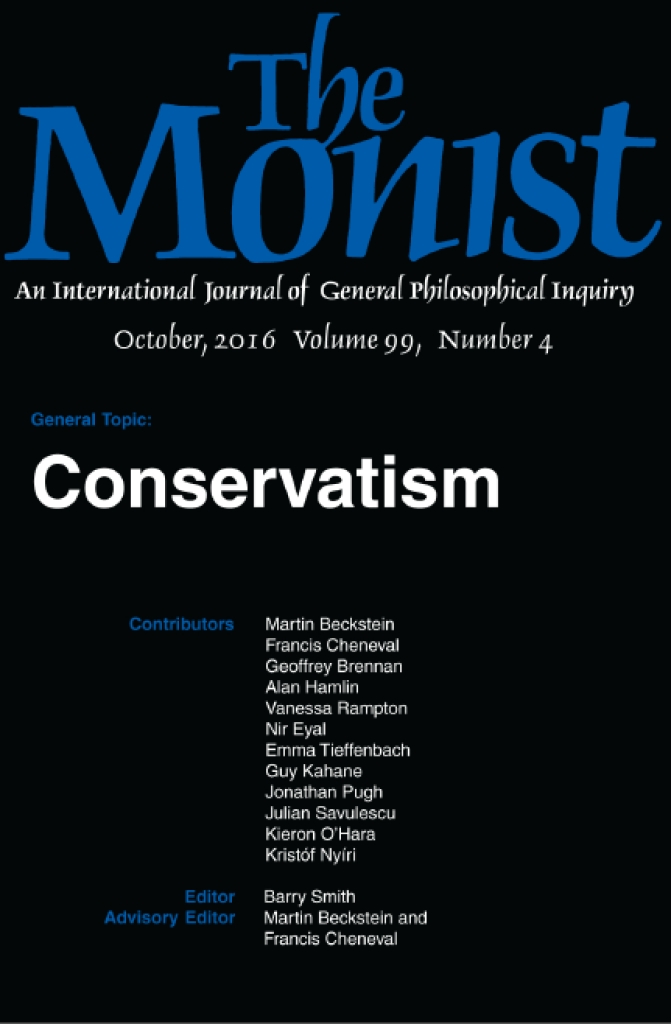
The new issue of The Monist: “This special issue is motivated by the observation that conservatism plays a marginal role in contemporary philosophy even though it appears to be of considerable importance in moral, social, and political reality. One reason for this neglect is that defenders of conservatism have often refrained from articulating their arguments in a language that is acceptable to and understandable by analytically trained philosophers. The contributions of this special issue show that conservatism can profitably be approached from the point of view of analytic philosophy. Many of them are indebted to Jerry Cohen’s (2012) seminal paper on conservative value, which develops a sophisticated justification of what Michael Oakeshott (1991) called the disposition to be conservative”.
Superintelligence: Science or Fiction?
Deirdre McCloskey on Dave Rubin
I had the honour and pleasure to spend the weekend at an intimate conference this past weekend with the delightful, funny, kind, supportive and of course brilliant Deirdre McCloskey. A true renaissance woman unlike the one-dimensional regressive hacks that populate most academia these days.
The Enactive Approach
Notice too that although the choice of processes under study is more or less arbitrary and subject to the observer’s history, goals, tools, and methods, the topological property unraveled isn’t arbitrary. — The Brains Blog

Why Ayaan Hirsi Ali’s Criticism of Islam Angers Western Regressives
Why Ayaan Hirsi Ali’s Criticism of Islam Angers Western Liberals Regressives. (Strike though added — they are certainly not liberals but authoritarians, with much in common with their bête noire — i.e. Fascists).
Cosmos + Taxis 4 (1)
Coming soon
Walker Percy Wednesday 120
“Hear this, Tom. I’ll make it short and sweet. We’re not talking about some bush-league medical project—fluoridating water to cure tooth decay. We’re not even talking about curing AIDS. We’re not even talking medicine, Tom. We’re talking about the decay of the social fabric. The American social fabric. I’m not telling you anything you don’t already know—all the way from the destruction of the cities, crime in the streets, demoralization of the underclass, to the collapse of the family.”
000000
“There is still grace, style, beauty, manners, civility left in the world. It’s not all gone with the wind. You know who’s coming up for the reception? Pete Fountain and his Half Fast Band. And Al Hirt. Both are personal friends of mine. I wish you could join me.”
00000
“Here’s a switch. Here’s Vergil, the scientist, skeptic, the new logical positivist, and here’s the uncle, defender of old legends, ghost ships, specters.”
00000
She is one of those women who have no other qualification than pleasantness and reliability.
00000
“You’re talking about violating the law of the land, gentlemen,” he says quietly. “Doe v. Dade, the landmark case decided by the U.S. Supreme Court which decreed, with solid scientific evidence, that the human infant does not achieve personhood until eighteen months.”
00000
There’s Hawkeye and Trapper John back in Korea. I never did like those guys. They fancied themselves super-decent and supertolerant, but actually had no use for anyone who was not exactly like them. What they were was super-pleased with themselves. In truth, they were the real bigots, and phony at that. I always preferred Frank Burns, the stuffy, unpopular doc, a sincere bigot.
00000
The Canadians are as affable but standoffish—though not as shy as the English.
But both, Canadians and Ohioans, are amiable, gregarious, helpful—and at something of a loss.
00000
The Ohioans looked zapped but keep busy.
The Canadians looked zapped but also wistful.
Every time I talk to a Canadian, either he will get around to asking me what I think of Canada or I will know that he wants to.
I realize that I do not have many thoughts about Canada. Reading Stedmann, who mentions the heroic role the Canadians played in World War I, I realize a curious fact about Canadians: When you hear the word Canada or Canadians, nothing much comes to mind—unlike hearing the words Frenchman or Englishman or Chinese or Spaniard—or Yankee. I realize this is an advantage. The Canadian is still free, has not yet been ossified by his word. (Why am I beginning to think like Father Smith?)
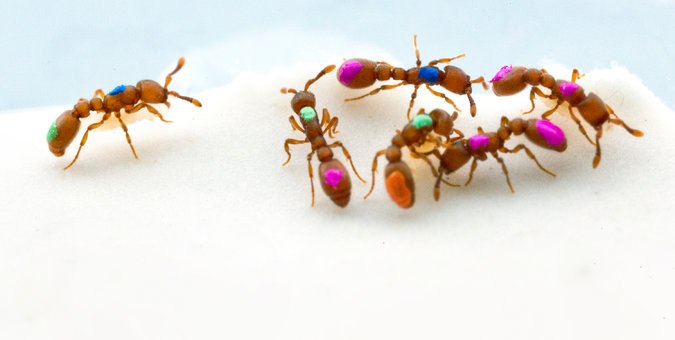
Gene-Modified Ants Shed Light on How Societies Are Organized
This from the New York Times (H/T Shannon Selin)
“Our ultimate goal is to have a fundamental understanding of how a complex biological system works,” Dr. Kronauer said. “I use ants as a model to do this.” As he sees it, ants in a colony are like cells in a multicellular organism, or like neurons in the brain: their fates joined, their labor synchronized, the whole an emergent force to be reckoned with.

Dreaming the future
We all want a better world, and we seemingly make progress, with more technology and less prejudice. Yet ideals and utopias are strangely difficult to imagine, let alone achieve. Is it that we just lack imagination or are leaders inherently corrupt? Or is there something impossible in the very idea?
Academic Hacks
The pun of the headline was unintended. Anyway, here is a short interview with Susan in Psychology Today — BTW, I highly recommend her Manifesto of a Passionate Moderate. The quote below captures the bind that befalls many humanities academics and is therefore a major driver of their hackery — ostrich-ism:
So, in the crudest career terms, yes, I suppose it would be more prudent to conform to the accepted academic pieties and hypocrisies or to avoid touchy topics altogether. And many professors seem to manage that quite well and even to thrive in the atmosphere of “lying and self-laudatory hallucination” that pervades universities today. But I simply couldn’t conduct my intellectual life that way, and to conduct my professional life like that would be just horrible.
In short, I’d much rather face the professional risks than sacrifice my independence. That’s why, when I was putting together Manifesto of a Passionate Moderate and a friend asked me: “Don’t you have enough enemies already?” I gave the answer you find in the introduction to the book: “Better ostracism than ostrich-ism.”