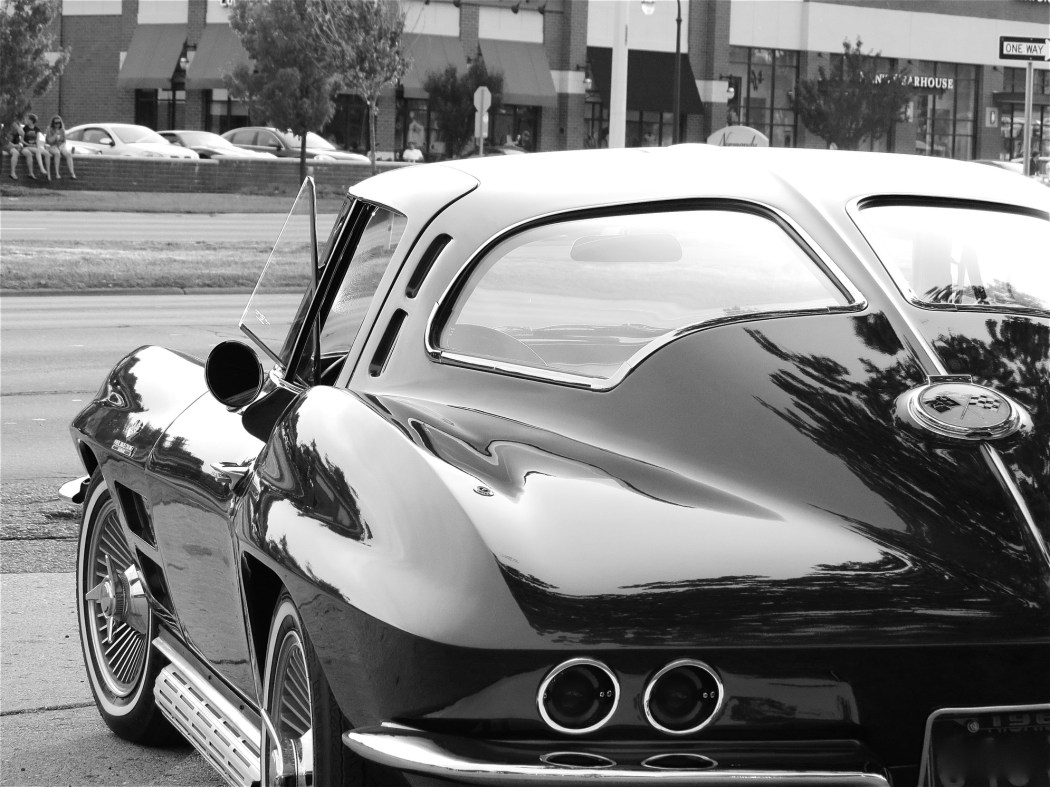
I liked this then and I unashamedly still do. Don Brewer chats about the song here. This good old fashioned mega thumper would be greatly appreciated by Dave Nice. P.S. Also first made in Flint, MI — Corvette!
E Pluribus Funk
Until about 2006 I read pretty much everything I could on the knowing-how/knowing-that distinction. Here is one paper that I’ve only recently come across by David Wiggins in Mind. I was very lucky to have Wiggins as a tutor, a most honorable man and an exacting philosopher.
This is one of the great performances from that superb series Live From Daryl’s House. I’m very much looking forward to seeing Booker T. live soon. There have been so many top-notch artists on the show, some of my favourites include: The O’Jays, Blind Boys of Alabama, Sharon Jones, and Joe Walsh (a bit disappointed with the Nick Lowe one though). Anyway, good food, good music and good friends — it doesn’t get much better. Joe is spot on about the state of music as is Daryl concerning that conceptually illiterate notion called cultural appropriation. Daryl, I think all your guests would join me in saying to these authoritarian vulgarians: “Fuck You“. Cheers Daryl!
Discussion here within the British context and from someone very well-placed to offer an overview of the problem: it’s easy to see similar trends in the US, CA and elsewhere. Aside from Red Ken, Corbyn and the like, the most despicable of characters are the regressive Jews, those trying ever so harder than even the bog standard street skinhead, to ingratiate themselves to their respective group, typically under the guise of anti-Zionism, and for most of whom, haven’t a frigging clue as to the ideological-conceptual topography of Zionism(s). A companion read should be Sander Gilman’s Jewish Self-Hatred: Anti-Semitism and the Hidden Language of the Jews, Baltimore: Johns Hopkins University Press.


Enrichment in such an age appears either as enrichment within immanence, i.e., the discriminating consumption of the goods and services of society, such as courses in personality enrichment, creative play, and self-growth through group interaction, etc.—or through the prime joys of the age, self-transcendence through science and art.
The pleasure of such transcendence derives not from the recovery of self but from the loss of self. Scientific and artistic transcendence is a partial recovery of Eden, the semiotic Eden, when the self explored the world through signs before falling into self-consciousness. Von Frisch with his bees, the Lascaux painter with his bison were as happy as Adam naming his animals.
00000
All at once, he saw how it all worked, saw the very mechanism of his sadness and therefore the means of rising above it. Above it he was and above all this, the people whom now he understood, the Indians, the tourists, even the scientist whom he knew by reputation. They, not he, were puppets worked by strings they could not see. But he knew, could see the strings and, best of all, work them himself—for the good of the Soviet Union and therefore for world peace.
00000
IN THE AGE OF science, scientists are the princes of the age. Artists are not. So that even though both scientists and artists achieve transcendence over the ordinary world in their science and art, only the scientist is sustained in his transcendence by the exaltation of the triumphant spirit of science and by the community of scientists.
It is perhaps no accident that at the high tide of physics in the nineteenth and early twentieth centuries, the great revolutionary physicists—e.g., Faraday, Maxwell, Bohr, Einstein—were also men of remarkable integrity and exultant wholeness of character, of generosity and benignity. Compare the lives and characters of the comparably great in literature at the same time: Dostoevsky, Baudelaire, Kafka, Joyce, Lawrence, Hemingway.
With the disappearance of the old cosmological myths and the decline of Judaeo-Christianity and the rise of the autonomous self, science and art, one the study of secondary causes, the other the ornamental handmaiden of rite and religion, were seized upon and elevated to royal highroads of transcendence in their own right. Such transcendence was available not only to the scientists and artists themselves but to a community of fellow scientists and students, and to the readers and listeners and viewers to whom the “statements” of art, music, and literature were addressed.

The very excellent “philosopher king” Jesse Norman on Britain’s current malaise.
Burke understood how language could be debased through the rhetoric of abstract nouns such as “liberty” or “equality”, which move people without enlightening them.

Here’s a good overview of the state of NOLA brewing. All sounds quite positive so long as over-hopped IPAs aren’t indiscriminately peddled as good craft beer, as they have most elsewhere in North America.