Just released. Below is a sample of one of their party pieces “fuck ’em if they can’t take a joke” — a sentiment that seems appropos in light of recent events in the UK. Now in their 40th year here’s a write up commemorating their 20th anniversary.
Philo goes “mainstream”
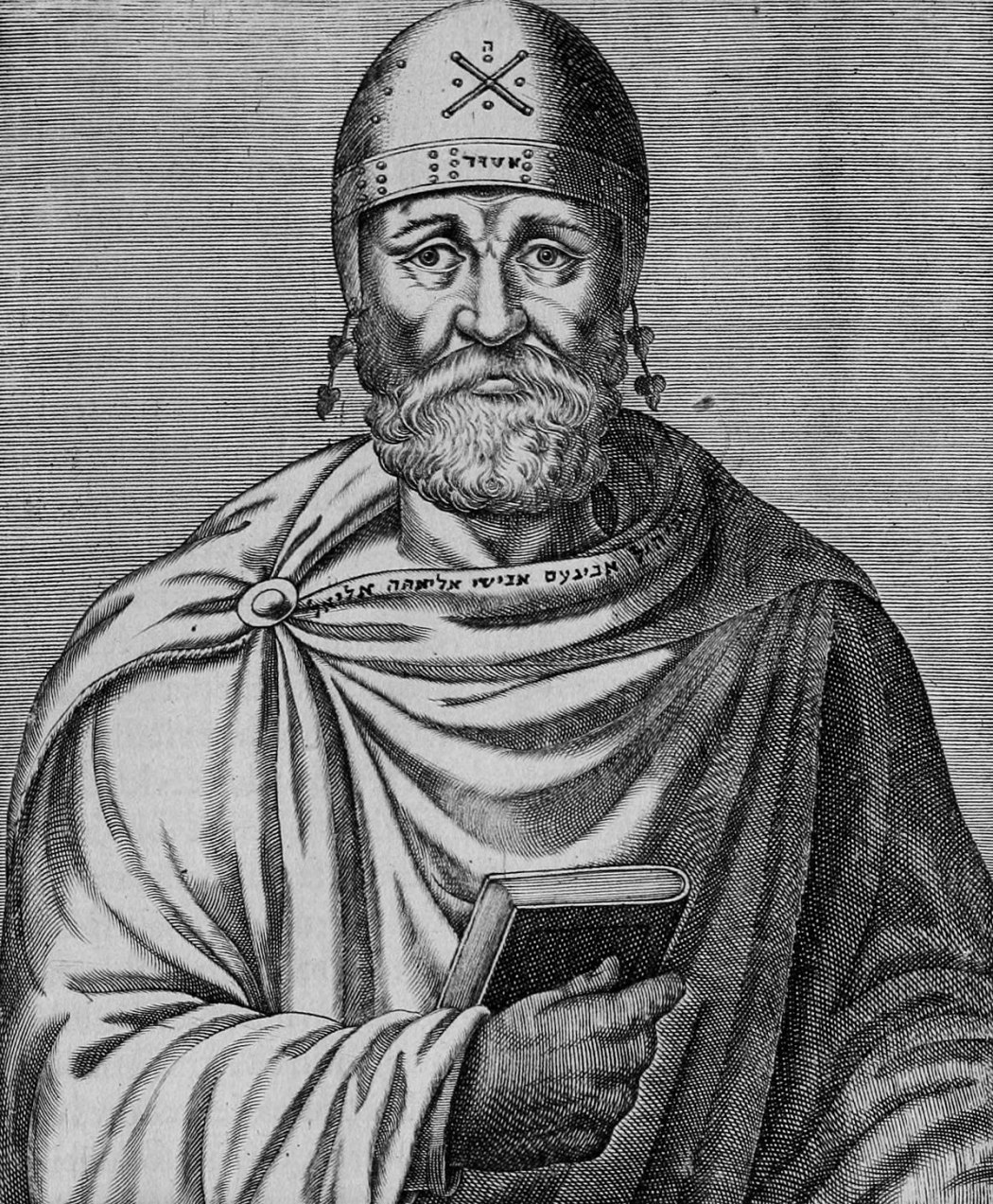
A couple of months ago I took to task the Philo entry in the Internet Encyclopedia of Philosophy. I have just noticed that in the interim a more nuanced entry of Philo has recently appeared in the Stanford Encyclopedia of Philosophy — and one that actually cites and acknowledges Runia. Oddly enough, Lévy does not mention E. R. Goodenough or H. A. Wolfson, two commentators that tried (and admittedly failed) to reclaim, rehabilitate or retrieve Philo the Jew (Philo Judaeus) for Jewish interest from Christianity’s Philo (Philo Alexandrinus). Moreover, the earlier brilliantly distilled scholarship of R. G. Bury and C. H. Dodd, not laboring under the task of trying to locate the Jew in Philo, is conspicuously missing. This said, Lévy makes an important contribution to mainstreaming Philo beyond the confines of classicists and philosophical theology circles.
Delvaux + Wagner + Williams
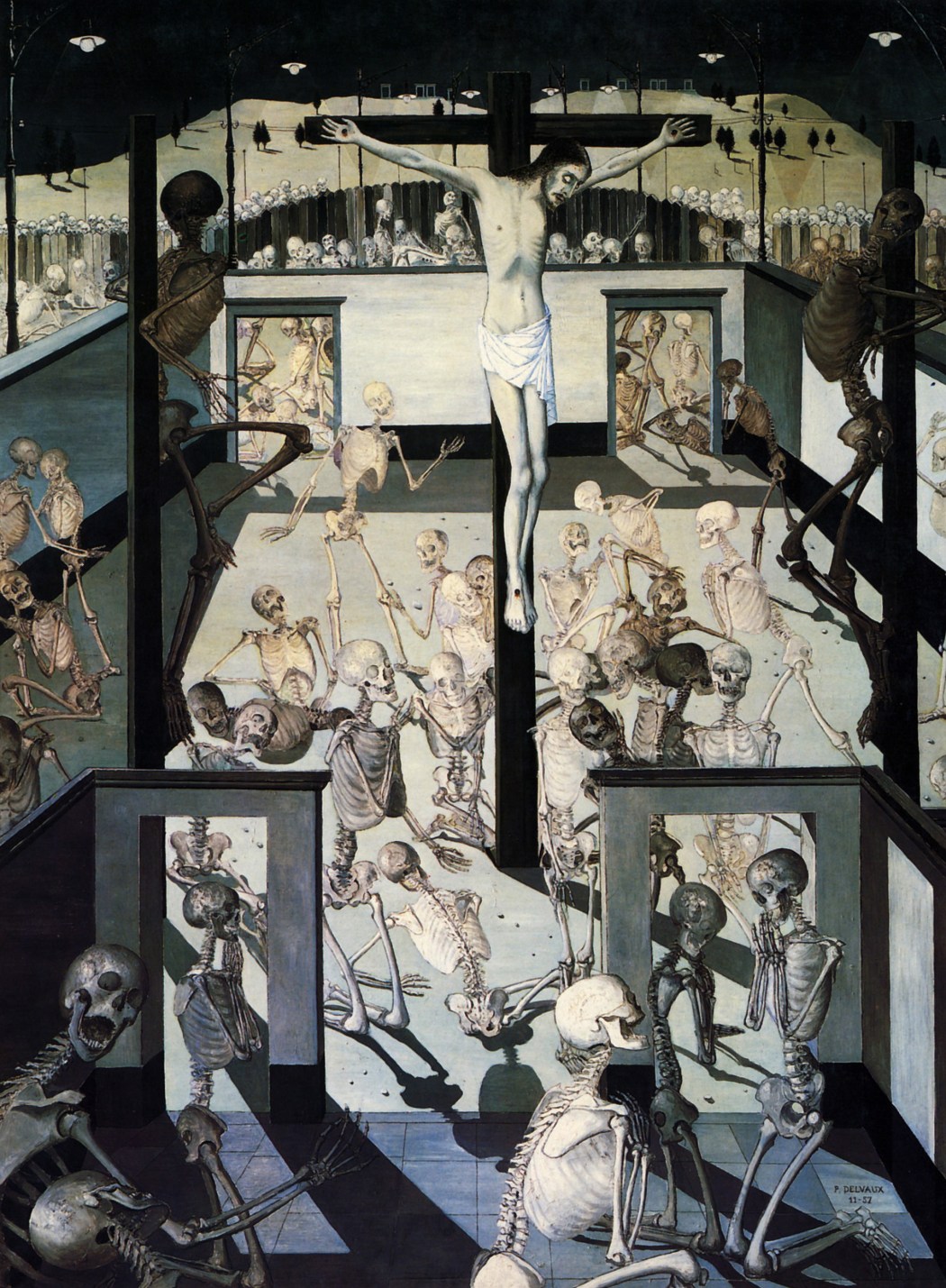
1957. Oil on canvas, 270 x 200 cm. Koninklij Museum voor Schone Kunsten
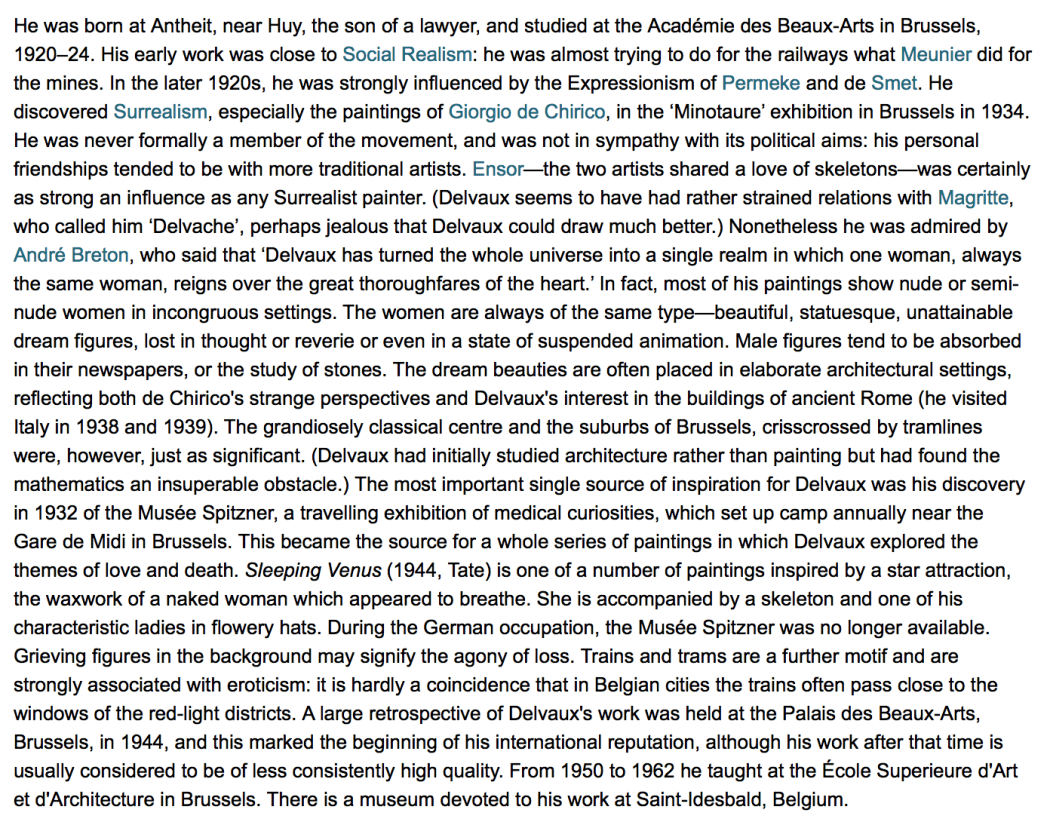 A Dictionary of Modern and Contemporary Art (3 ed.), John Glaves-Smith and Ian Chilvers
Here is a late piece by the one and only Bernard Williams from The New York Review of Books. (It’s easy to imagine the crass approach the regressive activist academic would have in explicating Wagner’s anti-Semitism).
The only reason for worrying about Wagner’s works is that they are powerful and interesting. But if that is so, what difference would these signatures, these local coded messages, make?
Prokofiev For Two: Argerich & Babayan

Scientism and its Discontents


Economics: the view from below
Marion Fourcade in the Swiss Journal of Economics and Statistics.

Ralph McInerny on Baron Corvo, the “Spoiled Priest”
Lovely talk by the late Ralph McInerny that opens with the vexed question of what one might mean by the “Catholic novel”, an idea deeply complicated by one of my favourite authors, the one and only Frederick Rolfe aka Baron Corvo, “the most anti-Catholic Catholic” (a la Buñuel). If you appreciate transgressive caustic humour (i.e. you are someone that hasn’t been lobotomized by PC fuckwittery) and perhaps you are already a fan of A Confederacy of Dunces, then Hadrian the Seventh will have much resonance. A classic work in its own right is A. J. A. Symons’s subtle biography of Rolfe The Quest for Corvo. It is also thanks to Donald Weeks who meticulously pieced together, insofar as he could, Rolfe’s life.
Stigmergy and Methodological individualism
We’ve been bloody well saying this for the past decade! Here and here and several other places besides. Good though to see The Review of Austrian Economics carry this paper — the late Don Lavoie (as did Hayek before him) was the first of the new generation of Austrians to explicitly grasp the concept of stigmergy, though admittedly, he didn’t invoke computational intelligence terminology. Herb Simon said it too! And those three “new” avenues for research are up and running, and maturing quite nicely.
Stigmergy also appears to have been anticipated by Hayek in his discussion of the price mechanism and the question of “how to dispense with the need for conscious control and how to provide inducements which will make the individuals do the desirable things without anyone telling them what to do” (1945, 88 emphasis mine).
This could open new avenues of research, of which I suggested three: optimisation; stigmergy; computational complexity.

Memphis Rent Party: The Blues, Rock & Soul in Music’s Hometown
No-one better placed to write about the Memphis scene than Robert Gordon. This holds out the promise of being a cracking read.

 manwithoutqualities