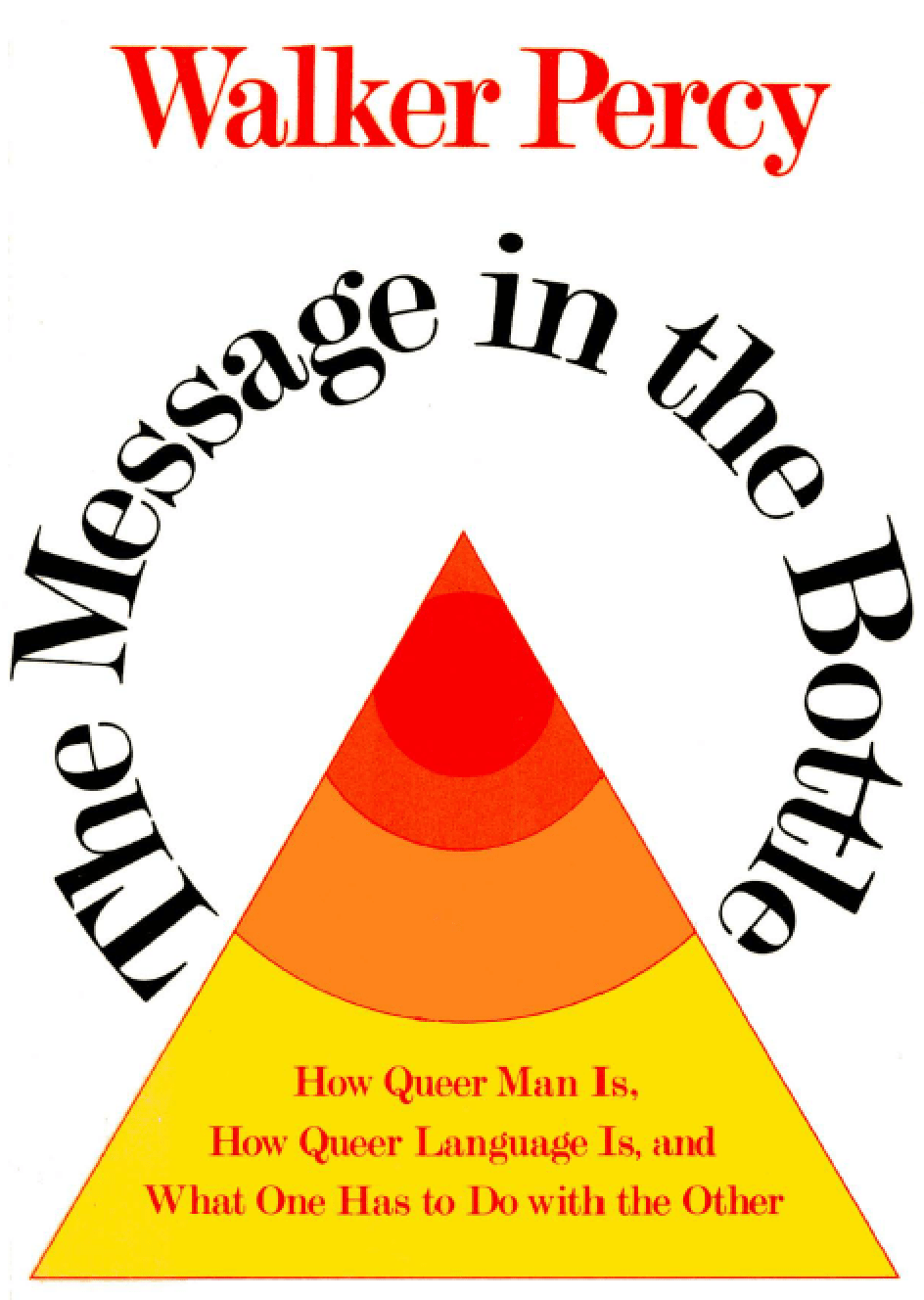
Walker Percy Wednesday 178

percycovercroppea

THE ANTINOMIES OF THE SCIENTIFIC METHOD IN ITS GRASP OF CULTURE

Kant believed that when “pure reason” ventures beyond the manifold of experience, it falls into an antinomy. That is to say, equally valid trains of argument lead to contradictory conclusions. Now, apart from the truth or falsity of Kant’s argument, the fact is that practicing scientists and scientifically minded laymen care very little either for metaphysical reasoning or for Kant’s a priori assault upon it. As Marcel has said, the spirit of the age is basically “ontophobic,” perhaps disastrously so. The scientist can hardly be indifferent, however, if it can be shown that the scientific method itself falls into a characteristic antinomy whenever it confronts a certain sector of reality. Such an antinomy can be demonstrated, I think, not by syllogistic argument but from the testimony of the empirical scientists themselves, when the scientific method tries to grasp the assertory phenomena of culture.

It is hardly necessary to add that my purpose in calling attention to the crisis of the cultural sciences is not to out-Kant Kant, not further to indict reason, but on the contrary to advance the cause of a radical anthropology, a science of man which will take account of all human realities, not merely space-time events.

The Antinomy of Myth

Examples of mythic assertions, S is P.

Marduk split Tiamat like a shellfish with two parts Half of her he set up and ceiled it as the sky.                                                                                                                  (Enuma Elis)

The Brahmin was his [the world’s] mouth, his arms were made the Rajanya [warrior], his two thighs the Vaisya [trader and agriculturalist], from his feet the Sudra [servile class] was born.                                                                                   (Rg Veda)

Maui, our ancestor, trapped the wandering sun and made it follow a regular course.                         (Maori myth)

( 1 ) What the scientist thinks of the assertion S is P when the assertion is proposed to him as a true-or-false claim:

The myth, S is P, is false. To say that the world was made by the Babylonian city-god Marduk from the body of Tiamat is absurd. There is not a shred of evidence to support such an assertion, and there is a great deal of evidence to the contrary.

(2) What the scientist thinks of the assertion S is P when the assertion is itself a phenomenon under investigation by the scientific method, to be ordered with other phenomena in the general corpus of scientific knowledge: A myth believed is true (Schelling). All societies have their myths; myths are therefore necessary for the function of a society (Malinowski, Mciver). Myth serves the function of seeing man through periods of peril and crisis (James, Malinowski). One of the troubles with modern society is the mythic impoverishment of the man of facts due to his rejection of old beliefs and the loss of archetypes. The answer is a “new mythology” (Langer). Recovery of mythic archetypes is necessary for mental health (Jung).

When myth is studied as an empirical phenomenon, it is evaluated not according as it is true or false or nonsensical but according to the degree to which it serves a social or cultural function. Thus a “genuine” culture (and a genuine myth) is a culture which is viable, satisfying the spiritual and emotional needs of the culture member; a “spurious” culture fails to do so (Sapir). It is a mistake to use rigid scientific standards and say that a myth is false; a myth may be poetically and symbolically “true” according as it satisfies the symbolic needs of world envisagement (Langer, Cassirer).

(3) Comment. The antinomy is manifest in the very usage of the word myth by modem ethnologists. As Bidney has pointed out, it is, to begin with, a value-charged term: myth means a belief which is not true. Then myth is used neutrally as a data-element along with other data-elements, canoes, baskets, dwellings. Bidney goes on to say, “The greatest myth of the twentieth century is the identification of all cultural ideology with myth in the name of social science.”

One serious consequence of this initial antinomy is a canceling of the social prescriptions of the scientist for the ills of the day. It becomes necessary for the scientist to recommend to culture or patient that which he, the scientist, has labeled false at the outset. But the fallacy of the prescription is that a myth can hardly be believed if it is believed to be false. The motto of the scientist when he is prescribing myth as a data-element necessary for mental and cultural health is: It may not be true but you had better believe it.

Another consequence is the compromise of the scientist’s own position in the face of the onslaught of the contemporary myths of fascism and Communism. If the scientist believes theoretically in the indispensability of myth for an integrated culture, it becomes difficult for him to make a coherent objection to the Nazi or Soviet ethos. The upshot is the anomalous situation, so familiar in academic circles today, of the professor who in the field and classroom recognizes only functional relationships and refuses to recognize norms, and who in private and public life is a passionate defender of the freedom and rights and sacredness of the individual.

The source of the antinomy is the arbitrary decree of the scientist that only functional relationships shall be certified among his “data” and that even ideological beliefs and assertions shall be evaluated not according to the true-or-false claim of the assertion but according to its function in the culture. The decree requires that a belief be labeled as a myth and at the same time certified as valid as a cultural function. Only two kinds of judgments about beliefs are forthcoming: false in fact and bad in function (Sapir’s “spurious” myth), false in fact and good in function (Sapir’s “genuine” myth). Thus the old-style rationalist attitude toward religion is reversed. The eighteenth-century rationalist accepted the true-or-false claim of religious belief-and usually argued against it. The modern culturologist denies the claim and accepts only a functional criterion in judging its validity. Thus C. G. Jung “accepts” the Catholic dogma of the Assumption because it validates the anima archetype, while at the same time he denies its claim to literal truth. Jung’s approach, once the total competence of the functional method is accepted, seems reasonable. I am not interested in the truth or falsity of religion, says Jung, but only in the structure and function of the human psyche. Yet such a neutrality is warranted only if the neutrality is consistent. It is not consistent when ideological belief is assigned first to the category of myth, then made to do duty as a neutral term in an objective culturology.
Screen Shot 2017-10-11 at 10.58.26 AM.png


Ralph McInerny on Baron Corvo, the “Spoiled Priest”

Lovely talk by the late Ralph McInerny that opens with the vexed question of what one might mean by the “Catholic novel”, an idea deeply complicated by one of my favourite authors, the one and only Frederick Rolfe aka Baron Corvo, “the most anti-Catholic Catholic” (a la Buñuel). If you appreciate transgressive caustic humour (i.e. you are someone that hasn’t been lobotomized by PC fuckwittery) and perhaps you are already a fan of A Confederacy of Dunces, then Hadrian the Seventh will have much resonance. A classic work in its own right is A. J. A. Symons’s subtle biography of Rolfe The Quest for Corvo. It is also thanks to Donald Weeks who meticulously pieced together, insofar as he could, Rolfe’s life.

Stigmergy and Methodological individualism

We’ve been bloody well saying this for the past decade! Here and here and several other places besides. Good though to see The Review of Austrian Economics carry this paper — the late Don Lavoie (as did Hayek before him) was the first of the new generation of Austrians to explicitly grasp the concept of stigmergy, though admittedly, he didn’t invoke computational intelligence terminology. Herb Simon said it too! And those three “new” avenues for research are up and running, and maturing quite nicely.

Stigmergy also appears to have been anticipated by Hayek in his discussion of the price mechanism and the question of “how to dispense with the need for conscious control and how to provide inducements which will make the individuals do the desirable things without anyone telling them what to do” (1945, 88 emphasis mine).

This could open new avenues of research, of which I suggested three: optimisation; stigmergy; computational complexity.

008_stigmergicmorphologiesnss01

Memphis Rent Party: The Blues, Rock & Soul in Music’s Hometown

No-one better placed to write about the Memphis scene than Robert Gordon. This holds out the promise of being a cracking read.

9781632867735

Experiences that cannot be put into words

Episode 3 of Marc Champagne’s podcast.

book_cover

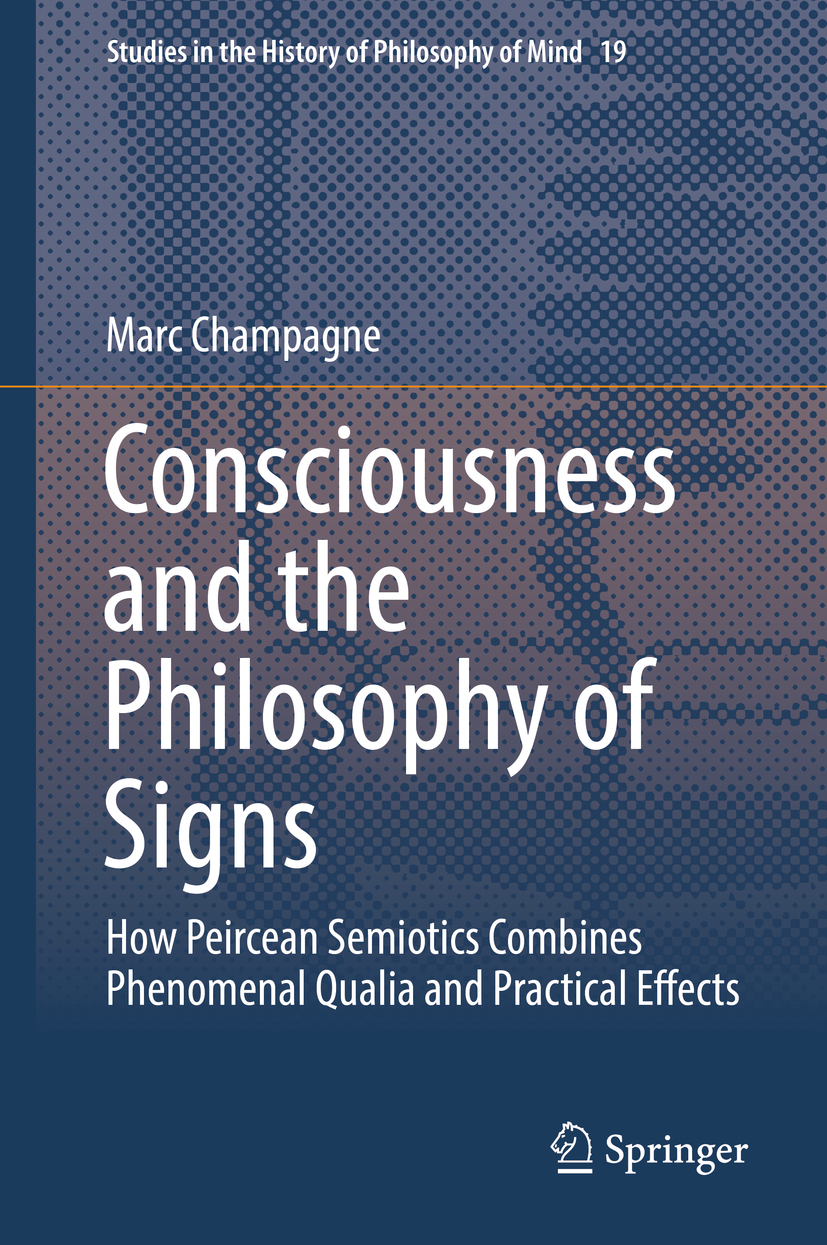
Walker Percy, Philosopher (in press)

For Walker Percy, philosophy and fiction were both tools for diagnosing the human condition, just as his medical training had taught him about tools for diagnosing the human body. His aim was nothing less than trying to understand how we fit into the cosmos. This collection of essays is a fascinating and worthy exploration of how philosophy informed his novels and the religious and existential quest that he called “the search.” I can imagine him reading this book, with his wry smile and lightly worn grace, nodding appreciatively. — Walter Isaacson, professor of history at Tulane and biographer of Leonardo da Vinci, Albert Einstein, Steve Jobs, and Benjamin Franklin.

TABLE OF CONTENTS

  1. Foreword: Percy: The Wondering Physician-Philosopher by Richard Gunderman
  2. Introducing Walker Percy: Philosopher of Precision and Soul by Leslie Marsh
  3. Percy, Peirce and Parsifal: Intuition’s Farther Shore by Stephen Utz
  4. Walker Percy, Phenomenology, and the Mystery of Language by Carolyn Culbertson
  5. That Mystery Category “Fourthness” and Its Relationship to the Work of C. S. Peirce by Stacey E. Ake
  6. Diamonds in the Rough: The Peirce-Percy Semiotic in The Second Coming by Karey Perkins
  7. Walker Percy’s Intersubjectivity: An Existential Semiotic or 3+3=4 by Rhonda McDonnell
  8. A Hard Fact of Life: A Commentary on Percy’s “Peirce and Modern Semiotic” by Kenneth Laine Ketner
  9. An Attempt Toward A Natural/UnNatural History of The Lay-Scientific Interface or How Walker Percy Got on the Way to Becoming a Radical (Anthropologist) by Scott Cunningham
  10. Percy’s Poetics of Dwelling: The Dialogical Self and the Ethics of Reentry in The Last Gentleman and Lost in the Cosmos by Christopher Yates
  11. “There Must Be a Place”: Walker Percy and the Philosophy of Place by Patrick Connelly
  12. On Being Jaded: Walker Percy’s Philosophical Contributions by Nathan Carson
  13. Percy on the Allure of Violence and Destruction by Brian A. Smith

Marshfinal

Chico Marx

Born on this day: Chico’s on-screen persona was the prototypical “foreign man” to Andy Kaufman’s Latka character. According to his daughter Maxine, Chico’s off-screen character can be summed up as a . . . 

Bon vivant, compulsive gambler, congenital liar, and faithless husband who, as manager for the Marx Brothers, steered them to phenomenal success from vaudeville to Hollywood.

The Tribe: The Liberal-Left and the System of Diversity

Looking forward to Ben’s forthcoming book. Ben, much like Frank Furedi, refreshingly offers sane commentary and insightful analysis from a Left perspective. Ben would be a terrific addition to the Spiked and Quillette rosters.

71157100124090L

Walker Percy Wednesday 177

percycovercroppea

CULTURE AS A SUBJECT OF THE SCIENTIFIC METHOD

What happens when the functional method of the sciences is applied to cultural phenomena? Does culture lend itself to such an understanding? If there are difficulties in the cultural sciences, are the difficulties due to the complexity of the material, as is often alleged, or are the difficulties inherently methodological?

Let us keep in mind what the scientific method does and what culture is. The scientific method seeks to arrive at regularities of two sorts, those which separate according to differences and those which unite according to functional similarities, the classificatory and the functional. Cassirer describes the totality of scientific knowledge as a complex of overlapping functions. Biologists who claim that biological laws like the law of allometry and Mendel’s rules are different from mechanical laws nevertheless insist on the unity of scientific knowledge. Franz Boas was frank to set forth the ultimate objective of anthropology as the understanding of culture as a dynamic and lawful process. The steadfast conviction behind the scientific method, whatever its subject matter, is that “every detailed occurrence can be correlated with its antecedents in a perfectly definite manner exemplifying general principles.”

Culture, in its most characteristic moments, is not a catalogue of artifacts or responses to an environment but is rather the ensemble of all the modes of assertory activity. Culture has been defined as all human inheritance, material as well as spiritual. As such it would include hoes, baskets, manuscripts, and monuments, as well as the living language and art of the current culture. If we consider culture in a broader, yet more exact sense-the sense in which Cassirer considered it-we will see it as the totality of the different ways in which the human spirit construes the world and asserts its knowledge and belief. These are the “symbolic forms”: language, myth, art, religion, science. Cassirer’s contribution has been described as the first philosophy of culture. The major symbolic forms of Cassirer’s long work, The Philosophy of the Symbolic Forms, provide a convenient frame of reference for the assertory phenomena of culture and I shall use them as such and without endorsing the Kantian mold in which they are cast.

If we examine Cassirer’s symbolic forms, we shall discover that each is, in its moment of actualization, an assertion. The major cultural forms which Cassirer treats in his long work-and the phenomena which we shall examine from the perspective of the scientific method-are myth, language, and science. Now an ethnologist can list any number of items which are the proper subject matter of his science and which are not assertions. A linguist may indeed spend his entire life compiling a dictionary of Kwakiutl without ever dealing with an assertion as such, as the phenomenon under investigation. But the fact remains that language, when it is spoken, is a tissue of assertions. Religion is not a museum of cult objects but a living tissue of beliefs, professions, avowals. The central act of myth and religion is the act of belief or worship. There is no such thing as an isolated word in speech; it is only to be found in dictionaries. The heart of science is not the paraphernalia of the laboratory; it is the method, the hunch, the theory, the formula. The art work is not the paint on the canvas or the print on the page; it is the moment of creation by the artist and the moment of understanding by the viewer.

But suppose this is true, suppose that cultural activity is mainly assertory activity. Does it follow that culture is placed beyond the reach of objective knowledge in general and the scientific method in particular? Certainly an assertion is a real event in the world albeit not a space-time event; it is also a natural, not a supernatural, event. People make assertions and we observe them do so. We can hear a man speak, read a formula, understand a painting. Then, if these various assertions are real happenings, phenomena in the world, is there any reason why they should be exempt from the searching gaze of science? Clearly not. And specifically, the functional method we have described should be used as long as it is useful. It has been so applied to culture and with great energy and resourcefulness.

The question which must be raised is not whether the scientific method should or should not be applied to culture. The question is rather whether its application has not already issued in an antinomy which compromises the usefulness of the method. If this is the case, two further questions must be asked. What is the source of the antinomy? And, how may the method be modified so that it may yield valid and fruitful conclusions when it is applied to culture?

Screen Shot 2017-10-11 at 10.58.26 AM.png