Ryle and Oakeshott on the “Knowing-How/Knowing-That” Distinction

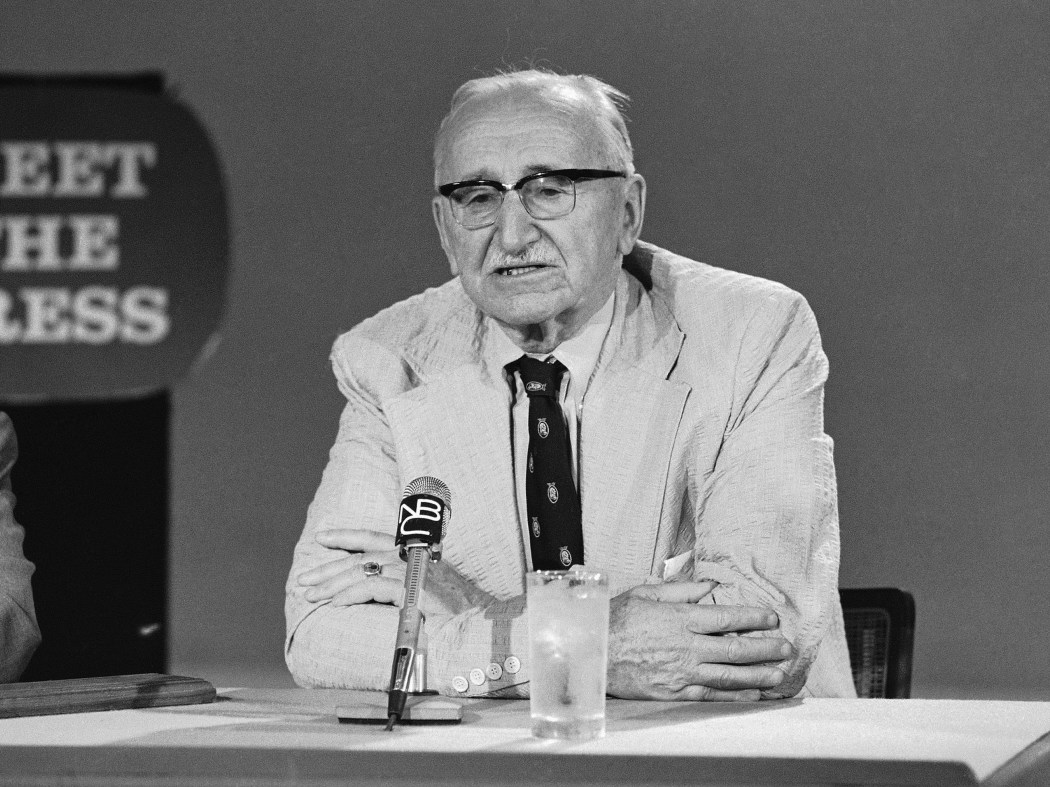
According to Robert Grant, Oakeshott only ever communicated with two “official” philosophers, one of which was Ryle:  Oakeshott warmly introduced Ryle, who delivered the annual August Comte Memorial Lecture at the LSE. John. D. Mabbott who read the proofs for On Human Conduct had, years earlier, been the first to recognize Oakeshott’s KH/KT connection with Ryle in his review of Rationalism in Politics in Mind. Mabbott crossed paths not just with Oakeshott but with Ryle, as a member of Ryle’s “Wee Teas,”philosophical tea parties.

71157105855300L

A Confederacy of Dunces – quotes and extracts – 90

Some cretin psychoanalyst would attempt to comprehend the singularity of his worldview. In frustration, the psychoanalyst would have him crammed into a cell three feet square. No. That was out of the question. Jail was preferable. There they only limited you physically. In a mental ward they tampered with your soul and worldview and mind. He would never tolerate that. And his mother had been so apologetic about this mysterious protection she was going to give him. All signs pointed to Charity Hospital.

Oh, Fortuna, you wretch!

. . .

“Oh, of course. There are all of my notes and jottings. We must never let them fall into the hands of my mother. She may make a fortune from them. It would be too ironic.” They went into his room. “By the way, you should know that my mother is enjoying the questionable attentions of a fascist.”

. . .

“My mother may return with her mob. You should see them. White supremacists, Protestants, or worse. Let me get my lute and trumpet. Are the tablets gathered together?”

“This stuff in here is fascinating,” Myrna said, indicating the tablet through which she was flipping. “Gems of nihilism.”

“That is merely a fragment of the whole.”

“Aren’t you even going to leave your mother some very bitter note, some articulate protest or something?”

. . .

Now that Fortuna had saved him from one cycle, where would she spin him now? The new cycle would be so different from anything he had ever known.

Image.ashx

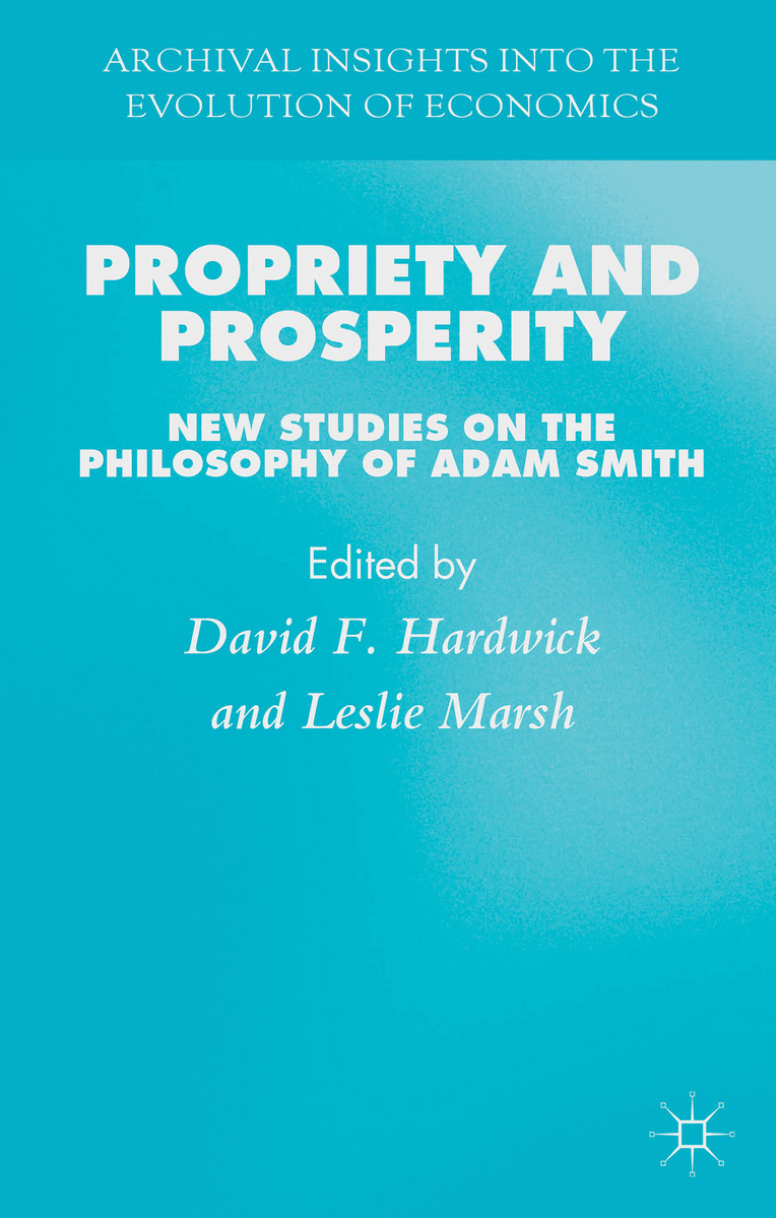
Adam Smith on Sympathy: From Self-Interest to Empathy

The intro to Gloria Zúñiga y Postigo’s essay

Is the assumption of self-interested behavior assumed in economics at odds with altruism and compassion? I believe that this question—which has been formulated in various ways in the literature for the past two centuries—is the thorn that often turns us away from reconciling the Adam Smith of the Wealth of Nations (hereinafter WN) with the Adam Smith of The Theory of Moral Sentiments (hereinafter TMS). Economics has certainly made WN the most known contribution by Smith since it is generally assumed that publication of WN marks the beginning of economics as a discipline independent from philosophy. Indeed, it is a widely held belief that the concept of self-interest is not only central to the WN, it also established self-interest as the founding principle of economic theory. For example, in his “Mathematical Psychics: an Essay on the Application of Mathematics to the Moral Sciences,” F. Y. Edgeworth wrote, “the first principle of economics is that every agent is actuated by self interest” (1881, p. 16). This was a received view at the time and the sentiment has not changed much since then, although the self-interest paradigm has graduated into the more sophisticated abstraction of utility maximizing behavior. Under this more palatable name, self interested behavior has been attributed more broadly to all human behavior, not just economic phenomena. Gary Becker, for example, claims that “the economic approach is a comprehensive one that is applicable to all human behavior” (1976, p. 8). In “The Successes and Failures of Professor Smith,” George Stigler claims that Smith “put in the center of economics the systematic analysis of the behavior of individuals pursuing their self-interest under conditions of competition. This theory was the crown jewel of The Wealth of Nations and it became, and remains to this day, the foundation of the theory of allocation of resources” (1976, p. 1201).

Part of the problem not only with the claim that self-interest is central to WN, but also with the claim that it is also the founding principle of economics, is that our understanding of self-interest seems to fall within a wide range and we often fail to see the variation in connotations from one end of this range to the other until we see the variety of interpretations of WN. On its leanest interpretation, Smith’s notion of self-interest is assumed to be a type of ethical egoism. And on its grandest interpretation, “the Wealth of Nations is a stupendous palace erected upon the granite of self-interest” (Stigler, 1971, p. 265). The curious thing is that these widely-different interpretations seem to draw from the WN the same conclusion: that Smith’s chief point is that our actions are principally motivated by self-interest. The problem is not only that both interpretations misunderstand Smith, but they also present dangerous implications since the least favorable interpretation can be used as a pretext for uncritical charges of greed and cut-throat individualism, and the grand interpretation can be used as justification for the uncritical view that we are best regulated by self-interest.

Where did we go wrong in the understanding of Smith? Nowhere in WN does Smith state that self-interest is the only or the best motivation for human action, not even of the economic sort. This has been recognized in the most sober commentaries. For example, R. H. Coase argues that “Self-interest is certainly, in Adam Smith’s view, a powerful motive in human behavior, but it is by no means the only motive” (1976, p. 529). Jon Elster observes that “the assumption that all behavior is selfish is the most parsimonious that we can make…[and] we cannot conclude that selfishness is the more widespread motivation…[because] the world is messy, and the most parsimonious explanation is wrong” (1989, p. 54). Vernon Smith recognizes that, “There is a vulgar representation of Adam Smith as championing the unconstrained pursuit of self-love to the exclusion of other values by humans…” (2013, p. 285).

But the strongest evidence is given to us by (Adam) Smith himself. We have to start with TMS, however, since it lays the foundation that makes WN intelligible as a systematic treatise on economic behavior.

Screen Shot 2014-12-03 at 4.13.38 PM

Thomas Hobbes: Twisted Fire-Starter?

In 1666, Oxford University ordered the wholesale burning of all copies of copies of Hobbes’s work . . . Such was the backlash against Hobbes, questions were asked in Parliament during the inquest into the Great Fire of London (2-5 September 1666), it was suggested that the burning of Hobbes’s books may have been a contributory cause of the blaze. (p. 130).

51ndgDnURoL

Walker Percy Wednesday – 21

I have to admire the St Louisan for his neat and well-ordered life, his gold pencil and his scissors-knife and his way of clipping articles on the convergence of the physical sciences and the social sciences; it comes over me that in the past few days my own life has gone to seed. I no longer eat and sleep regularly or write philosophical notes in my notebook and my fingernails are dirty. The search has spoiled the pleasure of my tidy and ingenious life in Gentilly. As late as a week ago, such a phrase as “hopefully awaiting the gradual convergence of the physical sciences and the social sciences” would have provoked no more than an ironic tingle or two at the back of my neck. Now it howls through the Ponchitoula Swamp, the very sound and soul of despair.

BB0525_2