Being Heidegger

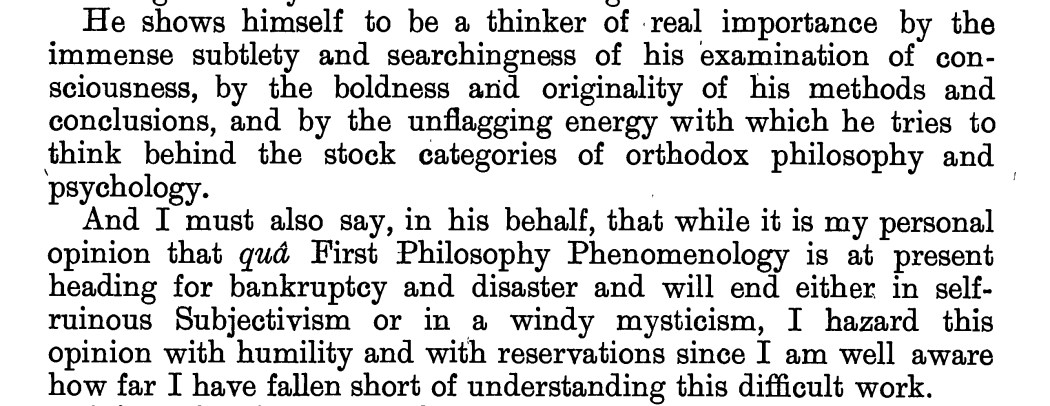
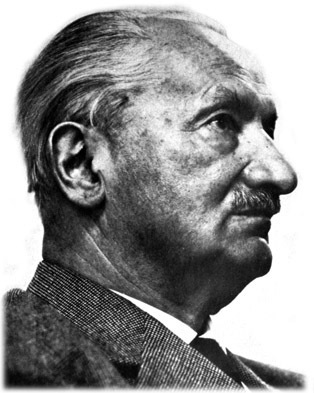
Simon Critchley has the first of an eight-part series of blog postings on Heidegger’s Being and Time. Will he discuss the influence Heidegger has had on non-Cartesian cognitive science? We will see. Unlikely as it sounds, Gilbert Ryle’s critical notice (Mind XXXVIII 1929, 355-370) warmly welcomed Sein und Zeit despite the inherent difficulties of the work (usually misappropriated or vulgarized in contexts where there is no philosophical culture): 

Ryle on Heidegger

As Critchley puts it: “Reading Being and Time can sometimes feel like wading through a conceptual mud of baroque and unfamiliar concepts.” Check out the BBC documentary on Heidegger.

heidegger2

Hayek in Mind: Hayek’s Philosophical Psychology

Call for papers

Hayek in Mind: Hayek’s Philosophical Psychology

Leslie Marsh, Volume Editor

Advances in Austrian Economics

Hayek’s philosophical psychology as set out in his The Sensory Order (1952) has, for the most part, been a neglected work. Social theory, Hayek’s traditional disciplinary constituency, has recently begun to take note and examine its place in the complete Hayek corpus. Despite being lauded by computer scientist grandee Frank Rosenblatt and more recently by neuroscientists Gerald Edelman and Joaquin Fuster, cognitive science (with few exceptions) has yet to discover Hayek’s philosophical psychology. This volume seeks to redress this lacuna by soliciting critical assessments on some aspect(s) of Hayek’s philosophical psychology. Proposals that offer a suggestive deployment of Hayek’s philosophical psychology are also welcome. What makes this volume distinctive is that the editors are seeking submissions that examine Hayek from the perspective of recent philosophy of mind.

Suggested topics include (but is not exhaustive):

Mind-body problem; connectionism; externalism; intentionality; knowing how-knowing that; the frame problem; enactivism; Hayek’s non-Cartesianism; cognitive closure; qualia; the hard vs. the easy problems; Hayek’s Kantianism; functionalism; individuation of mental states; cognitive science as a multi-disciplinary enterprise.

Accepted articles will form chapters in the hardcover book series Advances in Austrian Economics. All articles are subject to double blind review: further details about this series can be found on the publisher’s webpage.

Proposals not exceeding 500 words should be sent to Leslie Marsh by December 15, 2009.

The Bounds of Cognition

Once again I want to bring your attention to the superb Critical Notice by Justin Fisher in the latest issue of The Journal of Mind and Behavior on Adams’ and Aizawa’s The Bounds of Cognition.

9781405149143

Oakeshott on Religion, Science and Politics

The recent Zygon symposium on Oakeshott on religion, science and politics is now available as a free download. Click here and scroll down to the REFLECTING ON MICHAEL OAKESHOTT section.

Extended hype?

Galen Strawson, while thinking there is much to be said for non-Cartesianism, doesn’t think that the radical turn taken by the extended mind hypothesis, is fruitful nor indeed really all that new. Stay tuned for an excellent review by Chris Onof of Strawson’s Consciousness and Its Place in Nature: Does physicalism entail panpsychism? in The Journal of Mind and Behavior as well as reviews of Clark by Rob Rupert and Thompson by Dorothée Legrand. Rupert, long since an opponent of the extended mind, will be reviewed by Colin Klein.

Swarm cognition

Here is a terrific presentation entitled  “Macrotermes as models of swarm cognition” by Scott Turner. He writes:

This presentation was given at the Workshop on Research Efforts and Future Directions in Neuroergonomics and Neuromorphics sponsored by the US Army Research Office on 23-25 October 2007 in College Park Maryland. The presentation outlines the developing theme of our research of the termite-mound system as a cognitive system that has knowledge of its world and can map that knowledge onto functional structure. I concentrate on the “Collective Structural Defense” (CSD), which is the process of mound regeneration, repair and structural regulation 

Download here (28 mins, 65 MB, swf slide show with audio)

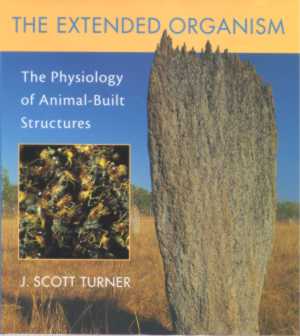
There is much else of interest on Turner’s website – well worth checking out if you have an interest in swarm intelligence and related topics. For those with an interest extended mind (for or against) Turner’s book THE EXTENDED ORGANISM: The Physiology of Animal-Built Structures should be consulted. I’ve rarely seen this work cited – it offers grist to the extended mind mill:

Building on Richard Dawkins’s classic, The Extended Phenotype, Turner shows why drawing the boundary of an organism’s physiology at the skin of the animal is arbitrary.

TEO cover

Noë on Clark

Noë’s Trends in Cognitive Sciences review “Extending our view of mind” of Clark’s Supersizing the Mind is now online (pay-per-view unless of course your university subscribes).

V. S. Ramachandran

VS


Speaking of homuncularity there is a nice profile of V. S. Ramachandran in the latest issue of The New Yorker (sorry it’s by subscription only). It’s a far superior piece than the one done on the Churchlands a while back. Beyond the areas that have made V.S. so well-known (synesthesia, phantom limb syndrome), several interesting topics (at least for me) that are covered include:

1. I had no idea that V. S. worked with (the very amusing) Richard Gregory

2. Penfield homunculus related to phantom limb syndrome

3. Picking up the Parma discoveries of mirror neurons in monkeys and seeing if he could, through non-evasive techniques, find them in humans.

In case you haven’t seen V.S in action, here is a video of him I posted some time back. 

Homuncularity

Courtesy of the Consortium on Cognitive Science Instruction I bring you a brief clip of the superbly rendered notion of the homunculus from the film Men in Black

Sensory_and_motor_homunculi

NEPSA Oakeshott Panel

For a long time the preeminent Oakeshott scholar in New England has been Paul Franco: this hasn’t changed. Fortunately, Paul’s presence has attracted other Oakeshott experts. Once again, Maine has proved to be an unlikely place for Oakeshott. As it happens, the New England Political Science Association’s (NEPSA) annual meeting took place in Portland with an Oakeshott panel – Theory: Michael Oakeshott and Modernity. It was very gratifying to come across three talented young scholars who come to the material from very distinctive angles. They fielded comments with immense poise and grace – these are names to look out for.  

The Chair and Discussant was my co-editor Paul Franco, Bowdoin College

Papers:

Conor Williams, Georgetown University
Michael Oakeshott’s Anti-Foundationalism: Solidarity and Embededness

Matthew Sitman, University of Virginia
Towers of Babel: Michael Oakeshott, Reinhold Niebuhr, and the Theological Defense of Modernity

James Poulos, Georgetown University
The Domesticated Animal? Beastly Displacement in the Politics of Oakeshott and Rorty