I think George Colligan makes a really fine point. After all, even “Pops” had hit singles. Both were great all rounders – and if that makes them an “entertainer”, so what? Furthermore, neither were “uncle Toms”.

I think George Colligan makes a really fine point. After all, even “Pops” had hit singles. Both were great all rounders – and if that makes them an “entertainer”, so what? Furthermore, neither were “uncle Toms”.
With the Michael Oakeshott Association conference in a few days my thoughts turned to my late chum Ken Minogue. I haven’t had time to write up my recollections of Ken (but I will get to it). Anyway, I was pleased to notice Andrew Sullivan’s post marking the death of Ken:
I have a personal reason to be grateful to Minogue as well. Unlike almost everyone on the American right, he saw what I was trying to do in Virtually Normal and understood it, as I did, as an exercise in Oakeshottian restraint and Burkean adaptation to social change – rather than a revolutionary ideology. He reviewed it in National Review (no longer online) with the following words:
Andrew Sullivan has done for homosexuality what John Stuart Mill did for freedom: he has presented the whole range of social opinion about his subject with lucidity and fairness, and gone to work refuting most of it … Only those familiar with the deep wells of the history of political philosophy … will recognize the scale of his achievement.
Given all the abuse I’ve received from the hard right on gay equality, it was a tonic. It remains the review I’m proudest of – because it came from an Oakeshottian conservative of such learned good humor and intellectual rigor. It helped remind me that I was not betraying conservatism in writing that book, but doing my best to represent it in a new way for changing times. I was trying to integrate gays into their own society and families – with as little social disruption as possible.
I’m in full accord with Andrew but I would put it this way. What was being claimed in the name of human rights can be redescribed as an Oakeshottian “intimation” that was being ignored. I would also claim (using the current argot) that this is an instance of embedded/situated knowledge and cognition. Oakeshott made this very same point about univeral suffrage. As Ken himself wrote in “OAKESHOTT AND POLITICAL SCIENCE” Annual Review of Political Science, Vol. 7: 227-246 ( June 2004):
[T]he answer Oakeshott suggests is that the actual political status of women coheres with the rest of life, and that it was not until the eighteenth century that changes were taking place in the social and legal position of women in Britain (and in other countries) that made their exclusion from a universal franchise look increasingly odd. This perceived incoherence in political arrangements “intimated” a reform. Oakeshott sometimes expresses the point by suggesting that politics is “the pursuit of intimations.”
As Paul and I reitterated in our intro to the Penn State Companion:
“It is not at all inconsistent,” Oakeshott wrote, “to be conservative in respect of government and radical in respect of almost every other activity.”
By one-thirty the cross was almost finished. It lacked only the little gold leaf letters that spelled GOD AND COMMERCE which Ignatius had ready to apply across the bottom of the cross.
. . .
“Now to the filing,” Ignatius said busily. “Then off to the factory. I cannot tolerate social injustice.”
. . .
Ignatius went behind the filing cabinets, picked up the accumulated and unfiled material, and threw it in the wastebasket (p. 98).
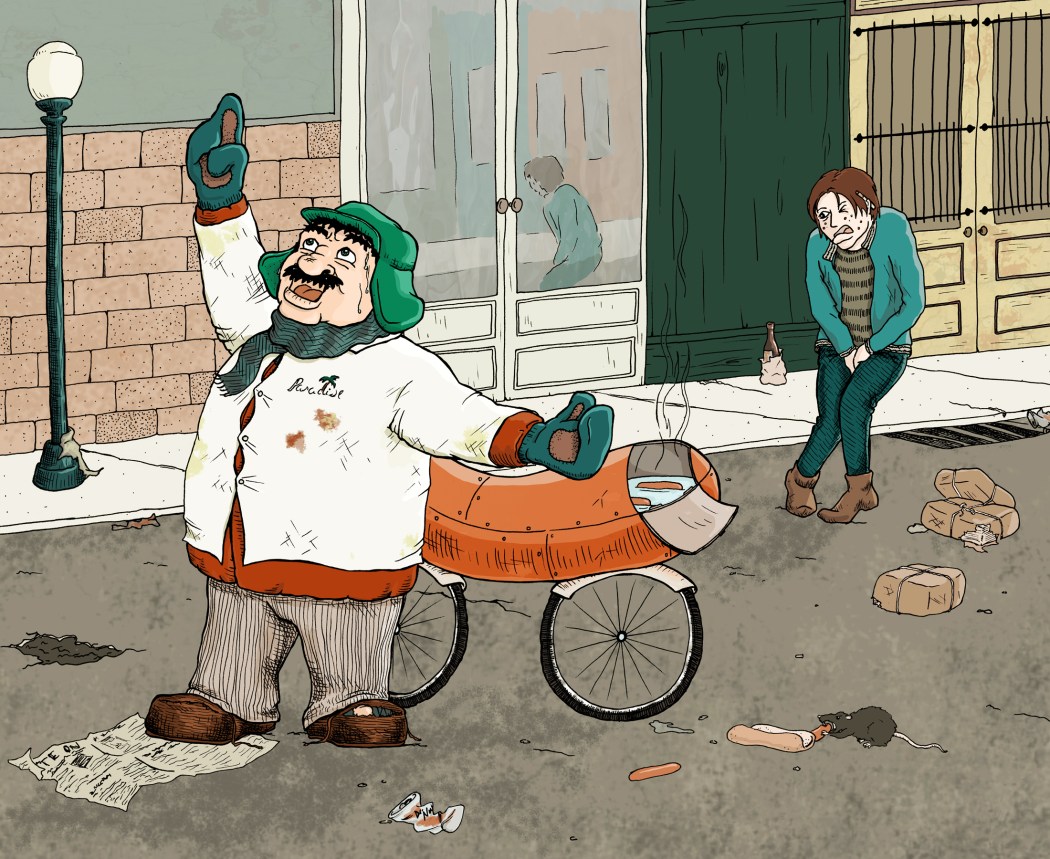
Image by Michelle Kondrich
If you would like to be among the first to learn about the exciting future of the Canadian Motion Picture Distribution Industry and how it will positively benefit the National Film Production Economy . . . You are cordially invited to attend the official mediAm launch presentation to be held at the Nat and Flora Bosa Centre for Film and Animation at Capilano University on September 24, 2013 between 7:00 & 9:00 PM. For more details about the event and some industry background discussion, see the mediAm Facebook page. This initiative is a practical instantiation of open systems and network theory as well as distributed knowledge and last but by no means least, in toto embodies the virtues of liberality I’ve dedicated my life to.

Gary Gutting weighs in on this discussion that I previously mentioned here.
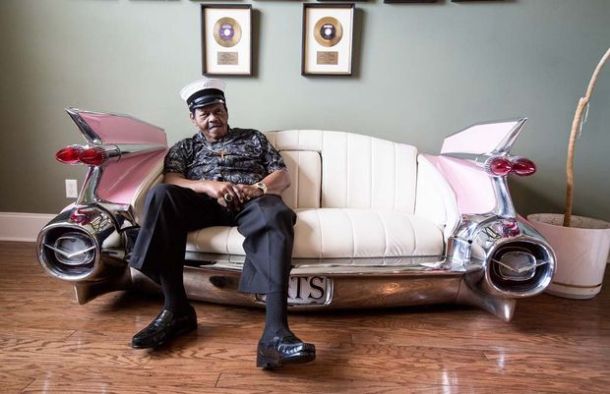
Music journalist Keith Spera reports on a very recent meeting between “Fats” and Irvin Mayfield. Love the Caddy couch!
“Of course it is a big deal to go to Fats Domino’s house,” he said later Wednesday evening. “Everything that’s great about New Orleans is in that house.
“As I was driving over, I was thinking that what makes New Orleans so great is not only the great music that has been created by so many people, but the fact that the personalities, and the people, are really of our town. This is his place. This is his city.”
Wynton Marsalis waxing philosophical about jazz. Despite the sour grapes one detects aimed at Wynton, he is without doubt the most naturally articulate spokesman for jazz and one of the most insightful thinker-practitioners within music generally – ask Simon Rattle or Eric Clapton.

Check out this discussion featuring Mark Rowlands on the possibility. Of course, Mark aside from being a preeminent extended mind philosopher has the unusual experience of having lived with a wolf for a decade.

This old review of Alan Mendelson’s Philo’s Jewish Identity validates the view that I’ve held since the mid-90s. That is, enabling us to see Philo as a proto-modern Jew.