Check out this collection — a “whose who” lineup with an amazing scope.

Check out this collection — a “whose who” lineup with an amazing scope.
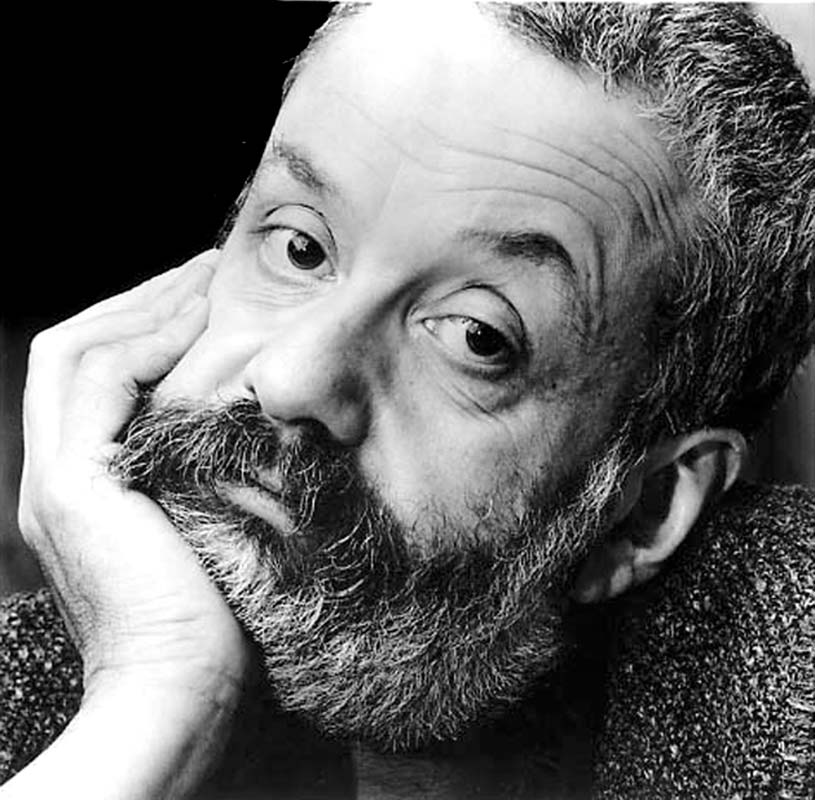
Speaking of the trials and tribulations of getting The Moviegoer to the screen, if ever there were someone who could do justice to the interior life, it is Mike Leigh. Regardless of his Englishness he has such a strong sense of place, and would therefore be ideal to undertake such a project.
AN ODD THING. Ever since Wednesday I have become acutely aware of Jews. There is a clue here, but of what I cannot say. How do I know? Because whenever I approach a Jew, the Geiger counter in my head starts rattling away like a machine gun; and as I go past with the utmost circumspection and with every sense alert—the Geiger counter subsides.
There is nothing new in my Jewish vibrations. During the years when I had friends my Aunt Edna, who is a theosophist, noticed that all my friends were Jews. She knew why moreover: I had been a Jew in a previous incarnation. Perhaps that is it. Anyhow it is true that I am Jewish by instinct. We share the same exile. The fact is, however, I am more Jewish than the Jews I know. They are more at home than I am. I accept my exile.
Another evidence of my Jewishness: the other day a sociologist reported that a significantly large percentage of solitary moviegoers are Jews.
Jews are my first real clue.
When a man is in despair and does not in his heart of hearts allow that a search is possible and when such a man passes a Jew in the street, he notices nothing.
When a man becomes a scientist or an artist, he is open to a different kind of despair. When such a man passes a Jew in the street, he may notice something but it is not a remarkable encounter. To him the Jew can only appear as a scientist or artist like himself or as a specimen to be studied.
But when a man awakes to the possibility of a search and when such a man passes a Jew in the street for the first time, he is like Robinson Crusoe seeing the footprint on the beach.

From the very excellent Eric Schliesser.

by Ron Shelton
A faithful but uncompelling translation of Percy’s novel to film is exactly what the world doesn’t need.
There are enough bad movies and precious few great novels. Let us allow that one of the signs of The Moviegoer’s greatness is that it cannot exist in any other form.
Binx Bolling was right. The movies always “screw it up.”

Though not particularly obvious “Soul Love” is to my mind the deepest song (and he’s had more than most) by Bowie (then aged 25) and by extension one of the most evocative of rock songs. It plays a pivotal role in the running order of arguably one of the greatest rock albums made and, of course, part of the catalogue of one of the longest genuinely creative runs in popular music — i.e. the Bowie of ’71-’80.
The lyrics
Stone love – she kneels before the grave
A brave son – who gave his life to see the slogan
That hovers between the headstone and her eyes
For they penetrate her grieving
New love – a boy and girl are talking
New words – that only they can share in
New words – a love so strong it tears their hearts
To sleep – through the fleeting hours of morning
Love is careless in it’s choosing – sweeping over ‘cross a baby
Love descends on those defenseless
Idiot love will spark the fusion
Inspirations have I none – just to touch the flaming dove
All I have is my love of love – and love is not loving
Soul love – the priest that tastes the word and
Told of love – and how my God on high is
All love – though reaching up my loneliness evolves
By the blindness that surrounds him
Love is careless in it’s choosing – sweeping over ‘cross a baby
Love descends on those defenseless
Idiot love will spark the fusion
Inspirations have I none – just to touch the flaming dove
All I have is my love of love – and love is not loving
This plausible interpretation of the song from Teenage Wildlife
Blatantly the most personal song on the album. Bowie dismisses the possibility of his own self being capable of love, but equally recognises the potency of love being a powerful force of inspiration in others. He starts by depicting the bond between mother and son, the child being a military recruitment killed in action for the ‘honour of the regiment, King and Country’ “Stone love, she kneels before the grave. A brave son who gave his life to save the slogan which hovers ‘tween the headstone and her eyes” There then follows the juxtaposition of this ‘dead love’ with the fresh romance of ‘boy meets girl’ and the innuendo’s that only such a pair would understand. “New words that only they can share in.” Bowie views love as a spirit/metaphysical force which descends indiscriminately, presenting this inspirational power upon the unprepared, sparking the fusion between one person and another. “Love is careless in it’s choosing, sweeping over cross a baby.” And Bowie, aware of his inability to feel love, professes his empathy to the word and the beneficial effect it has upon others. “All I have is my love of love-and love is not loving.” The final verse develops a thought of cynicism to the ‘love of God’. It is not that Bowie’s projected affection for the Christian deity is unrequited, moreover he cannot receive mutual feelings from those around, even when he lifts himself to the possibility of Gnostic beliefs he finds no reward. The inner desire of the soul, as related by “the priest who tastes the word”, and the prospect of a God on High being “all love” are dissolved, because his isolation and loneliness is a result of not lacking a god, but the oblivion such a god displays “though (by) reaching up my loneliness evolves by the blindness that surrounds him”.
Consequently, the chaos of the initial song expands to encompass a religious aspects mankind does have the ability and capability to love on a superficial level with the air of doom hanging above, but the love which god is believed to possess, apparently the greatest love of all, breeds discontent because of it’s inaccessibility.
The theme is not too dissimilar to Eleanor Rigby, Mac (aged 24) being the prime mover:
Though “Eleanor Rigby” was far from the first pop song to deal with death and loneliness, according to Ian MacDonald it “came as quite a shock to pop listeners in 1966”. It took a bleak message of depression and desolation, written by a famous pop band, with a sombre, almost funeral-like backing, to the number one spot of the pop charts. The bleak lyrics were not the Beatles’ first deviation from love songs, but were some of the most explicit.
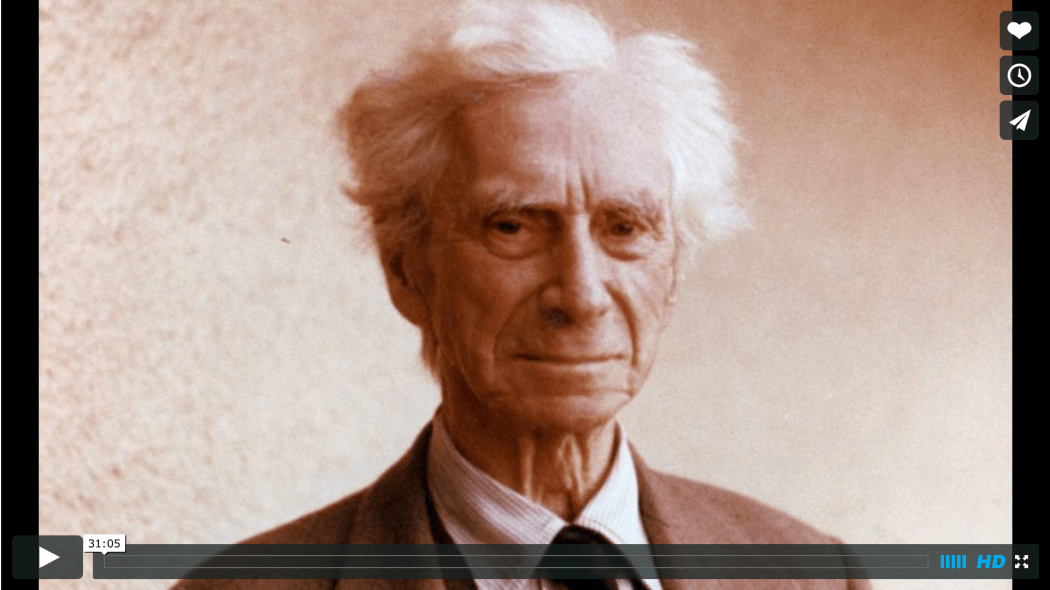
Speaking of Davidson, here is a two-parter from Stephen Neale (a Davidson expert) on Russell’s seminal paper “On Denoting” published in MIND in 1905 and the ensuing philosophical debate centred around it. “On Denoting” is arguably the most important philosophical paper of the 20th Century, a paper one has to tackle if one is trying to come to terms with Wittgenstein’s Tractatus (see Bertie’s intro below). Of course, by 1918 BR had pretty much handed the mantle to LW in his The Philosophy of Logical Atomism (Monist) — reprinted and freely available with an intro from the superb David Pears.
Pt: 1
Pt: 2
BY a “denoting phrase” I mean a phrase such as any one of the following: a man, some man, any man, every man, all men, the present King of England, the present King of France, the centre of mass of the Solar System at the first instant of the twentieth century, the revolution of the earth round the sun, the revolution of the sun round the earth. Thus a phrase is denoting solely in virtue of its form. We may distinguish three cases: (1) A phrase may be denoting, and yet not denote anything; e.g., “the present King of France”. (2) A phrase may denote one definite object; e.g., “the present King of England ” denotes a certain man. (3) A phrase may denote ambiguously; e.g., “a man” denotes not many men, but an ambiguous man. The interpretation of such phrases is a matter of considerable difficulty; indeed, it is very hard to frame any theory not susceptible of formal refutation. All the difficulties with which I am acquainted are met, so far as I can discover, by the theory which I am about to explain.
The subject of denoting is of very great importance, not only in logic and mathematics, but also in theory of knowledge. For example, we know that the centre of mass of the Solar System at a definite instant is some definite point, and we can affirm a number of propositions about it; but we have no immediate acquaintance with this point, which is only known to us by description. The distinction between acquaintance and knowledge about is the distinction between the things we have presentations of, and the things we only reach by means of denoting phrases. It often happens that we know that a certain phrase denotes unambiguously, although we have no acquaintance with what it denotes; this occurs in the above case of the centre of mass. In perception we have acquaintance with the objects of perception, and in thought we have acquaintance with objects of a more abstract logical character; but we do not necessarily have acquaintance with the objects denoted by phrases composed of words with whose meanings we are acquainted. To take a very important instance: There seems no reason to believe that we are ever acquainted with other people’s minds, seeing that these are not directly perceived; hence what we know about them is obtained through denoting. All thinking has to start from acquaintance; but it succeeds in thinking about many things with which we have no acquaintance.
. . .
Of the many other consequences of the view I have been advocating, I will say nothing. I will only beg the reader not to make up his mind against the view-as he might be tempted to do, on account of its apparently excessive complication – until he has attempted to construct a theory of his own on the subject of denotation. This attempt, I believe, will convince him that, whatever the true theory may be, it cannot have such a simplicity as one might have expected beforehand.
************
Mr Wittgenstein’s Tractatus Logico-Philosophicus, whether or not it prove to give the ultimate truth on the matters with which it deals, certainly deserves, by its breadth and scope and profundity, to be considered an important event in the philosophical world. Starting from the principles of Symbolism and the relations which are necessary between words and things in any language, it applies the result of this inquiry to various departments of traditional philosophy, showing in each case how traditional philosophy and traditional solutions arise out of ignorance of the principles of Symbolism and out of misuse of language.
The logical structure of propositions and the nature of logical inference are first dealt with. Thence we pass successively to Theory of Knowledge, Principles of Physics, Ethics, and finally the Mystical (das Mystische ).
In order to understand Mr Wittgenstein’s book, it is necessary to realize what is the problem with which he is concerned. In the part of his theory which deals with Symbolism he is concerned with the conditions which would have to be fulfilled by a logically perfect language. There are various problems as regards language. First, there is the problem what actually occurs in our minds when we use language with the intention of meaning something by it; this problem belongs to psychology. Secondly, there is the problem as to what is the relation subsisting between thoughts, words, or sentences, and that which they refer to or mean; this problem belongs to epistemology. Thirdly, there is the problem of using sentences so as to convey truth rather than falsehood; this belongs to the special sciences dealing with the subject-matter of the sentences in question. Fourthly, there is the question: what relation must one fact (such as a sentence) have to another in order to be capable of being a symbol for that other? This last is a logical question, and is the one with which Mr Wittgenstein is concerned. He is concerned with the conditions for accurate Symbolism, i.e. for Symbolism in which a sentence “means” something quite definite. In practice, language is always more or less vague, so that what we assert is never quite precise. Thus, logic has two problems to deal with in regard to Symbolism: (1) the conditions for sense rather than nonsense in combinations of symbols; (2) the conditions for uniqueness of meaning or reference in symbols or combinations of symbols. A logically perfect language has rules of syntax which prevent nonsense, and has single symbols which always have a definite and unique meaning. Mr Wittgenstein is concerned with the conditions for a logically perfect language—not that any language is logically perfect, or that we believe ourselves capable, here and now, of constructing a logically perfect language, but that the whole function of language is to have meaning, and it only fulfils this function in proportion as it approaches to the ideal language which we postulate.
The essential business of language is to assert or deny facts. Given the syntax of a language, the meaning of a sentence is determinate as soon as the meaning of the component words is known. In order that a certain sentence should assert a certain fact there must, however the language may be constructed, be something in common between the structure of the sentence and the structure of the fact. This is perhaps the most fundamental thesis of Mr Wittgenstein’s theory. That which has to be in common between the sentence and the fact cannot, so he contends, be itself in turn said in language. It can, in his phraseology, only be shown, not said, for whatever we may say will still need to have the same structure.
The first requisite of an ideal language would be that there should be one name for every simple, and never the same name for two different simples. A name is a simple symbol in the sense that it has no parts which are themselves symbols. In a logically perfect language nothing that is not simple will have a simple symbol. The symbol for the whole will be a “complex,” containing the symbols for the parts. In speaking of a “complex” we are, as will appear later, sinning against the rules of philosophical grammar, but this is unavoidable at the outset. “Most propositions and questions that have been written about philosophical matters are not false but senseless. We cannot, therefore, answer questions of this kind at all, but only state their senselessness. Most questions and propositions of the philosophers result from the fact that we do not understand the logic of our language. They are of the same kind as the question whether the Good is more or less identical than the Beautiful” (4.003). What is complex in the world is a fact. Facts which are not compounded of other facts are what Mr Wittgenstein calls Sachverhalte, whereas a fact which may consist of two or more facts is called a Tatsache: thus, for example, “Socrates is wise” is a Sachverhalt, as well as a Tatsache, whereas “Socrates is wise and Plato is his pupil” is a Tatsache but not a Sachverhalt.
He compares linguistic expression to projection in geometry. A geometrical figure may be projected in many ways: each of these ways corresponds to a different language, but the projective properties of the original figure remain unchanged whichever of these ways may be adopted. These projective properties correspond to that which in his theory the proposition and the fact must have in common, if the proposition is to assert the fact.
In certain elementary ways this is, of course, obvious. It is impossible, for example, to make a statement about two men (assuming for the moment that the men may be treated as simples), without employing two names, and if you are going to assert a relation between the two men it will be necessary that the sentence in which you make the assertion shall establish a relation between the two names. If we say “Plato loves Socrates,” the word “loves” which occurs between the word “Plato” and the word “Socrates” establishes a certain relation between these two words, and it is owing to this fact that our sentence is able to assert a relation between the person’s name by the words “Plato” and “Socrates.” “We must not say, the complex sign ‘aRb’ says ‘a stands in a certain relation R to b’; but we must say, that ‘a’ stands in a certain relation to ‘b’ says that aRb” (3.1432).
Mr Wittgenstein begins his theory of Symbolism with the statement (2.1): “We make to ourselves pictures of facts.” A picture, he says, is a model of the reality, and to the objects in the reality correspond the elements of the picture: the picture itself is a fact. The fact that things have a certain relation to each other is represented by the fact that in the picture its elements have a certain relation to one another. “In the picture and the pictured there must be something identical in order that the one can be a picture of the other at all. What the picture must have in common with reality in order to be able to represent it after its manner—rightly or falsely—is its form of representation” (2.161, 2.17).
We speak of a logical picture of a reality when we wish to imply only so much resemblance as is essential to its being a picture in any sense, that is to say, when we wish to imply no more than identity of logical form. The logical picture of a fact, he says, is a Gedanke. A picture can correspond or not correspond with the fact and be accordingly true or false, but in both cases it shares the logical form with the fact. The sense in which he speaks of pictures is illustrated by his statement: “The gramophone record, the musical thought, the score, the waves of sound, all stand to one another in that pictorial internal relation which holds between language and the world. To all of them the logical structure is common. (Like the two youths, their two horses and their lilies in the story. They are all in a certain sense one)” (4.014). The possibility of a proposition representing a fact rests upon the fact that in it objects are represented by signs. The so-called logical “constants” are not represented by signs, but are themselves present in the proposition as in the fact. The proposition and the fact must exhibit the same logical “manifold,” and this cannot be itself represented since it has to be in common between the fact and the picture. Mr Wittgenstein maintains that everything properly philosophical belongs to what can only be shown, to what is in common between a fact and its logical picture. It results from this view that nothing correct can be said in philosophy. Every philosophical proposition is bad grammar, and the best that we can hope to achieve by philosophical discussion is to lead people to see that philosophical discussion is a mistake. “Philosophy is not one of the natural sciences. (The word ‘philosophy’ must mean something which stands above or below, but not beside the natural sciences.) The object of philosophy is the logical clarification of thoughts. Philosophy is not a theory but an activity. A philosophical work consists essentially of elucidations. The result of philosophy is not a number of ‘philosophical propositions,’ but to make propositions clear. Philosophy should make clear and delimit sharply the thoughts which otherwise are, as it were, opaque and blurred” (4.111 and 4.112). In accordance with this principle the things that have to be said in leading the reader to understand Mr Wittgenstein’s theory are all of them things which that theory itself condemns as meaningless. With this proviso we will endeavour to convey the picture of the world which seems to underlie his system.
The world consists of facts: facts cannot strictly speaking be defined, but we can explain what we mean by saying that facts are what make propositions true, or false. Facts may contain parts which are facts or may contain no such parts; for example: “Socrates was a wise Athenian,” consists of the two facts, “Socrates was wise,” and “Socrates was an Athenian.” A fact which has no parts that are facts is called by Mr Wittgenstein a Sachverhalt. This is the same thing that he calls an atomic fact. An atomic fact, although it contains no parts that are facts, nevertheless does contain parts. If we may regard “Socrates is wise” as an atomic fact we perceive that it contains the constituents “Socrates” and “wise.” If an atomic fact is analysed as fully as possible (theoretical, not practical possibility is meant) the constituents finally reached may be called “simples” or “objects.” It is not contended by Wittgenstein that we can actually isolate the simple or have empirical knowledge of it. It is a logical necessity demanded by theory, like an electron. His ground for maintaining that there must be simples is that every complex presupposes a fact. It is not necessarily assumed that the complexity of facts is finite; even if every fact consisted of an infinite number of atomic facts and if every atomic fact consisted of an infinite number of objects there would still be objects and atomic facts (4.2211). The assertion that there is a certain complex reduces to the assertion that its constituents are related in a certain way, which is the assertion of a fact: thus if we give a name to the complex the name only has meaning in virtue of the truth of a certain proposition, namely the proposition asserting the relatedness of the constituents of the complex. Thus the naming of complexes presupposes propositions, while propositions presupposes the naming of simples. In this way the naming of simples is shown to be what is logically first in logic.
The world is fully described if all atomic facts are known, together with the fact that these are all of them. The world is not described by merely naming all the objects in it; it is necessary also to know the atomic facts of which these objects are constituents. Given this total of atomic facts, every true proposition, however complex, can theoretically be inferred. A proposition (true or false) asserting an atomic fact is called an atomic proposition. All atomic propositions are logically independent of each other. No atomic proposition implies any other or is inconsistent with any other. Thus the whole business of logical inference is concerned with propositions which are not atomic. Such propositions may be called molecular.
Wittgenstein’s theory of molecular propositions turns upon his theory of the construction of truth-functions.
A truth-function of a proposition p is a proposition containing p and such that its truth or falsehood depends only upon the truth or falsehood of p, and similarly a truth-function of several propositions p, q, r…is one containing p, q, r…and such that its truth or falsehood depends only upon the truth or falsehood of p, q, r… It might seem at first sight as though there were other functions of propositions besides truth- functions; such, for example, would be “A believes p,” for in general A will believe some true propositions and some false ones: unless he is an exceptionally gifted individual, we cannot infer that p is true from the fact that he believes it or that p is false from the fact that he does not believe it. Other apparent exceptions would be such as “p is a very complex proposition” or “p is a proposition about Socrates.” Mr Wittgenstein maintains, however, for reasons which will appear presently, that such exceptions are only apparent, and that every function of a proposition is really a truth-function. It follows that if we can define truth-functions generally, we can obtain a general definition of all propositions in terms of the original set of atomic propositions. This Wittgenstein proceeds to do.
It has been shown by Dr Sheffer (Trans. Am. Math. Soc., Vol. XIV. pp. 481–488) that all truth-functions of a given set of propositions can be constructed out of either of the two functions “not-p or not-q” or “not-p and not-q.” Wittgenstein makes use of the latter, assuming a knowledge of Dr Sheffer’s work. The manner in which other truth-functions are constructed out of “not-p and not-q” is easy to see. “Not-p and not-p” is equivalent to “not-p,” hence we obtain a definition of negation in terms of our primitive function: hence we can define “p or q,” since this is the negation of “not-p and not-q,” i.e. of our primitive function. The development of other truth-functions out of “not-p” and “p or q” is given in detail at the beginning of Principia Mathematica. This gives all that is wanted when the propositions which are arguments to our truth-function are given by enumeration. Wittgenstein, however, by a very interesting analysis succeeds in extending the process to general propositions, i.e. to cases where the propositions which are arguments to our truth-function are not given by enumeration but are given as all those satisfying some condition. For example, let fx be a propositional function (i.e. a function whose values are propositions), such as “x is human”—then the various values of fx form a set of propositions. We may extend the idea “not-p and not-q” so as to apply to simultaneous denial of all the propositions which are values of fx. In this way we arrive at the proposition which is ordinarily represented in mathematical logic by the words “fx is false for all values of x.” The negation of this would be the proposition “there is at least one x for which fx is true” which is represented by “(∃x).fx.” If we had started with not-fx instead of fx we should have arrived at the proposition “fx is true for all values of x” which is represented by “(x).fx.” Wittgenstein’s method of dealing with general propositions [i.e. “(x) . fx” and “(∃x) . fx”] differs from previous methods by the fact that the generality comes only in specifying the set of propositions concerned, and when this has been done the building up of truth-functions proceeds exactly as it would in the case of a finite number of enumerated arguments p, q, r….
Mr Wittgenstein’s explanation of his symbolism at this point is not quite fully given in the text. The symbol he uses is (p, ξ, N (ξ)). The following is the explanation of this symbol:
p stands for all atomic propositions.
ξ stands for any set of propositions.
N(ξ) stands for the negation of all the propositions making up ξ.The whole symbol (p,ξ,N(ξ)) means whatever can be obtained by taking any selection of atomic propositions, negating them all, then taking any selection of the set of propositions now obtained, together with any of the originals—and so on indefinitely. This is, he says, the general truth-function and also the general form of proposition. What is meant is somewhat less complicated than it sounds. The symbol is intended to describe a process by the help of which, given the atomic propositions, all others can be manufactured. The process depends upon:
(a) Sheffer’s proof that all truth-functions can be obtained out of simultaneous negation, i.e. out of “not-p and not-q”;
(b) Mr Wittgenstein’s theory of the derivation of general propositions from conjunctions and disjunctions;
(c) The assertion that a proposition can only occur in another proposition as argument to a truth-function. Given these three foundations, it follows that all propositions which are not atomic can be derived from such as are, by a uniform process, and it is this process which is indicated by Mr Wittgenstein’s symbol.
From this uniform method of construction we arrive at an amazing simplification of the theory of inference, as well as a definition of the sort of propositions that belong to logic. The method of generation which has just been described, enables Wittgenstein to say that all propositions can be constructed in the above manner from atomic propositions, and in this way the totality of propositions is defined. (The apparent exceptions which we mentioned above are dealt with in a manner which we shall consider later.) Wittgenstein is enabled to assert that propositions are all that follows from the totality of atomic propositions (together with the fact that it is the totality of them); that a proposition is always a truth-function of atomic propositions; and that if p follows from q the meaning of p is contained in the meaning of q, from which of course it results that nothing can be deduced from an atomic proposition. All the propositions of logic, he maintains, are tautologies, such, for example, as “p or not p.”
The fact that nothing can be deduced from an atomic proposition has interesting applications, for example, to causality. There cannot, in Wittgenstein’s logic, be any such thing as a causal nexus. “The events of the future,” he says, “cannot be inferred from those of the present. Superstition is the belief in the causal nexus.” That the sun will rise tomorrow is a hypothesis. We do not in fact know whether it will rise, since there is no compulsion according to which one thing must happen because another happens.
Let us now take up another subject—that of names. In Wittgenstein’s theoretical logical language, names are only given to simples. We do not give two names to one thing, or one name to two things. There is no way whatever, according to him, by which we can describe the totality of things that can be named, in other words, the totality of what there is in the world. In order to be able to do this we should have to know of some property which must belong to every thing by a logical necessity. It has been sought to find such a property in self-identity, but the conception of identity is subjected by Wittgenstein to a destructive criticism from which there seems no escape. The definition of identity by means of the identity of indiscernibles is rejected, because the identity of indiscernibles appears to be not a logically necessary principle. According to this principle x is identical with y if every property of x is a property of y, but it would, after all, be logically possible for two things to have exactly the same properties. If this does not in fact happen that is an accidental characteristic of the world, not a logically necessary characteristic, and accidental characteristics of the world must, of course, not be admitted into the structure of logic. Mr Wittgenstein accordingly banishes identity and adopts the convention that different letters are to mean different things. In practice, identity is needed as between a name and a description or between two descriptions. It is needed for such propositions as “Socrates is the philosopher who drank the hemlock,” or “The even prime is the next number after 1.” For such uses of identity it is easy to provide on Wittgenstein’s system.
The rejection of identity removes one method of speaking of the totality of things, and it will be found that any other method that may be suggested is equally fallacious: so, at least, Wittgenstein contends and, I think, rightly. This amounts to saying that “object” is a pseudo-concept. To say “x is an object” is to say nothing. It follows from this that we cannot make such statements as “there are more than three objects in the world,” or “there are an infinite number of objects in the world.” Objects can only be mentioned in connexion with some definite property. We can say “there are more than three objects which are human,” or “there are more than three objects which are red,” for in these statements the word object can be replaced by a variable in the language of logic, the variable being one which satisfies in the first case the function “x is human”; in the second the function “x is red.” But when we attempt to say “there are more than three objects,” this substitution of the variable for the word “object” becomes impossible, and the proposition is therefore seen to be meaningless.
We here touch one instance of Wittgenstein’s fundamental thesis, that it is impossible to say anything about the world as a whole, and that whatever can be said has to be about bounded portions of the world. This view may have been originally suggested by notation, and if so, that is much in its favour, for a good notation has a subtlety and suggestiveness which at times make it seem almost like a live teacher. Notational irregularities are often the first sign of philosophical errors, and a perfect notation would be a substitute for thought. But although notation may have first suggested to Mr Wittgenstein the limitation of logic to things within the world as opposed to the world as a whole, yet the view, once suggested, is seen to have much else to recommend it. Whether it is ultimately true I do not, for my part, profess to know. In this Introduction I am concerned to expound it, not to pronounce upon it. According to this view we could only say things about the world as a whole if we could get outside the world, if, that is to say, it ceased to be for us the whole world. Our world may be bounded for some superior being who can survey it from above, but for us, however finite it may be, it cannot have a boundary, since it has nothing outside it. Wittgenstein uses, as an analogy, the field of vision. Our field of vision does not, for us, have a visual boundary, just because there is nothing outside it, and in like manner our logical world has no logical boundary because our logic knows of nothing outside it. These considerations lead him to a somewhat curious discussion of Solipsism. Logic, he says, fills the world. The boundaries of the world are also its boundaries. In logic, therefore, we cannot say, there is this and this in the world, but not that, for to say so would apparently presuppose that we exclude certain possibilities, and this cannot be the case, since it would require that logic should go beyond the boundaries of the world as if it could contemplate these boundaries from the other side also. What we cannot think we cannot think, therefore we also cannot say what we cannot think.
This, he says, gives the key to Solipsism. What Solipsism intends is quite correct, but this cannot be said, it can only be shown. That the world is my world appears in the fact that the boundaries of language (the only language I understand) indicate the boundaries of my world. The metaphysical subject does not belong to the world but is a boundary of the world.
We must take up next the question of molecular propositions which are at first sight not truth-functions, of the propositions that they contain, such, for example, as “A believes p.”
Wittgenstein introduces this subject in the statement of his position, namely, that all molecular functions are truth-functions. He says (5.54): “In the general propositional form, propositions occur in a proposition only as bases of truth-operations.” At first sight, he goes on to explain, it seems as if a proposition could also occur in other ways, e.g. “A believes p.” Here it seems superficially as if the proposition p stood in a sort of relation to the object A. “But it is clear that ‘A believes that p,’ ‘A thinks p,’ ‘A says p’ are of the form ‘p says p’; and here we have no coordination of a fact and an object, but a coordination of facts by means of a coordination of their objects” (5.542).
What Mr Wittgenstein says here is said so shortly that its point is not likely to be clear to those who have not in mind the controversies with which he is concerned. The theory with which he is disagreeing will be found in my articles on the nature of truth and falsehood in Philosophical Essays and Proceedings of the Aristotelian Society, 1906–7. The problem at issue is the problem of the logical form of belief, i.e. what is the schema representing what occurs when a man believes. Of course, the problem applies not only to belief, but also to a host of other mental phenomena which may be called propositional attitudes: doubting, considering, desiring, etc. In all these cases it seems natural to express the phenomenon in the form “A doubts p,” “A desires p,” etc., which makes it appear as though we were dealing with a relation between a person and a proposition. This cannot, of course, be the ultimate analysis, since persons are fictions and so are propositions, except in the sense in which they are facts on their own account. A proposition, considered as a fact on its own account, may be a set of words which a man says over to himself, or a complex image, or train of images passing through his mind, or a set of incipient bodily movements. It may be any one of innumerable different things. The proposition as a fact on its own account, for example the actual set of words the man pronounces to himself, is not relevant to logic. What is relevant to logic is that common element among all these facts, which enables him, as we say, to mean the fact which the proposition asserts. To psychology, of course, more is relevant; for a symbol does not mean what it symbolizes in virtue of a logical relation alone, but in virtue also of a psychological relation of intention, or association, or what-not. The psychological part of meaning, however, does not concern the logician. What does concern him in this problem of belief is the logical schema. It is clear that, when a person believes a proposition, the person, considered as a metaphysical subject, does not have to be assumed in order to explain what is happening. What has to be explained is the relation between the set of words which is the proposition considered as a fact on its own account, and the “objective” fact which makes the proposition true or false. This reduces ultimately to the question of the meaning of propositions, that is to say, the meaning of propositions is the only non-psychological portion of the problem involved in the analysis of belief. This problem is simply one of a relation of two facts, namely, the relation between the series of words used by the believer and the fact which makes these words true or false. The series of words is a fact just as much as what makes it true or false is a fact. The relation between these two facts is not unanalysable, since the meaning of a proposition results from the meaning of its constituent words. The meaning of the series of words which is a proposition is a function of the meanings of the separate words. Accordingly, the proposition as a whole does not really enter into what has to be explained in explaining the meaning of a proposition. It would perhaps help to suggest the point of view which I am trying to indicate, to say that in the cases we have been considering the proposition occurs as a fact, not as a proposition. Such a statement, however, must not be taken too literally. The real point is that in believing, desiring, etc., what is logically fundamental is the relation of a proposition considered as a fact, to the fact which makes it true or false, and that this relation of two facts is reducible to a relation of their constituents. Thus the proposition does not occur at all in the same sense in which it occurs in a truth-function.
There are some respects, in which, as it seems to me, Mr Wittgenstein’s theory stands in need of greater technical development. This applies in particular to his theory of number (6.02 ff.) which, as it stands, is only capable of dealing with finite numbers. No logic can be considered adequate until it has been shown to be capable of dealing with transfinite numbers. I do not think there is anything in Mr Wittgenstein’s system to make it impossible for him to fill this lacuna.
More interesting than such questions of comparative detail is Mr Wittgenstein’s attitude towards the mystical. His attitude upon this grows naturally out of his doctrine in pure logic, according to which the logical proposition is a picture (true or false) of the fact, and has in common with the fact a certain structure. It is this common structure which makes it capable of being a picture of the fact, but the structure cannot itself be put into words, since it is a structure of words, as well as of the facts to which they refer. Everything, therefore, which is involved in the very idea of the expressiveness of language must remain incapable of being expressed in language, and is, therefore, inexpressible in a perfectly precise sense. This inexpressible contains, according to Mr Wittgenstein, the whole of logic and philosophy. The right method of teaching philosophy, he says, would be to confine oneself to propositions of the sciences, stated with all possible clearness and exactness, leaving philosophical assertions to the learner, and proving to him, whenever he made them, that they are meaningless. It is true that the fate of Socrates might befall a man who attempted this method of teaching, but we are not to be deterred by that fear, if it is the only right method. It is not this that causes some hesitation in accepting Mr Wittgenstein’s position, in spite of the very powerful arguments which he brings to its support. What causes hesitation is the fact that, after all, Mr Wittgenstein manages to say a good deal about what cannot be said, thus suggesting to the sceptical reader that possibly there may be some loophole through a hierarchy of languages, or by some other exit. The whole subject of ethics, for example, is placed by Mr Wittgenstein in the mystical, inexpressible region. Nevertheless he is capable of conveying his ethical opinions. His defence would be that what he calls the mystical can be shown, although it cannot be said. It may be that this defence is adequate, but, for my part, I confess that it leaves me with a certain sense of intellectual discomfort.
There is one purely logical problem in regard to which these difficulties are peculiarly acute. I mean the problem of generality. In the theory of generality it is necessary to consider all propositions of the form fx where fx is a given propositional function. This belongs to the part of logic which can be expressed, according to Mr Wittgenstein’s system. But the totality of possible values of x which might seem to be involved in the totality of propositions of the form fx is not admitted by Mr Wittgenstein among the things that can be spoken of, for this is no other than the totality of things in the world, and thus involves the attempt to conceive the world as a whole; “the feeling of the world as a bounded whole is the mystical”; hence the totality of the values of x is mystical (6.45). This is expressly argued when Mr Wittgenstein denies that we can make propositions as to how many things there are in the world, as for example, that there are more than three.
These difficulties suggest to my mind some such possibility as this: that every language has, as Mr Wittgenstein says, a structure concerning which, in the language, nothing can be said, but that there may be another language dealing with the structure of the first language, and having itself a new structure, and that to this hierarchy of languages there may be no limit. Mr Wittgenstein would of course reply that his whole theory is applicable unchanged to the totality of such languages. The only retort would be to deny that there is any such totality. The totalities concerning which Mr Wittgenstein holds that it is impossible to speak logically are nevertheless thought by him to exist, and are the subject-matter of his mysticism. The totality resulting from our hierarchy would be not merely logically inexpressible, but a fiction, a mere delusion, and in this way the supposed sphere of the mystical would be abolished. Such an hypothesis is very difficult, and I can see objections to it which at the moment I do not know how to answer. Yet I do not see how any easier hypothesis can escape from Mr Wittgenstein’s conclusions. Even if this very difficult hypothesis should prove tenable, it would leave untouched a very large part of Mr Wittgenstein’s theory, though possibly not the part upon which he himself would wish to lay most stress. As one with a long experience of the difficulties of logic and of the deceptiveness of theories which seem irrefutable, I find myself unable to be sure of the rightness of a theory, merely on the ground that I cannot see any point on which it is wrong. But to have constructed a theory of logic which is not at any point obviously wrong is to have achieved a work of extraordinary difficulty and importance. This merit, in my opinion, belongs to Mr Wittgenstein’s book, and makes it one which no serious philosopher can afford to neglect.
I met DD very briefly at the LSE in the early 90s. Putnam had recently filled the Peacock Theatre and I expected that since DD was to be there that he would fill the auditorium easily. Oddly enough, the event was held in a small seminar room in the warren that LSE is and was severely oversubscribed. Knowing that one the great names was to be there WTF were they thinking? Jennifer Hornsby did a good job of trying to bring some decorum to the ridiculously crammed room. One of the things that stuck in my mind was that someone asked DD about what some commentator had said and he replied something along the lines that he can’t keep track of what others have attributed to him.
Stanford Encyclopedia of Philosophy

Born on this day (7th)

“You must stop all of this,” Ignatius shouted to Dorian, who was winking at the cowboy. “Aside from the fact that I am witnessing a most egregious offense against taste and decency, I am also beginning to smother from the stench of glandular emissions and cologne.”
“Oh, don’t be so drab. They’re just having fun.”
I am very sorry,” Ignatius said in a businesslike tone. “I am here tonight on a mission of the utmost seriousness. There is a girl who must be attended to, a bold and forward minx of a trollop. Now turn off that offensive music and quiet these sodomites. We must get down to brass tacks.”
“I thought you were going to be fun. If you’re just going to be tacky and dreary, then you’d better leave.”
“I shall not leave! No one can deter me. Peace! Peace! Peace!”
“Oh, dear. You are serious about this, aren’t you?”
. . .
Ignatius’ valve responded to his emotions by plopping closed. His hands sympathized by sprouting a rich growth of tiny white bumps that itched maddeningly. What could he tell Myrna about the movement for peace now? Now, like the abortive Crusade for Moorish Dignity, he had another debacle on his itching hands. Fortuna, that vicious slut. The evening had hardly begun; he couldn’t return to Constantinople Street and a variety of assaults from his mother, not now that his emotions had been stimulated toward a climax that had been snatched from his grasp. For almost a week he had been preoccupied with the kickoff rally, and now, ejected from the political arena by three dubious girls, he stood frustrated and furious on the damp flagstones of St. Peter Street.