Roger stylishly and lucidly outlines the timelessness of The Ring’s significance — especially salient to our troubled current times.
Roger stylishly and lucidly outlines the timelessness of The Ring’s significance — especially salient to our troubled current times.
H/T to Simon Garnier: Slime molds don’t look like much. Amorphous and gloppy, they spread across the forest floor in a mindless quest to consume whatever lies in their path. But research scientists are now learning that the routes slime molds take through their environment are anything but random. Despite their lack of a brain—or even a neuron—these organisms have evolved a very clever, physical way of making decisions about where to go to find the best food sources. Because slime molds move so slowly (just a few centimeters a day), it’s necessary to speed up time to truly understand their complex behaviors. Simon Garnier and his team at the New Jersey Institute of Technology’s SwarmLab use time-lapse macrophotography in their research, and with these techniques are beginning to unravel the nature of these organisms’ “brainless intelligence.” By better understanding how slime molds move and make decisions, Garnier’s team hopes to shed light on how intelligence may have evolved in the first place.


The only mystery is that nothing changes. Nothing really happens. Marriages, births, deaths, terrible wars had occurred but had changed nothing. War is not a change but a poor attempt to make a change. War and peace are not events.
*****
And, strange to say, at the very moment of his remembering the distant past, the meaning of his present life became clear to him, instantly and without the least surprise as if he had known it all along but had not until now taken the trouble to know that he knew.
*****
Yes, I did all that and succeeded in everything except believing in the Christian God—maybe you were right about one thing after all—what’s more even beat you, made more money, wrote a law book, won an honorary degree, listened to better music.
Now Marion is dead and I can’t believe I spent all those years in New York in Trusts and Estates and taking dogs down elevators and out to the park to take a crap.
In two seconds he saw that his little Yankee life had not worked after all, the nearly twenty years of making a life with a decent upstate woman and with decent Northern folk and working in an honorable Wall Street firm and making a success of it too. The whole twenty years could just as easily have been a long night’s dream, and here he was in old Carolina, thinking of Ethel Rosenblum and having fits and falling down on the golf course—what in God’s name was I doing there, and am I doing here?
*****
After you make a living, then what do you do? How do you live?
*****
But maybe he’s right, and it’s one way to keep from going nutty, but maybe there’s something nutty too about an Englishman puttering about his mums while the sceptered isle slowly sinks into the sea.

What was my (your, our) discovery? That I could act. I was free to act. Is this something everyone knows or thinks he knows or, if he knows, knows in the wrong way? With gold-tinted corneas everything looks like gold but it’s fool’s gold.
Here was the kind of gold-tinted corneas I had: Dr. Duk told me many times I should be free to act for myself. I believed him. Just as I believed him when he suggested I take up bird-watching. So, clever straight-A student that I was, I set forth to act for myself. Which, of course, is not doing so at all. I was following instructions. Then how does one ever make the discovery that one can actually be free to act for oneself? I don’t know. I don’t even know how many people, if any, do it.
*****
Perhaps the secret of talking was to have something to say.
*****
He had come to see it as an emblem of his life, a small failure at living, a minor deceit, perhaps even a sin.
*****
Was there an unspoken understanding between all of them that what they were doing, knocking little balls around a mountain meadow while the fitful wind bustled about high above them, was after all preposterous but that they had all assented to it and were doing it nevertheless and because, after all, why not? One might as well do one thing as another.
The great Bernard Lewis is 100! Two pieces are worth reading: his essay The New Anti-Semitism and a review of Lewis’ memoir from whence the quotes below are from. The regressive left is in denial that at most Edward Said’s Orientalism is only making a socio-psychological claim about all self-conscious cultures and not as he would have us believe that only occidental cultures are inherently imperialistic. The Chinese, Japanese and Moorish conquests are obvious counter-examples.
Academic criticism of Lewis’ work came overwhelmingly from the left, starting with Edward Said’s 1978 polemic Orientalism, “in which,” Lewis writes, “Said imputed to Orientalists a sinister role as part of the imperialist domination and exploitation of the Islamic world by the West. In particular, he imputed to me an especially sinister role as what he called the leader of the Orientalists.” With a few strokes in this present book, Lewis severs Said’s head and holds it up to show that it is empty.
. . .
His earliest writings, he concedes, betrayed a Marxist influence—what he calls his own intellectual version of “measles and chicken pox,” a juvenile disease he outgrew in time.

Most will know of Charles Bradley (a thorough mensch) through the documentary Soul of America. I’ve been listening closely to his excellent three albums No Time For Dreaming, Victim of Love, and Changes but have come to the view that his best is yet to come. The latest features a cover of Black Sabbath’s “Changes” and even has Charles doing an Ozzie pose from the Black Sabbath 4 album cover. Though this great little label Daptone Records have done a superb job of, for the most part “de-James Browning” Charles, I’d like to see him move to a more psychedelic soul style for his next album. Speaking of acid funk/soul, Charles would be an ideal “replacement” for Gean West of The Relatives. At the very least it could be an interesting experiment.

“Always allow 18 inches between chair and furniture . . .” (21:41 — 24:28: here the distinction and value between enterprise association and civil association gets profoundly disregarded). This mentality (30:53-31:50) has been institutionalized within the academy and the intelligentsia at large. From 33:28 your day begins . . . “terrified by towels”. “Trade was all about the great and the good from one country signing a treaty with the great and the good of another country . . . but real life is starting to leave that behind.”
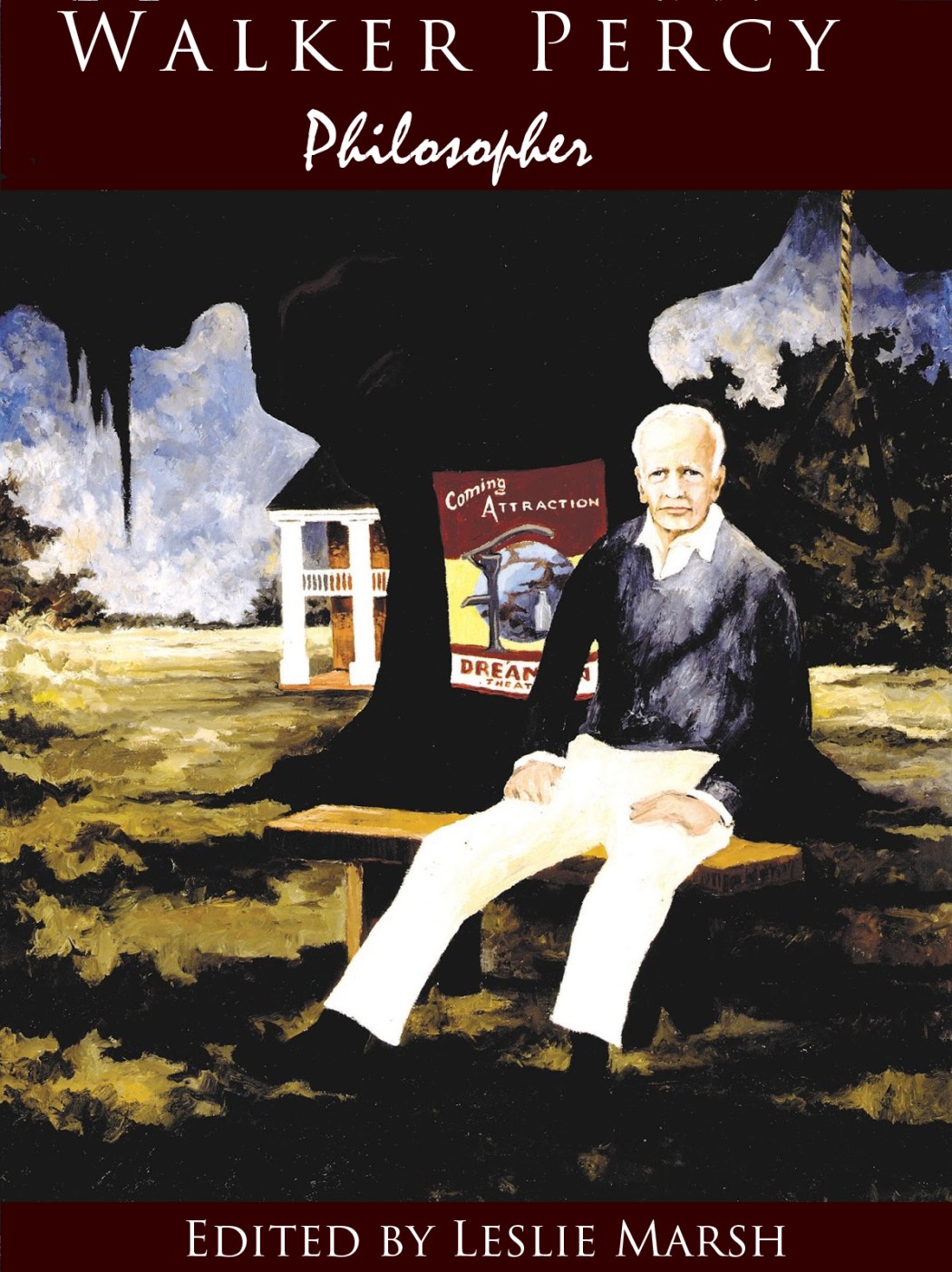
May 28th marks the centenary of Walker Percy’s birth. Here is the first public announcement of this work-in-progress for Louisiana State University Press to commemorate Percy’s birth.
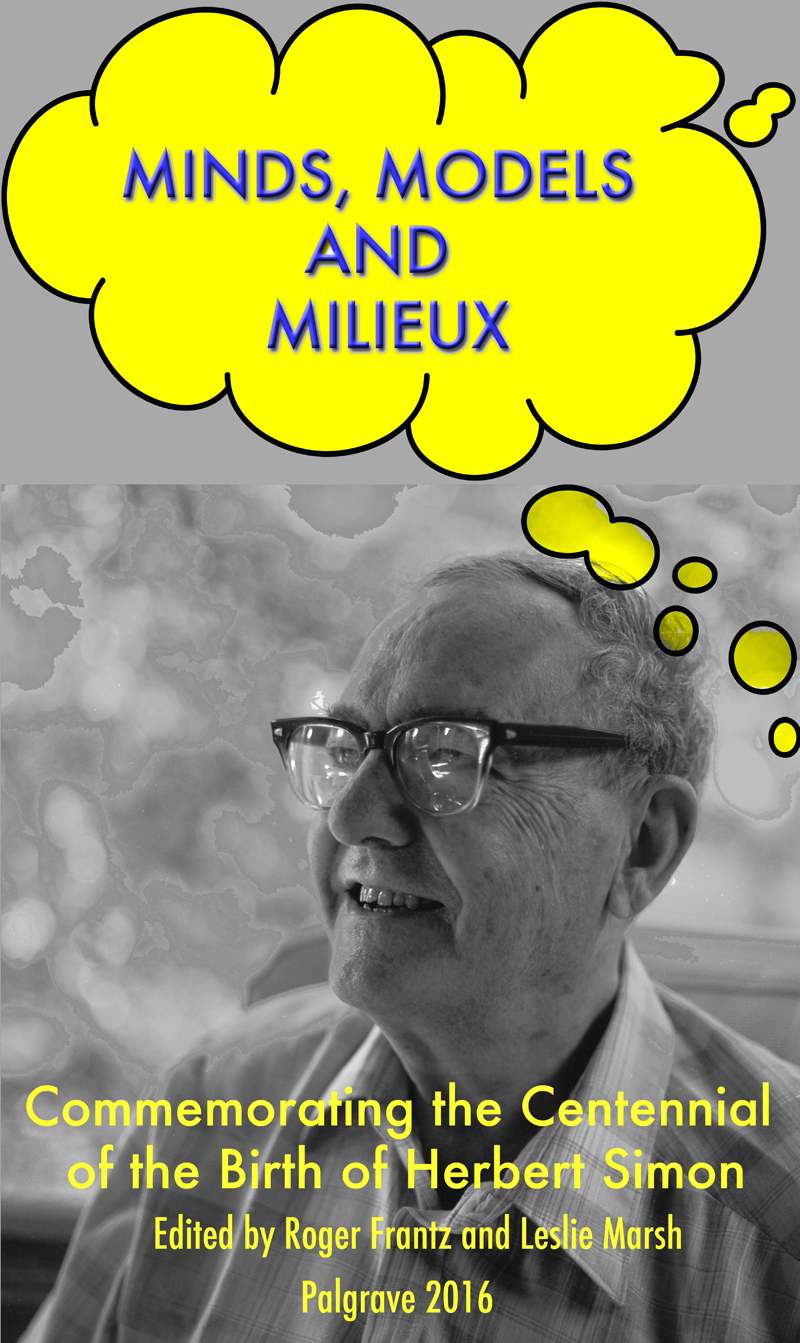
The sixteenth (and final) in a series of excerpts from Minds, Models and Milieux: Commemorating the Centennial of the Birth of Herbert Simon.
Mie Augier and Bhavna Hariharan
Organizing a professional school. Is very much like mixing oil with water: it is easy to describe the intended product, less easy to produce it. And the task is not finished when the goal has been achieved. Left to themselves, the oil and water will separate again. So also will the disciplines and the professions. Organizing, in these situations, is not a once-and-for-all activity. It is a continuing administrative responsibility, vital for the sustained success of the enterprise (Simon, 1967, p. 16).
Herbert Simon in recognized for his contributions to areas and fields such as organization theory, economics, cognitive science, artificial intelligence, and psychology, as well as others.[1] His paper on the business school as a problem of organizational design (1967) is, although perhaps less well known, a paper that reflects both his mind as an organization theorist and scholar, but also his awareness of the importance of some of the fundamental issues in the education of professions and in professional schools (such as business schools). As a person, he was well known for his strong mind and his insistence on going against the centripetal forces of scholarly disciplines, even if it might have been easier for him to stay within one (or two) disciplines. As he said in conversation, “if you see any discipline dominating you, you join the opposition and fight it for a while”.
The reformation of business schools and management education that Simon and colleagues became a symbol of had similarties with the changing of medical schools, which had happened a few decades earlier. Simon’s and Flexner’s visions for professional education have some similarities although there is little indication that Simon and Flexner overlapped in person. There are lessons from their work that alone – and together – may provide fruitful avenues for future research.
In this chapter, we take as our starting point Simon’s organizational analysis of the professional school, and discuss it in the light of some of the changes that happened in other professional schools (medical schools and engineering schools), as they went through institutional and intellectual transformations.
Simon directed his energy towards creating and reforming much of the intellectual content of one type of professional school, (the business schools), by creating with colleagues, among other things, the new field of organization studies. Flexner, on the other hand directed his efforts towards the institutional and societal reform of another type of professional education – namely medical schools.[ii] Together, Simon’s and Flexner’s contribution are powerful not only for understanding some of the tensions facing professional schools as institutions, but also hold possible implications for how we think of the education of professions in the future. Discussing some of these aspects is the aim of this paper. In particular, section 2 will discuss the Simon/Flexner visions for professional schools, taking into account the tensions that exist and the concept of professionalism embedded in Simon’s and Flexner’s visions. Then we will discuss how some of the Simon/Flexner insights are embedded in the history of another professional school, the engineering school. We end with some implications and the importance of curiosity in research as emphasized by Simon.
[1] Simon preferred to see his legacy and intellectual footprints as integrating, not jumping through, the fields and different disciplines.
[ii] Simon did also work on the larger institutional issues, for instance, being involved in the initiatives leading to places such as the Center for Advanced Studies in Behavioral Social Science (CASBSS), in particular through his involvement with the Ford Foundation. At the even larger institutional and science policy level, he was central in the national academy of science; both in creating room for the social and behavioral sciences there, and on committee work throughout the years.