Extending the Mind

A brief discussion from an anthropological perspective on Robert Logan’s book from a few years back.

Image

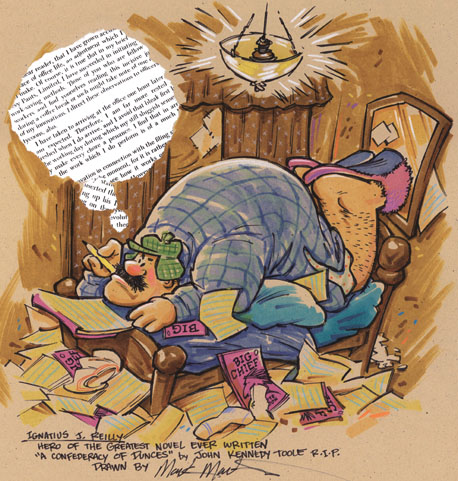
A Confederacy of Dunces – quotes and extracts – 52

His blue and yellow eyes rested on an unopened manila envelope on the top of the toilet. For quite a while Ignatius had been trying to decide whether or not he would open the envelope. The trauma of having found employment had affected his value negatively, and he was waiting until the warm water in which he wallowed like a pink hippopotamus has a calming effect upon his system. Then he would attack the envelope. Paradise Vendors should prove to be a pleasant employer. He would spend his time parked somewhere by the river accumulating thoughts for the Journal. Mr. Clyde had a certain paternal quality that Ignatius liked; the old man, the scarred and wizened mogul of the frankfurter, would be a welcome new character in the Journal.

At last Ignatius felt relaxed enough and, raising his dripping hulk out of the water, picked up the envelope.

He tore the envelope open, wetting the paper, and pulled out a folded poster that said in large letters:

LECTURE! LECTURE!

M. Minkoff speaks boldly about

“Sex in Politics: Erotic Liberty as a Weapon Against Reactionaries”

8 p.m. Thursday, the 28th

Y.M.C.A. – Grand Concourse

Admission: $1.00 – OR – Sign M. Minkoff’s Petition Which Aggressively Demands More and Better Sex for All and a Crash Program for Minorities! (The petition will be mailed to Washington.) Sign now and save America from sexual ignorance, chastity, and fear. Are you committed enough to help in this bold and crucial movement? (p. 152).
1.0.3

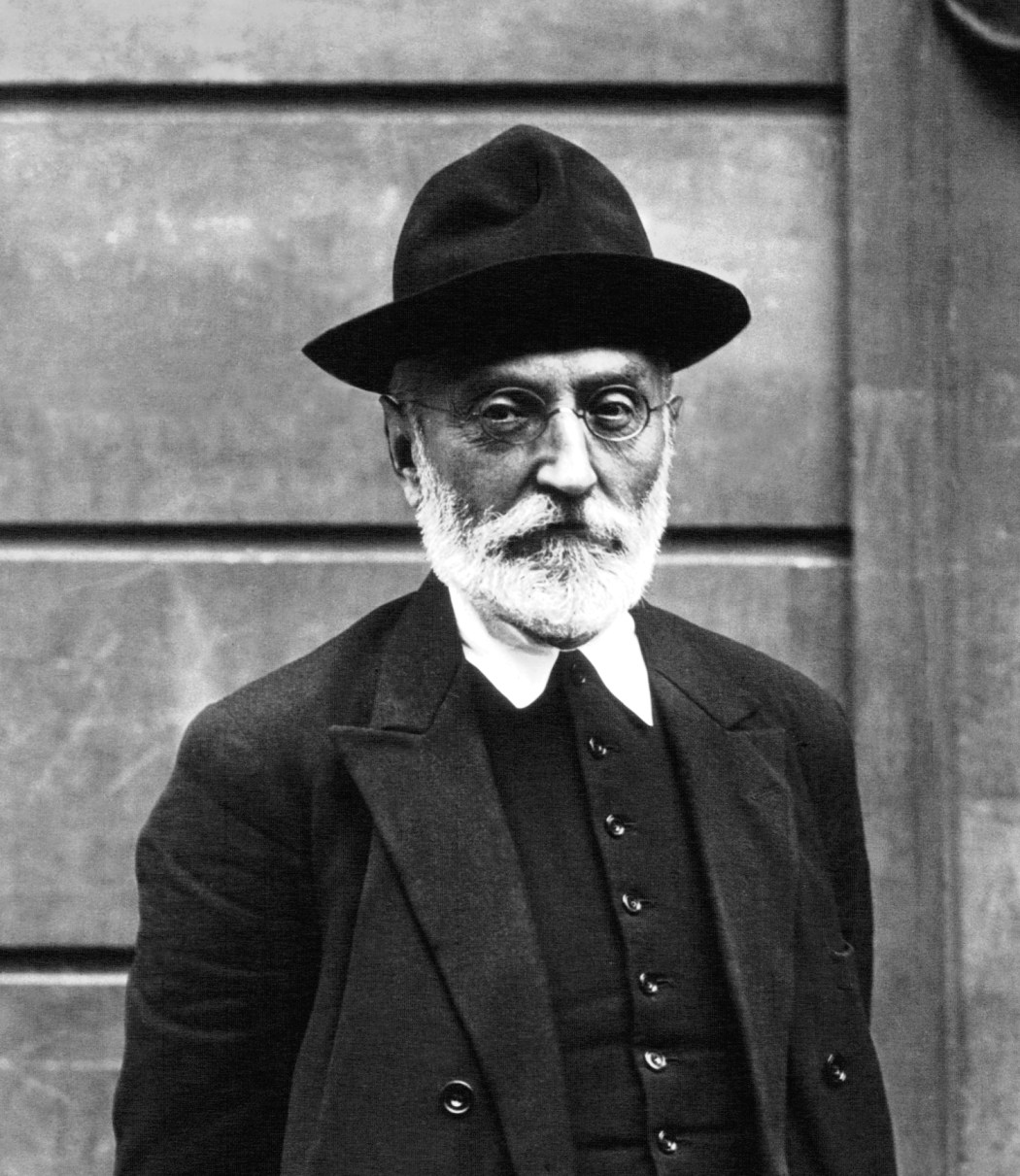
Miguel de Unamuno and Walker Percy

Immersed in reading Percy it has become blindingly clear that these two writers have such similar concerns. de Unamuno’s the  Tragic Sense of Life rates as having made the most profound of impressions upon me — and that was going on thirty years ago. Whatever else separates Percy and de Unamuno, it is my view that de Unamuno and Percy are kindred spirits, more so than Flannery O’Connor and Percy. Here is a good and recent essay on the Tragic Sense of Life. For my “Precyeana” see here.

Miguel_de_Unamuno_Meurisse_1925

There’s Something About Mary

Frank Jackson on the Mary thought experiment and “Epiphenomenal Qualia”

Elsewhere I’ve written:

Jackson’s thought experiment bears a striking resemblance to Hayek’s discussion in The Sensory Order, 1.95. Hayek took inspiration from C. D. Broad, the idea that an omnipotent being would still not be able to predict the qualia associated with a substance, for example, ammonia (Broad, 1925, p. 71). Here Hayek poses the question: how could one communicate the idea of vision generally and color in particular to the congenitally blind? In The Sensory Order, 1.97 and 1.98, Hayek cites physicist Kenneth Mees’ thought experiment as illustrating the distinction between the physical and the phenomenal orders. Mees asks us to consider the case of a congenially and totally deaf person confronted by someone playing a violin. Moreover, he asks us to suppose that this person knows nothing of sound even in a theoretical way. Confronted by the actions of the violin player, to the deaf person the actions will appear irrational. But, says Mees, if our deaf person was a scientist, he or she would eventually figure out that the movements of the violin bow generated vibrations that could be detected by equipment (the science of acoustics). Now whatever the issues Hayek has with Mees’ example, his conclusion is this: ‘‘the congenitally blind or deaf can never learn all that which the seeing or hearing person owes to the direct experience of the sensory qualities in question, because no description can exhaust all the distinctions which are experienced’’ (Hayek, 1952/1976, 1.102). The similarity of the conclusion shared by Hayek and Jackson is uncanny.

jackson-1

George Avakian interview

An emotional highlight of the 2013 Satchmo Summerfest in New Orleans as legendary record producer George Avakian was interviewed by Louis Armstrong historians Ricky Riccardi and David Ostwald about a 9-CD boxed set of live recordings of Armstrong that Avakian produced in the 1950s. Towards the end of the interview, the 94-year-old Avakian listens to audio of a conversation he had with Armstrong in 1956, resulting in a beautiful moment and a record-length standing ovation for the Satchmo Summerfest.

A Confederacy of Dunces – quotes and extracts – 51

“The sisters loved Ignatius. He was such a darling child. He used to win all them little holy pictures for knowing his catechism.”

“Them sisters shoulda knocked his head in.”

“When he useta come home with all them little holy pictures,” Mrs. Reilly sniffed, “I sure never thought then he’d end up selling weenies in the broad daylight.” Mrs. Reilly coughed nervously and violently into the telephone. “But tell me. sweetheart, how Angelo’s making out?”

“His wife Rita rings me up a little while ago to tell me she thinks he”s coming down with pneumonia from being stuck in that toilet all the time. I tell you true, Irene, that Angelo’s getting as pale was a ghost. The cops sure don’t treat that boy right. He loves the force. When he graduated from the cops’ academy, you woulda thought he just made it outta the Ivory League. He was sure proud.”

“Yeah, poor Angelo looks bad,” Mrs. Reilly agreed. “He’s got him a bad cough, that boy. Well, maybe he’ll feel a little better after he reads that thing Ignatius gave me to give him. Ignatius says it’s inspirational literature.”

“Yeah? I wouldn’t trust no ‘inspirational literature’ I got from that Ignatius. It’s prolly fulla dirty stories.” (p. 150).

cof

David Chalmers and Andy Clark Interview

This from the New Philosopher.

Andy’s colleagues at Edinburgh in the epistemology department proposed the extended knowledge project, where you start thinking of knowledge as this extended process that involves interaction with the environment.

I’ve been calling it stigmergic epistemology.

Image

Why Study Philosophy?

This from The Atlantic.

Image