Here is Simon Critchley talking at Cornell. Love Critchley’s scathing take on Bono at about 50 mins in.
What Bowie describes is a Büchnerian world of terror. The first line, “Silhouettes and shadows watch the revolution,” describes the languor and disappointment of a post-revolutionary situation. In an allusion to Eddie Cochran’s posthumously released 1960 hit, there are no longer “three steps to heaven.” All that remains are “Big heads and drums—full speed and pagan.” “So, where’s the moral?” Bowie asks. “People have their fingers broken.” In the final verse of “Part 2,” Bowie concludes,
Children round the world
Put camel shit on the walls
They’re making carpets on treadmills
Or garbage sorting.
So, where’s the moral in all this camel shit? Pop stars, like the dreadful Bono, are meant to morph into slimmer versions of Salman Rushdie and mouth liberal platitudes about the state of the world and what we can do to put it right. But here Bowie gives the lie to such liberal complacency by exposing it to a simple, visceral critique. The inexpensive carpets that we use to furnish our home are made by those living in camel-shit huts. Rather than amuse ourselves by playing with some fraudulent political agenda, Bowie simply declares that “It’s no game.” Shit is serious.
The next track on Scary Monsters, “Up the Hill Backwards,” begins, “The vacuum created by the arrival of freedom, and the possibilities it seems to offer.” Like Lucile’s cry at the end of Danton’s Death, this line sounds like Edmund Burke’s conservative critique of the French Revolution. But adapting Celan’s logic, this is no homage to any monarchy or any yesterday, apart from the majesty of the absurd, which is the world of human beings. Such is poetry in Celan’s sense, Bowie’s poetry.
The Irish Times
Bowie, carrot-topped and androgynous, seemed less like a pop star than some cosmic John the Baptist sent to earth with news of the apocalypse, or the Rapture, or both.
Bowie was not the first example of rock star as existential alien (Robert Johnson, Elvis, Jim Morrison and Syd Barrett all preceded him), but he was the first to cast himself as an actual extra-terrestrial. Bowie-as-Ziggy seemed savagely intelligent as well as sexually charismatic, projecting the kind of mystique that now seems exotic in an age of ten-a-penny slebs who devalue their cult-of-personality currency with tweets and selfies, or nice boys next door like Coldplay or Mumford & Sons.
When Bowie later left LA for Europe, swapping coke and the occult for booze, coffee, fags and krautrock, he began to incorporate more spiritual lyrical ideas.
“Station to Station is the railway journey suggested by the opening synthesized locomotive noise,” Critchely observes. “But it is also the stations of the via dolorosa of Jesus in Jerusalem from Gethsemane to Calvary. Bowie’s lyric, steeped in Kabbalistic esotericism, concerns the passage between the divine and the human and the possible divinity of the human, which is Christ’s Passion.”
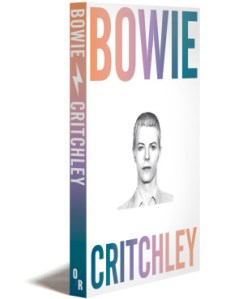
The Art’s Filthy Lesson (Extract)
After Andy Warhol had been shot by Valerie Solanas in 1968, he said, “Before I was shot, I suspected that instead of living I’m just watching TV. Since being shot, I’m certain of it.” Bowie’s acute ten-word commentary on Warhol’s statement, in the eponymous song from Hunky Dory in 1971, is deadly accurate: “Andy Warhol, silver screen / Can’t tell them apart at all.” The ironic self-awareness of the artist and their audience can only be that of their inauthenticity, repeated at increasingly conscious levels. Bowie repeatedly mobilizes this Warholian aesthetic.
The inability to distinguish Andy Warhol from the silver screen morphs into Bowie’s continual sense of himself being stuck inside his own movie. Such is the conceit of “Life on Mars?,” which begins with the “girl with the mousy hair,” who is “hooked to the silver screen.” But in the final verse, the movie’s screenwriter is revealed as Bowie himself or his persona, although we can’t tell them apart at all:
“But the film is a saddening bore
‘Cause I wrote it ten times or more
It’s about to be writ again.”
The conflation of life with a movie conspires with the trope of repetition to evoke a melancholic sense of being both bored and trapped. One becomes an actor in one’s own movie. This is my sense of Bowie’s much-misunderstood lines in “Quicksand”:
“I’m living in a silent film
Portraying Himmler’s sacred realm
Of dream reality.”
Bowie displays an acute awareness of Himmler’s understanding of National Socialism as political artifice, as an artistic and especially architectural construction, as well as a cinematic spectacle. Hitler, in the words of Hans-Jürgen Syberberg, was ein Film aus Deutschland, a film from Germany. As Bowie put it, Hitler was the first pop star. But being stuck inside a movie evokes not elation but depression and a Major Tom–like inaction:
“I’m sinking in the quicksand of my thought
And I ain’t got the power anymore.”
In “Five Years,” after having received the news that the Earth will soon die, Bowie sings, “And it was cold and it rained and I felt like an actor.” Similarly, in one of my all-time favorite Bowie songs, “The Secret Life of Arabia” (outrageously and ferociously covered by the late, great Billy Mackenzie with the British Electric Foundation), Bowie sings,
“You must see the movie
The sand in my eyes
I walk though a desert song
When the heroine dies.”
The world is a film set, and the movie that’s being shot might well be called Melancholia. One of Bowie’s best and bleakest songs, “Candidate,” begins with a statement of explicit pretense, “We’ll pretend we’re walking home,” and is followed by the line, “My set is amazing, it even smells like a street.”
Art’s filthy lesson is inauthenticity all the way down, a series of repetitions and reenactments: fakes that strip away the illusion of reality in which we live and confront us with the reality of illusion. Bowie’s world is like a dystopian version of The Truman Show, the sick place of the world that is forcefully expressed in the ruined, violent cityscapes of “Aladdin Sane” and “Diamond Dogs” and more subtly in the desolate soundscapes of “Warszawa” and “Neuköln.” To borrow Iggy Pop’s idiom from Lust for Life (itself borrowed from Antonioni’s 1975 movie, although Bowie might well be its implicit referent), Bowie is the passenger who rides through the city’s ripped backside, under a bright and hollow sky.
aestheticsAndy WarholbonoBowieDavid BowieexistentialismMartin Heideggermusicnietzschesimon critchleyWilliam Seward Burroughs