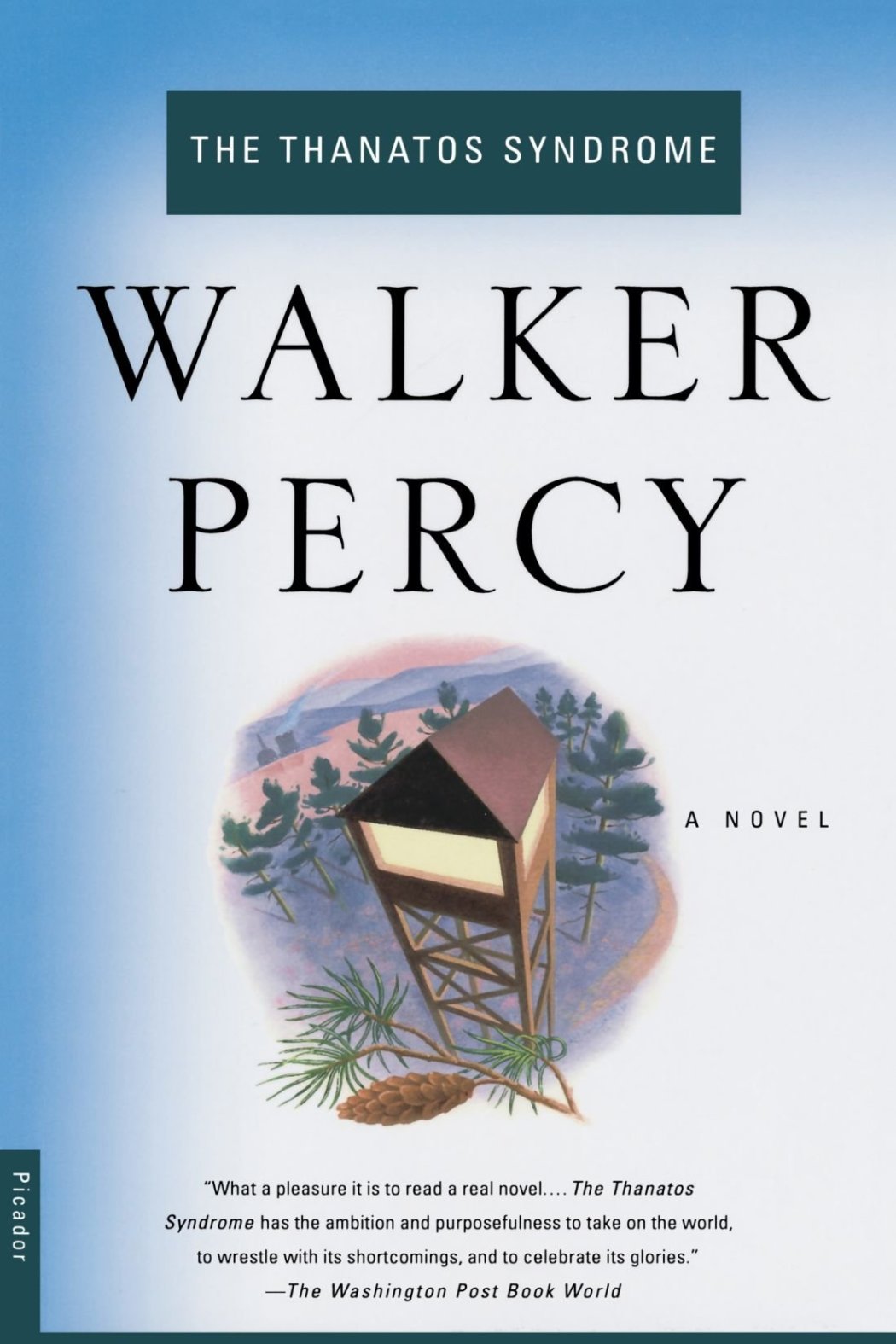
THE PLACE WHERE the strange events related in this book occur, Feliciana, is not imaginary. It was so named by the Spanish. It was and is part of Louisiana, a strip of pleasant pineland running from the Mississippi River to the Perdido, a curious region of a curious state. Never quite Creole or French or Anglo-Saxon or Catholic or Baptist like other parishes of Louisiana, it has served over the years as a refuge for all manner of malcontents. If America was settled by dissenters from various European propositions, Feliciana was settled by dissenters from the dissent, American Tories who had no use for the Revolution, disgruntled Huguenots and Cavaliers from the Carolinas, New Englanders fleeing from Puritanism, unionists who voted against secession, Confederate refugees from occupied New Orleans, deserters from the Confederate Army, smugglers from both sides, criminals holed up in the Honey Island Swamp.
Welcomed in the beginning by the hospitable and indolent Spanish of a decrepit empire, some of these assorted malcontents united long enough to throw out the Spanish and form an independent republic, complete with its own Declaration of Independence, flag, army, navy, constitution, and capital in St. Francisville. The new republic had no inclination to join French Louisiana to the south or the United States to the north and would as soon have been let alone. It lasted seventy-four days. Jefferson had bought Louisiana and that was that.
As pleasant a place as its name implies, it still harbors all manner of fractious folk, including Texans and recent refugees from unlikely places like Korea and Michigan, all of whom have learned to get along tolerably well, better than most in fact, who watch L.S.U. football and reruns of M*A*S*H, drink Dixie beer, and eat every sort of food imaginable, which is generally cooked in some thing called a roux.
The downside of Feliciana is that its pine forests have been mostly cut down, its bayous befouled, Lake Pontchartrain polluted, the Mississippi River turned into a sewer. It has too many malls, banks, hospitals, chiropractors, politicians, lawyers, realtors, and condos with names like Château Charmant.
Still and all, I wouldn’t live anywhere else.
It is strange, but these Louisianians, for all their differences and contrariness, have an affection for one another. It is expressed by small signs and courtesies, even between strangers, as if they shared a secret.
In what follows, the geography of the place has been somewhat scrambled. All of the people in Feliciana have been made up. The only real persons are the German and Austrian professors and physicians who were active in both the Weimar Republic and the Third Reich—Drs. de Crinis, Villinger, Schneider, Nitsche, Heyde—and the Swiss psychiatrist Dr. C. G. Jung. For this information about the Nazi doctors and their academic precursors in the Weimar Republic, I am indebted to Dr. Frederic Wertham’s remarkable book, A Sign for Cain.
Journal of Behavioral Economics for Policy
My chum and collaborator Roger Frantz is the founding editor of this new open access journal. So stay tuned for the first issue.

Remembering Ken Minogue
Born on this day — see the themed issue of Cosmos + Taxis dedicated to Ken. Here is Ken at his elegant and wry best in Morals & the servile mind. I think Ken would have been chuffed by BREXIT not necessarily because of which side actually won, but because of which side was the most arrogant. Clue . . .
We must face up to the grim fact that the rulers we elect are losing patience with us.

September 11
Turing learning
I’ve been thinking about Turing’s lesser-known but still very important other contribution (i.e. to mathematical biology) — so while in Turing groove, I was pleased to come across this open access paper from the latest issue of Swarm Intelligence. So glad to report that Swarm Intelligence has seen through its first decade.

Evidence Rebuts Chomsky’s Theory of Language Learning
Much of Noam Chomsky’s revolution in linguistics—including its account of the way we learn languages—is being overturned. Paul Ibbotson and Michael Tomasello in Scientific American

The Sensory Order and Other Writings on the Foundations of Theoretical Psychology
I’m very much looking forward to the reissue of TSO conveniently bundled along with other important MSS heretofore only available as Hoover photocopies. Kudos to Viktor Vanberg for pulling this together and of course to Bruce Caldwell, the series’ general editor.

Walker Percy Wednesday 100
Thirty years earlier the child knew that something was going to happen, and that the something was all he ever wanted or needed to know, and that it only remained for him to wait for it to happen and to settle for nothing less until it did.
What was the something? Women? War? Or victory in life? Death?
Thirty years passed. He had women, war, and victory in life.
But nothing changed. Thirty years later he knew no more than he knew in Dalhart, Texas, squeezing his legs together and looking at girls.
Yes, but you have just discovered again what you knew all along, that something is going to happen.
*****
But is it not also a surprise that discovering you’ve been dead all these years, you should now feel somewhat alive?
He killed me then and I did not know it. I even thought he had missed me. I have been living, yes, but it is a living death because I knew he wanted me dead.
Am I entitled to live? I am alive by a fluke like the sole survivor of Treblinka, who lived by a fluke, but did not really feel entitled to live.
Ah, but there is a difference between feeling dead and not knowing it, and feeling dead and knowing it. Knowing it means there is a possibility of feeling alive though dead.
*****
Again the past rose to haunt him and the future rose to beckon to him. Things took on significance.
*****
“Tell me the single truth, not two or more separate truths, unless separate truths are subtruths of the single truth. Is there one truth or several separate truths?”
*****
In any event, the historical phenomenon of the Jews cannot be accounted for by historical or sociological theory.

Screwtopia
The philosopher Alicja Gescinska visits Roger Scruton at his farm and chats about this, that, and the other or as Alicja puts it “on life, beauty and what we are about”. I didn’t know of Roger’s fall but glad to see him up and about and in good spirits. (Bob Grant in conversation with me always affectionately refers to RS as “Screwtape”).
Memoirs of an Anti-Semite
I’m pleased to see that Gregor von Rezzori’s Memoirs of an Anti-Semite has been rereleased — well, it was some eight years ago, as I’ve just discovered. Anyway, here is a review piece by Hitch on the reissue from the days when The Atlantic still retained some distinction.