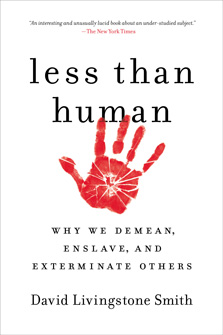
“Less Than Human” wins 2012 Anisfield-Wolf Book Award

Here’s a scoop. My chum and colleague David Livingstone Smith’s Less Than Human has been awarded 2012 Anisfield-Wolf Book Award for non-fiction. Nice one DLS! Proud to know you (even before the award!)

Mind and Machine

Look out for the this forthcoming book by Joel Walmsley. Joel co-wrote with the one and only Andre Kukla a terrific paper a few years back  for one of the early issues of EPISTEME.

Google as cognitive extension

“Google Effects on Memory: Cognitive Consequences of Having Information at Our Fingertips” in Science.

The advent of the Internet, with sophisticated algorithmic search engines, has made accessing information as easy as lifting a finger. No longer do we have to make costly efforts to find the things we want. We can “Google” the old classmate, find articles online, or look up the actor who was on the tip of our tongue. The results of four studies suggest that when faced with difficult questions, people are primed to think about computers and that when people expect to have future access to information, they have lower rates of recall of the information itself and enhanced recall instead for where to access it. The Internet has become a primary form of external or transactive memory, where information is stored collectively outside ourselves.

Rationalism in Politics

In anticipation of a talk I’m giving later on in the week on Oakeshott’s so-called “dispositional conservatism”, here is a nice little piece by my chum Gene Callahan serving as a good introduction to RIP.

The British philosopher and historian Michael Oakeshott is a curious figure in twentieth-century intellectual history. He is known mostly as a “conservative political theorist,” although he rejected ideology and his conservatism was primarily temperamental. Furthermore, his work on politics was only a fraction of his output, which comprised idealist philosophy, aesthetics, religion, education, the philosophy of history, and even horse racing. His popularity reached its zenith in the 1950s and early 1960s, when he was well known on both sides of the Atlantic, appearing on the BBC and becoming the favorite philosopher at National Review. But he never seemed to seek popularity, and did little or nothing to boost his own when it subsequently faded. Today, despite the growing interest in Oakeshott since his death in 1990, even his best-recognized work, his essay “Rationalism in Politics,” is, I contend, not appreciated widely enough—thus, this article.

Lovers of liberty should keep Oakeshott’s work on rationalism in mind for at least two reasons. First, it offers a complementary but still significantly different critique of planning to those of Mises and Hayek. However, at the same time, it provides a warning to the advocates of freedom not to fall into the rationalist quagmire themselves. The relevance of the latter point is demonstrated by, for example, the tendency of many development economists, even those who are “market oriented,” to attempt to impose their theoretical schemes for taking a shortcut to westernization on some Third World country, while running roughshod over all the traditions, customs, and morals native to the place, which, whatever their short-comings, at least managed to sustain the society in question over previous centuries. Freedom cannot be “imposed” on a people according to some preconceived scheme. We all need to watch out for “the rationalist within.”

The Web-extended mind

A pre-print of Paul Smart’s paper.

A Note on the Influence of Mach’s Psychology in the Sensory Order

Here is the intro to Giandomenica Becchio’s paper:

In the Preface of The Sensory Order, Hayek stated that this book was based on his readings in psychology during 1919–1920, when he was still a young student in Vienna interested in both psychology and economics. Among many others, Hayek explicitly cited Mach’s influence on him. Hayek’s contacts with the lively Viennese milieu during the 1920s and 1930s had a fundamental role in the story of the use of Mach in Hayek’s book. As Hayek himself explained, Mach had a great influence on Viennese students and scholars until the 1930s, because he represented ‘‘the only source of arguments against a metaphysical and nebulous attitude’’ that was spreading among scientists (Blackmore, Itagaki, & Tanaka, 2001, p. 124). The use of Mach’s philosophy as a tool against any metaphysical attitude was particularly strong inside the Vienna Circle, where scholars like Otto Neurath and Rudolph Carnap had founded the Ernst Mach Society (Verein Ernst Mach, 1927) to support their movement and to link Mach’s empiricism to their philosophical approach,which they later named ‘‘logical positivism’’ (Blumberg & Feigl, 1931). Hayek strongly criticized the Vienna Circle’s philosophical approach: he mainly rejected Neurath’s physicalism (the belief that all science ultimately reduces to the laws of physics, Neurath, 1931; Caldwell, 2004), even if he showed some interest in Carnap’s logical system (Carnap, 1928). When Hayek introduced the system of multiple classification in The Sensory Order, he cited Carnap as the one who provided ‘‘a somewhat similar statement of the problems of the order of sensory qualities’’ (Hayek, 1952, p. 51). Nevertheless, in the mid-1930s, when Carnap officially subscribed to Neurath’s physicalism, it culminated in the project of the unification of science (Stadler, 2001).1 Hayek’s aversion arose: From the fact that we shall never be able to achieve more than an ‘explanation of the principle’ by which the order of mental events is determined, it also follows that we shall never achieve a complete ‘unification’ of all sciences in the sense that all phenomena of which it treats can be described in physical term. (Hayek, 1952, p. 191)

And in the following footnote he specifically named both Carnap and Neurath: their physical language, since it refers to the phenomenal or sensory qualities of the objects, is not ‘‘physical’’ at all. Their use of this term rather implies a metaphysical belief in the ‘‘ultimate reality’’ and constancy of the phenomenal world for which there is little justification. (ibid.) In this passage Hayek accused them of having dropped their original antimetaphysical attitude – mediated through Mach – to propose a new form a metaphysical belief, based on the reduction of any reality to the empirical realm. Hayek’s j’accuse is significant: for 30 years the philosophers of the Vienna Circle claimed Mach’s philosophy as one of the main sources of their aversion to metaphysics and a pillar of their philosophical approach based on a new form of positivism.2 In the International Encyclopedia of Unified Science, Joergensen explained the three common traits between ‘‘Mach’s positivism’’ and the Vienna Circle philosophy: the idea that ‘‘human knowledge is a biological phenomenon’’; the rejection of any form of ‘‘thing-in-itself’’ (and for that matter, of any form of Kantianism) and the overlap between physical reality and physical elements (Joergensen, 1951, p. 853). To explain the link between Mach and Hayek on the one hand and Hayek’s aversion to the logical positivism (apparently and ‘‘officially’’ rooted in Mach’s philosophy) on the other hand, we need to consider what Hayek meant when he mentioned Mach’s influence in The Sensory Order.

Collective Intelligence 2012

Just under a week until the CI2012 shindig – as it so happens I’m busy co-writing a paper and co-editing a themed issue of Cognitive Systems Research on a species of CI – surprise, surprise “stigmergy.”

Turing Test

Another of probably several Turing related posts in the run up to the summer commemorations of Turing’s birth and death (23 June 1912 – 7 June 1954) – the following from Science Magazine 13 April 2012: Vol. 336 no. 6078. I paste in a couple of paragraphs from each paper as a preview. Here is a Wired article based upon the articles below.

1. Beyond Turing’s Machines – Andrew Hodges

In marking Alan Turing’s centenary, it’s worth asking what was his most fundamental achievement and what he left for future science to take up when he took his own life in 1954. His success in World War II, as the chief scientific figure in the British cryptographic effort, with hands-on responsibility for the Atlantic naval conflict, had a great and immediate impact. But in its ever-growing influence since that time, the principle of the universal machine, which Turing published in 1937 (1), beats even this.

When, in 1945, he used his wartime technological knowledge to design a first digital computer, it was to make a practical version of that universal machine (2). All computing has followed his lead. Defining a universal machine rests on one idea, essential to Turing’s mathematical proof in 1936, but quite counter-intuitive, and bearing no resemblance to the large practical calculators of the 1930s. It put logic, not arithmetic, in the driving seat. This central observation is that instructions are themselves a form of data. This vital idea was exploited by Turing immediately in his detailed plan of 1945. The computer he planned would allow instructions to operate on instructions to produce new instructions. The logic of software takes charge of computing. As Turing explained, all known processes could now be encoded, and all could be run on a single machine. The process of encodement could itself be automated and made user-friendly, using any logical language you liked. This approach went far beyond the vision of others at the time.

2. Dusting Off the Turing Test – Robert M. French

Hold up both hands and spread your fingers apart. Now put your palms together and fold your two middle fingers down till the knuckles on both fingers touch each other. While holding this position, one after the other, open and close each pair of opposing fingers by an inch or so. Notice anything? Of course you did. But could a computer without a body and without human experiences ever answer that question or a million others like it? And even if recent revolutionary advances in collecting, storing, retrieving, and analyzing data lead to such a computer, would this machine qualify as “intelligent”?

Just over 60 years ago, Alan Turing published a paper on a simple, operational test for machine intelligence that became one of the most highly cited papers ever written (1). Turing, whose 100th birthday is celebrated this year, made seminal contributions to the mathematics of automated computing, helped the Allies win World War II by breaking top-secret German codes, and built a forerunner of the modern computer (2). His test, today called the Turing test, was the first operational definition of machine intelligence. It posits putting a computer and a human in separate rooms and connecting them by teletype to an external interrogator, who is free to ask any imaginable questions of either entity. The computer aims to fool the interrogator into believing it is the human; the human must convince the interrogator that he/she is the human. If the interrogator cannot determine which is the real human, the computer will be judged to be intelligent.

Bloom’s The Closing of the American Mind

Allan Bloom’s The Closing of the American Mind remains as important as ever, and as misunderstood, 25 years after the 1980s culture wars.


Turing Centenary

Conference page. Here is also one of Turing’s most famous papers:

I propose to consider the question, “Can machines think?” This should begin with definitions of the meaning of the terms “machine” and “think.” The definitions might be framed so as to reflect so far as possible the normal use of the words, but this attitude is dangerous, If the meaning of the words “machine” and “think” are to be found by examining how they are commonly used it is difficult to escape the conclusion that the meaning and the answer to the question, “Can machines think?” is to be sought in a statistical survey such as a Gallup poll. But this is absurd. Instead of attempting such a definition I shall replace the question by another, which is closely related to it and is expressed in relatively unambiguous words.