Yom huledet “Pops”

Today is Louis Armstrong’s birthday, in my view a musical titan to match the likes of Wagner. No artist has given me such pleasure as Pops as well as being a perennial symbol or a paragon of dignity in trying circumstances. Below are two of my favourite photos of Pops. I also highly recommend you read two books, the latter author works tirelessly and brilliantly as a keeper of the Pops flame @ The Louis Armstrong House Museum. The world is forever indebted to the Karnofskys.

Terry Teachout’s Pops: A Life of Louis Armstrong

Ricky Riccardi’s What a Wonderful World: The Magic of Louis Armstrong’s Later Years

Hubig’s Pies

It’s been just over a week since Hubig’s Pies burnt to the ground. To get a sense of the importance of this institution here is no less the NYT and the local view from NOLA.com.

Jazz and NOLA artistry

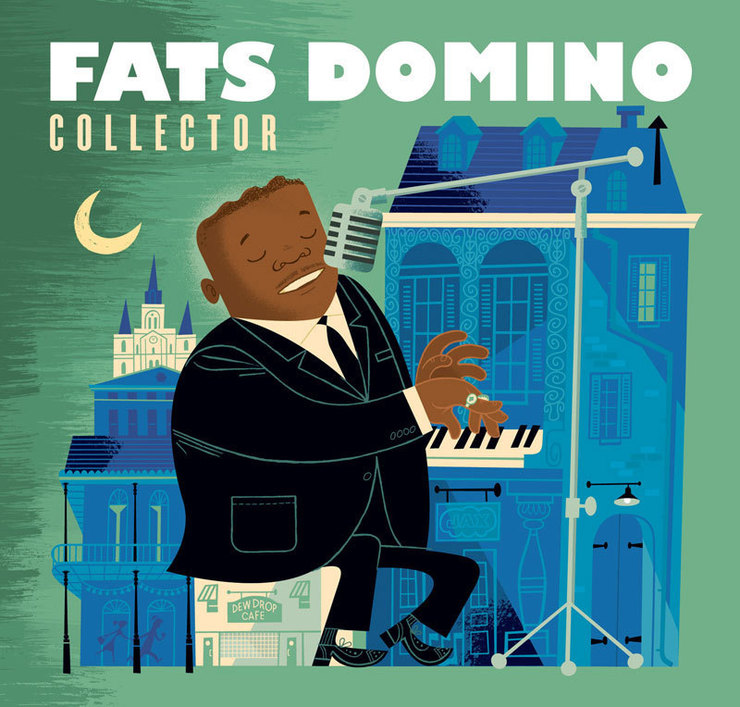
Check out the terrific artistry of Paul Rogers (no, not the PR from a rather successful 70s beat combo). Paul’s work reminds me a great deal of Rockwell Kent‘s work – now that is high praise indeed. Paul’s jazz drawings is a world away from the schlock that typically populates Jackson Square. Though I like all of Paul’s work, not surprisngly I particularly like his Jazz and NOLA themed ones, notably the one of “Fats” that Paul has recently done for an album cover. Paul talks about his work process here.

Biking, boozing and nosebagging

Once one has worked the brashness and tat of Bourbon Street through one’s system the best way to discover NOLA is to take a bicycle tour through the Confederacy of Cruisers. Not only is the owner/operator Jeff Shyman a history buff giving a warts and all appreciation of NOLA but he is also another “character” that has found refuge in the bohemian enclave that is NOLA. And the great thing is that the highest incline (if I recall correctly) is only 6 inches and the bikes have pedal breaks leaving one hand free to knock back a beer as you ride.

We’re fairly simple here at Confederacy of Cruisers…We like to enjoy our city; meaning  we like to bike, and we like to drink. We like to give tours and take people to out of the way spots and give them a taste of the neighborhoods of New Orleans, and now we found a way to combine all of that. The drink holders are hooked up to the handlebars and we roll on Mondays,  Thursdays and Fridays at 10:15 AM.

AND there are no civic injunctions to wear a helmet and bubble wrap. And if you are looking for the best recommendations for food and music on a budget, Jeff’s the man to ask.

These tours will give you an understanding of the joy it is to spend a life in one of America’s food meccas. The intersection of flavors from the earliest French settlers, the Africans both free and slaves, along with the waves of later immigrants such as the Italians and our country cousins, the Cajuns all give New Orleans a culture that not only loves great food, but lives it. We’ll bike through the Creole side of town stopping at a few personally picked spots that will let you sample local cuisine. Come hungry, the calories we burn will not even touch the number we consume. And a friendly warning, this tour is not for faint stomaches…we eat a lot and we eat New Orleans style, pigs and seafood make up the bulk of our culinary experience; folks with special dietary needs should let us know in advance so we can see if we are able to accomodate you.

If one can’t let ones “special dietary needs” lapse for one day, then you will miss out on one of the greatest qualic experiences you’ll ever have – even better than congress with your wished-for sexual mate. But if you are there with a foodie paramour, you are in for one hell of a time. One of the greatest days of my life began with a CC tour and through Jeff’s guidance worked my way through the Frenchman Street clubs, typically with no cover. One can walk in just for the music and not spend a dime. And the age demographic is thoroughly mixed: young and young at heart are all drawn by the music and the dancing. Maine’s claim to the tag line “The Way Life Should Be” is even more applicable to NOLA.

Laphroaig Cáirdeas now available

According to the distillery blurb:

This whisky is now between 13 and 21 years old. We blended it (50:50) with another ‘special’ whisky we had been quietly maturing. This new spirit was then placed into small quarter casks, enjoying a very intense maturation for seven years. Both whiskies were fine expressions of Laphroaig® in their own right, but when blended together something exceptional emerged as befits this 18th anniversary.

It is 51.2%ABV strength and non-chill filtered, and as I’m sure you can imagine, tastes just wonderful. Here are the notes:

Nose:
With a nose that constantly evolves and is full of flavour, Cáirdeas Origin begins with a quick hint of concentrated orange moving quickly into huge peat flavours, ashy, dusty with hazelnut. It becomes crisp and fresh with cold green apples, grapes and finishing with a fresh cut grassy flavour.

Palate:
The flavours evolve slowly on the palate and with great body it begins with white pepper moving into an earthy peaty flavour, some slight salt then purple heather. Huge creamy apricots that last and last, and it ends with some charred damp wood.

Here is one independent review.

Master of Malt

The Peripheral Mind

According to the author a new book can be expected. In this ever crowded genre I do like the title.

A Jazz Museum for NOLA

I was interested to read Jan Ramsey’s OffBeat discussion of the relative failure of NOLA to honour it’s most famous (and of course America’s most famous art form, Jazz) not to mention the rather patchy public space recognition accorded to its most famous musical sons and daughters. Plaques such as located at the site of Cosimo Matassa‘s J&M Recording Studio and Coco Robicheaux‘s bust of Professor Longhair at Tipitina’s and other assorted statues mentioned by Jan, are in toto, a rather poor showing. A focal point such as a museum is really needed. Jan writes:

This is an idea that’s been in the works for over a decade, but as per usual, nothing moves fast in New Orleans. While this is a great start towards a music museum in New Orleans, we need something grander to celebrate New Orleans as the birthplace of jazz. Impresario and musician Irvin Mayfield was involved in proposing a national jazz center on the corner of Loyola and Perdido, but that project has been on hold for years.

I don’t think that the problem of getting such projects of the ground is unique to NOLA (especially in a downturned economy) – people forget that Boston has a pretty murky local political culture as well. Having been privy to some of the deep background and civic machinations behind the proposed (and stalled) Boston Museum and other big projects elsewhere (Vancouver) I have a few thoughts on the matter.

First, while Jazz would understandably be the predominant theme, this being NOLA, a wonderful emergent and dynamic social and musical soufflé (or Gumbo if you want to invoke a well-worn cliché), it shouldn’t be exclusively a Jazz theme. A history should give Jazz context (social and musical) and that includes Gospel, the Blues, marching bands, Cajun, early R &R, even C & W and much more besides – right bang up to date with the likes of Wynton Marsalis‘ work with Simon Rattle and Eric Clapton as well as the power funk of Trombone “Shorty” and hip-hop.

Second, people get too detracted by capital projects at the expense of substance. At best these structures tend to become vanity projects for funders, civic leaders and others often neglecting the content and the day-to-day overhead entailed once the structure is in place. While it’s nice to have wonderful new structures such as the Guggenheim Bilbao Museoa (money no object), this very impressionistic rendering just doesn’t cut it (to me it reeks of a conference centre/mall aesthetic). One can get a bigger bang for the buck by having a much simpler building hopefully, as Jan says, with a decent location.

Thirdly, loose alliances should be forged say with Preservation Hall, the “Pops” museum in Corona, NY and others who are doing such a fabulous job at not merely being “museumy” but are strong programmatically, putting on concerts and in the case of the latter, offering a valuable research resource. A Jazz museum should be ALIVE and offer up-close rehearsal and performance facilities, and not least, outreach programmes to get the kids in, whatever their musical tastes.

A NOLA Jazz museum could be both a regional attraction drawing in interest from Nashville, Memphis and Austin but also a world “Mecca” for all things Jazz. The upshot is that an imaginative, vibrant and historically informed curating vision should come first. Only then can a suitable (and cost-effective) building be tailored to meet these needs. Of course, compromises are inevitable . . .

A new direction

This post marks the winding down of this website as primarily interested in matters philosophical and matters CogsSci – the new emphasis will be toward music. Of course one can never escape philosophical contemplation, but perhaps the impulse can be kept at bay. Three quotes from Thoreau seem to capture this turn:

When I hear music, I fear no danger. I am invulnerable. I see no foe. I am related to the earliest times, and to the latest.

You must live in the present, launch yourself on every wave, find your eternity in each moment.

My books I’d fain cast off, I cannot read,
‘Twixt every page my thoughts go stray at large
Down in the meadow, where is richer feed,
And will not mind to hit their proper targe.
The Summer Rain, st. 1 (1842).

Philosophy of Time

Here’s a very crisp articulation by Jonathan Tallant explaining McTaggart’s famous A and B series of time and more besides. It was the late Michael Dummett (Truth and Other Enigmas, 1978) who made me want to take another look at McTaggart’s argument, surprisingly not referenced in the SEP entry. Here’s McTaggart’s original paper and a freely available commentary paper on Dummett’s McTaggart. Oakeshott, by the way, attended McTaggart’s lectures at Cambridge, lectures pitched at the talented philosophical novice.

Embodying the Mind and Representing the Body

Two papers of note from the special issue “The Body Represented/Embodied Representation” of Review of Philosophy and Psychology and one from the current issue:

A Moderate Approach to Embodied Cognitive Science – Alvin Goldman

Embodying the Mind and Representing the Body – Adrian John Tetteh Alsmith and Frédérique de Vignemont

In Defense of Phenomenological Approaches to Social Cognition: Interacting with the Critics – Shaun Gallagher