I may have some valuable insights which may benefit my employer. Perhaps the experience can give my writing a new dimension. Being actively engaged in the system which I criticize will be an interesting irony in itself (p. 46).
EPISTEME 10:2 – Privacy, Secrecy, and Epistemology
Now available.
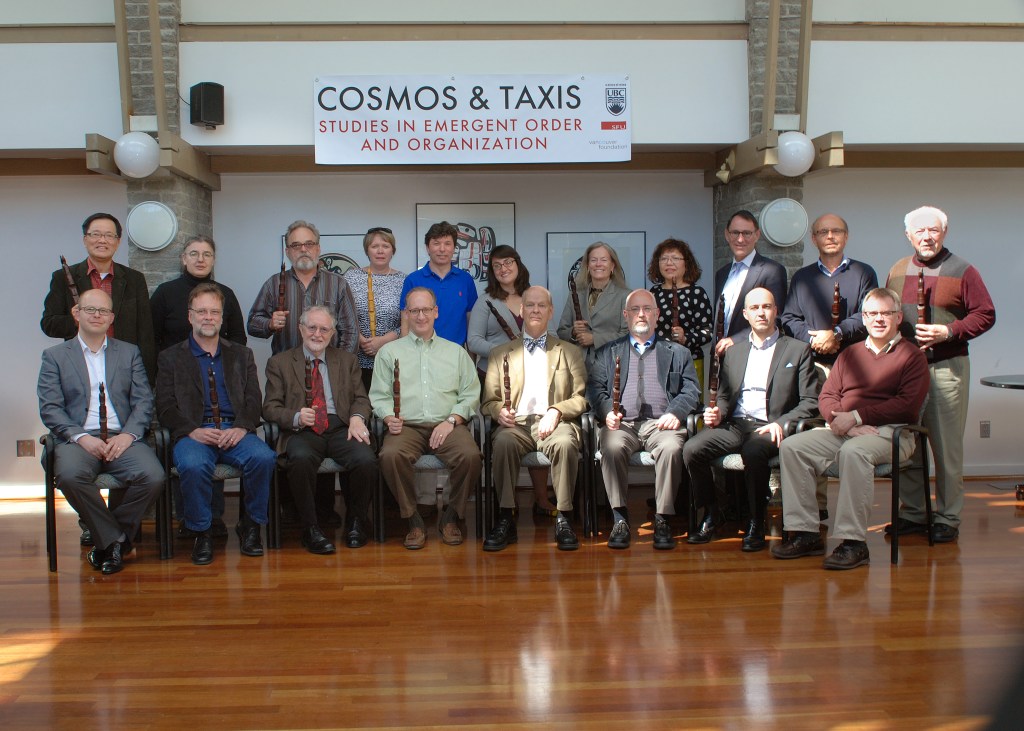
Cosmos & Taxis: Vancouver 2013
Photos from the conference: an unqualified success.
The Plant Man
The only superstar of the 60s and 70s who never rested on his laurels and continues to explore his musical roots with authenticity and integrity, from blues to rock n’ roll, to country to gospel. He understands where the source is – NOLA, the delta from which all styles emanated and flowed back again. The interesting stuff is happening at that porous sweet spot where all different styles converge where one is never sure of the provenance. The Band never lost that knack; the Stones once were able to do that a long time ago . . .
Intuition Pumping: Dennett Interview
3:AM Magazine: Dennett plugging his latest. See also Real People: Personal Identity without Thought Experiments.
Persons and the Extended-Mind Thesis
An extract from Lynne Rudder Baker’s paper:
Cognitive scientists have become increasingly enamored of the idea of extended minds. The extended-mind thesis (EM) is the claim that mentality need not be situated just in the brain or even within the boundaries of the skin. EM is the modal claim that it is possible that the mind is not bound by skull or skin. EM is quite radical: A mind is a collection of processes
that easily extends to tools, programs, other minds, and language. Cognitive states may have all sorts of components—neural, bodily, environmental. The heart of the extended-mind thesis is that we biological creatures can “couple” with nonbiological entities or features of our environment and thereby expand the entities that we are. Some versions do away with enduring agents altogether; “extended selves” (Clark and Chalmers 1998, 18) are relatively transitory couplings of biological organisms and external resources. There is a huge and complex literature on the idea of an extended mind, both pro and con. I focus here on some of Andy Clark’s work, especially the article he wrote with David Chalmers in 1998, “The Extended Mind.”
Here is my plan for the article. First, I show how EM can be seen as an extension of traditional views of mind. Then, after voicing a few qualms about EM, I reject it in favor of a more modest hypothesis that recognizes enduring subjects of experience and agents with integrated bodies. Nonetheless, my modest hypothesis allows subpersonal states to have nonbiological parts that play essential roles in cognitive processing. I present empirical warrant for this hypothesis and show how it leaves room for science and religion to coexist.
FROM TRADITIONAL VIEWS TO THE EXTENDED MIND
One way to understand EM is to start with a traditional picture of mental states and then see how EM revises it. Here is one traditional picture: Many mental states have content—states of desire are satisfied or not, intentions are fulfilled or not, beliefs are true or false. Typically, contents are given by the that-clauses that follow psychological and linguistic verbs such as thinks, believes, desires, intends, says. Thoughts and other contentful states are said to have two kinds of properties: properties determined by the content and properties of the vehicles that carry content. (The distinction brings to mind Descartes’ distinction between representative, or objective, reality and formal reality.)
What makes a thought the very thought that it is is its content. That is, states that have content are individuated by their contents. The thought that snow is white differs from the thought that grass is green in virtue of the difference between snow’s being white and grass’s being green. The contents of thoughts (and other mental states)—that snow is white or that grass is green—are carried by vehicles, traditionally thought of as neural states. Neural states are internal states, “in the head.” Call this view vehicleinternalism.
Even if, as traditionally supposed, vehicles are internal to the thinker, the contents of thoughts may be determined by phenomena outside the thinker (or so many think). The view that the contents of our thoughts— and, hence, the identity of which thoughts we can have—are determined by features of the environment is called content-externalism. To take a well-worn example, Pam, who lives on Earth where there is H2O (water), may have the thought that water is wet. Now suppose that there is another world in which there is an abundant liquid that looks like water but is not water because it has a different chemical composition. Suppose also that people in that waterless world drink, brush their teeth with, and swim in the water look-alike. The inhabitants speak a language similar to English, but when they utter what sounds like “water” in English, they are not speaking of water but of the other stuff, the water look-alike. In that world, where there is no water (no H2O), a molecular duplicate of Pam—call her Cam—could not have the thought that water is wet. The duplicate’s thought can be reported in English as the thought that twater (the stuff in the other world) is wet, but it cannot be reported as the thought that water is wet. Cam’s thoughts that correspond to Pam’s water-thoughts are twater-thoughts. Cam cannot have any water-thoughts. Because Pam and Cam are molecular duplicates, their brain states are of identical types. But if content-externalism is true, their thoughts are not of identical types.
Although content-externalism is not altogether uncontroversial, it is well-entrenched enough to say that a version of the traditional view combines vehicle-internalism and content-externalism. We may see EM as an extension of the externalism of contents to an externalism of vehicles. With the combination of vehicle-internalism and content-externalism in the background, EM treats vehicles in a way analogous to the way that the (externalist) traditional view treats content. EM is a kind of extreme externalism in that not only the determinants of content but also the vehicles may be located outside the organism. Clark, an early proponent of EM, characterizes EM as “the view that the material vehicles of cognition can be spread out across brain, body and certain aspects of the physical environment itself ” (2005, 1). EM in effect extends content-externalism to vehicle-externalism (Hurley 1998). Until recently, vehicles were thought to be only brain states (vehicle-internalism). According to vehicle-externalism, however, not only is the content determinable by features of the environment, but the vehicle also may be spread out into the environment. Vehicle-externalism supposes that cognitive processes may have vehicles that include aspects of the environment.
For example, beliefs are normally embedded in memory, but they need not be. Consider Otto, who is impaired in such a way that he cannot form new memories. He writes down what he wants to remember in a notebook that he always carries. Suppose that Otto is on Fifth Avenue in New York City and is looking for the Museum of Modern Art (MoMA). He knows that he cannot simply search his memory for the location of MoMA, so he automatically reaches for his trusty notebook and looks up the address: 53rd Street. The information in the notebook—just like the information stored in brain-based memory—“is reliably there when needed, available to consciousness and available to guide action, in just the way that we expect a belief to be” (Clark and Chalmers 1998, 13). Viewed from the lens of EM, the skin is seen as an artificial boundary.
In one of the most important early articles on EM, Clark and Chalmers state that “when it comes to belief, there is nothing sacred about skull and skin. What makes some information count as a belief is the role it plays, and there is no reason why the relevant role can be played only from inside the body.” For some of Otto’s mental states—his extended beliefs—Otto and his notebook are coupled; they form a cognitive system, all components of which are causally active. The “relevant parts of the world are in the loop, not dangling at the other end of a long causal chain” (Clark and Chalmers 1998, 9). Hence, extended cognition is sometimes called “active externalism” (p. 8).
As Clark puts it later, “taken as a single, integrated system, Otto-andthe- notebook exhibit enough of the central features and dynamics of a normal agent having (amongst others) the dispositional belief that MOMA is on 53rd Street to warrant treating him as such.” He asks rhetorically, “If an inner mechanism with this functionality [passive aspects of memory] would intuitively count as cognitive, then (skin-based prejudices aside) why not an external one?” (Clark 2005, 7) The point of EM is that neither the organic brain nor the skin sets a boundary on the vehicles of cognition. Features of the environment may or may not be components of the vehicle.
In general, tools extend cognition. A tool, “even when temporarily in use, is rapidly assimilated into the brain’s body maps and is treated (temporarily) just like a somewhat less sensitive part of the body.” For example, the receptive visual field of a macaque using a rake for as little as thirty seconds becomes elongated as if the rake were part of the arm (Clark 2005, 8). Use of a tool, even temporarily, changes neural maps. Neural plasticity “makes it possible for new equipment to be factored deep into both our cognitive and physical problem-solving routines” (p. 9). So, we become physical and cognitive hybrids—part biological and part artifactual.
Not only is there physically extended cognition, there is socially extended cognition as well. As many have observed, their spouses are their external memory devices. My husband serves as part of a vehicle for many of my memories. For such memories (as well as in other ways), a proponent of EM may say that my husband and I are coupled. Coupling between agents is effected by language, among other things. Language “is not a mirror of our inner states but a complement to them. It serves as a tool whose role is to extend cognition in ways that on-board devices cannot” (Clark and Chalmers 1998, 18).
Clark emphasizes that hybridization (Otto-and-his-notebook) is quite normal. We routinely use “transparent technologies” such as pencils for calculating sums. We are just shifting combinations of biological and nonbiological elements.
Dynamic empathy: A new formulation for the simulation theory of mind reading
The intro to Teed Rockwell’s paper:
There are currently two popular theories for explaining “mind reading” i.e. our ability to become aware of what other people are feeling and thinking, and to predict (and/or respond skillfully to) behavior on the basis of that awareness. The first, known as the theory-theory (TT), claims that we have a theory of mind, which we use to make sense out of both our own and other people’s behavior. The second, known as the simulation theory (ST), has taken on two importantly different meanings.
(1) The first meaning is “equated with… imaginatively ‘putting oneself in the other’s place”’ (Gordon, 2004). Because the words ‘imaginative” and “imagine” are different forms of the word “image”, this definition seems to imply something like “creating an image in the mind”, and could include all five sensory modalities, not just audio-visual. There are arguably problems with thinking of this diverse range of qualities in the pictorial terms implied by the word “image”. However, this is very much in line with the traditional British Empiricist view. The Empiricists usually used visual examples like triangles and patches of red as their prototypes for “ideas”, and then used that word to refer to all sorts of sensations and feelings, including more qualitatively complex feelings such as thirst, hunger, disgust, fear, etc.
(2) Gordon also points out that ST refers to simulations of mental states where the pictorial connotations of “image” are much more problematic. These interpretations rely on the association of the word “simulation” with pretense or hypothetical “acting out”.
One’s own behavior control system is employed as a manipulable model of other such systems… The system is first taken off-line, so that the output is not actual behavior but only predictions or anticipations of behavior (Gordon, 2004).
According to this view, any aspect of our mental life can be turned into a simulation by taking it off-line—not just images and feelings, but abstract thoughts such as beliefs, desires, and decisions. Abstract thoughts of this sort include what are called the propositional attitudes, because they are focused towards a claim expressible in a proposition. (I believe/desire/ have decided that Paris is the capital of France, the war in Iraq must end, etc.) Because theories are ordinarily thought of as being sets of propositions, many people argue that there is no important difference between “simulating” these kinds of verbalizable thoughts and thinking them yourself, and thus the Simulation Theory collapses into the Theory Theory. (This requires the plausible assumption that thinking about something requires having a theory about it.)
It would take at least another whole paper to paraphrase and respond to the detailed and ingenious replies made by ST theorists to this objection (see especially Goldman, 2006, pp. 30–40). Most of them involve accepting what Goldman calls a hybrid theory, which describes mind reading as requiring both theories and simulations. The debate then continues as each side either defends or attacks claims that all alleged simulations in such a hybrid system can actually be reduced to theories, which in turn requires arguing over exactly what a theory is. The problem has become so complex that some have argued that we ought to drop the term “simulation” altogether (Stich & Nichols, 1992).
I personally find the criticisms made by TT theorists to be reasonably convincing, and agree with Stich and Nichols that the current defense of ST has made it hard to tell the difference between a theory and a simulation. I do believe, however, that the Simulation Theory got something importantly right, which would be lost if we retreated to a pure Theory Theory. The goal of this paper is to preserve these essential insights with a redefined Simulation Theory, which returns to an idea inspired by the first of Gordon’s descriptions of simulation, i.e. as a kind of “movie” consisting of perceptual sensations. I think the hybrid TT/ST theory does explain much (perhaps most) of what can be called mind reading. But I also believe that there is a kind of mind reading which is in a certain sense purely “perceptual” and unaided by any verbal theoretical elements. I understand why Gordon, Goldman and the other defenders of the Simulation Theory have not taken this route. There are excellent reasons, with a distinguished lineage, for rejecting pure ST. In the following section, I am going to trace that lineage. I will then argue that something like a pure ST is possible, if we greatly expand our concepts of “simulation” and “perception” by using conceptual resources from connectionist neuroscience. However, once these concepts are taken out of the brain and put into the world, there is no longer a compelling reason to always refer to our awareness of other minds as being a simulation. In certain circumstances, it arguably makes more sense to say that I share the same emotion with another person, rather than make a simulation of their emotion in my own private mind.
1. The Kantian objection to the simulation theory
In many ways, the argument between the Theory-Theory and the Pure Simulation Theory is the same argument that Kant and Hume had about the true nature of ideas. Hume and the other British empiricists thought that an idea was a particular ‘image’ in one of the sensory modalities, such as a red triangle or the taste of chocolate. These images were also capable of being shaped in a variety of ways by the faculty of imagination once they were received by the mind. Hume apparently believed that imagination was all that was needed to give these particular images the powers rationalists attributed to generalized abstractions.
Kant, however, argued that no image could ever do the work of a concept. The concept of triangle applies to triangles of mutually exclusive shapes and sizes, and therefore such an image of a “Universal Triangle” would be self-contradictory. The later Wittgenstein raised a similar objection to his earlier picture theory of language by pointing out that a picture of a man walking down a hill could just as easily be a picture of a man walking up a hill backwards. It is only our interpretation of the picture that makes it one or the other, just as it is our interpretation that decides that an image of a red triangle is an example of a triangle, rather than an example of a red thing. Jerry Fodor labeled this Humean position the resemblance theory and raised this objection to it.
The difficulty with the resemblance theory is that any portrait showing John to be tall must also show him to be many other things: clothed or naked, lying standing or sitting, having a head or not having a head, and so on. A portrait of a tall man who is sitting resembles a man’s being seated, as much as it resembles a man being tall. On the resemblance theory, it is not clear what distinguishes thoughts about John’s height from thoughts about his posture (Fodor, 1981, pp. 127–128).
The resemblance theory is the genus of which the pure simulation theory is a species, and the latter is thus vulnerable to all of these objections. Kant claimed that the only way to deal with this problem was to see an idea not as an image, but as a verbalizable theoretical rule. To have a concept of a triangle or dog is to have some sort of criteria or set of definitions that identifies all the different triangles or dogs. Even though a picture of a particular dog may be similar to all other dogs, It is also similar to countless other things. The only way you can make a distinction between relevant and irrelevant similarities is with a rule that connects the image to other members (and only other members) of the same category. Similarly, being able to simulate someone else’s emotions or beliefs is not going to help you “read her mind” unless you have some sort of theory that enables you to classify the simulated emotions and beliefs into some kind of category, such as fear or pain.
Cosmos & Taxis: Launch
Today marks the start of the Cosmos & Taxis conference to launch the associated journal. In attendance will be philosophers, economists, political scientists, sociologists, English profs, complexity theorists, computer scientists, urban geographers and more besides from North America, the Far East, Australasia, and Europe. Please consider submitting a paper, a review or discussion piece to C&T – it is an open access but fully referred journal, and given the nature of the subject matter, is very ecumenical. To keep apprised of developments, see the C&T Facebook page.
A Confederacy of Dunces – quotes and extracts – 14
“You realize, of course, that this is all your fault. The progress of my work will be greatly delayed. I suggest that you go to your confessor and make some penance, Mother. Promise him that you will avoid the path of sin and drinking in the future. Tell him what the consequence of your moral failure has been. Let him know that you have delayed the completion of a monumental indictment against our society. Perhaps he will comprehend the magnitude of your failing. If he is my type of priest, the penance will no doubt be rather strict. However, I have learned to expect little from today’s clergyman” (p. 46).
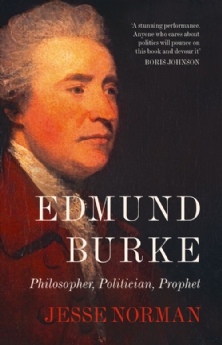
Jesse Norman’s Burke
Some very positive reviews of Jesse Norman’s Burke. Could Jesse be a Disraeli in the making?