A personal obit in Forbes. (I met Leonard in Portsmouth, NH)

A personal obit in Forbes. (I met Leonard in Portsmouth, NH)
Nassim Nicholas Taleb has freely made available a collection of his lectures.
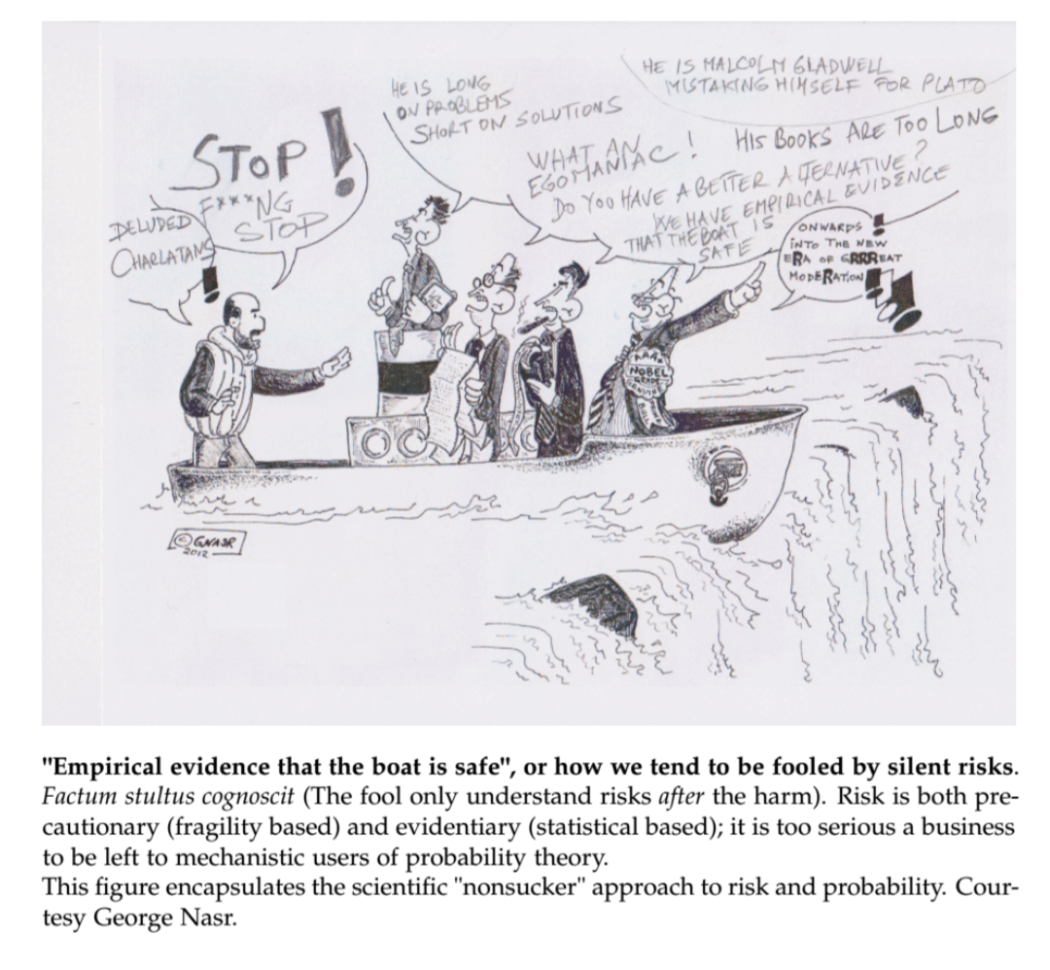
Russ Roberts’ latest getting some high-profile press, and endorsed by some top-notch names including the redoubtable Nassim Taleb. Here is an extended interview with Reason. On this general approach to Smith see this forthcoming collection.
Adam Smith, didn’t think the pursuit of wealth was a very good idea, thought it was corrosive, thought it was bad for you, thought ambition was bad for you, thought the pursuit of fame would destroy your character and your happiness, your serenity, your tranquility.

A new co-authored paper by the very versatile Tom Froese.
The model is in agreement with the traditional assumption that collective action is faced by serious problems without centralized hierarchical control, but it also clearly shows that spontaneous cooperation is feasible without it. At least in principle, there is no necessity to assume the existence of a lineage of powerful rulers to explain the origins of Teotihuacan.

“I no longer pretend to understand the world.” She is shaking her head yet still smiling her sweet menacing smile. “The world I knew has come crashing down around my ears. The things we hold dear are reviled and spat upon.” She nods toward Prytania Street. “It’s an interesting age you will live in—though I can’t say I’m sorry to miss it. But it should be quite a sight, the going under of the evening land. That’s us all right. And I can tell you, my young friend, it is evening. It is very late.”
For her too the fabric is dissolving, but for her even the dissolving makes sense. She understands the chaos to come. It seems so plain when I see it through her eyes. My duty in life is simple. I go to medical school. I live a long useful life serving my fellowman. What’s wrong with this? All I have to do is remember it.
“—you have too good a mind to throw away. I don’t quite know what we’re doing on this insignificant cinder spinning away in a dark corner of the universe. That is a secret which the high gods have not confided in me. Yet one thing I believe and I believe it with every fiber of my being. A man must live by his lights and do what little he can and do it as best he can. In this world goodness is destined to be defeated. But a man must go down fighting. That is the victory. To do anything less is to be less than a man.”
She is right. I will say yes. I will say yes even though I do not really know what she is talking about.
But I hear myself saying: “As a matter of fact I was planning to leave Gentilly soon, but for a different reason. There is something—” I stop. My idea of a search seems absurd.”
“To my surprise this lame reply is welcomed by my aunt.
“Of course!” she cries. “You’re doing something every man used to do. When your father finished college, he had his Wanderjahr, a fine year’s ramble up the Rhine and down the Loire, with a pretty girl on one arm and a good comrade on the other. What happened to you when you finished college? War. And I’m so proud of you for that. But that’s enough to take it out of any man.”
Wanderjahr. My heart sinks. We do not understand each other after all. If I thought I’d spent the last four years as a Wanderjahr, before “settling down,” I’d shoot myself on the spot.
“How do you mean, take it out of me?”
“Your scientific calling, your love of books and music. Don’t you remember how we used to talk—on the long winter evenings when Jules would go to bed and Kate would go dancing, how we used to talk! We tired the sun with talking and sent him down the sky. Don’t you remember discovering Euripides and Jean-Christophe?”
“You discovered them for me. It was always through you that—”All at once I am sleepy. It requires an effort to put one foot in front of the other. Fortunately my aunt decides to sit down. I wipe off an iron bench with my handkerchief and we sit, still arm in arm. She gives me a pat.”

Unaware that he was being trailed, Ignatius pushed his cart against the traffic down St. Charles toward the Quarter. He had stayed up so late the night before working on his lecture for the kickoff rally that he hadn’t been able to move from his yellowed sheets until almost noon, and then it had only been his mother’s violent pounding and screaming that had awakened him. Now that he was out on the streets, he had a problem. Today the sophisticated comedy was opening at the RKO Orpheum. He had been able to bleed ten cents out of his mother for carfare home, although she had even begrudged him that. Somehow he had to sell five or six hot dogs quickly, park the wagon somewhere, and get to that theater so that his disbelieving eyes could drink in every blasphemous technicolored moment.

After the first long swallow — really a slow and noiseless suck, because the thick crushed ice comes against your teeth and the ice must be kept out and the liquor let in — Cap Mac would say: “Very fine, Camille, you make the best julep in the world.” She probably did. Certainly her juleps had nothing in common with those hybrid concoctions one buys in bars the world over under that name. It would have been sacrilege to add lemon, or a slice of orange or of pineapple, or one of those wretched maraschino cherries. First you needed excellent bourbon whisky; rye or Scotch would not do at all. Then you put half an inch of sugar in the bottom of the glass and merely dampened it with water. Next, very quickly — and here was the trick in the procedure — you crushed your ice, actually powdered it, preferably in a towel with a wooden mallet, so quickly that it remained dry, and, slipping two sprigs of fresh mint against the inside of the glass, you crammed the ice in right to the brim, packing it with your hand. Last you filled the glass, which apparently had no room left for anything else, with bourbon, the older the better, and grated a bit of nutmeg on the top. The glass immediately frosted and you settled back in your chair for half an hour of sedate cumulative bliss. Although you stirred the sugar at the bottom, it never all melted, therefore at the end of the half hour there was left a delicious mess of ice and mint and whisky which a small boy was allowed to consume with calm rapture.
— William Alexander Percy, Lanterns on the Levee, pp. 65-66.
Check out the latest (and last) raft of papers from the soon to be defunct SIEO now hosted under auspices of C+T:
Symposium on Luigino Bruni’s The Genesis and Ethos of the Market
Symposium on Gary Chartier’s Anarchy and Legal Order
Symposium on Deborah Stevenson’s The City

The very excellent Stephen Turner on tacit knowledge in the latest issue of Tradition & Discovery: The Polanyi Society Periodical.

Dear Reader,
Nature has sometimes made a fool; but a coxcomb is always of man’s own making.
— Addison
As I was wearing the soles of my desert boots down to a mere sliver of crepe rubber on the old flagstone banquettes of the French Quarter in my fevered attempt to wrest a living from an unthinking and uncaring society, I was hailed by a cherished old acquaintance (deviate). After a few minutes of conversation in which I established most easily my moral superiority over this degenerate, I found myself pondering once more the crises of our times. My mentality, uncontrollable and wanton as always, whispered to me a scheme so magnificent and daring that I shrank from the very thought of what I was hearing. “Stop!” I cried imploringly to my godlike mind. “This is madness.” But still I listened to the counsel of my brain. It was offering me the opportunity to Save the World Through Degeneracy. There on the worn stones of the Quarter I enlisted the aid of this wilted flower of a human in gathering his associates in foppery together behind a banner of brotherhood.
Our first step will be to elect one of their number to some very high office — the presidency, if Fortuna spins us kindly. Then they will infiltrate the military. As soldiers, they will all be so continually busy in fraternizing with one another, tailoring their uniforms to fit like sausage skins, inventing new and varied battle dress, giving cocktail parties, etc., that they will never have time for battle. The one whom we finally make Chief of Staff will want only to attend to his fashionable wardrobe, a wardrobe which, alternately, will permit him to be either Chief of Staff or debutante, as the desire strikes him. In seeing the success of their unified fellows here, perverts around the world will also band together to capture the military in their respective countries. In those reactionary countries in which the deviates seem to be having some trouble in gaining control, we will send aid to them as rebels to help them in toppling their governments. When we have at last overthrown all existing governments, the world will enjoy not war but global orgies conducted with the utmost protocol and the most truly international spirit, for these people do transcend simple national differences. Their minds are on one goal; they are truly united; they think as one.
None of the pederasts in power, of course, will be practical enough to know about such devices as bombs; these nuclear weapons would lie rotting in their vaults somewhere. From time to time the Chief of Staff, the President, and so on, dressed in sequins and feathers, will entertain the leaders, i.e., the perverts, of all the other countries at balls and parties. Quarrels of any sort could easily be straightened out in the men’s room of the redecorated United Nations. Ballets and Broadway musicals and entertainments of that sort will flourish everywhere and will probably make the common folk happier than did the grim, hostile, fascistic pronouncements of their former leaders.
Almost everyone else has had an opportunity to run the world. I cannot see why these people should not be given their chance. They have certainly been the underdog long enough. Their movement into power will be, in a sense, only a part of the global movement toward opportunity, justice, and equality for all; (For example, can you name one good, practicing transvestite in the Senate? No! These people have been without representation long enough. Their plight is a national, a global disgrace.)
Degeneracy, rather than signaling the downfall of a society, as it once did, will now signal peace for a troubled world. We must have new solutions to new problems.
I shall act as a sort of mentor and guide for the movement, my not inconsiderable knowledge of world history, economics, religion, and political strategy acting as a reservoir, as it were, from which these people can draw rules of operational procedure. Boethius himself played a somewhat similar role in degenerate Rome. As Chesterton has said of Boethius, “Thus he truly served as a guide, philosopher, and friend to many Christians; precisely because, while his own times were corrupt, his own culture was complete.”
This time I shall really confound Myrna minx. The scheme is too breathtaking for the literal, liberal minx mind mired in a claustrophobic clutch of clichés. The Crusade for Moorish Dignity, my brilliant first attack upon the problems of our times, would have been a rather grand and decisive coup had it not been for the basically bourgeois worldview of the rather simple people who were members of the vanguard. This time, however, I shall be working with people who eschew the insipid philosophy of the middle class, people who are willing to assume controversial positions, to follow their cause, however unpopular it may be, however it may threaten the smugness of the middle class.
Does M. Minkoff want sex in politics? I shall give her sex in politics — and plenty of it! No doubt she will be too overcome to respond to the originality of my project. At the very least, she will seethe with envy. (That girl must be attended to. Such effrontery cannot go unchecked.)
A debate between Pragmatism and Morality rages in my brain. Is the glorious end, Peace, worth the awesome means, Degeneracy? Like two figures in the medieval Morality play, Pragmatism and Morality spar in the boxing ring of my brain. I cannot await the outcome of their furious debate: I am too obsessed with Peace. (If any perceptive film producers are interested in buying the movie rights to this Journal, I might here make a note on the filming of this debate. A musical saw would provide excellent background accompaniment, and the hero’s eyeball may be superimposed upon the debate scene in a most symbolic manner. Certainly some attractive new discovery could be found in a drugstore or a motel or in whatever den people are “discovered” to play the Working Boy. The film may be made in Spain, Italy, or some other interesting land which the cast may wish to see, such as North America.)
Sorry. Those of you who are interested in the latest bleak frankfurter news will find none. My mind is too preoccupied with the magnificence of this design. Now I must communicate with M. Minkoff and make some jottings for my lecture at the kickoff rally. Social note: My truant mother is gone again, which is really rather fortunate. Her vigorous assaults and blistering attacks against my being are negatively affecting my valve. She said that she was going out to attend a Crowning of the May Queen at some church, but since it isn’t May, I tend to doubt her veracity.
The “sophisticated comedy” featuring my number one female film favorite is opening at a downtown palace momentarily. Somehow I must be there on opening day. I can only imagine the film’s latest horrors, its flaunting of vulgarity in the face of theology and geometry, taste and decency. (I do not understand this compulsion of mine for seeing movies; it almost seems as if movies are “in my blood.”)
Health note: My stomach is getting out of bounds; the seams of my vendor’s smock are creaking ominously.
Until later,
Tab, Your pacifist Working Boy


