It is particularly meaningful for me to be giving this lecture on the 25th anniversary of the one by Walker Percy. I took the train from New York for that occasion, looking out of the window and thinking of his eerie essay about the malaise, “The Man on the Train.” If memory serves, it was over at the Mellon Auditorium, and Lynne Cheney did the introduction.
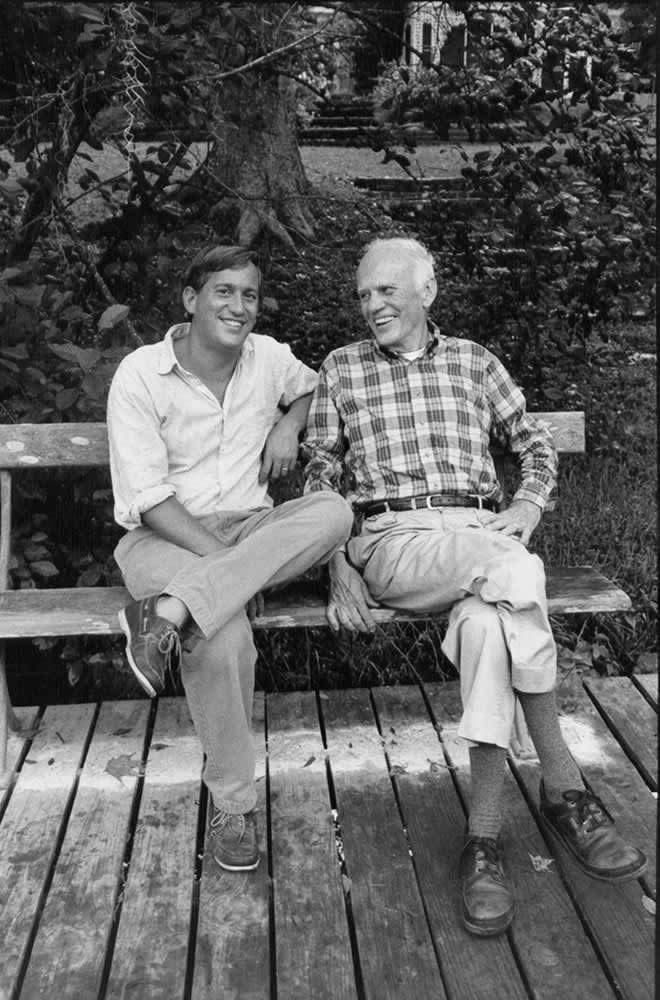
Dr. Percy, with his wry philosophical depth and lightly-worn grace, was a hero of mine. He lived on the Bogue Falaya, a bayou-like, lazy river across Lake Pontchartrain from my hometown of New Orleans. My friend Thomas was his nephew, and thus he became “Uncle Walker” to all of us kids who used to go up there to fish, capture sunning turtles, water ski, and flirt with his daughter Ann. It was not quite clear what Uncle Walker did. He had trained as a doctor, but he never practiced. Instead, he seemed to be at home most days, sipping bourbon and eating hog’s head cheese. Ann said he was a writer, but it was not until his first novel, The Moviegoer, had gained recognition that it dawned on me that writing was something you could do for a living, just like being a doctor or a fisherman or an engineer. Or a humanist.
He was a kindly gentleman, whose placid face seemed to know despair but whose eyes nevertheless often smiled. He once said: “My ideal is Thomas More, an English Catholic who wore his faith with grace, merriment, and a certain wryness.” That describes Dr. Percy well.
His speech twenty-five years ago was, appropriately enough for an audience of humanists, about the limits of science. “Modern science is itself radically incoherent, not when it seeks to understand subhuman organisms and the cosmos, but when it seeks to understand man,” he said. I thought he was being a bit preachy. But then he segued into his dry, self-deprecating humor. “Surely there is nothing wrong with a humanist, even a novelist, who is getting paid by the National Endowment for the Humanities, taking a look at his colleagues across the fence, scientists getting paid by the National Science Foundation, and saying to them in the friendliest way, ‘Look, fellows, it’s none of my business, but hasn’t something gone awry over there that you might want to fix?’” He said he wasn’t pretending to have a grand insight like “the small boy noticing the naked Emperor.” Instead, he said, “It is more like whispering to a friend at a party that he’d do well to fix his fly.”
The limits of science was a subject he knew well. He had trained as a doctor and was preparing to be a psychiatrist. After contracting tuberculosis, he woke up one morning and had an epiphany. He realized science couldn’t teach us anything worth knowing about the human mind, its yearnings, depressions, and leaps of faith.
So he became a storyteller. Man is a storytelling animal, especially southerners. Alex Hailey once said to someone, who was stymied about how to give a lecture such as this, that there were six magic words to use: “Let me tell you a story.” So let me tell you a story: Percy’s novels, I eventually noticed, carried philosophical, indeed religious, messages. But when I tried to get him to expound upon them, he demurred. There are, he told me, two types of people who come out of Louisiana: preachers and storytellers. For goodness sake, he said, be a storyteller. The world has too many preachers.
For Dr. Percy, storytelling was the humanist’s way of making sense out of data. Science gives us empirical facts and theories to tie them together. Humans turn them into narratives with moral and emotional and spiritual meaning.
His specialty was the “diagnostic novel,” which played off of his scientific knowledge to diagnose the modern condition. In Love in the Ruins, Dr. Thomas Moore, a fictional descendant of the English saint, is a psychiatrist in a Louisiana town named Paradise who invents what he calls an “Ontological Lapsometer,” which can diagnose and treat our malaise.
I realized that Walker Percy’s storytelling came not just from his humanism – and certainly not from his rejection of science. Its power came because he stood at the intersection of the humanities and the sciences. He was our interface between the two.