Big News for “Pops” Aficionados

The Louis Armstrong House Museum has acquired the only known film of the great jazz musician in a recording studio, recording the 1959 album, “Satchmo Plays King Oliver.” This exclusive video depicts Armstrong and his All Stars recording the master take of “I Ain’t Got Nobody,” as well as silent footage of them listening to the playback. Also featured in the clip are Trummy Young, trombone, Peanuts Hucko, clarinet, Billy Kyle, piano, Mort Herbert, bass and Danny Barcelona, drums. The original album was produced for Audio Fidelity records by Sid Frey, who commissioned the film to be made. It was discovered in a storage facility in 2012 and was brought to the Armstrong House with help of Frey’s daughter, Andrea Bass.
Fun things to look out for:
*There’s no sheet music, forcing Louis to make up a few lyrics (“hot mamas!”)
*Watch for Louis breaking himself up after quoting “Pennies from Heaven” during the opening trumpet chorus.
*Armstrong often said when he scatted, he’d move his fingers as if he was playing the trumpet; watch the dramatic hand gestures during the vocal!
*We can’t hear the playback, but Louis looks satisfied. (That’s Dukes of Dixieland manager Joe Delaney sitting next to Louis.) And dig those shorts!
*This was all filmed at the famous Radio Recorders in Los Angeles, a great glimpse into a world-renowned studio.

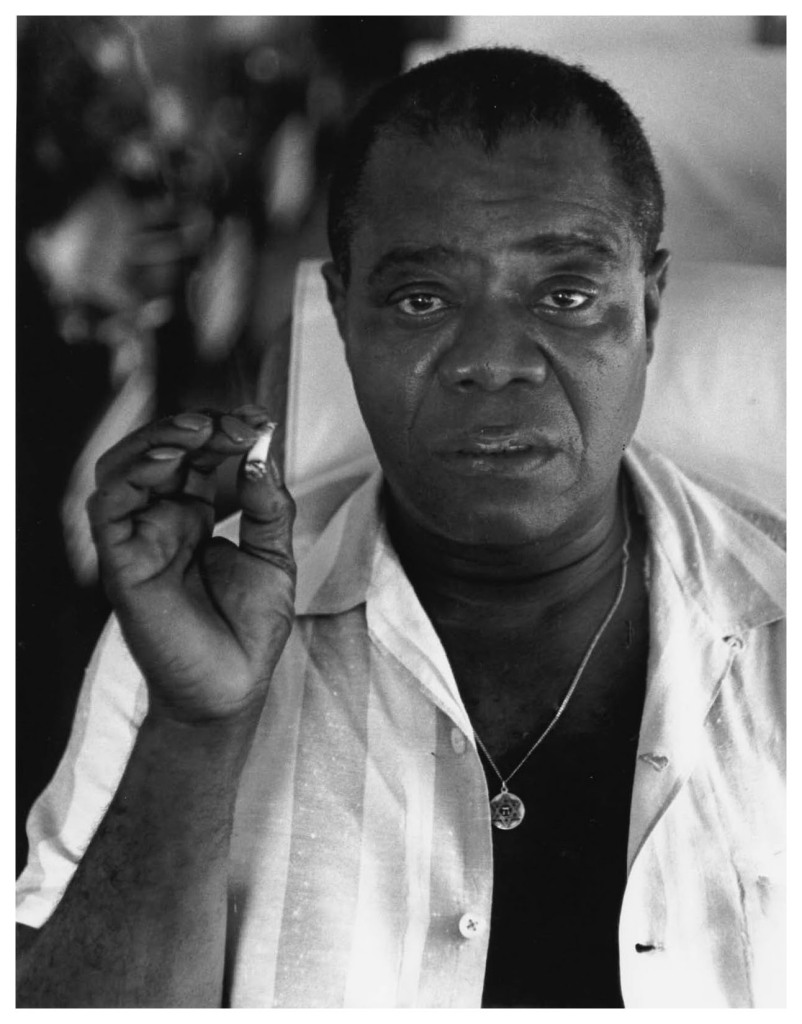
louis-armstrong-with-the-star-of-david-on-his-chest-tanglewood-ma-1960

Organizational Decisions in the Lab

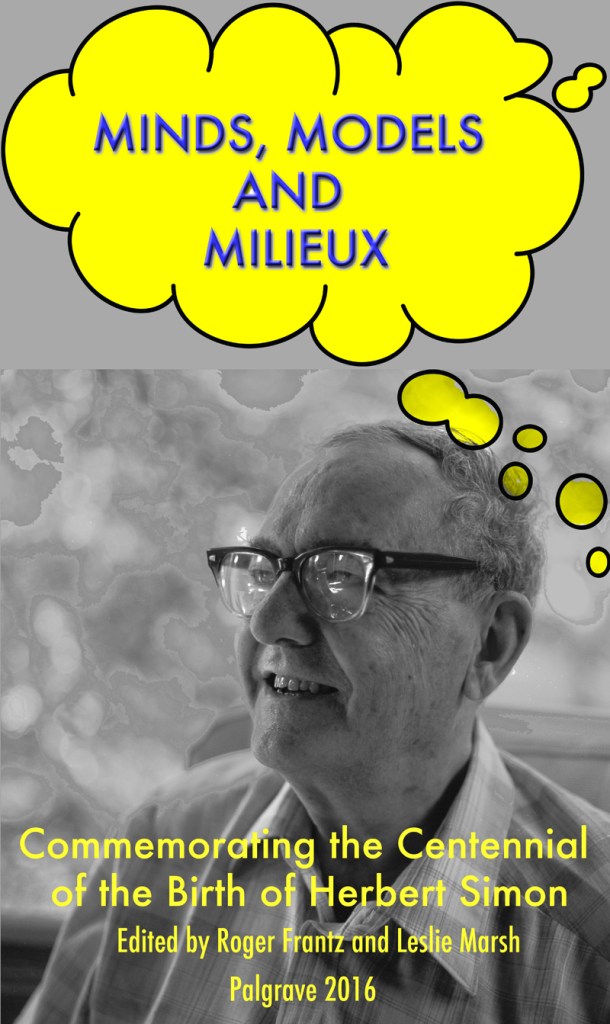
The eleventh in a series of excerpts from Minds, Models and Milieux: Commemorating the Centennial of the Birth of Herbert Simon.

Massimo Egidi

“Bounded Rationality” is a label that gathers the most important advancements of Herbert Simon’s scientific production. His fundamental contributions to cognitive psychology and to the theory of problem solving were developed jointly, each being nurtured by the discoveries emanating from the other discipline. I will briefly review some steps on the path to the creation of the theory of bounded rationality, in order to introduce to the issue of organizational decision making, and the associated laboratory experiments.

From the very start, Simon built the idea of bounded rationality on close observation of the behavior of employees and managers in large organizations. In Administrative Behavior, published in 1947, he came to the realization that organization’s internal mechanisms, insofar as they are characterized by division of labour and cooperation, are the product of a complex activity of goal achieving. Important progresses in this direction were achieved in the fifties, through some empirical analyses of managerial decisions that he conducted at the Graduate School of Industrial Administration of Carnegie Mellon. Among them, of primary interest is the research he conducted jointly with Cyert and Trow in which they realize that beyond the routine decisions, managers make non-repetitive decisions that require solving problems in ill-defined conditions. (Cyert, Simon and Trow, 1956, p. 238)

The field analysis of problem solving sowed the seeds of theory of bounded rationality. In Organizations (1958) March and Simon moved forward from the notion of problem solving as individual activity to the notion of organizational problem solving, with a clear recognition of the evolutionary processes of organizational adaptation and organizational learning within business corporations. The identification of these processes was enhanced by the assumption that the division of labour can be considered a collective problem solving activity. Thus, the development of a deeper theory of problem solving became crucial in explaining human decisions and for the creation of new ideas in theory of organization: in particular the notion of organizational routines within business firms, and of their evolution.

At the time he was finishing his work on Organizations, Simon began his collaboration with Allen Newell. Human Problem Solving, which they published together in 1972, is a bridge between computation, artificial intelligence and cognitive psychology. Here Simon went beyond the notion of “computation” as a human activity that relates means to ends, replacing it with the notion of symbolic manipulation and deepening the various connected mental abilities — memorization, evocation, categorization, abstraction, judgment.

HS_POSTER

Dirty Mind

Neither For You nor Prince was adequate preparation for the full-blown masterpiece of Prince’s third album, Dirty Mind. Recorded in his home studio, with Prince playing nearly every instrument, Dirty Mind is a stunning, audacious amalgam of funk, new wave, R&B, and pop, fueled by grinningly salacious sex and the desire to shock. Where other pop musicians suggested sex in lewd double-entendres, Prince left nothing to hide — before its release, no other rock or funk record was ever quite as explicit as Dirty Mind [ed. What about the Mothers @ Filmore East?], with its gleeful tales of oral sex, threesomes, and even incest. Certainly, it opened the doors for countless sexually explicit albums, but to reduce its impact to mere profanity is too reductive — the music of Dirty Mind is as shocking as its graphic language, bending styles and breaking rules with little regard for fixed genres. Basing the album on a harder, rock-oriented beat more than before, Prince tries everything — there’s pure new wave pop (“When You Were Mine”), soulful crooning (“Gotta Broken Heart Again”), robotic funk (“Dirty Mind”), rock & roll (“Sister”), sultry funk (“Head,” “Do It All Night”), and relentless dance jams (“Uptown,” “Partyup”), all in the space of half an hour. It’s a breathtaking, visionary album, and its fusion of synthesizers, rock rhythms, and funk set the style for much of the urban soul and funk of the early ’80s. — AllMusic

71b5lyb1SbL._SL1114_

Walker Percy Wednesday 81

percycovercroppea

During the last months I found that I could be moderately happy if I simultaneously (1) drank, (2) read Raymond Chandler, and (3) listened to Beethoven.

*****

The world had gone crazy, said the crazy man in his cell. What was nutty was that the movie folk were trafficking in illusions in a real world but the real world thought that its reality could only be found in the illusions. Two sets of maniacs.

*****

Which is a better world, this cocksucking cuntlapping assholelicking fornicating Happyland U.S.A. or a Roman legion under Marcus Aurelius Antoninus? Which is worse, to die with T. J. Jackson at Chancellorsville or live with Johnny Carson in Burbank?

Yes, I’ll be out of here in a month or two. What do we intend to do, you ask? We? I can only speak for me. Others will then do likewise. But let me give you an example from my future life. Yes! I may be uncertain about the past, about what happened—it’s all confused, I’d rather not think about it—but I know what the future and the new order and my life will be like. The new order will not be based on Catholicism or Communism or fascism or liberalism or capitalism or any ism at all, but simply on that stem rectitude valued by the new breed and marked by the violence which will attend its breach. We will not tolerate this age. Don’t speak to me of Christian love. Whatever came of it? I’ll tell you what came of it. It got mouthed off on the radio and TV from the pulpit and that was the was the end of it. The Jews knew better. Billy Graham lay down with Nixon and got up with a different set of fleas, but the Jewish prophets lived in deserts and wildernesses and had no part with corrupt kings. I’ll prophesy: This country is going to turn into a desert and it won’t be a bad thing. Thirst and hunger are better than jungle rot. We will begin in the Wilderness where Lee lost. Deserts are clean places. Corpses turn quickly into simply pure chemicals.

*****

Children will be merry because they will know what they are to do.

*****

New Orleans is a shabby gentle benign place. We shall buy a small Victorian cottage under the levee and live a simple life.

71-7RaZSTxL

Want to See Women’s Equality? Look to Jazz

Mark Judge article in Acculturated (Mark can be excused for using the tarnished term “liberal” which unfortunately gives genuine free speech liberals a bad name).

Many of the best jazz musicians are women, and many of them are creating brilliant music. Furthermore, they create without having to resort to shedding clothing or causing public scandal to get attention.

91pQ6mBHpzL._SL1500_

The Emergence of “Emergence” in the Work of F. A. Hayek: A Historical Analysis

Recent article by the very excellent Paul Lewis in History of Political Economy Volume 48, Issue 1. Abstract: This article identifies the sources on which Friedrich Hayek drew in order to develop his understanding of the notion of emergence. It is widely acknowledged that the notion of emergence plays a significant role in Hayek’s analyses of both the mind and the market. In Hayek’s account, the key capacities of the human mind—such as its capacity to enable people to perceive the world around them and to form plans about how to act—are emergent properties of the structured array of neurons found in the human brain. Analogously, Hayek’s analysis of the market portrays the coordinative powers of the price mechanism as an emergent property of the social system that is formed when people’s (inter)actions are governed by a set of norms that includes both the formal rules of property and tort and contract law, and also informal norms of honesty and promise keeping. However, while several scholars have identified the importance of the notion of emergence in Hayek’s thought, none have explored systematically and in detail the sources from which he acquired his knowledge of the concept. This article remedies that omission by examining the history of Hayek’s use of the concept of emergence and identifying the sources through which notions of emergence and “emergent properties” entered his thinking. It is argued that the three main sources of influence are as follows: the ideas of the German psychologist Wilhelm Wundt; the work of members of the gestalt school of psychology; and the writings of the organicist biologists Joseph Woodger and Ludwig von Bertalanffy. The significance of the article’s findings for those interested in the development of Hayek’s economics is also discussed.

vonhayek

Black Jews in Africa and the Americas

I’ve been following the fascinating work of Tudor Parfitt for the past thirty or so years. He is known primarily for his television programmes broadcast on the BBC and Channel Four. I finally got to reading his book Black Jews in Africa and the Americas. In this age of crude identity politics and “cultural appropriation” fundamentalists, the story that Parfitt tells would, needless to say, obfuscate their ideologically and robotically regurgitated narrative. This aside from the fact that Jewish identity has ALWAYS been THE puzzle case in matters of social ontology. Parfitt’s book is very accessible and relatively brief, so if you want to get beyond the standard literature on race and colonialism, this book is just the ticket to muddy the waters. Despite seeing some value to the work one snippy reviewer in The American Historical Review completely misses the deep philosophical point that is the driver to the discussion. The reviewer writes: “However, Black Jews does little to define the terms “blacks” and “Jews,” and they are in bad need of denotation, particularly when counterpoised.” Now, that’s precisely the point!! There are no necessary and sufficient conditions for social identity, but this doesn’t mean either that one needs to buy into vulgar social constructivism, characteristic of the off-the-peg sort that is making headlines, under prevailing (and yes essentialist) identity politics paradigm. The reviewer then goes on to say that: “For a work deeply concerned with identity construction, it is also remarkable that Parfitt does not discuss the huge body of sociological and psychological literature that demonstrates how contemporary identities of individuals and groups are constructed.” Again, this is added value to Parfitt’s work — he’s not buying into the standard (and often) ideological lenses that sociologists especially, uncritically peddle, lapped up by their SJW cannon-fodder acolytes. Psychologically speaking, I don’t have a sense that the reviewer is au fait with much (or any) of the recent respectable research into social cognition. Perhaps the most idiotic comment is that: “Parfitt’s quest for etiology mirrors the very racialist reasoning he exposes earlier in his work as colonialist or the spawn of mono- and polygenesis theoreticians.” Across Parfitt’s work, this was never ever something entertained or even hinted at. Parfitt is merely using a tool, one legitimately employed scientific tool, to trace the spread of a genetic marker across vast geographical areas, adding some scientific credence to investigating the mythology of these stories. Parfitt is in no way claiming that this marker constitutes the essence to some racial or social profile — hence he desisted from defining “black” and “Jew”, precisely avoiding the dreadful essentialism that the reviewer chastised him for not engaging in earlier. Doesn’t the reviewer grasp that sociality is contingent and is not tied to some dubious metaphysic? That’s why to be critical of some aspect of a culture is the sine qua non to free speech and liberality. If that is denied, then our Enlightenment inheritance is doomed and we are about to enter the Dark Ages again — in some respects we are already there. Anyway, if you are genuinely interested in the puzzle cases thrown up by social ontology (and social history) this little book sheds light on the relatively little known phenomenon of black Jewry and should give food for thought (to Jew and Gentile alike) on critically engaging with these fascinating issues in social identity.

9780674066984-lg

Multiple Equilibria, Bounded Rationality, and the Indeterminacy of Economic Outcomes: Closing the System with Institutional Parameters

The tenth in a series of excerpts from Minds, Models and Milieux: Commemorating the Centennial of the Birth of Herbert Simon.

Morris Altman

A critical point made by behavioral economists from a wide set of methodological perspectives is that individuals typically do not make decisions that are consistent with conventional economic theoretical norms of rational behavior. This is true of those building on the errors and biases or heuristics and biases approach derived from the research of Kahneman and Tversky (Kahneman, 2003, 2011; Thaler and Sunstein, 2008), and those building upon the bounded rationality approach introduced by Herbert Simon (1978, 1979, 1987; Altman, 1999; Gigerenzer, 2007; Smith, 2003). Such ‘irrational’ behavior form the perspective of the mainstream is considered to be inefficient or sub-optimal. And sub-optimal outcomes should not be able to survive—it would fail the test of the survival of the fittest. However, various and different socio-economic outcomes or solutions for the same specific decision problems appear to be consistent with the survival on the market place. This is even true of economic outcomes, when firms are not maximizing productivity. Both low and high productivity firms can survive simultaneously on in the market. Moreover, ethical or socially considerate firms, and other-giving and empathic individuals can also survive and persist, even if such behavior is often considered to be sub-optimal and irrational from the perspective of the conventional economic wisdom.

It was just such apparent anomalies that Herbert Simon attempts to address through the concept of multiple equilibria, set in contrast with the more mainstream focus on convergence towards some optimal and unique equilibrium. From this perspective, both inefficient and efficient economic entities can persist over time in equilibrium. Therefore, survival and existence need not be in any way indicative or proof of uniqueness or optimality or efficiency in outcomes or decision making processes.

It is important to note that conventional and dominant economic methodology that deduces optimality and efficiency and even uniqueness from survival and existence is derived from the methodological paradigm articulated by Milton Friedman (1953; see also, Alchain, 1950). He maintained that survival is proof of optimality and efficiency of both outcomes and decision-making processes. One can deduce from outcomes—from survival—that individuals or economic agents behave in a particular and unique fashion—optimally and efficiently.

HS_POSTER

Allen Toussaint’s Final Release

The master’s final release. The blurb from Nonsuch Records as follows: “American Tunes is the final recording from legendary New Orleans musician Allen Toussaint. It was produced by Joe Henry and features both solo piano recordings made at Toussaint’s home studio in New Orleans and others made in Los Angeles with musicians like Jay Bellerose, Bill Frisell, Greg Leisz, Charles Lloyd, David Piltch, and special guests Rhiannon Giddens and Van Dyke Parks. There are works by Toussaint, Professor Longhair, Duke Ellington, Fats Waller, and Paul Simon, among others. Nonesuch Store pre-orders include an instant download of the track “Big Chief” and an exclusive, limited-edition print”.

allen-toussaint-american-tunes-1000sq_5