See Red: New Deltaphonic

Having spent the day previewing Deltaphonic’s forthcoming release See Red I’m pleased to report that they are very much on form. Given that their last album Texas, Texas set the bar so high, one had to wonder if they could ever approximate that again (this was the bind that Television found themselves in after Marquee Moon). See Red is still growing on me: I’ll report in more detail once the album has been officially released and I’ve “test driven” the album both sober and “under the influence” :) Speaking of which, I’d urge you to catch them at DBA for the launch — with some 17 gigs leading up to DBA they are going to be blindingly good. One of the greatest, if not THE greatest live musical night of my life, was seeing them absolutely shred the audience at the Apple Barrel last summer.

17097817_1379357198796294_7121799924598474512_o

Life is precious because it is precarious: Individuality, mortality, and the problem of meaning

The very excellent Tom Froese has a preprint of his latest available here for free download.

leadimage_large

A cleansing fire: Moral outrage alleviates guilt and buffers threats to one’s moral identity

[we] test the counter-intuitive possibility that moral outrage at third-party transgressions is sometimes a means of reducing guilt over one’s own moral failings and restoring a moral identity

— Rothschild & Keefer, Motivation and Emotion

moral_outrage_by_bunytech-d8twdbt

Lost Tribes of Israel, Blood and History

I’ve been fascinated by Tudor Parfitt’s work for some thirty years. If ever there were someone whose life as an academic had any genuine appeal to me, it would be his. In his pursuit of knowledge for knowledge’s sake he has had a profound effect on the understanding of that paradigm puzzle case of social identity, i.e. Jewish identity, and indeed social identity at large, without having to resort to a clunky tired off-the-peg marxism that still lingers over anthropology like a bad smell. Judiciously bringing science together with history and anthropology, Parfitt has come up with some fascinating results, results that the pseudo-inquiry aprioristic social justice castrati can never achieve — as Susan Haack cautioned twenty years ago:

A pseudo-inquirer seeks to make a case for the truth of some proposition(s) determined in advance. There are two kinds of pseudo-inquirer, the sham and the fake. A sham reasoner is concerned, not to find out how things really are, but to make a case for some immovably-held preconceived conviction. A fake reasoner is concerned, not to find out how things really are, but to advance himself by making a case for some proposition to the truth-value of which he is indifferent.

The takeover of the humanities and the social sciences is now complete, so much so, that there is nowhere left for them to colonize (as veriphobes, reality is indifferent to them, hence their frustration, bitterness and of course authoritarianism) — and so we can delight in the spectacle of them eating their own via purity tests, not to mention the ludicrousness of them having become Islam’s bitch.

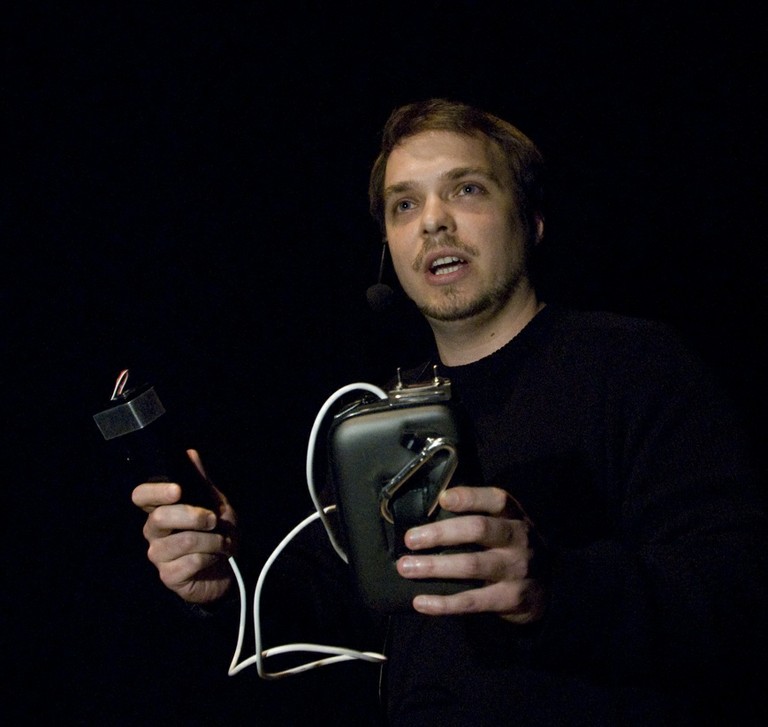
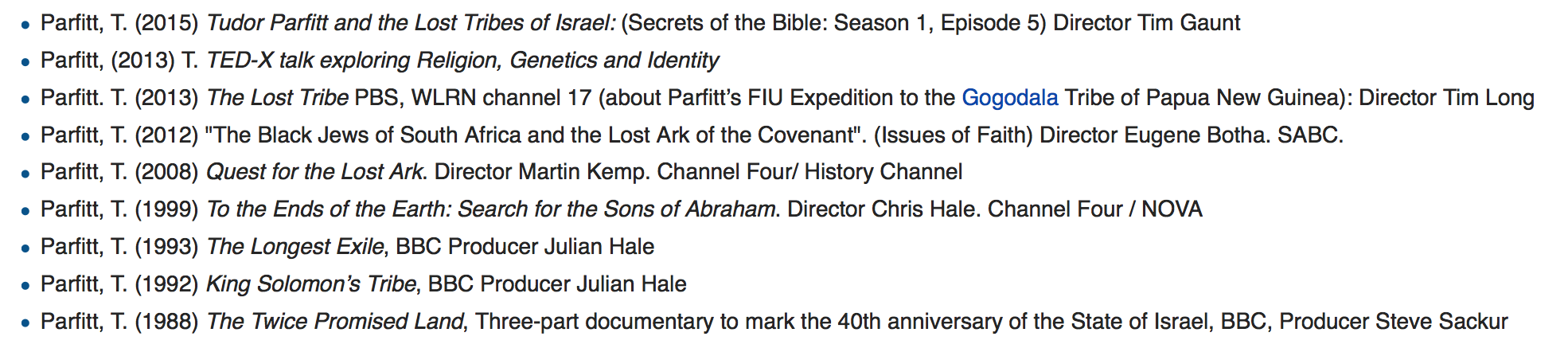
For those unfamiliar with Tudor Parfitt’s work, below is a recent introductory and quite personal talk (unfortunately we don’t see the slides). Several documentaries are available on YouTube — well worth checking out if you seek some intelligent and entertaining viewing:

screen-shot-2017-03-01-at-2-26-39-pm

And of course Parfitt’s books give the fine-grained detail that his programmes and talks cannot — and they are very easy reads. I was lucky enough to have had dinner with Tudor’s Oxford tutor some twenty years ago, David Patterson (obits here and here). With hindsight I’m embarrassed to say that my chat with David solely concerned Tudor but he was most gracious about it. Fortunately Tudor wasn’t at SOAS when I was in the vicinity in Malet St. — if at all possible, I tried to avoid going into that hateful cesspool of activism.

Walker Percy Wednesday 125

percycovercroppea

(6) Consider the following short descriptions of different kinds of consciousness of self. Which of the selves, if any, do you identify with?

(a) The cosmological self. The self is either unconscious of itself or only conscious of itself insofar as it is identified with a cosmological myth or classificatory system, e.g., totemism. Ask a Bororo tribesman: Who are you? He may reply: I am parakeet. (Ask an L.S.U. fan at a football game: Who are you? He may reply: I am a tiger.)

(b) The Brahmin-Buddhist self. Who are you? What is your self? My self in this life is impaled on the wheel of non-being, obscured by the veil of unreality. But it can realize itself by penetrating the veil of maya and plumbing the depths of self until it achieves nirvana, nothingness, or the Brahman, God. The atman (self) is the Brahman (God).

(c) The Christian self (and, to a degree, the Judaic and Islamic self). The self sees itself as a creature, created by God, estranged from God by an aboriginal catastrophe, and now reconciled with him. Before the reconciliation, the self is, as Paul told the Ephesians, a stranger to every covenant, with no promise to hope for, with the world about you and no God. But now the self becomes a son of God, a member of a family of selves, and is conscious of itself as a creature of God embarked upon a pilgrimage in this life and destined for happiness and reunion with God in a later life.

(d) The role-taking self. One sociological view of the self is that the self achieves its identity by taking roles and modeling its own role from the roles of others, e.g., one’s mother, father, housewife, breadwinner, macho-boy-man, feminine-doll-girl, etc.—and also, as George Mead said, upon how one perceives others’ perceptions of oneself.

(e) The standard American-Jeffersonian high-school-commencement Republican-and-Democratic-platform self. The self is an individual entity created by God and endowed with certain inalienable rights and the freedom to pursue happiness and fulfill its potential. It achieves itself through work, participation in society, family, the marketplace, the political process, cultural activities, sports, the sciences, and the arts. It follows that in a free and affluent society the self should succeed more often than not in fulfilling itself. Happiness can be pursued and to a degree caught.

(f) The diverted self. In a free and affluent society, the self is free to divert itself endlessly from itself. It works in order to enjoy the diversions that the fruit of one’s labor can purchase. The pursuit of happiness becomes the pursuit of diversion, and in this society the possibilities of diversion are endless and as readily available as eight hours of television a day: TV, sports, travel, drugs, games, newspapers, magazines, Vegas.

(g) The lost self. With the passing of the cosmological myths and the fading of Christianity as a guarantor of the identity of the self, the self becomes dislocated, Jefferson or no Jefferson, is both cut loose and imprisoned by its own freedom, yet imprisoned by a curious and paradoxical bondage like a Chinese handcuff, so that the very attempts to free itself, e.g., by ever more refined techniques for the pursuit of happiness, only tighten the bondage and distance the self ever farther from the very world it wishes to inhabit as its homeland. The rational Jeffersonian pursuit of happiness embarked upon in the American Revolution translates into the flaky euphoria of the late twentieth century. Every advance in an objective understanding of the Cosmos and in its technological control further distances the self from the Cosmos precisely in the degree of the advance—so that in the end the self becomes a space-bound ghost which roams the very Cosmos it understands perfectly.

(h) The scientific and artistic self. Or that self which is so totally absorbed in the pursuit of art or science as to be selfless. The modern caricature is the “absentminded professor” or the demonic possessed artist, which is to say that as a self he is “absent” from the usual concerns of the self about itself in the world. E.g., Karl von Frisch and his bees, Schubert in a beer hall writing lieder on the tablecloth, Picasso in a restaurant modeling animals from bread.

(i) The illusory self. Or the conviction that one’s sense of oneself is a psychological or cultural illusion and that with the advance of science, e.g., behaviorism, Lévi-Strauss’s structuralism, the self will disappear.

(j) The autonomous self. The self sees itself as a sovereign and individual consciousness, liberated by education from the traditional bonds of religion, by democracy from the strictures of class, by technology from the drudgery of poverty, and by self-knowledge from the tyranny of the unconscious—and therefore free to pursue its own destiny without God.

(k) The totalitarian self. The self sees itself as a creature of the state, fascist or communist, and understands its need to be specified by the needs of the state.

(CHECK ONE)

9780312253998_custom-879fe996d0c45da2a69a358283ae164595a77f96-s6-c30

Christina Hoff Sommers on warped “fainting-couch” feminism

Fainting-couchers view women as psychically fragile and prone to trauma. They demand trigger warnings, safe spaces, and micro-aggression monitoring.

The institutionalized pseudo-inquiry of “professionalized” whining, perpetual victimhood and self-aggrandizement railing against “the patriarchy”, is no more than yet another ill-founded conspiracy theory peddled by the intellectually lazy virtue-signaling prof with no skin in the game. Here is an Interview with based mom Christina Hoff Sommers in The Dartmouth Review. It is well-worth checking out CHS’ Factual Feminist series and more to be found here. Educate yourself, educate your daughters — so that they might actually fulfill their true potential in age that is the most conducive to their flourishing in history.

christina_hoff_sommers

Two Kinds of Mind: Dennett and Scruton

Nicely balanced review of Dennett and Scruton’s latest books. We need both approaches. See article in Standpoint.

methode-times-prod-web-bin-b6e14bca-f91f-11e6-a6f0-cb4e831c1cc0

onhumannature