THE MYSTERY OF LANGUAGE
LANGUAGE IS an extremely mysterious phenomenon. By mysterious I do not mean that the events which take place in the brain during an exchange of language are complex and little understood-although this is true too. I mean, rather, that language, which at first sight appears to be the most familiar sort of occurrence, an occurrence which takes its place along with other occurrences in the world-billiard balls hitting other billiard balls, barkings of dogs, cryings of babies, sunrises, and rainfalls-is in reality utterly different from these events. The importance of a study of language, as opposed to a scientific study of a space-time event like a solar eclipse or rat behavior, is that as soon as one scratches the surface of the familiar, and comes face to face with the nature of language, one also finds himself face to face with the nature of man.
If you were to ask the average educated American or Englishman or Pole, or anyone else acquainted with the scientific temper of the last two hundred years, what he conceived the nature of language to be, he would probably reply in more or less the following way:
When I speak a word or sentence and you understand me, I utter a series of peculiar little sounds by which I hope to convey to you the meaning I have in mind. The sounds leave my mouth and travel through the air as waves. The waves strike the tympanic membrane of your outer ear and the motion of the membrane is carried to the inner ear, where it is transformed into electrical impulses in the auditory nerve. This nerve impulse is transmitted to your brain, where a very complex series of events takes place, the upshot of which is that you “understand” the words; that is, you either respond to the words in the way I had hoped you would or the words arouse in you the same idea or expectation or fear I had in mind. Your understanding of my sounds depends upon your having heard them before, upon a common language. As a result of your having heard the word ball in association with the thing ball, there has occurred a change in your brain of such a character that when I say ball you understand me to mean ball. This explanation of language is not, of course, entirely acceptable to a linguist or a psychologist. But it is the sort of explanation one would give to a question of this kind.
It is the sort of explanation to be found in the Book of Knowledge and in a college psychology textbook. It may be less technical or a great deal more technical- no doubt modem philosophers of meaning would prefer the term response to idea in speaking of your understanding of my words-but, technical or not, we agree in general that something of the kind takes place. The essence of the process is a series of events in space-time: muscular events in the mouth, wave events in the air, electrocolloidal events in the nerve and brain.
The trouble is that this explanation misses the essential character of language. It is not merely an oversimplified explanation; it is not merely an incomplete or one-sided explanation. It has nothing at all to do with language considered as language.
What I wish to call attention to is not a new discovery, a new piece of research in psycholinguistics which revolutionizes our concept of language as the Michelson-Morley experiment revolutionized modern physics. It is rather the extraordinary sort of thing language is, which our theoretical view of the world completely obscures. This extraordinary character of language does not depend for its unveiling upon a piece of research but is there under our noses for all to see. The difficulty is that it is under our noses; it is too close and too familiar. Language, symbolization, is the stuff of which our knowledge and awareness of the world are made, the medium through which we see the world. Trying to see it is like trying to see the mirror by which we see everything else.
There is another difficulty. It is the fact that language cannot be explained in the ordinary terminology of explanations. The terminology of explanations is the native attitude of the modern mind toward that which it does not understand-and is its most admirable trait. That attitude is briefly this: Here is a phenomenon . . . how does it work? The answer is given as a series of space-time events. This is how C works; you see, this state of affairs A leads to this state of affairs B, and B leads to C. This attitude goes a long way toward an understanding of billiards, of cellular growth, of anthills and sunrises. But it cannot get hold of language.
All of the space-time events mentioned in connection with the production of speech do occur, and without them there would be no language. But language is something else besides these events. This does not mean that language cannot be understood but that we must use another frame of reference and another terminology. If one studies man at a so-to-speak sublanguage level, one studies him as one studies anything else, as a phenomenon which is susceptible of explanatory hypothesis. A psychologist timing human responses moves about in the same familiar world of observer and data-to-be-explained as the physiologist and the physicist. But as soon as one deals with language not as a sequence of stimuli and responses, not as a science of phonetics or comparative linguistics, but as the sort of thing language is, one finds himself immediately in uncharted territory.
The usual version of the nature of language, then, turns upon the assumption that human language is a marvelous development of a type of behavior found in lower animals. As Darwin expressed it, man is not the only animal that can use language to express what is passing in his mind: “The Cebus azarae monkey in Paraguay utters at least six distinct sounds which excite in other monkeys similar emotions.” More recent investigations have shown that bees are capable of an extraordinary dance language by which they can communicate not only direction but distance. This assumption is of course entirely reasonable. When we study the human ear or eye or brain we study it as a development in continuity with subhuman ears and eyes and brains. What other method is available to us? But it is here that the radical difference between the sort of thing that language is and the sort of thing that the transactions upon the billiard table are manifests itself to throw us into confusion. This method of finding our way to the nature of language, this assumption, does not work. It not only does not work; it ignores the central feature of human language.
The oversight and the inability to correct it have plagued philosophers of language for the past fifty years. To get to the heart of the difficulty we must first understand the difference between a sign and a symbol.
A sign is something that directs our attention to something else. If you or I or a dog or a cicada hears a clap of thunder, we will expect rain and seek cover. It will be seen at once that this sort of sign behavior fits in very well with the explanatory attitude mentioned above. The behavior of a man or animal responding to a natural sign (thunder) or an artificial sign (Pavlov’s buzzer) can be explained readily as a series of space-time events which takes place because of changes in the brain brought about by past association.
But what is a symbol? A symbol does not direct our attention to something else, as a sign does. It does not direct at all. It ” means” something else. It somehow comes to contain within itself the thing it means. The word ball is a sign to my dog and a symbol to you. If I say ball to my dog, he will respond like a good Pavlovian organism and look under the sofa and fetch it. But if I say ball to you, you will simply look at me and, if you are patient, finally say, “What about it?” The dog responds to the word by looking for the thing; you conceive the ball through the word ball.
Now we can, if we like, say that the symbol is a kind of sign, and that when I say the word ball, the sound strikes your ear drum, arrives in your brain, and there calls out the idea of a ball. Modem semioticists do, in fact, try to explain a symbol as a kind of sign. But this doesn’t work. As Susanne Langer has observed, this leaves out something, and this something is the most important thing of all.
The thing that is left out is the relation of denotation. The word names something. The symbol symbolizes something. Symbolization is qualitatively different from sign behavior; the thing that distinguishes man is his ability to symbolize his experience rather than simply respond to it. The word ball does all the things the psychologist says it does, makes its well-known journey from tongue to brain. But it does something else too: it names the thing. So far we have covered ground which has been covered much more adequately by Susanne Langer and the great German philosopher of the symbol, Ernst Cassirer. The question I wish to raise here is this: What are we to make of this peculiar act of naming? If we can’t construe it in terms of space-time events, as we construe other phenomena-solar eclipses, gland secretion, growth-then how can we construe it?
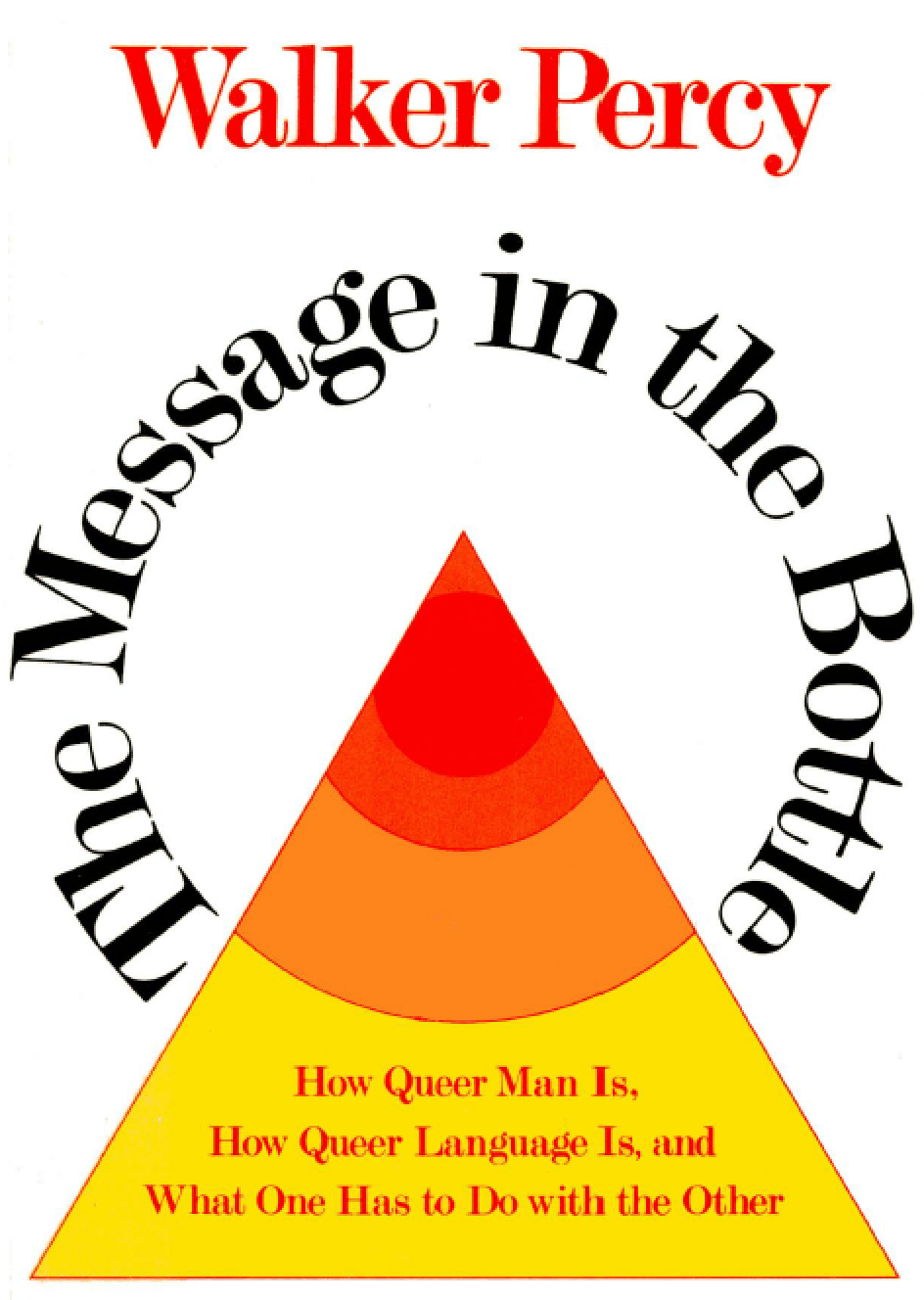
existentialismPhilosophy of LanguagesemioticsThe Message in the BottleWalker Percy