Calmer Sutra
Peter C. Grosvenor’s review essay in Nationalism and Ethnic Politics Volume 25, 2019 – Issue 2: 240-245 (Corrected for spelling). Sadly there are many dhimmi–“Funktionshäftling”-like Jews that comprise the Regressive Left, their silence on this issue highlighting their mauvaise foi.
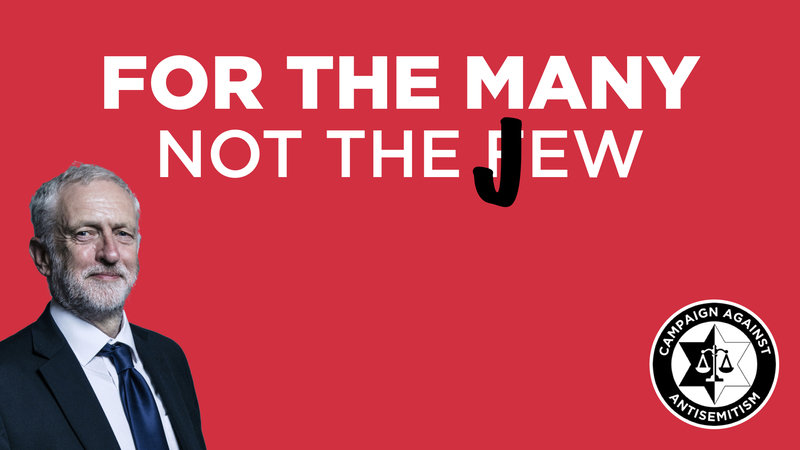
That Labour has an antisemitism problem is beyond dispute
There is nothing new about left-wing antisemitism, or what the German social democrat August Bebel is said to have called “the socialism of fools.”
bierkeller antisemitism and a polite and civilized bistro antisemitism, or what Hirsh calls “the antisemitism of good people” (p. 1). It is the latter that Hirsh finds in Labour.
The formulation consists of two related propositions: that the left, by definition, is inoculated against all forms of racism, including antisemitism, and that, therefore, allegations of left-wing antisemitism can only be veiled Zionist attempts to pre-empt criticism of the Israeli state. Though an increasingly identitarian left feels comfortable with restricting free speech in the cause of anti-racism, it dismisses objections to antisemitism as attempts to suppress free speech in the cause of Zionism, which is depicted as itself a form of racism.
Rich also documents how Labour’s current antisemitism problem is closely associated with the unlikely emergence of political cooperation between Islamists and the left
Luciana Berger was born into the British Labour Party. She is the grandniece of Manny Shinwell, the distinguished Jewish socialist who served in Clement Attlee’s post-war Labour government. She formed an ambition to be a Labour Member of Parliament (MP) as a child and was elected in 2010. Yet on February 18, 2019, Berger resigned from the party and became a founder member of The Independent Group in the House of Commons. While doing so, Berger accused the Labour Party of institutional antisemitism, insisting that she had been forced into resignation by sustained antisemitic abuse that had required her to have police protection at the party’s 2018 annual conference. The six other Labour MPs resigning alongside her also cited the party’s ineffectual response to widespread instances of internal antisemitism as a major consideration in their reasons for departure.
That Labour has an antisemitism problem is beyond dispute. In February 2019, the party’s general secretary Jennie Formby disclosed that she had received 673 complaints about antisemitic words and actions by party members. Ninety-six members had been suspended, and 12 were expelled. Some of the more publicized cases have verged on the bizarre, and they have by no means been confined to local activists and low-ranking party officials. In 2014, Naseem Shah MP was temporarily suspended from the party after a Facebook post in which she suggested that Israel should be relocated to the United States. In the summer of 2018, former MP and London Mayor Ken Livingstone resigned from the party after the prolonged suspension that followed his repeated suggestions that the Zionist movement had cooperated with the Nazis in the 1930s. Later that year, veteran Labour activist Pete Willsman was re-elected to the party’s National Executive Committee despite the leak of a recording in which he claimed that Labour antisemitism was a fabrication by Trump-supporting Jews. Immediately after the The Independent Group launch, Ruth George MP tweeted that Israel may have funded the breakaway. And, shortly afterwards, Chris Williamson MP was suspended after a video was released in which he told an applauding audience of Labour activists that the party had apologized too much for antisemitism. In early March 2019, the Equality and Human Rights Commission announced that it was investigating complaints of antisemitic discrimination in the Labour Party.
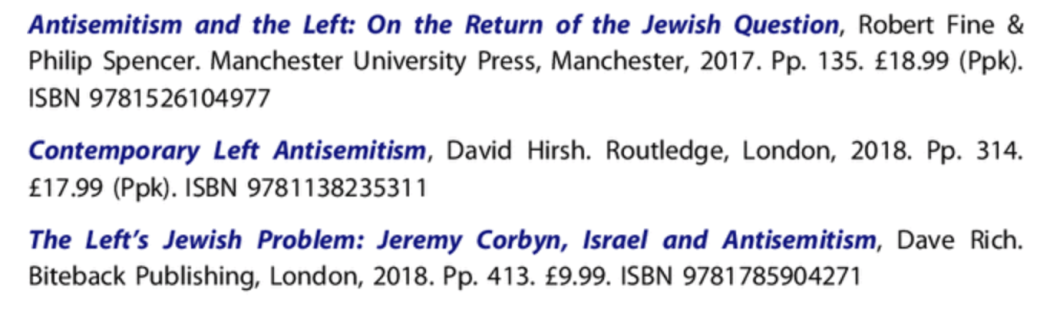
There is nothing new about left-wing antisemtism, or what the German social democrat August Bebel is said to have called “the socialism of fools.” Jewish identity, the Zionist movement, and the existence and conduct of the state of Israel have long posed challenges for socialist political theory, and this is the subject of Robert Fine and Philip Spencer’s intellectual history Antisemitism and the Left: On the Return of the Jewish Question. Left-wing antisemitism has clearly undergone a resurgence in recent years and, in Britain, that resurgence has coincided with Jeremy Corbyn’s leadership of the Labour Party since 2015. David Hirsh’s Contemporary Left Antisemitism and Dave Rich’s The Left’s Jewish Problem: Jeremy Corbyn, Israel and Antisemitism both aim to demonstrate the reality of this phenomenon and to confront the arguments of those within the Labour fold who continue to deny its existence.
Fine is Emeritus Professor of Sociology at the University of Warwick, and Spencer is Emeritus Professor of Holocaust and Genocide Studies at Kingston University. Both work within the traditions of Marxist sociology, and they write normatively to counter the re-emergence on the left of the “Jewish question,” which they reasonably present as inherently antisemitic: “All formulations of the Jewish question come back to the harm ‘the Jews’ allegedly inflict on humanity at large and what is to be done about this harm” (p. 103).
The frame for their historical analysis of left antisemitism is the tension in socialist thought between the universal and the particular or, in other words, the left’s emphasis on human commonalities and global solidarity in a world of more localized and specific identities. They posit two manifestations of universalism. The first is emancipatory and inclusive, based on the conviction that the “other” is ultimately a fellow human being; the second is repressive and assimilationist, deeming the “other” to lack certain prerequisites for membership in a common humanity. The authors show how, since the Enlightenment, the duality of universalism has been present in the Jewish historical experience: as a force for the political, civil, and social inclusion of Jews but also as a source of antisemitic prejudice that asserts their necessary “Outsiderness”.
The challenges posed by Jewish identity to the radical left-wing universalism can be found in Marx’s 1843 writings On The Jewish Question. Marx was responding to his then-fellow Young Hegelian Bruno Bauer, who argued that Jewish political emancipation could only be achieved at the cost of Jews renouncing their religious identity: emancipation presupposes secularism and can therefore provide no space for religious particularism of any kind. Fine and Spencer find in the literature two readings of Marx’s critique of Bauer. First, there is what they term the “disparaging” view, which is prominent in contemporary antisemitism studies. On this reading, Marx’s writings anticipate the left-wing antisemitism to come—Marx’s own Jewish family origins notwithstanding—in their deployment of classic anti-Jewish tropes such as the identification of Jews with finance. By contrast, an “apologetic” reading, standardly advanced by Marxist scholars, has ignored Marx’s antisemitic remarks or trivialized them as insubstantive asides reflecting nothing more than commonplace prejudices of the time and having no bearing on Marx’s scientific socialism.
Fine and Spencer find both readings unsatisfactory. The first fails to acknowledge that the overall corpus of Marx’s writings contains few, if any, compelling examples of antisemitism. Furthermore, it fails to acknowledge Marx’s and Engels’s unequivocal support for the cause of Jewish emancipation in Germany and their confrontation with left-wing opponents of that cause. The second contends that Marx’s universalism ultimately protects him from the charge of antisemitism, but this ignores the oppressive and assimilationist aspects of universalism, some of which are evidenced in Marx’s echoing of the anti-Jewish sentiments of his time. What emerges from Fine and Spencer’s analysis is a quintessentially humanist Marx who wrote, contra Bauer, that “[w]e do not tell the Jews that they cannot be emancipated politically without radically emancipating themselves from Judaism …” (quoted p. 35). They find support in Marx for their own contention that “a universalism that creates its own ‘other’ ends up as no universalism at all” (p. 44).
But Marxism after Marx took a decidedly nationalist turn, as Lenin distinguished between “the nationalism of the oppressor” and “the nationalism of the oppressed” (quoted p. 47) and Stalin enshrined the nation as an indispensable building block in the socialist project. Rosa Luxemburg stood out for her fundamentalist defense of Marx’s universalism but, in general, Marxism’s accommodation of a nation-state nationalism that identified Jews as rootless cosmopolitans undoubtedly created the conditions for the re-emergence of the “Jewish question” on the left.
In the Weimar era, the German Social Democrats failed to prioritize the struggle against antisemitism, even as it became weaponized by the Nazis. Many Jewish activists left European Communist parties after the 1939 Nazi–Soviet Pact, and the Russian nationalism of Stalin’s Great Patriotic War fueled antisemitism in the Soviet Union. To some extent, the Trotskyists may have had a greater understanding of antisemitism, but the Trotskyist intellectual Ernest Mandel initially likened the Holocaust to the expulsion of Germans from Poland and Czechoslovakia before later conceding that “there can be no greater injustice than Auschwitz” (quoted p. 53).
The Holocaust—a massive body blow to all progressive theories of history—forced Marxism to re-engage seriously with antisemitism. In this, the Frankfurt School, dominated by Jewish intellectuals such as Max Horkheimer and Theodor Adorno, took the lead. The evolution of the state of Israel after 1948 then brought another dimension to disputes over antisemitism, and Fine and Spencer trace the exacerbation of tensions between the universal and the particular occasioned by Zionism through the writings of Hannah Arendt, a cosmopolitan republican pluralist who nonetheless insisted that Jews, when attacked as Jews, should defend themselves as Jews.
Though they unhesitatingly acknowledge that “criticism of Israel is no less or more problematic than criticism of any other country,” Fine and Spencer write that “[t]he most significant expression of the reconfiguring of the Jewish question in the present period lies in the rise of negative representations of Israel and Zionism” (p. 111). Viewing Israel and Zionism through the lens of the “Jewish question,” they plausibly contend, involves the kind of prejudice and selection that the sociology of deviance has shown to account for the criminalization of individuals. The most prominent examples of the criminalization perspective are Israel’s exclusivity as a Jewish state, its allegedly genocidal policies toward the Palestinians, and parallels between Israel and apartheid South Africa, all charges to which Fine and Spencer offer their own detailed counterarguments.
The denigration of Israel and Zionism looms large in the antisemitism that is to be found in today’s Labour Party. In Contemporary Left Antisemitism, David Hirsh, a senior lecturer in sociology at Goldsmiths and a Labour Party member, uses numerous empirical studies to demonstrate “how antisemitism emerges out of the ostensibly democratic discourse of criticism of Israel” (p. 2). More broadly, Hirsh is concerned with “antisemtism among people who believe that they strongly oppose antisemitism” (p. 1), focusing on the multiplicity of examples from within the Labour Party and from the anti-Israeli Boycott, Divest, and Sanction movement in British academia. He employs the distinction, first made by the writer Ben Cohen, between violent and hate-filled bierkeller antisemitism and a polite and civilized bistro antisemitism, or what Hirsh calls “the antisemitism of good people” (p. 1). It is the latter that Hirsh finds in Labour.
A principal feature of bistro antisemitism is the tendency to see the accusation of antisemitism, rather than antisemitism itself, as the problem. Hirsh devotes an entire chapter to his coinage of the “Livingstone formulation,” his characterization of Ken Livingstone’s oft-repeated response to allegations made against him of serial antisemitism. The formulation consists of two related propositions: that the left, by definition, is inoculated against all forms of racism, including antisemitism, and that, therefore, allegations of left-wing antisemitism can only be veiled Zionist attempts to pre-empt criticism of the Israeli state. Though an increasingly identitarian left feels comfortable with restricting free speech in the cause of anti-racism, it dismisses objections to antisemitism as attempts to suppress free speech in the cause of Zionism, which is depicted as itself a form of racism.
As Hirsh details, the reductio ad absurdum of the Zionism-as-racism case is the comparison of Zionism, and/or the practices of the Israeli state, with Nazism, another apparently obsessive–compulsive trope of Livingstone’s and one widely observed on the placards of left-wing demonstrators. This perspective exists on two levels. Firstly, it is a specific reference to the Haavara agreement of August 1933 between Nazi Germany and the Zionist Federation of Germany, under which Jews were permitted to move to Palestine subject to their prior agreement to buy German goods. For Livingstone and others, this constitutes evidence that Hitler was himself a Zionist and that there were structures of cooperation between Nazis and Zionists. In reality, the agreement was exceptional, and it was deeply controversial and divisive within the international Zionist movement at the time. Though Nazi Germany no doubt benefited from the exacerbation of intercommunal tensions within the British Mandate of Palestine caused by increased Jewish immigration in the 1930s, no serious historical analysis supports the contention that the Third Reich favored the establishment of a Jewish state.
More generally, there are attempts on the part of sections of the left to compare the ideological content of Zionism with that of Nazism: that both are examples of “race thinking,” both reject the possibilities of coexistence between Jews and non-Jews, and both require the creation of an ethnically exclusive state. Most Jews, Hirsh points out, are Zionists, and to compare them to their ultimate historical nemesis is a particularly vehement form of Jew-baiting. Furthermore, Zionism was a response to antisemitism, whereas Nazism had antisemitism at its core. Consequently, it is incoherent at the most fundamental level to equate the two ideologies.
Nonetheless, Hirsh finds the Livingstone formulation and its attendant Nazi comparisons to be widespread on the pro-Corbyn Labour left. For Hirsh, Corbynism is “another variant of populism, rather than a democratic alternative to it. While Brexit and Trump are tolerant of xenophobia, racism and Islamophobia, the Corbyn left tends to be tolerant of antisemitism” (p. 50). For Hirsh, Corbyn has redefined Labour’s “community of the good” (note 1) in such a way that Labour members protesting antisemitism will put themselves outside of it. In Hirsh’s interpretation, Corbyn and his supporters inhabit a Manichaean world of American, British, and Israeli imperialists versus developing world anti-imperialists in whose ranks the Iraqi resistance to Anglo-American occupation, Hamas, and Hezbollah have pride of place. This binary shatters the left universalism that Hirsh, like Fine and Spencer, wants to recover, and Jews occupy a highly problematic place within it: “The Jews of the Holocaust still symbolize absolute powerlessness, the oppressed; but the Jews who survived the Holocaust, particularly those who found sanctuary in Israel or the USA, fit better into another ready-made way of thinking about Jews: disproportionate power” (p. 58).
Academic lawyer Lesley Klaff has labeled the juxtaposition of the Holocaust with contemporary Israeli power “Holocaust inversion” (quoted p. 24) (note 2). This consists of an “inversion of reality”—the casting of the Israelis as the new Nazis—and an “inversion of morality,” in which the Holocaust is presented as a course of moral instruction that Jews failed to internalize (cited p. 24). This moral inversion expresses itself in, for example, Archbishop Desmond Tutu’s claim that Israel’s treatment of the Palestinians proves that Jews have forgotten the lessons of the Holocaust. Perhaps the most deft and concise navigation of this phenomenon is Howard Jacobson’s indispensable When Will the Jews Be Forgiven the Holocaust? (2013) (Note 3).
The claim that Labour’s current antisemitism problem is intimately connected to Corbyn’s leadership is supported in greater detail in the updated new edition of Dave Rich’s The Left’s Jewish Problem, which was originally published in 2016. Rich, an associate at the Pears Institute for the Study of Antisemitism, begins his account with a survey of the Left’s changing historical perceptions of Zionism and Israel.
Zionism was led by European Jewish socialists, and the Labour Party consistently supported the Balfour Declaration after 1917. The state of Israel was created through an insurgency against British imperialism, and it was immediately recognized by the Soviet Union. Many on the left drew inspiration from the libertarian socialism of the kibbutz movement and from the central role played by the Histadrut trade union confederation in the Israeli welfare state. And Jews were prominent in the leaderships of European left parties. All of this changed in the 1960s, with the rise of an ideologically “Third Worldist” New Left and Israel’s conquest of the West Bank, Gaza, and the Golan Heights in the Six Day War of 1967, after which the New Left presented Israel as a projection of Western imperialism. By contrast, Jews around the world experienced 1967 as an existential crisis for Israel and became more disposed to support the Jewish state.
Rich’s research shows that the development of anti-Zionism as a core feature of New Left thinking in Britain was the work of Young Liberals such as Louis Eaks, Peter Hellyer, and Peter Hain. These activists were also prominent in the direct action campaigns against the South African regime, and they contributed much to the New Left’s depiction of Israel as another apartheid state, an allegation that remains central to the anti-Zionism of today’s Labour left. Rich also documents how Labour’s current antisemitism problem is closely associated with the unlikely emergence of political cooperation between Islamists and the left in organizations such as the Stop the War Coalition and George Galloway’s now-defunct Respect Party. The invasion of Iraq provided many of the settings in which Corbyn and some of his supporters shared platforms with deeply controversial Islamist speakers with long track records of explicitly antisemitic rhetoric, a legacy that even Corbyn’s most loyal supporters will find it difficult to defend.
Like Hirsh, Rich plausibly concludes that the Labour Party is now institutionally antisemitic, which is to say that the party’s culture, as opposed to its formal rules, makes it an uncomfortable, and possibly untenable, environment for Jewish people. Whereas Fine and Spencer’s work reminds us that left antisemitism predates Israel, and even Zionism, Hirsh and Rich acknowledge that the breakdown in the Israel–Palestine peace process and the rightward drift in Israeli domestic politics have provided the context, but by no means the justification, for the antisemitic words and actions of party members that are now a matter of record.
But responsibility for Labour’s long-drawn-out and public failure to deal with the “socialism of fools” lies clearly with the current leadership. It is widely accepted that Corbyn’s unexpected election as leader was, to a large extent, the result of Labour activists’ pent-up revulsion at Tony Blair’s invasion of Iraq. Ironically, then, the emphatically pro-Israeli New Labour bears some responsibility for the Corbyn Labour Party that is mired in allegations of antisemitism. If Corbyn’s perceived New Left anti-Zionism continues to bleed into antisemitism, it will permanently alienate Labour’s rapidly declining Jewish support, further divide the party, and, taken together with its Brexit equivocations, deprive Labour of its leadership of the British progressive movement, even as the electoral system blocks the emergence of an alternative. For more than its own sake, therefore, Labour needs to save its socialism from its fools.
Notes
1 David Hirsh, The Corbyn Left: Politics of Position and Politics of Reason, Fathom, Autumn 2015. http://fathomjournal.org/the-corbyn-left-the-politics-of-position-and-the-politics-of-reason/
2 Lesley Klaff, Holocaust Inversion and Contemporary Antisemitism, Fathom, Winter, 2014. http://fathomjournal.org/holocaust-inversion-and-contemporary-antisemitism/
3 Howard Jacobson, When Will Jews Be Forgiven the Holocaust?, Amazon Kindle, December 2013.
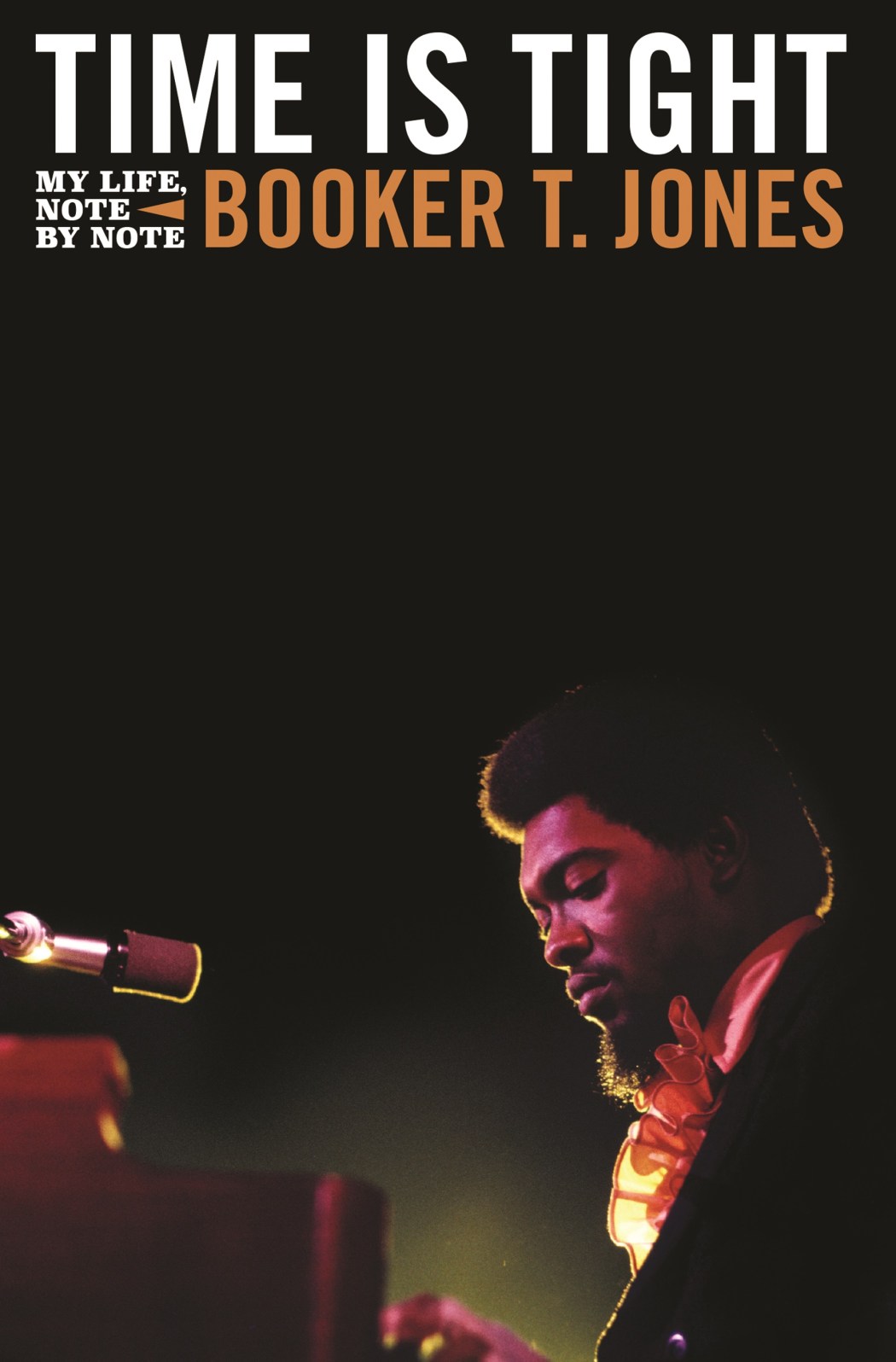
Time Is Tight: My Life, Note by Note has just been published. Here’s a review.
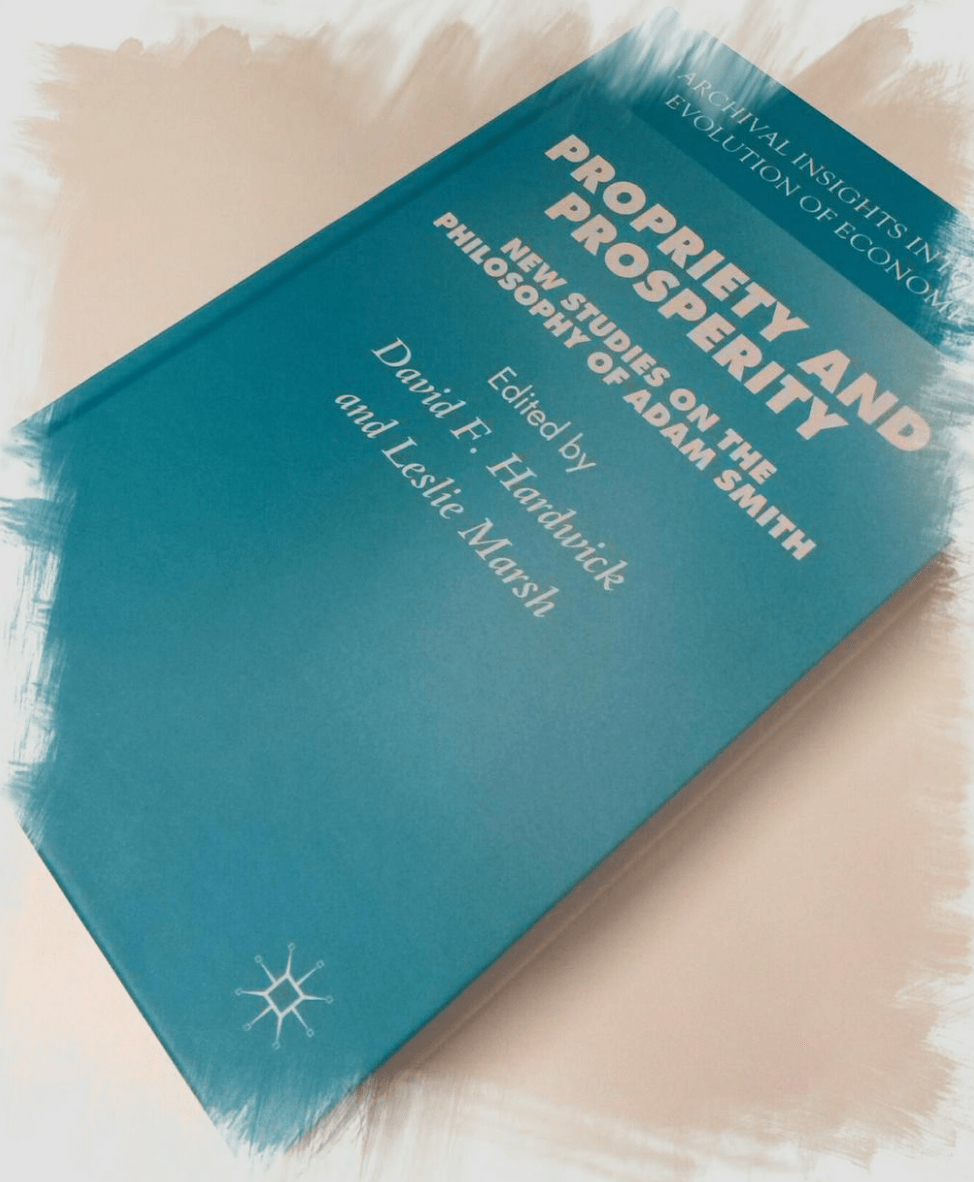
Smith scholarship is split on whether the apparent conflict between self-interest in the Wealth of Nations (WN) and sympathy in the Theory of Moral Sentiments (TMS) indicates an intractable problem or is merely the result of a misunderstanding of Smith’s overall system. This chapter is written as a response both to the believers in das Adam Smith Problem and to those who offer a way of pulling the two texts together. In the first place, I argue that das Adam Smith Problem highlights the complexity of Smith’s body of work and his belief that the motives for behavior in the private sphere will be different from and sometimes conflict with the rules of the public sphere. Second, I argue that the higher-level economic order relies fundamentally on norms of behavior and rules of conduct that are nourished by the sympathy fostered in the lower-level orders of family and friends. At the same time, the economic order affects these lower orders, influencing in turn the norms of behavior and rules of conduct that support economic activity. Understanding how these different levels of order interact is central to understanding the often murky link between economics and morality. Such an understanding also begs for the rescue of the social sciences from the silos of separate political and economic analysis back to a Smithian ‘moral philosophy’ that takes into account human social behavior in its many forms.
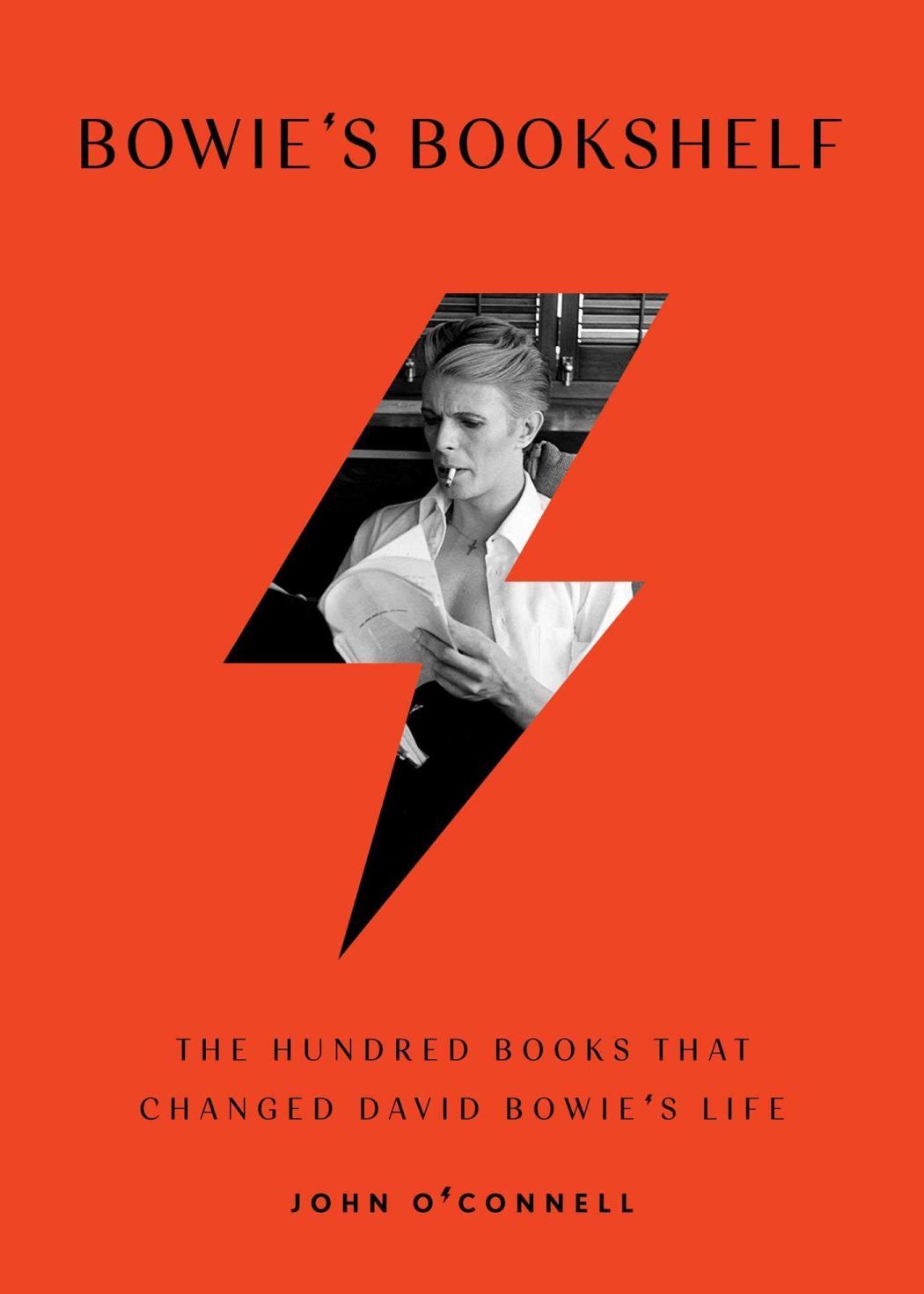
Pretty naff cover what with the Aladdin Sane lightening bolt layered over a decent photo. The UK cover is better. Anyway, the books (and periodicals) have a strong dose both of sophisticated and pretty basic humour, counterposed by books of philosophical interest, especially if one is wary of regressive Leftism. The following are the most significant titles, at least for me, but there are many other books besides that are equally worthy:
The invisible hand means a variety of things to modern writers, who use the phrase loosely to imply the market, the price system, efficiency, laissez-faire, greed is good, and so on (Samuels et. al., 2011; Medema, 2009; Rothschild, 1994). In some circles the invisible hand is referred to with reverence and in others with mockery. What Smith wrote, and meant, is quite different from current constructions. At first reading, Smith’s three references to an invisible hand appear to be unconnected turns of phrase. One can find ample reason for agreeing with Kennedy (2009) that the expression’s current use has been blown out of all proportion to its author’s original intent and any reasonable extrapolation thereof. On the other edge of the spectrum are authors like Klein and Lucas (2011), who argue that the invisible hand is the central concept of Smith’s work and that Smith consciously placed it at the exact physical midpoint of both his books as a rhetorical pièce de résistance, the most nourishing part of the meal. This proposition is implausible on many levels. If there were such an intended dialectical message it is curious that it remained hidden from all of Smith’s friends and closest colleagues. It is possible to argue a middle ground, however, as in this essay, that the concept behind the invisible hand is central to Smith’s work, but that the phrase itself is only one of many spread out through his work, and that the placement, as well as the exact phraseology, are non-issues. In the wider context of Adam Smith’s moral philosophy, the “invisible hand” represents those unseen instincts of human nature that motivate and direct behavior. When channeled through appropriate human institutions, the invisible hand can generate a spontaneous order that in many cases produces a beneficial social outcome.
Much of modern analysis of the ‘invisible hand’ remains tenuously connected to Adam Smith’s more modest rhetorical purposes (Nozick, 1974; Grampp, 2000; Petsoulas, 2001; Aydinonat, 2008; Klein, 2009, and Tieffenbach, 2011). Few recent references are close to Adam Smith’s intentions, except, notably and exceptionally, Emma Rothschild (2001) on Smith’s ‘ironic joke’. Moreover, after 1875, intermittent references continued until the 1940s, when the trickle became a flood.
This chapter does not take sides on ideological debates about the merits of free-markets versus government interventions. Its focus is on the variance between Smith’s ideas and modern attributions of them in philosophical ideas and policies widely variant from Smith’s limited use of the ‘invisible hand’ metaphor. The consequential dragging deadlock and failures of unsound policies has heavy social costs in economic performance and public welfare.
Harold Bloom: 1930-2019

“Harold Bloom.” Contemporary Authors, Gale, 2018.
The Sterling Professor of Humanities at Yale University, Harold Bloom is perhaps the best-known literary critic in America today, as well as one of the most controversial. Describing the influence of the past upon poetry as a relationship of conflict, Bloom’s writings have consistently contradicted mainstream trends in literary theory.
When Bloom declared his theory of poetic creation in The Anxiety of Influence: A Theory of Poetry and its companion work, A Map of Misreading, he built his discussion on the model of Oedipal conflict asserted by Sigmund Freud, the founder of modern psychoanalysis. Freud stated that each infant views its father as a rival for its mother’s attention, and wishes to take its father’s place. Bloom’s adaptation of Freud recasts the infant, father, and mother in the roles of belated poet, precursor poet, and Muse of poetic inspiration, respectively. Bloom also states that, like the Freudian concept of “repression” of motives from consciousness and behavior, literary influence is sometimes notable by omission. In a Diacritics interview with Robert Moynihan, Bloom acknowledged conventional methods of tracing the presence of similarities between poems, but then asserted the importance of looking at what is not in a particular poem: “I think this is a much more interesting and vital area in which interpoetic relationships tend to cluster. That is, what is it which is missing or all but present in a poem, what is suggested or evaded? That is usually, I think, a much better path, or hidden path, hidden channel, for what is taking place between two poems. … To a considerable extent, I try to study those hidden pressures.”
The Anxiety of Influence asserts six “revisionary ratios,” methods of misreading to which Bloom attaches specialized Greek names. In Contemporary Literature, Paul de Man asserted that “the main interest of The Anxiety of Influence, is not the literal theory of influence it contains but the structural interplay between the six types of misreading, the six ‘intricate evasions’ that govern the relationships between texts.” “A Map of Misreading,” noted Michael Wood in the New York Review of Books, “adds six rhetorical tropes, six psychic defenses, six sets of imagery, and three movements of creation to Bloom’s original six ratios of revision.” Observing the use of invented and Kabbalistic terminology throughout Bloom’s theoretical works, Helen Regueiro Elam in the Dictionary of Literary Biographystated: “Readers may feel hopelessly bewildered by this proliferation of terms, but for Bloom they constitute a basic vocabulary which, despite constant revisions and refinements, retains its parallels from text to text.”
Several reviewers have charged that Bloom’s literary theory is excessively reductive. “In The Breaking of the Vessels [Bloom] says that his kind of reading ‘does not know a poem as being apart from the agon it enacts,'” noted Denis Donoghue in the Times Literary Supplement. The critic then asked: “If a reading doesn’t know a poem as being apart from the agon it enacts, what prevents the reading from reducing the poem to that agon?” Writing in the New York Times Book Review, Christopher Ricks noted repetition in the arguments appearing in The Anxiety of Influence, A Map of Misreading,Kabbalah and Criticism, and Poetry and Repression: Revisionism from Blake to Stevens, then declared: “Bloom had an idea; now the idea has him. … He now has nothing left to do but to say the same things about new contests and with more decibels.” However, in a New Republic review of Agon: Towards a Theory of Revisionism, Helen Vendler wrote: “Any collection of essays and addresses composed in the span of a few years by a single powerful mind will tend to return to the same questions, and to urge (even covertly) the same views.”
Some critics have complained of a tendency toward assertion rather than exposition in Bloom’s works. Discussing statements of influence between particular poems in A Map of Misreading, Yale Reviewcontributor Jonathan Culler said: “If Bloom were to consider how he knows these things, tell us the story of his formidable poetic perceptions, he would produce a far more valuable and instructive book.” “Bloom hasn’t validated his values, he has merely urged them,” wrote Donoghue in his Times Literary Supplement article.
Bloom engages in his own theological revisionism in The Book of J, which presents the text of David Rosenberg’s new translation of the “J” strand of the Bible–“J” for “Jehovah,” an incorrect transliteration of “Yahweh,” the “J”-text author’s name for God–and Bloom’s interpretation of the text. “The earliest known texts of the Hebrew Bible were not religious writings at all but a sublime work of literature, a comic masterpiece of ironic power,” said Richard Bernstein in summary of Bloom’s thesis in the New York Times Book Review. Bernstein further reported that Bloom suggests the “J” author was a court woman writing immediately after the reign of Solomon. Chicago Tribune reviewer Joseph Coates noted Bloom’s assertion that later segments of the Pentateuch, the first five books of the Bible, traditionally ascribed to Moses, were revisions written “by priests and redactors who over a period of 600 years inflicted later forms of patriarchal Judaism on the work of a secular, and often quite bawdy, author.” In his conclusion, Coates suggested that The Book of J is “restoring to Western literature a major author at the very beginning of the canon.” According to Bloom, the grouping of texts into a canon is an extension of the agonistic action of literary criticism. Elam commented: “Canonization expresses the critic’s own will-to-power over texts and is the most extreme form of literary revisionism.”
Omens of Millennium: The Gnosis of Angels, Dreams, and Resurrection is a more personal book on a similar subject in which Bloom discusses contemporary spirituality and his own admitted Gnosticist beliefs. “While presenting an informative history of ideas and provocative cultural critique,” according to Mark Taylor in the New York Times Book Review, “Omens of Millennium is, above all else, a spiritual autobiography.” Los Angeles Times Book Review writer Jonathan Kirsch wrote: “The whole point of Bloom’s book is that the offerings of the so-called New Age–‘an endless saturnalia of ill-defined longings,’ as he defines it–are shallow and silly when compared to what the ancients knew.” Bloom offers the teachings of the Gnostic tradition as an alternative to millenarian spiritual malaise, accompanied by glancing examples from his own life. Commenting on Bloom’s disclosure of his struggle with depression in his thirties, Kirsch noted that Bloom “is apparently too courtly, too cerebral and perhaps too shy to engage in much baring of the soul.” Instead, as Washington Post Book Worldcontributor Marina Warner noted, Bloom invokes the wisdom of ancient Zoroastrianism, early Christian Gnosticism, medieval Sufism, and Kabbalism “in order to create an antidote to the New Age.” Praising the “trenchancy, verve and learning” of the book, Warner wrote: “Omens of Millennium is born of despair, but it focuses throughout on possibility, with a true teacher’s refusal to give up the job of stimulating and informing, no matter how restless the class or desolate the wasteland of the schoolyard outside.”
In The Western Canon: The Books and School of the Ages, Bloom focuses his attention on select writings of twenty-six authors, including Dante, Chaucer, Shakespeare, Jane Austen, Charles Dickens, Marcel Proust, Virginia Woolf, and Samuel Beckett, whom he contends are among the most significant figures of the Western literary tradition. Concerned over the current underappreciation of serious reading and literary study among students and educators, Bloom laments, as quoted by Norman Fruman in the New York Times Book Review, that “we are destroying all intellectual and esthetic standards in the humanities and social sciences, in the name of social justice.” Fruman praised Bloom’s effort as “a heroically brave, formidably learned and often unbearably sad response to the present state of the humanities,” particularly Bloom’s vehement opposition to “the School of Resentment” in which he corrals “Feminists, Marxists, Lacanians, New Historicists, Deconstructionists, Semioticians.” Bloom is “supremely confident of his own esthetic judgment,” according to Fruman, and “he takes little notice of the vagaries of individual taste or the pressure of cultural or national loyalties.” Commenting on the tone of “sorrowful resignation” that permeates the book, Michael Dirda wrote in Washington Post Book World: “Such mournful authority is irresistible, and it is this unswerving defense of reading, of ‘hard’ reading, that transmutes The Western Canon into a work of power and plangency.”
“Shakespeare: The Invention of the Human is, simply, the book of a lifetime, the culmination of a career,” wrote Frank McConnell in Commonweal. The book contains Bloom’s views on Shakespeare’s plays, which loosely argues the theory that Shakespeare invented the human personality. It is a “series of brilliant, persuasive, highly idiosyncratic readings,” according to a reviewer in Publishers Weekly. To Bloom the most important Shakespearean characters are Falstaff and Hamlet. McConnell wrote: “Falstaff is … the very archetype of life in the moment, of consciousness as perpetual, minute-by-minute celebration of itself, and all it sees, for all the ill it sees. … Hamlet is … transcendence, aware to the point of pain of the world’s complexity, and wanting nothing so much as to evade it all for the absoluteness of one’s being.” Delivering his case against the politicizing of college departments of English, Bloom “cheerfully calls himself a ‘wicked old aesthete'” related Donald Lyons in Commentary,as he dismisses feminist, revisionist, and structuralist theories imposed on Shakespeare’s works. Michiko Kakutani in the New York Times noted that, “indeed, this volume is best read as an old-fashioned humanistic commentary on Shakespeare’s plays that gives us a renewed appreciation of the playwright’s staggering achievement.” McConnell wrote: “In a world where academic criticism is ever more aridly formalist and/or politically correct, ever less connected to the needs of human readers, this book is exhilaratingly old-fashioned, arguing … that we read poetry to save, or find, our lives.” James Shapiro, writing in the New York Times Book Review, felt the work is “marred by a compulsion to denigrate” Shakespeare’s contemporaries, but admits that “the most exhilarating observations–and the best chapters are littered with them–have the quality of aphorisms.” A critic in the Economist wrote: “What is most heartening about his book is the sheer joy, awe, and wonder that the plays still inspire in him after a lifetime of studying and teaching them.”
How to Read and Why is Bloom’s attempt to communicate to readers the best way to read. The book is broken into sections on short stories, poems, novels, and plays. Colin Walters in the Washington Times described the work as “a roundup of favorite reading treats accumulated over sixty years.” “This book is a testament to Bloom’s view that reading is above all a pleasurably therapeutic event,” concluded a critic in Publishers Weekly, while Henry Carrigan in Library Journal described the book as an “apologia for the art of reading well.”
In his 2002 book, Genius: A Mosaic of One Hundred Exemplary Creative Minds, Bloom discusses his choice for the one hundred most influential writers in world history. His choices–among them William Shakespeare, John Milton, Homer, Ralph Ellison, Miguel Cervantes, and Leo Tolstoy–would not surprise those who have followed the educator’s career or literary predilections. However, as noted by Jonathan Rose in the Europe Intelligence Wire, Genius includes “some provocative surprises.” Rose went on to add: “You will wake up when he introduces you to Machade de Assis (a Brazilian zany in the tradition of Laurence Sterne) and Ea de Queriroz (a Portuguese satirist who ‘united Voltaire and Robert Louis Stevenson in a single body’).” Bloom begins his book by discussing genius and outlining how he has grouped the writers included, which is according to the ten divine attributes in the ancient Jewish text the Kabbalah. Each of the subsequent chapters focuses on one writer.
Writing in Book, Penelope Mesic found Genius to “have a lack of focus [that] contributes to a more serious deficiency: the absence of a point to be made.” Mesic asserted that the groupings based on the Kabbalah “reflect not an underlying truth about these authors’ works but rather Bloom’s past scholarship and predilections.” Booklist contributor Donna Seaman believed that the groupings work, noting that “this makes for some wonderfully fresh and provocative juxtapositions, and for an elevating concentration on how each writer extends the path toward wisdom.” Writing in the Library Journal,Shana C. Fair commented that “although the book is a delight to read, its real value lies in the author’s ability to provoke the reader into thinking about literature, genius, and related topics.”
With Jesus and Yahweh: The Names Divine, Bloom returns to the subject that was featured in The Book of J: his assertion that the first true biblical texts, a portion of the Hebrew Bible, were written by a man he calls “J” and feature Yahweh, a sort of combination of man and God. Tracing this biblical strand, Bloom believes one eventually comes to what should be the true basis for religion, as opposed to either Christianity or Judaism. However, when the initial determinations were made to include certain scriptures in the Bible while discarding others, this segment of text was ultimately eliminated in favor of those that painted God in a more beneficent and less aggressive way. Bloom’s book is not devoted to Yahweh alone, but actually begins with Jesus and an explanation of the differences between the Hebrew account and the New Testament account of Jesus’s life. He separates Jesus and Jesus Christ as two distinct individuals, the first of whom was an actual man who lived and worked, but about whom very little is truly known. The second is a mythological figure whom theologians created from a series of stories in order to provide the faithful with a figure on which to fix their hopes and desires for a better existence. Jonathan Rosen, writing in the New York Times Book Review,commented that “in Bloom’s account, Jesus, with his deep connection to the uncanny Yahweh, can seem like the last real Jew, rather than the first Christian.” He went on to conclude: “The battle between the New Testament and the Hebrew Bible is a struggle over religious truth that goes to a core crisis in Western civilization, and in Bloom himself. It helps explain why, in Bloom’s agonistic literary universe, literature, despite his genius for explaining it, can seem oddly irrelevant. It is religious truth that matters.” Ray Olson, writing in Booklist, found the book “more personal than argumentative and more literary than religious criticism.”
Fallen Angels is Bloom’s response to the popularity of angels in current pop culture and literature. He takes his readers on a tour of angels throughout history, focusing in particular on the fallen angel and the different ways it has been represented in literature and other cultural mediums through the centuries, covering everything from Tanakh to Angels in America. The slim book includes illustrations of various paintings, illuminated letters, and sketches of angels. Bloom also concentrates his efforts on more cultural examples of fallen angels and avoids reference to theological examples that might have been far more plentiful. Writing in the Library Journal, David B. Levy found that, “for what it sets out to do, … Bloom’s book succeeds. A delightful read.” June Sawyers, reviewing the work in Booklist,considered it “erudite and entertaining” and “a bracing riposte to the run of precious angel books that glut the market.” In the Los Angeles Times Book Review, Nick Owchar wrote of Bloom: “What he gets at in this brief work is that by treating angels as different from us, we have lessened ourselves: We forget that angels ‘represent something that was ours.'”
Published when Bloom was eighty-one, The Anatomy of Influence: Literature as a Way of Liferedefines the author’s approach to literary criticism. The book is, in a sense, a revision of The Anxiety of Influence. Comparing the two volumes, Bloom told Basak Bíngöl in the online Sunday’s Zaman: “I think they are very different books–one of them comes from a young man writing; this one is someone’s who began writing it at 73.” Composed over the course of seven years, The Anatomy of Influence is both a personal and academic exploration of literature. Bloom connects, compares, and contrasts the writers and critics who have influenced him. He writes of how his life and perspective have been shaped by the Western Canon, and asks how some writers have influenced him while others have failed to. Specific authors Bloom cites and explores are Shakespeare, Walt Whitman, Alfred Tennyson, and William B. Yeats.
Noting that Bloom writes with an eye toward refining his legacy, a Kirkus Reviews critic observed: “We wouldn’t want Bloom to be anyone but Bloom: an old-fashioned literary critic passionately committed to art for art’s sake.” Sam Tanenhaus, writing in the New York Times Book Review, lauded The Anatomy of Influence, asserting: “Even in his late season of garrulity, still has many arresting things to say and says them, often, with exquisite precision. He is, by any reckoning, one of the most stimulating literary presences of the last half-century.” Tanenhaus went on to state: “The subtitle of Bloom’s new book, ‘Literature as a Way of Life,’ is not an overstatement. For him, great authors don’t merely imitate life or capture facets of being. They create ‘heterocosms,’ alternative but accessible worlds, open to us all. He had always been an esoteric populist, like his first subjects, Blake and Shelley.” Describing The Anatomy of Influence in his own words, Bloom explained to Bíngöl: “I was, from the age of 5, obsessed with imaginative literature. It was to make oneself wiser, a more human, a more understanding, a more forgiving person. … And so I would say that the principle end of the literary life goes back to Shakespeare again. It is too with Shakespeare’s most incredible gift to expand your consciousness without deforming your consciousness. A literary life is apprehension, a greater joy of apprehension, deep and powerful and wide expansion of consciousness without paying the price of deformation of consciousness.”
In The Daemon Knows: Literary Greatness and the American Sublime, published in 2015, Bloom explores the “daemonic,” or sublime element of American literature. He examines the work of six pairs of major American writers, with pairings based on various factors such as influences: Walt Whitman and Herman Melville, Ralph Waldo Emerson and Emily Dickinson, Nathaniel Hawthorne and Henry James, Mark Twain and Robert Frost, Wallace Stevens and T.S. Eliot, and William Faulkner and Hart Crane. He defines the “daemonic impulse” as a phenomenon that transcends the physical world and consists of achieving sublimity in the absence of God and Christianity (with the exception of Eliot). Each of these major authors, according to Bloom, share a receptivity to the influx of the daemonic, which Bloom traces by mapping influences and variations.
Critics did not quite know what to make of The Daemon Knows, and in some instances they were sharply critical of the book. A Kirkus Reviews contributor appreciated Bloom’s effort, praising the author’s “enormous, shaggy erudition” and his “elegiac, gracious literary ponderings.” The reviewer concluded by commenting: “As always, Bloom conveys the intimate, urgent, compelling sense of why it matters that we read these canonical authors.” In contrast, a Publishers Weekly reviewer remarked that “what Bloom’s instructive, entertaining abracadabra adds up to is uncertain.” David Keymer, in a review in Library Journal, had mixed views about the book, commenting that it was “at times perceptive, at others slapdash” and calling it “a perplexing mix of perceptive and self-indulgent.”
One critic who admired The Daemon Knows was Booklist writer Donna Seaman, who applauded Bloom’s “erudite and passionate exegesis.” Also seeming to admire the book was Joanna Scutts, who observed in the London Guardian Online: “Though Bloom speaks often like a cranky Prospero, insisting that the world actually is the way he happens to see it, this book is often humble, doubting, and human. … Bloom threads these pages with life stories and memories of a host of ‘departed’ mentors and friends, who live on, for him, in books, and whose ghostly presence brings the literary sublime back down to earth.” Taking a different view was Duncan White, who, in a broadly facetious review for the London Telegraph Online, commented that Bloom “explains his choices with … bombast and brio.” White further commented: “Bloom is as enraptured as ever by the ‘aesthetic power’ of the books he loves and quotes lavishly to support his appreciations. He also remains maddeningly repetitious … and prone to inadvertent silliness.” In examining the source of Bloom’s appeal as an arbiter of literary taste for many readers, White asks: “Why do so many people like to be rather imperiously told what books they should read? There is the reassurance of expertise: Bloom can recommend a poet like a maâtre d’ steering you away from the plonk. There is also a snobbish complicity: it is reassuring to be among the Bloomian Elect while the grubby masses read Harry Potter.”
Bloom continues to explore Shakespeare’s works in Falstaff: Give Me Life, Cleopatra: I Am Fire and Air, and Lear: The Great Image of Authority. All three works examine the ways in which Shakespeare brought these expressive personalities to life–although, to Bloom, they almost appear as fully formed individuals in their own right, outside the plays in which they appear. In fact, for Bloom, these characters are the reason for creating works of art in the first place. “The whole point of ‘imaginative literature,’ he argues, is the creation of vehement personalities, diverse characters, ‘distincts,'” stated Andy Martin in an interview with the critic appearing in the London Independent. “The phrase he uses about Shakespeare’s characters is that they are all ‘artists of themselves,’ they appear self-created, fully autonomous. But here is the thing, and this is the only way to make sense of his inventing-the-human, they have (in part) created us, now. All those great Shakespearean figures have so hugely impacted on our consciousness of what it means to be human, that they have affected our concept of ourselves, and therefore shaped us, in another millennium.” “Bloom uses the word ‘personality’ to capture Shakespeare’s innovation rather than the word ‘character,'” explained Kate Havard in Commentary, “because he feels that Shakespeare’s creations–particularly Hamlet and Falstaff–have the depth and complexity of living beings and thinks ‘character’ implies these are mere fictional roles to be played by an actor. In Bloom’s view, Shakespeare’s influence is so vast that all of us are, in a way, reflections of the personalities he created. All of us are either Falstaffs or Hamlets. We are either lovers of life or lovers of death.”
Falstaff is, for Bloom, the most fully realized of Shakespeare’s personalities. “In one of his books, he wrote, ‘Bloom is only a parody of Falstaff.’ He used to look a lot like I imagined Falstaff, only he’s lost a bit of weight recently. The Fat Knight, but on a strict diet,” Martin declared. Falstaff is “his homage to a character he feels he knows well. Or who, to put it in a Bloomian way, knows him. This is one of his great theories: that Shakespeare, with his vast vocabulary of 22,000 words, ‘an art so infinite it contains us,’ knew pretty much everything there is to know about humankind. That he therefore ‘invented the human.'”
Cleopatra and Lear also appear in Bloom’s canon of Shakespeare’s personalities. For Bloom, Cleopatra’s most expressive characteristic is her sexuality, but she is also, as she says in Antony and Cleopatra, a creature of fire and air. “The ‘law’ of her personality–‘ebb, flow, ebb, return’–is about renewal and vitality,” said a Kirkus Reviews contributor, “while Antony’s is ‘ebb, flow, ebb, and do not return.'” Lear’s play, Bloom states, is dominated by language that signifies the title character’s disintegration. The text features “repeated references to nature, natural, and the unnatural,” declared a Publishers Weekly reviewer, “whose ominous repetition throughout the text foreshadows the depths of [Lear’s] degradation.”
In his Diacritics interview with Moynihan, Bloom proposed an alternative to the tradition of Eliot and Matthew Arnold–who anticipated some of Eliot’s views–in academia, stating: “It’s quite clearly the tradition that moves from [John] Ruskin through [Walter] Pater and [Oscar] Wilde that interests me and which I would certainly want to set up more as a model for the professorial or academic criticism of poetry than the Arnoldian, Eliotic line.” Consistent with his critical preference, Bloom has edited an edition of Pater’s Marius the Epicurean: His Sensations and Ideas, and he has also edited and written introductions for Selected Writings of Walter Pater and The Literary Criticism of John Ruskin.
Bloom links the Ruskin/Pater/Wilde tradition of criticism with the ancient Greco-Roman philosophies of Stoicism and Epicureanism. He told Moynihan that “there is an element of Stoic and indeed explicitly Epicurean mode of interpretation that does get into Pater very strongly, and before him does exist implicitly in Ruskin, and I would suppose that Ruskin, Pater, Wilde, and in this country, [Ralph Waldo] Emerson, who was a kind of intuitive Gnostic, are the major influences on my work.” Bloom further contended that as an alternative to the mainstream of literary criticism descended from Plato and Aristotle, “Stoic and Epicurean models in terms of philosophy, and Gnostic and Kabbalistic models in terms of religion, which themselves owe a good deal I think to Stoic doctrines, are of more interest.”
American Religious Poems, which Bloom edited along with Jesse Zuba, is a collection of poetry that he believes serves as a sort of spiritual hymnal for the nation. Along with his mainstream literary criticism, Bloom has always maintained an interest in religion and religious writings, having written and edited numerous books on the subject. Here, however, he does not refer to religious texts, but to the secular writings of some of America’s most prominent nineteenth-century poets known for their work on the inner life: Emily Dickinson, Ralph Waldo Emerson, and Walt Whitman. Bloom suggests that there is a spiritual quality in the poetry of these three greats, as well as that of Hart Crane, who was their stylistic descendent. He goes on to consider the three poets as a sort of holy trinity, whose work not only brought joy, awe, and reflection to the readers of the day, but also continued to inspire and affect the writing of generations of poets and prose writers alike, continuing into modern-day literary efforts. Bloom and Zuba have included these literary acolytes as well, offering readers the chance to see how the trinity of poetry passed on their wisdom, their talent, and their ways of looking at the world around them. Mark Doty, writing in O, the Oprah Magazine, referred to the volume as “a big, juicy collection” that is “compelling.” Marilynne Robinson, reviewing Bloom’s effort in Poetry, remarked: “Aside from the rather perfunctory selection of early writing and a few songs and hymns that seem to have been chosen for their familiarity rather than for their interest as poetry, most of the work collected here is thoughtful and sophisticated by any standard. Much of it would seem ‘religious’ only in a context that encouraged the reader to consider it in this light. Yet in this light it is indeed religious.”
Bloom’s love of literature and wish to tell everyone about it has also extended to children. He has edited a series of study guides for grade-school children and up. These books cover authors such as F. Scott Fitzgerald, Ernest Hemingway, Langston Hughes, and many, many more. Each volume in the series includes Bloom’s essay “The Work in the Writer” and a different introduction written for each volume. Bloom also includes a brief biography of the author, discussion of the author’s accomplishments, and, as noted by Susan D. Yutzey in Book Report, “an original critical essay that puts the author’s works into cultural and historical perspective.”
Bloom’s assertion that literary activity is a struggle against past and future literary actions has, throughout his career, provided a controversial and provocative alternative to the widely followed traditional schools of criticism. “Since the publication of The Anxiety of Influence, it has been impossible to discuss theories of influence and tradition without reference to Bloom,” wrote Elam. Bloom has, in fact, become an outcast among many of his colleagues due to his idiosyncratic and independent approach, explained Larissa Macfarquhar in the New Yorker. For Bloom’s part, he does not see himself in the role of literary curmudgeon: he explained that while he believes “Shakespeare is still the best of all writers. … I also enormously admire such current authors as Philip Roth, Don DeLillo, Thomas Pynchon, and Cormac McCarthy among novelists, John Ashbery the poet, and Tony Kushner the dramatist.”