The latest issue of EPISTEME is now available – based upon last year’s Edinburgh conference.
An experimental study of blind proficiency tests in forensic science
Check out the very important work being done by Roger Koppl and his associate Jim Cowan of the Institute for Forensic Science Administration (for an accessible overview of Roger and Jim’s work see Roger’s Forbes interview from a few years back). To get a sense just how vital their work is consider the stats cited in their paper:
There are over one million felony convictions per year. Risinger (2007) has established that the “minimum factual wrongful conviction rate” for capital rape-murders from 1982 through 1989 is at least 3.3% (pp. 768 & 778). The study of Saks and Koehler (2005) suggests that about two thirds of false convictions arise in part from forensic science testing errors or false or misleading forensic science testimony. Multiplying these numbers gives you a number greater than 20,000.
Lego Turing Machine
Turing machine: this via my chum David Livingstone Smith.
Overextended Cognition
Here’s a new paper by Shannon Spaulding. The abstract:
Extended cognition is the view that some cognitive processes extend beyond the brain. One prominent strategy of arguing against extended cognition is to offer necessary conditions on cognition and argue that the proposed extended processes fail to satisfy these conditions (Adams and Aizawa, 2008; Rupert, 2010; Weiskopf, 2008). I argue that this strategy is misguided and fails to refute extended cognition. I suggest a better way to evaluate the case for extended cognition that should be acceptable to all parties, captures the intuitiveness of previous objections, and avoids the problems with the strategy of offering necessary conditions on cognition. I conclude that extended cognition theorists have failed to establish the truth of extended cognition.
Robert Nozick
Today marks the death of Robert Nozick one of the most versatile philosophers of the last quarter of the 20th Century. The more I read Nozick, the more astonishing his talent seems to be. He writes with such subtle twists about so many issues from politics to epistemology to identity to consciousness, to ethics to philosophical method – with great humility and aplomb. Philosophical Explanations is amazing for its clarity and its “meaning of life” purview for somebody within the analytical tradition. Though I admire the quality of Nozick’s mind I don’t think he led in any interesting directions. Anarchy, State and Utopia is full of clever arguments but there are counter-arguments as well (yet another mind, along with Hayek, misappropriated by the ideological libertarians). The book rests on assumptions about rights which are never made good anywhere in Nozick’s work. PE treats of ethics but doesn’t say anything about how the rights-talk of ASU can be supported. The epistemological parts of PE are a blind alley: his tracking theory doesn’t work for knowledge – or for value. He was a brilliant firework, spectacular in full blaze, then leaving us as much in the dark as ever. This said, he remains one of my favourite philosophers up there with Ryle.
A view that chimes with mine is by Alan Ryan and can be found in The Independent. A rather dull obituary can be found in The Telegraph. Here is a piece from the Harvard Gazette written by none other than Putnam, Scanlon, Scarry and Cavell. For a thoroughly uninformed (not to mention the typos) obituary see The Guardian. I briefly made contact with Nozick on the publication of his last book primarily because of the chapter on Truth and Relativism which was well within the EPISTEME remit. I wanted to ask if he’d care to become an honorary founding editor of EPISTEME: I had no idea just how ill he was. It was not to be.

I’m surprised that I couldn’t find any recordings (video or audio) of Nozick. Here is a recording that I assume is of Nozick.
Swarm Intelligence: special issue
The new issue of Swarm Intelligence is now available. The excerpt below from the editors’ introduction – they may not realise it, but it this is as Hayekian as one can get:
Swarm Cognition is a novel multidisciplinary approach that encompasses research in neurosciences, cognitive psychology, social ethology and swarm intelligence, with the aim of studying cognition as an emergent collective phenomenon in which perception, attention, decision making and other cognitive processes are brought forth by a multitude of elementary units tightly interacting among each other. Within the Swarm Cognition framework a broad view of cognition is adopted, so that its definition also includes the behaviour displayed in a distributed system like an ant colony. Indeed, an ant colony can display complex cognitive functions as a result of the interactions among the system components. The parallel with brain activities is straightforward. An ant is part of a colony, much as a neuron is part of a brain. An ant cannot do much in isolation, but a colony is a highly resilient adaptive system. Similarly, a neuron is individually able to only make limited interactions with other neurons, but the brain is capable of highly complex cognitive processes. In other words, both ants and neurons behave/act in perfect harmony with other conspecifics/cells to accomplish tasks that go beyond the capability of a single individual. Out of metaphor, Swarm Cognition aims at studying cognitive processes as the emergent result of the collective dynamics in a distributed system, be the system composed of autonomous agents like ants or basic control units like neurons.
Therefore, Swarm Cognition can be considered part of swarm intelligence, above all for those studies that recognise cognitive processes in the behaviour of distributed systems. In this respect, swarm intelligence can offer a wide range of tools and techniques to understand, study and implement complex behaviour in distributed systems. Swarm Cognition can broaden the perspective of swarm intelligence by applying such techniques to the study of cognitive behaviour, and by exploring the relationship of the behaviour of complex distributed systems with studies in neuro- and cognitive sciences, which are not commonly targeted in the context of swarm intelligence.
F.H. Bradley
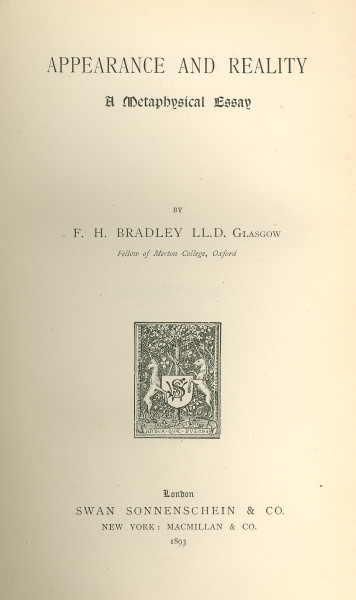
Here is a recently published entry on F.H. Bradley for the Stanford Encyclopedia of Philosophy. To my mind, Bradley was the most formidable of the British idealists. I treasure my first edition copy of Appearance and Reality.
Oakeshott Conference: Tulsa 2011
Religion, Politics and the Future of Liberal Education:
The Tenth Anniversary Meeting of the
Michael Oakeshott Association, 2001-2011
UNIVERSITY OF TULSA
OCTOBER 13-16, 2011
2011 marks the tenth anniversary of the founding of the Michael Oakeshott Association, a group established to encourage the critical study of one of the twentieth century’s most important political philosophers. Previous conferences have taken place at the London School of Economics, Colorado College, the University of Jena in Germany, and Baylor University.
The University of Tulsa will host the Association’s meetings this year. The focus of the conference will be Oakeshott’s understanding of liberal education and the contemporary university. Also central will be the possible relationships between university education, politics and religion. Potential authors should strive both to engage Oakeshott’s work on its own terms and to locate it in broader discussions about education, religion and politics. Papers that compare Oakeshott to other relevant thinkers are encouraged.
Abstracts, no more than 500 words, should be sent by April 15, 2011 to Elizabeth_Corey@baylor.edu. Abstracts should also include: title of paper, full name(s), affiliation, current position, and an email address.
Tallis Reviews Ramachandran’s Latest
Via Pete Mandik at Brain Hammer here is a rather snippy review by Raymond Tallis in the WSJ on V. S. Ramachandran’s latest which just yesterday I was leafing through. Is this the opening salvo of a slanging match akin to the APA Eastern Division meeting a few years back with Dennett vs. Bennett and Hacker?
The trouble begins when the neurologist turns philosopher and tries to use these insights to get closer to “what makes us human.” He suggests that such cross-wiring underpins both humans’ ability to enjoy metaphors and artists’ capacity to create novel connections—an assertion that has scarcely any research to back it up. (What little has been done depends on laughably simplistic models of how metaphors and creativity really work.) Likewise, his explanation of how we became speaking animals has scarcely a toe-hold on empirical data.

Social Epistemology in Good Health
Here is a new title from OUP comprising new essays on social epistemology. Some of the best names in the business are here. This is a nice compliment to the New Studies and Essential Readings volumes that came out earlier in 2010.


