A Confederacy of Dunces – quotes and extracts – 45

“Go dangle your withered parts over the toilet!” Ignatius screamed savagely (p. 122).

“Oh, shut up your little pussymouth, you mongoloid” (p. 123).

“A little job in a office and you can’t hold it down. With all your education.”

“I was hated and resented,” Ignatius said, casting a hurt expression at the brown walls of the kitchen. He pulled his tongue from the mouth of the bottle with a thump and belched some Dr. Nut. “Ultimately it was all Myrna Minkoff’s fault. You know how she makes trouble.”

“Myrna Minkoff? Don’t gimme that foolishness, Ignatius. That girl’s in New York. I know you, boy. You must really pulled some boo-boos at that Levy Pants.”

“My excellence confused them.”

“Gimme that paper, Ignatius. We gonna take a look at them want ads.”

“Is that true?” Ignatius thundered. “Am I going to be thrown out again into the abyss? Apparently you have bowled all the charity out of your soul. I must have at least a week in bed, with service, before I shall again be whole.”

“Are you really going to attempt to read aloud? I doubt whether my system could bear that trauma at the moment. Anyway, I am looking at a very interesting article in the science column about mollusks.”

Mrs. Reilly snatched the paper from her son, leaving two little scraps of it in his hands.

“Mother! Is this offensive display of ill manners one of the results of your association with those bowling Sicilians?” (p.125).

ignatius_j__reilly__gypsy_mother_by_gpapanto-d6dddsj

Bad Decision Bars

This bit of froth I actually found amusing. It is wryly written, it is about New Orleans and alcohol — oops the latter two are of course at one —  and most of all, it is true. I think that were I a student at any of the terrific universities in New Orleans, I wouldn’t have made it out alive.

03

Political Studies Review of Oakeshott Companion

Here is a very warm review of Paul and my Companion.

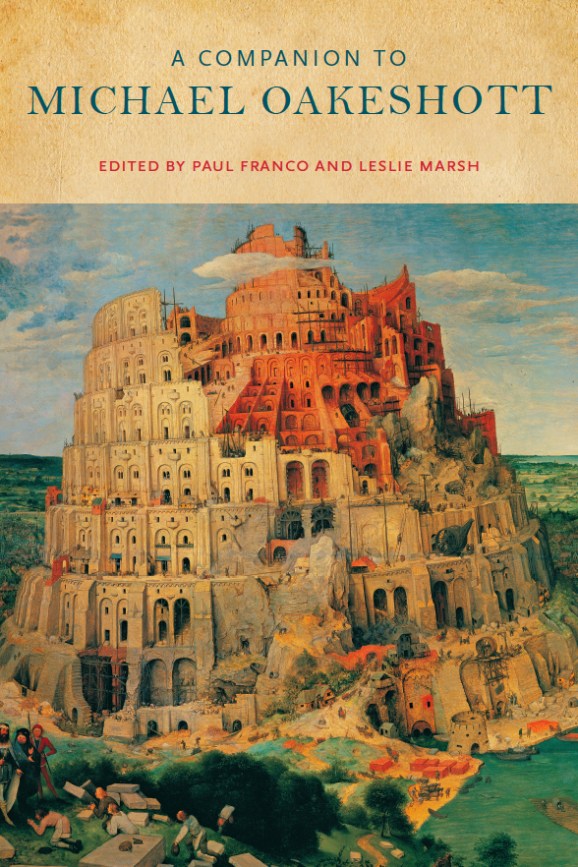
A Companion to Michael Oakeshott by Paul Franco and Leslie Marsh (eds). Pennsylvania PA: Penn State Press, 2012. 346pp., £52.95, ISBN 978 0 271 05407 0
Image

The publication of this Companion by Penn State Press is proof of the increasing recognition of Oakeshott’s philosophical work in recent years. The fact that another such work has been issued simultaneously by Cambridge University Press (1) underscores this British thinker’s importance to the intellectual world. Yet were these two products to be taken as mere rivals, rather than complementary pieces of scholarship, Paul Franco and Leslie Marsh’s volume need not fear the comparison.

In their volume, Franco and Marsh assemble fifteen articles by leading experts in the field to cast a kaleidoscopic view on the ‘life and letters’ of Michael Oakeshott. Perhaps one should more precisely say that the Companion wishes to inform readers about Oakeshott’s multifarious philosophical achievements as well as his eccentric (and much less meritorious) love life, or so the focus of the unlikely biographical note at the beginning of the book (by Robert Grant) suggests. The articles that follow the introduction by the editors and the biographical note are organised in two parts. The first part deals with Oakeshott’s reflections on the practice of philosophy, morality and historical knowledge, as well as religious and aesthetic kinds of experience. The second part discusses his work on political philosophy and the history of political thought. Thus, the wide range of Oakeshott’s oeuvre is covered and, what is more, the quality of contributions is generally high.

Inevitably, not all interests can be wholly accommodated when assembling a collection on a prolific philosopher. For instance, readers will not find a succinct conspectus of Oakeshott’s political philosophy and the limits of his ideas, or its reception in the academic world. Also Oakeshott’s stance on economic policy is not addressed in great depth. (Leslie Marsh’s outstanding article on Oakeshott and F. A. Hayek primarily inquires into issues of cognitive science and the philosophy of mind.) Finally, though this is probably a virtue rather than a vice, the editors refrain from attempting to reconcile the partly diverging interpretations of the individual authors (p. 12). However, there is no doubt that the articles manage to acquaint the reader with Oakeshott’s philosophical achievements without being uncritical, and take the existing literature in several respects one step further. A Companion to Michael Oakeshott can therefore legitimately claim to serve as an authoritative guide to Oakeshott’s thought. It will be of great value to advanced scholars as well as students unfamiliar with his ideas.

Note 1

The Cambridge Companion to Oakeshott, ed. Efraim Podoksik.

Martin Beckstein (University of Zurich)

COSMOS + TAXIS 1:2

Image

Coming Soon: C+T 1.2

Frederick Turner — “Quality, quantity, granularity, and thresholds of emergence”

Stefano Moroni — “Two different theories of two distinct spontaneous phenomena: orders of actions and evolution of institutions in Hayek”

Chor-yung Cheung — “Hayek on Nomocracy and Teleocracy: a critical assessment”

Lauren K. Hall — “Guiding the invisible hand: spontaneous orders and the problem of character”

Joseph Isaac Lifshitz — “Spontaneous order theory in a Heideggerian context”

Politics in a poetic key

This from ABC (Australia) from a few years back — audio and transcript — featuring two chaps who made it over to London for MOA 2001. The fresh Oakeshott images below by Brian John Spencer.

544479_10151487480273260_341646767_n

Michael-Oakeshott-pic

A Confederacy of Dunces – quotes and extracts – 44

He dramatically whipped from his pelvis the sheet, flapping it open. Among the yellow stains the word FORWARD was printed in high block letters in red crayon. Below this Crusade for Moorish Dignity was written in an intricate blue script.

“Sheet? What sheet!” Ignatius replied. “I am holding before you the proudest of banners, an identification of our purpose, a visualization of all that we seek.” The workers studied the stains more intensely. “If you wish to simply run into the office like cattle, you will have participated in nothing more than a riot. This banner alone gives form and credence to the agitation. There is a certain geometry involved in these things, a certain ritual which musty be observed. Here, you two ladies standing there, take this between you and wave it thus with honor and pride, hands held high, et cetera.”

The two women who Ignatius indicated ambled slowly to the cutting table, gingerly took the banner with their thumbs and index fingers, and held it between them as if it were a leper’s shroud (p. 119).

Image

New Editor for EPISTEME

Jennifer Lackey assumes the editorship of EPISTEME. Here is an interview with Jennifer. Here also is the programme for the recent 10th anniversary conference.

lackey03

The Global Brain

Here’s a paper by David Weinbaum that invokes stigmergy, my first mention of stigmergy and the global brain this year.

Image