Excerpt from Anna Sherman’s The Bells of Old Tokyo: Meditations on Time and a City in The Paris Review.
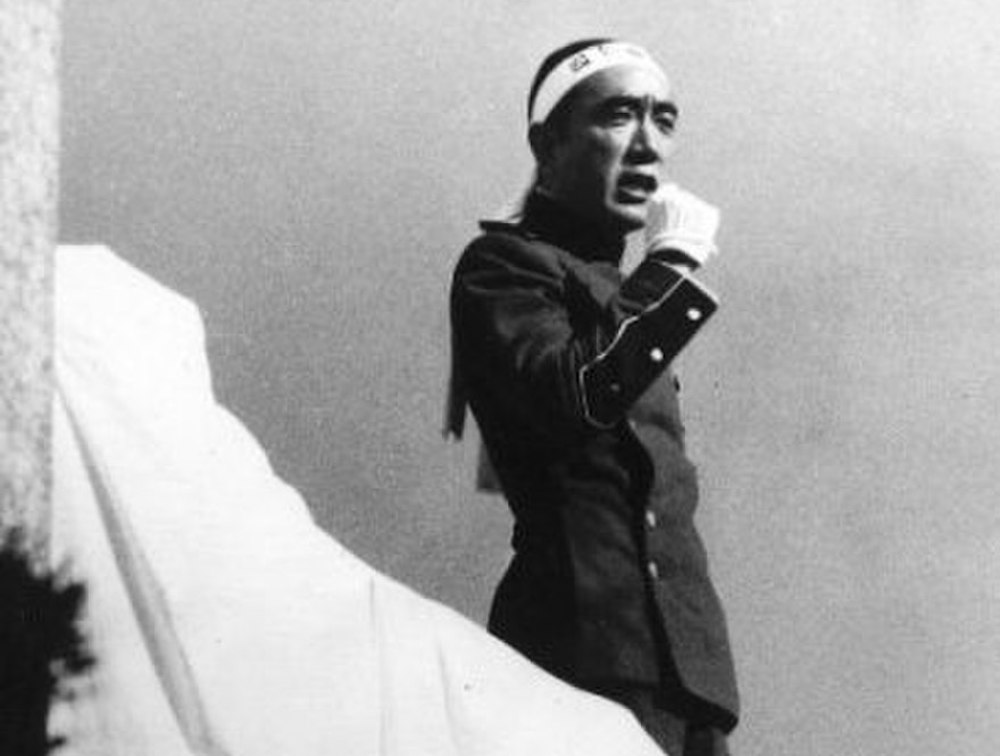
Excerpt from Anna Sherman’s The Bells of Old Tokyo: Meditations on Time and a City in The Paris Review.

Newly published as open access in Frontiers in Psychology. At long last Hayek makes an appearance outside of Austrian and behavioral circles though myself and others been banging on about him as a situated theorist for yonks. See Bill Butos’ (ed.) The Social Science of Hayek’s The Sensory Order.
economic reasoning is never just an individual process carried out by an autonomous individual, classically understood. In this regard, understanding the concept of relational autonomy allows us to see how economic reasoning is always embodied, embedded in, and scaffolded by intersubjective interactions, and how such interactions make the market what it is.
Here is the second piece that Ken Minogue gave me thirty or so years ago. This time it’s a piece by Oakeshott himself. Pardon the markings . . . a clean version can be found in What Is History? And Other Essays. Not that it matters much, but the date for the published version is question-marked as 1961?; the version I’ve posted is marked 1963.
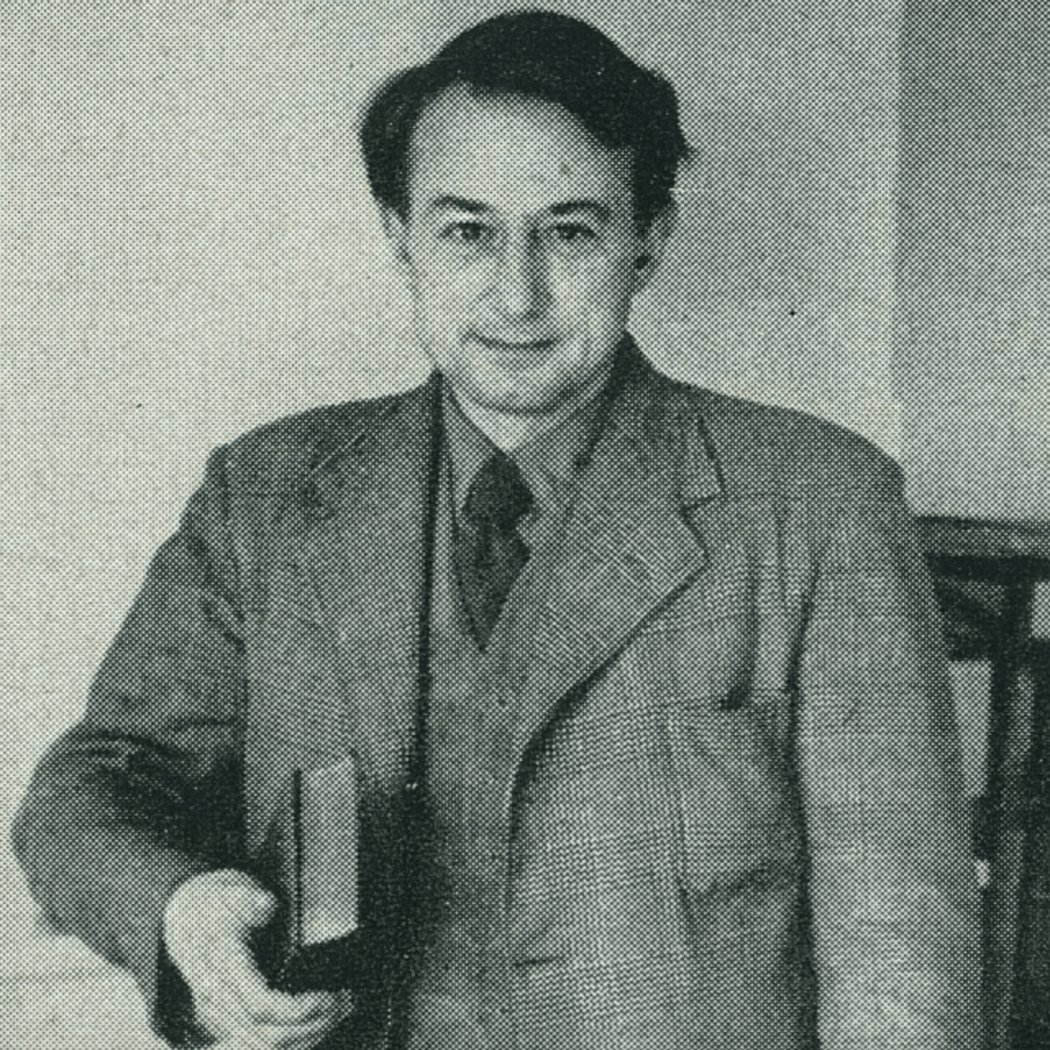
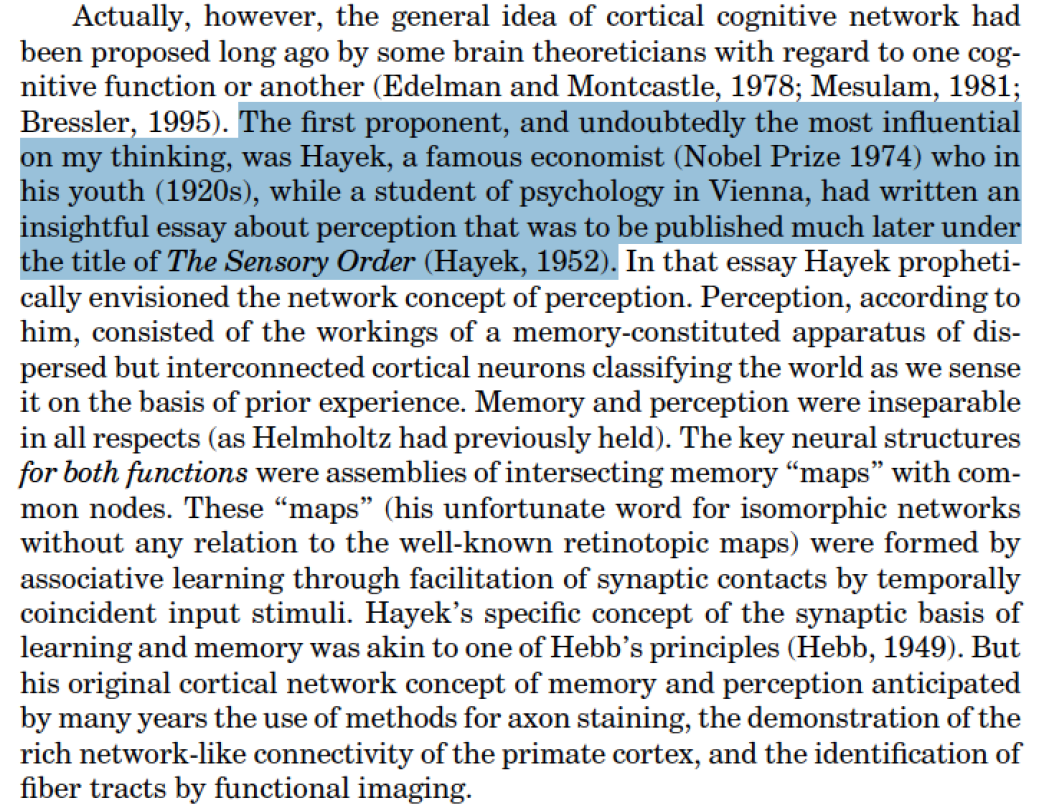
Happy birthday to Joaquín. Here is a bio-sketch of Joaquín’s life and a summary of his work. Also check out Joaquín’s “Hayek in Today’s Cognitive Neuroscience” which he wrote for my edited collection in 2011. Some 20 years ago I gave a talk on Hayek’s philosophical psychology examining the continuities between Hayek’s social connectionism and his proto-neuroconnectionism, only for him to be dismissed by snide “neo-liberal” aspersions. It was at that point it became apparent just how ideologically mendacious and ill-informed things had become in the academy. Had I’d known of Joaquín’s work back then, someone with real distinction in CogSci, it would have been rather easy to show up this person’s bad faith.
The aim of this chapter is to propose an account of sensory perception from the known writings of Adam Smith, chiefly his juvenile work, “On the External Senses.” This account asserts that when we perceive an object we simulate its painful or pleasurable effects on our body—we imaginatively place ourselves in proximity to the object and feel some measure of the pain or pleasure we naturally associate or have learned to associate with its presence. When we smell food, our mouths water with the pleasure we anticipate will result from eating it (ES 80). When we hear a loud sound, we automatically shrink with fright in anticipation of the pain we imagine would be caused by such an object (ES 87). As Adam Smith writes, the senses “instinctively suggest to us some conception of the solid and resisting substances which excite their respective sensations” (ES 75).
In two previous papers I have expounded on some aspects of Smith’s account of perception. Glenney (2011) provides analysis of some of the sensory mechanisms involved in Smith’s account of perception. The spatial senses of vision and audition employ an innate mechanism of “suggestion” that attributes externality to the objects of sight and sound by way of instinctively simulating the associated feelings of tactile resistance that automatically suggest the externality of objects. Without associations of resistance, sight and sound are non-spatial and, as in Smith’s initial assessment of Cheselden’s once-blind patient, colors (and sounds) are felt in the eye (or ear) (ES 65). The remaining senses of smell, taste, and felt temperature, even when associated with feelings of resistance, remain proto-spatial at best, “some vague idea or preconception of the existence of that body; of the thing to which it directs, though not the precise shape and magnitude of that thing” (ES 79; See also ES 85). Hence, non-spatial senses never engage the “suggestion” mechanism for external attributions, but rather derive external “anticipations” from a mechanism that Smith calls “preconception.” Thus, two distinct inborn mechanisms guide two different external associations. But Smith provides little further detail regarding how these innate mechanisms actually work, alluding only to an “ascription by our imagination” (ES 54); later, in TMS, he writes of a “transporting by the imagination” (TMS III.iii.2) in his discussion of perception as analogy to moral judgment.
A second paper on ES extends the possibility that these innate mechanisms of external attribution and anticipation are the work of a mechanism of “sympathy,” paralleling Smith’s account of the moral assessments made of the behavior of others (Glenney, 2014). A perceiver first attributes a sight, sound, smell, taste or felt temperature to a particular object, projects him or herself into proximity with that object, and approximates the associated feelings that would be felt were the object made present, leading to an evaluative judgment as to the health or harm such proximity would generate for the body based on comparing a similarity or difference of their immediate feelings and approximated feelings. While the epistemic reliability of these perceptual judgments by sympathy is marked by concerns similar to those expressed by Smith regarding moral judgments in TMS, a kind of “impartial spectator” provides analogical support for their reliability. Hence, it is likely that perception and morality rely on a similar mechanism of sympathy for Smith. An account of perception, however, requires more than the structural and epistemic theories outlined in these two papers.
The focus of this paper covers perhaps the most important of Smith’s considerations on perception, his discussion of its qualia or the character of sensory experience. Qualia are usually characterized by very simple features: the qualia of a tomato are its appearance as red and round, its softness when squeezed, and its garden patch smell and tangy taste. These sensations help compose what it is like to experience a tomato with our different senses. Crucially, qualia distinguish a tomato sensory experience from a thought about a tomato, adding vivacious feelings to our tomato representations. Qualia reflect, in many ways, the unique nature of perception; to study qualia is to study what it is that makes perception distinctive. Today, the study of qualia is informed primarily by consideration of the representational content that determines the experiential character of qualia. For example, the red and round character of a tomato experience is determined by round and red tomato representations rather than, say round and red rubber ball representations. In this paper, consideration of representational content will provide an instructive model for studying Smith’s own discussion of sensory experience.
Smith’s own study of qualia in ES is focused on two kinds of sensory experience: the feeling of resistance in tactile experience and the feeling of “presence” or externality of objects in non-tactile experience:
While the qualia of both tactile resistance and tactile empathy represent objects as external, the former do so directly, the latter indirectly. Smith’s account of how visual, auditory, and olfactory qualia indirectly generate feelings of tactile qualia of resistance is a most important contribution to the study of perception, and becomes the particular focus here.
While this is a reconstruction of Smith’s discussion of perception by sympathy, it is one that Smith may have made more explicit had the focus of his philosophical inquiries turned to the topic of perception. Smith’s would-be proposal based on sympathy is, furthermore, unique to philosophical accounts of perception both historical and contemporary. Lastly, as documented in the previous work on ES discussed above, the cognitive sciences provide empirical support for such an account. Thus, though preliminary descriptions of ES judged it to be a mere “essai” that was “no more than competent,” closer inspection may reveal a startlingly innovative theory of some importance.
Some thirty years ago Ken Minogue kindly gave me copies of three pieces, two of which he’d written on Oakeshott: the third was by Oakeshott himself. All may well have already been published, but if not, here is the first installment.