Epistemic Approaches To Democracy

This is the latest issue of EPISTEME: it’s currently available as hard copy but not online, though this will happen before long.

EPISTEMIC APPROACHES TO DEMOCRACY
Guest Editor: David Estlund

• Introduction: Epistemic Approaches to Democracy, David Estlund

• Science, Religion, and Democracy, Philip Kitcher

• The Epistemic Value of the Democratic Process, William Nelson

• Pure Epistemic Proceduralism, Fabienne Peter

• The Premises of Condorcet’s Jury Theorem Are Not Simultaneously Justified, Franz Dietrich

• Epistemic Democracy and the Social Character of Knowledge, Michael Fuerstein

• A Culture of Justification: The Pragmatist’s Epistemic Argument for Democracy, Cheryl Misak

• Toward a Social Epistemic Comprehensive Liberalism, Robert B. Talisse

• An Epistemic Defense of Democracy: David Estlund’s Democratic Authority, Elizabeth Anderson

Testimony – Free Download

EPISTEME 

Issue 4.3 

A themed issue on Testimony – will be freely available for download for 14 days only (July 7- July 14).

Take advantage of this freebie.

A Companion to Michael Oakeshott

Here is the collection of newly commissioned essays edited by Paul Franco and Leslie Marsh forthcoming from Penn State University Press.

1. Editorial Introduction (Paul Franco & Leslie Marsh)

The editors give an overview of the importance of Oakeshott to 20th Century philosophy and account for the abiding interest in Oakeshott’s work.

2. The Pursuit of Intimacy, or Rationalism in Love (Robert Grant)

An account of Oakeshott’s life and times designed to introduce readers to the flesh and blood man.

3. The Victim of Thought: The Idealist Inheritance (David Boucher)

A discussion of Oakeshott’s idealist theory of knowledge and metaphysics in relation to Hegel and British Idealism.

4. Philosophy and its Moods: Oakeshott on the Practice of Philosophy (Kenneth McIntyre)

Oakeshott on philosophical method.

5. Michael Oakeshott’s Philosophy of History (Geoffrey Thomas)

A critical exposition of Oakeshott’s philosophy of history, one of the most important aspects of Oakeshott’s philosophy and often considered to be one of the most profound treatments of historical knowledge in the 20th century.

6. Radical Temporality and the Modern Moral Imagination: Two Themes in the Thought of Michael Oakeshott (Timothy Fuller)

An analysis of Oakeshott’s concept of philosophy as it developed over the course of his career and especially as it relates to political philosophy.

7. The Religious Sensibility of Michael Oakeshott (Elizabeth Corey)

Oakeshott wrote extensively on religion and theology from the 1920s right through to the 1970s. Only now is this aspect of Oakeshott attracting attention.

8. Whatever It Turns Out To Be: Oakeshott on Aesthetic Experience (Corey Abel)

A discussion of Oakeshott’s philosophy of art, especially in connection with his important essay “The Voice of Poetry in the Conversation of Mankind”.

9. Un Début dans la Vie Humaine: Michael Oakeshott on Education (Paul Franco)

Oakeshott’s philosophy of education is gaining more and more prominence as a classic defence of a liberal arts education while simultaneously being a critique of instrumentalist education.

10. Michael Oakeshott on the History of Political Thought (Martyn Thompson)

Oakeshott’s legendary lectures on the history of political thought, delivered at the LSE in the 1950s and ‘60s, have recently been published. The question of how to write the history of political thought was an abiding concern of Oakeshott’s and links him to other contemporaries such as Leo Strauss, J.G.A. Pocock, and Quentin Skinner.

11. Oakeshott and Hobbes (Noël Malcolm)

Oakeshott’s interpretation of Hobbes as the preeminent philosopher of the political theory of individuality is generally regarded as one of the most important contributions to Hobbes scholarship in the 20th century.

12. The Fate of Rationalism in Oakeshott’s Thought  (Kenneth Minogue)

A critical analysis of this best-known aspect of Oakeshott’s political philosophy, which bears comparison with other postwar critiques of central planning and utopian thinking by Berlin, Hayek, Popper, and Polanyi.

13. Oakeshott and Hayek: Situating the Mind (Leslie Marsh)

Oakeshott and Hayek contemporaneously presented the two major and most sustained critiques of rationalism. Conceived as social epistemologists, a contrastive and critical picture is drawn.

14. Oakeshott as Conservative (Robert Devigne)

Oakeshott is generally regarded as one of the most important conservative thinkers of the second half of the 20th century. This essay presents a critical analysis of his distinctive and skeptical brand of conservatism with comparisons to other 20th-century conservatisms.

15. Oakeshott on Civil Association (Noël O’Sullivan)

Civil association, defined in opposition to purposive or enterprise association, is the central concept of Oakeshott’s most highly developed statement of his political philosophy set out in his magnum opus On Human Conduct.

16. Oakeshott on Law (Steven Gerencser)

This is one of the most neglected aspects of Oakeshott. The rule of law is a vital to Oakeshott’s conception of the liberal (civil) state.
What is it like to be a bat?

This press release from the National Science Foundation would confound those who subscribe to Thomas Nagel’s classic thought experiment.

Dartmouth 2008

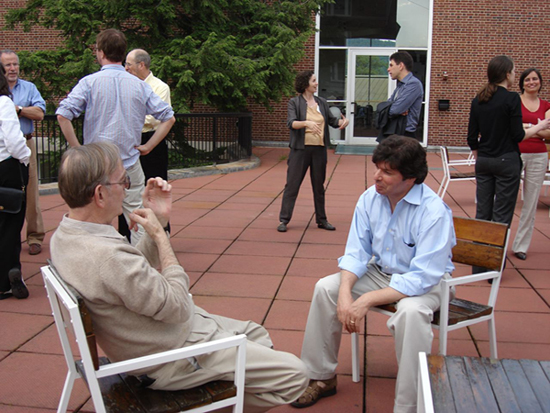
This weekend saw the fifth annual EPISTEME conference take place at Dartmouth College. The highlight for me was meeting the legendary Larry Laudan (left) – not only was he great company but his performance was outstanding.

Social Identity

In today’s Guardian there is an article entitled Who do you think I am? with the tag line “It’s all too easy to categorise people but it isn’t inevitable. We can still consider the alternatives.”

The writer is quite correct so say that:

Identity is a contemporary buzzword

and goes onto list instances of its use. I have been banging on about this casual uncritical use of the term identity. The writer goes on to say:

The everyday meaning of identity is never entirely fixed but there are successful definitions that have particular influence in particular contexts. There are two general definitions of identity in the articles featured in the Guardian. The first appears in articles on ID cards and identity fraud and encapsulates the notion of an individual’s possession of official characteristics, a recognised legal identity to which a bundle of rights (political, economic and social) can be attached. The second is primarily concerned with culture and is often tagged with a national, ethnic or religious complement, “British identity” and, “Muslim identity” being by far the most common. In both cases, identity is construed as a recognisable object, a specific something with a given content that can be tagged with an appropriate label. This in itself is not uncontroversial, though it is not questioned as often as it ought to be.

The writer makes the valid distinction between the rather superficial notion of legal identity and the deeper, more slippery notion, of social identity: the latter tied to the blithely used notion “multiculturalism”.

The problem here is that the writer doesn’t at all offer even the beginnings of a conceptual analysis of what multiculturalism might denote. I understand the writer to be saying (though not using philosophical jargon) that there cannot be necessary and sufficient conditions for the complexity that is social identity – there are multitudinous overlapping collecting features.

We are not, however, condemned to theorising identity as a series of ever receding circles of categorisation: white, English, female, middle-class and so on, each with its inevitable weight of external definition over which we have little or no control.

That’s an eminently sensible approach. The writer then goes onto to say:

There are alternatives. The Vedanta philosophy of Hinduism, for instance, emphasises the universal state of flux of which the self is a mere part: you are me and I am you and we are all the world. If that seems just a little too vague and lyrical, then it is worth noting that recent theories of the self which draw on connectionism in cognitive science have very similar conceptions of identity, not “egos in bags of skin” but embodied minds intimately connected to their environment through every vibrant nerve-ending.

The Buddhist conception is also a conception of the self that challenges the Lockean notion. It’s ironic that the writer characterises the Hindu conception as too “vague and lyrical”: and yet there is no indication at all that the writer understands what a connectionist theory of the self is. There seems to be a conflation between personal identity and social identity, identities that, I would grant, are somehow related. This said, I see no entailment between a connectionist theory of mind and an embodied and situated agent.

The writer should check out the discussion at the blog What Sorts of People.

Jack Greenleaf

Jack Greenleaf has died. Greenleaf provided the first full length study of Oakeshott. We did speak in 2001 since I’d hoped he’d come to the inaugural conference of the Michael Oakeshott Association at the LSE. The sense that I got was that he felt somewhat resentful for primarily being known for his work on Oakeshott. It was a fine book and is still worthy to be read. Here are two obituaries:

The Telegraph

The Guardian 

Cognitive Closure

If the human brain were so simple that we could understand it, we would be so simple that we couldn’t.                                                                                                                                       

                                                                                                                                                    (Pugh, c. 1938)


I was going to write something about this article that recently appeared in the New Scientist until I discovered that Brain Hacks had already done so. Hayek would have been appalled by what he’d term a logical contradiction – the mind explaining itself. Hayek is acutely aware that self-referentiality leads to dead-ends: the instrument of explanation simultaneously being the object of explanation cannot get us anywhere. Hayek takes the view that a unified theory of consciousness is forever beyond our grasp. See also Colin McGinn on cognitive closure.