Cognitive scienceDescartesexistentialismHubert DreyfusMartin Heideggerphenomenologysituated cognition
A Confederacy of Dunces – quotes and extracts – 85
“Oh, my God! You’re wearing your bowling shoes,” Ignatius cast a pink and blue and yellow eye over the side of the bed down past his mother’s hanging slip and drooping cotton stockings. “Only you would wear bowling shoes to your child’s sick bed.”
But his mother did not rise to the challenge. She had the determination, the superiority that comes with intense anger. Her eyes were steely, her lips thin and firm.
Everything was going wrong.
. . .
Dr. Talc had had them both in separate classes one grim semester, during which they had disrupted his lectures with strange noises and impertinent, venomous questions that no one, aside from God, could possibly have answered. He shuddered. In spite of everything, I he must reach Reilly and extract an explanation and confession. One look at Mr. Reilly and the students would understand that the note was the meaningless fantasy of a sick mind. He could even let the administration look at Mr. Reilly. The solution was, after all, really a physical one: producing Mr. Reilly in the abundant flesh.
Dr. Talc sipped the vodka and V-8 juice that he always had after a night of heavy social drinking and looked at his newspaper. At least the people in the Quarter were having rowdy fun. He sipped his drink, and remembered the incident of Mr. Reilly’s dumping all of those examination papers on the heads of that freshman demonstration beneath the windows of the faculty office building. The administration would remember it, too. He smiled complacently and looked at the paper again. The three photographs were hilarious. Common, bawdy people — at a distance — had always I amused him. He read the article and choked, spitting liquid onto his smoking jacket.
How had Reilly ever sunk so low? He had been eccentric as a student, but now…. How much worse the rumors would be if it were discovered that the note had been written by a hot dog vendor. Reilly was the sort who would come to the campus with his wagon and try to sell hot dogs right before the Social Studies Building. He would deliberately turn the affair into a three-ring circus. It would be a disgraceful farce in which he, Talc, would become the clown.
Dr. Talc put down his paper and his glass and covered his face with his hands. He would have to live with that note. He would deny everything.

Jimmy Page
Born on this day.
Here’s Jimbo’s hour-long interview with Jeff Koons.
In the Q&A, JP discusses his official photographic autobiography, the recent re-mastered releases of Led Zeppelin IV and Houses of the Holy and also reveals plans for what promises to be a very exciting 2015…
A better, less gushing interview:
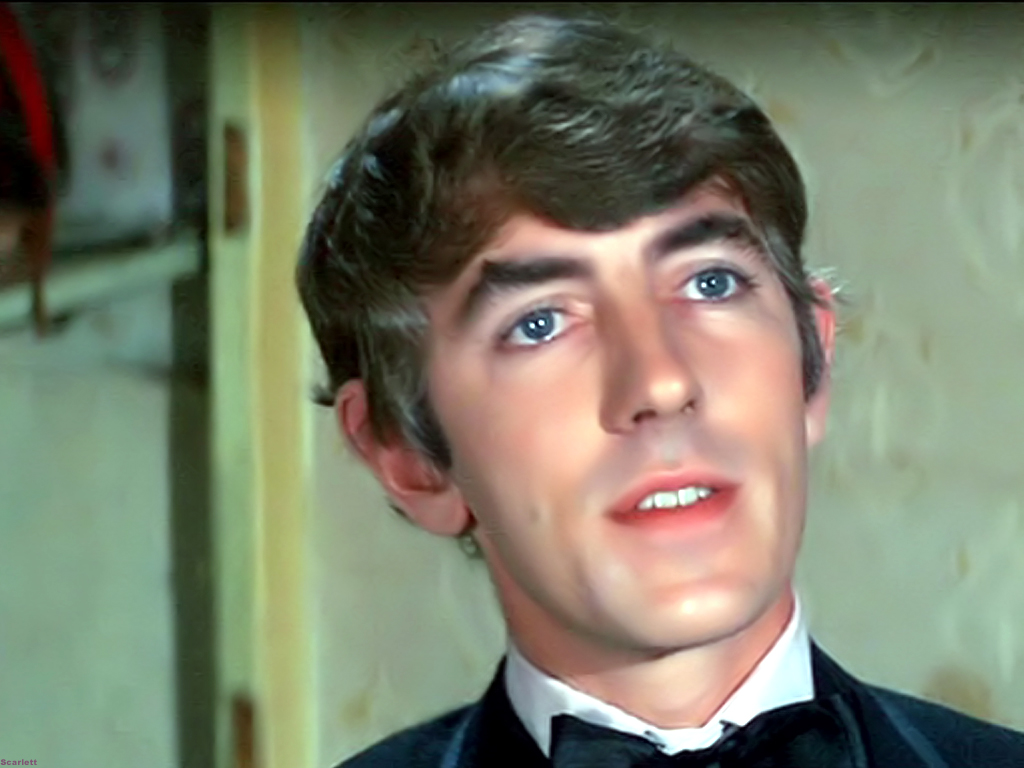
Peter Cook
This genius died 20 years ago. Check out the documentary Peter Cook At A Slight Angle To The Universe. Also John Bird’s obit.
The direction his work took had nothing whatever to do with marketing a talent, finding a niche, developing a career. It had everything to do with a compulsive articulation of his view of life, beady, remorseless, hilarious.
Cook had a remarkable feeling for language. He had an unblinking bullshit detector which never failed him; and he would never draw back in his comments.

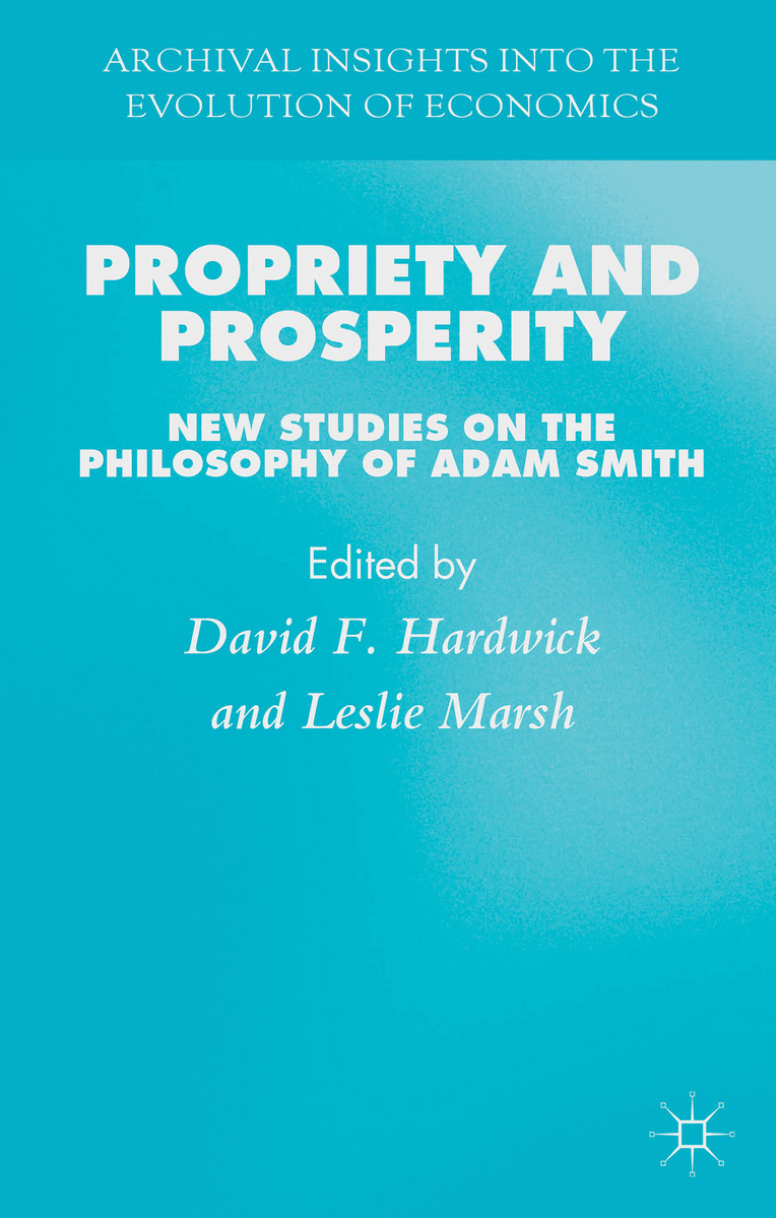
Friendship in Commercial Society Revisited: Adam Smith on Commercial Friendship
Intro from Spiros Tegos’ chapter.
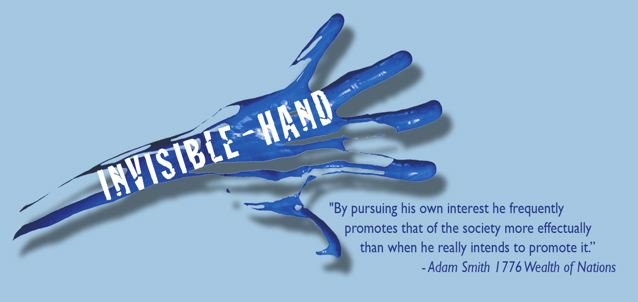
Friendship is a rather unusual topic for Adam Smith scholars given the emphasis that the concept of sympathy has received in the field of Scottish Enlightenment scholarship. However it has been quite rightly pointed out that Smith considered sympathy to be central to commercial motivation (See Hanley, ms). The emblematic Smithian motto, the effort of every single human being to better its condition is driven by the human desire ‘to be taken notice of with sympathy, complacency and approbation’ (TMS I.3.2.1). Throughout Smith’s oeuvre, to turn moderate wealth-getting into a widespread legitimate and ‘improving’ social activity is a priority. To this end, he pleads for the ‘trickle down’ effect of an increasingly productive economy together with the subsequent development of a social and cultural framework that will turn wealth-getting into a morally acceptable and politically manageable activity. In the same vein, an analogous, ‘proper’ consumption mentality should be equally developed, immune to the dangers of aristocratic conspicuous consuption and the subsequent ‘corruption of the moral sentiments’ due to boundless admiration of the rich and famous. In this specific context the idea that Theory of Moral Sentiments (TMS) is a ‘manifesto of middle class mores’ (Barzilai, 2010) gains acceptance. In this Smithian landscape, is there any place left for a modern conception of friendship beyond a vestigial classical legacy? The core claim of this paper is that there is something particularly original in Smith’s treatment of friendship. Indeed, Smith explores the void left once both the idealized, largely elitist ‘virtue friendship’ on the one hand and what one could name ‘kinship friendship’, that is enlarged family solidarity on the other become or are expected to become obsolete within commercial civilization.
In this chapter first I address an under-appreciated scholarly debate regarding the status of friendship within the framework of a declining clan based environment and an emerging commercial society such as was encountered in 18th century Scotland. I then examine Smith’s own conceptual strategy and terminology in added part VI of the TMS in its last edition (1790). New forms of social visibility and prestige emerge within the frame of commercial civil society. Friendship will be reframed and repositioned within a novel affective economy. This frame of analysis could be profitably set next to a broader agenda of Enlightenment ideals of enlarging one’s opportunities to interact with strangers expanding the circles of affective ties of individuals beyond the clan and the polis without reflecting classic cosmopolitan sensibilities. To conclude, elaborating the issue of refined, commercial affectivity, I thus succinctly address the existence of similar thought patterns in French enlightenment focusing on Sophie de Grouchy, Condorcet’s widow an important intellectual figure of the old regime. She highlights the transition of modern, ‘Scottish’ sympathetic affectivity in the immediate post-French revolution context, within a set of refined manners leading to the progress of civilization.

Are You Your Brain, and Is Your Brain a Computer?
Andy Clark talk.
The Moviegoer – quotes and extracts – 16
What is the malaise? you ask. The malaise is the pain of loss. The world is lost to you, the world and the people in it, and there remains only you and the world and you no more able to be in the world than Banquo’s ghost.
You say it is a simple thing surely, all gain and no loss, to pick up a good-looking woman and head for the beach on the first fine day of the year. So say the newspaper poets. Well it is not such a simple thing and if you have ever done it, you know it isn’t—unless, of course, the woman happens to be your wife or some other everyday creature so familiar to you that she is as invisible as you yourself. Where there is chance of gain, there is also chance of loss. Whenever one courts great happiness, one also risks malaise.
The car itself is all-important, I have discovered. When I first moved to Gentilly, I bought a new Dodge sedan, a Red Ram Six. It was a comfortable, conservative and economical two-door sedan, just the thing, it seemed to me, for a young Gentilly businessman. When I first slid under the wheel to drive it, it seemed that everything was in order—here was I, a healthy young man, a veteran with all his papers in order, a U.S. citizen driving a very good car. All these things were true enough, yet on my first trip to the Gulf Coast with Marcia, I discovered to my dismay that my fine new Dodge was a regular incubator of malaise. Though it was comfortable enough, though it ran like a clock, though we went spinning along in perfect comfort and with a perfect view of the scenery like the American couple in the Dodge ad, the malaise quickly became suffocating. We sat frozen in a gelid amiability. Our cheeks ached from smiling. Either would have died for the other. In despair I put my hand under her dress, but even such a homely little gesture as that was received with the same fearful politeness. I longed to stop the car and bang my head against the curb. We were free, moreover, to do that or anything else, but instead on we rushed, a little vortex of despair moving through the world like the still eye of a hurricane. As it turned out, I should have stopped and banged my head, for Marcia and I returned to New Orleans defeated by the malaise. It was weeks before we ventured out again.
This is the reason I have no use for cars and prefer buses and streetcars. If I were a Christian I would make a pilgrimage by foot, for this is the best way to travel. But girls do not like it. My little red MG, however, is an exception to the rule. It is a miserable vehicle actually, with not a single virtue save one: it is immune to the malaise. You have no idea what happiness Marcia and I experienced as soon as we found ourselves spinning along the highway in this bright little beetle. We looked at each other in astonishment: the malaise was gone! We sat out in the world, out in the thick summer air between sky and earth. The noise was deafening, the wind was like a hurricane; straight ahead the grains of the concrete rushed at us like mountains.

Architecture Continues To Implode: More Insiders Admit The Profession Is Failing
The very excellent scathe merchant Justin Shubow in Forbes.
Betsky explicitly said that context was appropriately irrelevant to the design. It was clear that for Betsky and Kroloff, the anonymous globalized starchitecture that is all the rage in Dubai, Davos, and Shanghai equally belongs in New Orleans’ Lower Ninth Ward.
If the architects had their way, elevator music in New Orleans public housing would be screeching Stockhausen, not native Louis Armstrong or Fats Domino. Modernists have no room for harmony, rhythm, or soul; they are high-culture elitists, not multiculturalists who celebrate class and ethnic diversity.

From the Band’s Music, the Weight Builds a Future
A Confederacy of Dunces – quotes and extracts – 84
Mrs. Reilly reached down next to her chair and picked from the floor the large volume of The Consolation of Philosophy. She aimed one of its corners at Ignatius’ stomach.
“Awff,” Ignatius gurgled.
“Angelo found it in that barroom last night,” Mrs. Reilly said boldly. “Somebody stole it off him in the toilet.”
“Oh, my God! This has all been arranged,” Ignatius screamed, rattling the huge edition in his paws. “I see it all now. I told you long ago that that mongoloid Mancuso was our nemesis. Now he has struck his final blow. How innocent I was to lend him this book. How I’ve been duped.” He closed his bloodshot eyes and slobbered incoherently for a moment. “Taken in by a Third Reich strumpet hiding her depraved face behind my very own book, the very basis of my worldview. Oh, Mother, if only you knew how cruelly I’ve been tricked by a conspiracy of subhumans. Ironically, the book of Fortuna is itself bad luck. Oh, Fortuna, you degenerate wanton!”