The publisher has finally got a page up for Paul and my Companion. We’re getting there . . . click on the graphic below and our dedicated page for more details.

The publisher has finally got a page up for Paul and my Companion. We’re getting there . . . click on the graphic below and our dedicated page for more details.
Here’s a recent article from The Guardian. The brain in the clip turns from red to solid yellow during climax.
The latest and final issue of EPISTEME is now available. As of the next issue (9) EPISTEME will be published by Cambridge University Press.
Daniel Kahneman’s recently released book Thinking, Fast and Slow aimed at a popular audience is certainly generating a great deal of press, so far as I can tell, most of it very positive. Here he is outlining his experimental work in a Ted Talk. As a behavioral economist much of what he says about rationality will have resonance for Hayek and Simon and other situated cognitive theorists. I think that much of what Kahneman says is consistent with Gunderman from the previous posting though they are of course very different thinkers.
This past weekend at a conference on the philosophy of philanthropy held in Indianapolis, I had the deep privilege and pleasure to meet up again with Richard Gunderman. I originally met Richard at a conference in Portsmouth, NH exactly three years ago and was mesmerised by his conference talk and his attentive kindness. Knowing that this would appeal to him, I subsequently sent him a copy of Oakeshott’s Rationalism in Politics with instructions to read “The voice of poetry in the conversation of mankind” first. He assured me he did. The second time I met Richard was at his invitation to come to Indianapolis for a conference on philanthropy some 18 months ago. Again, I was struck by his brilliance, humanity, passion and subtlety.
I can say that in my orbit of living persons with immense intellectual power and moral virtue in equal measure, Richard ranks within the top five – I would not want to order them – since I wouldn’t have met one without the other. Meeting him has been one of the most transformative encounters of life. He has a profoundly rich and deep religious/aesthetic sensibility without ever coming over as a closed “preachy” mind. His moral sensibility is so palpable one becomes aware that one is in the company of a great human being and one is humbled. I’m hardly the first person to make this observation. I’m also honoured to be a part of the journal issue that Richard will be participating in. As the wonderful Heather Wood Ion (who I met through Richard as well) referring to Richard’s We Make a Life by What We Give puts it:
Some books enlighten us, some books inspire us, and some books challenge us to expand our understanding of who we are and who we can become. [This book] does all three…. It simply surpasses all other books in the field, but more importantly, it expands our understanding of the field of philanthropy and of ourselves and our potential.
Here is a press release sketching Richard’s interests. How he juggles all this and with a family is astonishing.
Here’s a video of Richard in full flight:
My chum Gene Callahan has just alerted me to the forthcoming publication of his book.
The political system of the Roman Republic were based almost entirely on tradition, “the way of the ancestors,” rather than on a written constitution. While the founders of the American Republic looked to ancient Rome as a primary model for their enterprise, nevertheless, in line with the rationalist spirit of their age, the American founders attempted to create a rational set of rules that would guide the conduct of American politics, namely, the US Constitution.
These two examples offer a striking case of the ideal types, famously delineated by Michael Oakeshott in “Rationalism in Politics” and elsewhere, between politics as a practice grounded in tradition and politics as a system based on principles flowing from abstract reasoning.
This book explores how the histories of the two republics can help us to understand Oakeshott’s claims about rational versus traditional politics. Through examining such issues we may come to understand better not only Oakeshott’s critique of rationalism, but also modern constitutional theory, issues in the design of the European Union, and aspects of the revival of republicanism.
About the Author
Gene Callahan holds a PhD in political theory from Cardiff University, and is a Fellow at the university’s Collingwood and British Idealism Centre. He teaches economics at SUNY Purchase is the author of Economics for Real People (Ludwig von Mises Institute)
Here’s an article in this month’s Atlantic.
Rejecting the views of classic political philosophers like Hobbes, Locke, and Rousseau that primitive humankind started out as a collection of scattered, unorganized individuals, Fukuyama writes: “Human sociability is not a historical or cultural acquisition, but something hardwired into human nature.” Nowhere is Wilson, who pioneered this view, even mentioned.
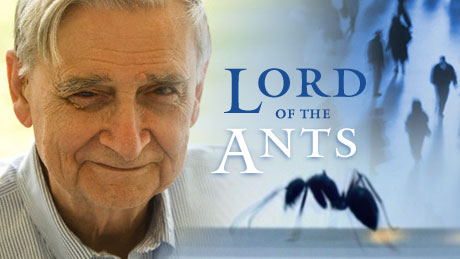
Wilson is of course famous for his work on stigmergy:
• Sematectonic stigmergy.
• Sign-, cue-, or marker-based stigmergy.
Sematectonic stigmergy denotes communication via modification of a physical environment, an elementary example being the carving out of trails. One needs only to cast an eye around any public space, a park or a college quadrangle for instance, to see the grass being worn away, revealing a dirt pathway that is a well-traveled, unplanned and thus indicates an ‘‘unofficial’’ intimation of a shortcut to some salient destination.
Marker-based stigmergy denotes communication via a signaling mechanism. A standard example is the phenomenon of pheromones laid by social insects. Pheromone imbued trails increase the likelihood of other ants following the aforementioned trails. Unlike sematectonic stigmergy which is a response to an environmental modification , marker-based stigmergy does not make any direct contribution to a given task.
Wilson, E. O. (1975/2000). Sociobiology: The new synthesis. Cambridge, MA: Harvard University Press.
Here’s a recently published paper by David DeMoss.
With all the hipster hype accorded to Steve Jobs on his passing, there are two names that are being overlooked – Dennis Ritchie and John McCarthy. Here is their obituary from The Economist.

