Tucson 2014: The 20th Anniversary Toward a Science of Consciousness

Save the Date

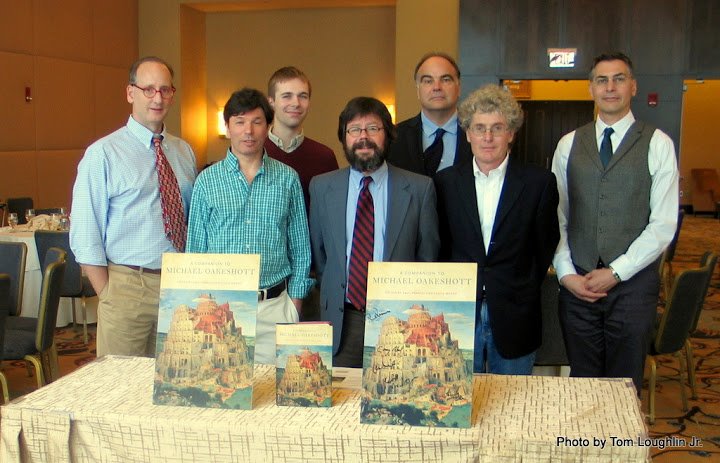
Companion Luncheon Launch

Thanks to Corey Abel, Paul Franco, Steven Gerencser, Ken McIntyre and Ken Minogue, five of the Companion’s contributors, all of whom did such a sterling job of expressing to the assembled audience why Oakeshott is such a worthwhile thinker. Thanks also to our AHI hosts Bob Paquette and Thomas Cheeseman.

Image

Stigmergic dimensions of online creative interaction

Extracts from Jimmy’s paper:

The web has experienced a recent proliferation of design expert communities in domains from software engineering (e.g. Sourceforge and Github) to art (DeviantArt and others). These communities have become hotbeds of creative interaction, with users posting their projects, closely interacting on new endeavors, and engaging in spirited discussion about their craft. With users in these communities constantly generating out new software, images, music and any other artifact imaginable, it is hard to deny that there is significant creative interaction happening. Members of these communities often possess widely varying degrees of proficiency, but more often than not, they have some baseline amount of talent that allows them to enter the community.

Enter Picbreeder. Picbreeder is a web-based system for collaborative interactive evolution of images. The Picbreeder applet starts by randomly generating several images, which are then mated and mutated based on the user’s selections. The user can then publish the image to the Picbreeder website where other users can download and continue the image’s evolution. Within Picbreeder, one need not have artistic talent to contribute to the community, although good taste typically helps. As in more traditional design, new innovations are typically small modifications to the existing structure, which can change the design incrementally or effect a larger shift. Even though users followed their individual interests when evolving this phylogeny, new interesting directions emerged. Many users contributed repeatedly to an evolving lineage, using the design itself to encourage and facilitate collaboration.

Successful collaborative design in Picbreeder does not require shared intentions, suggesting that effective collaboration may be emergent rather than planned from the top down. The surprising result of this emergent process is the gradual discovery by untrained users of hidden treasures within a vast uncharted space. Picbreeder also serves as a fascinating, though initially unintentional, experiment in stigmergic creativity.

The concept of stigmergy was first introduced by Pierre-Paul Grassé, a zoologist, who used it to describe the activities of the termite mound. As he described it, “(s)tigmergy manifests itself in the termite mound by the fact that the individual labour of each construction worker stimulates and guides the work of its neighbour”. The concept of stigmergy can be extended to human endeavors if one expands the notion of the mound to human venues, and replaces “construction worker” with any type of worker. If such an extension is permitted to human creative communities, this description becomes even more apt. Part of the excitement inherent in creative pursuits, whether it is visual art, music or creating open source software, is the moment when the work of a colleague “stimulates and guides” ones own work. Add that “(in) an insect society individuals work as if they were alone while their collective activities appear to be coordinated.” This description too can apply to creative communities. Points out that “(s)tudies on creativity . . . have focused on the individual, obscuring the fact that creativity is a collective affair. The ideas and inventions an individual produces build on the ideas of others (the ratchet effect).” It is very easy to focus on individual creative luminaries, while forgetting the environment and social milieu that are a large part of their creative interaction.

The results of Picbreeder not only demonstrate the truth of creativity as collaboration, but that a large component of creativity can be stigmergic. By abstracting out almost all direct communication and collaboration, and allowing users to be stimulated only by their work and the work of others, Picbreeder demonstrates the extent to which stigmergic processes can yield astounding results. This paper expounds on this point by first describing in detail what Picbreeder is and how it works (section 2). Next, the paper casts creativity in general and Picbreeder specifically into the context of memetic evolution, a model of how ideas spread, change, evolve and die out (section 3). The point is then made in section 4 that these collaborative creative environments draw a great deal of their effectiveness from stigmergic interaction facilitated through creative artifacts. In sections 5, an analysis of the Picbreeder data is described that shows, despite the fact that Picbreeder users engage in almost no direct communication, it shares numerous properties with other collaborative creative environments. Finally, some conclusions and recommendations are made in section 6.

This paper has shown that Picbreeder, an almost fully stigmergic means of collaborative creative interaction, follows many of the same patterns as other collaborative creative networks. Picbreeder demonstrates that it is possible to facilitate creative collaboration through entirely stigmergic means, and this paper explored the mechansisms that gave rise to that stigmergy. Because in other creative communities, stigmergic and non-stigmergic components of creative interaction are difficult to separate, Picbreeder provided an ideal opportunity to study this dimension. It is hoped that future studies will be able to isolate and study the contribution of stigmergic components in other creative communities.

It is also hoped that more quantitative analysis will be done on other creative communities. Academic publishing bibliometrics were used because they are plentiful and easy to access. While it is difficult to trace influence in similar way in musical or visual arts communities, developing techniques to analyze these communities is a worthwhile pursuit. This analysis may provide answers of real economic value. For instance, to answer the question, what will create a broader, more economically viable base of musical development, a U.S. style system in which music distribution is dominated by a few large gatekeepers to the music industry, or a Canadian style system which frequently uses government sponsored incentives to encourage development in musical communities?

There is a great deal of analysis left to be done and questions to be answered with respect to the dynamics of creative communities. For instance, how can Axelrod’s model of cultural diffusion (1997) explain creative influence? Also, how can Friedkin’s analysis of weak ties versus strong ones in organization flows (1982) inform the analysis of how creativity develops within and between organizations. Picbreeder is currently a “flat” community, which does not fully represent the wide variety of social creative arrangements. The addition of this dimension to analysis will hopefully yield additional insight.

Stigmergy is clearly involved in creativity. It is no accident that Silicon Valley is well known for technical innovation and Paris is a well known muse of artists. These physical locations host large collaborative and competent communities for one, but also frequently display and demonstrate the results of their interaction, to “stimulate and guide” other participants. Other creative communities might benefit by explicitly taking advantage of stigmergic concepts to improve their efficcacy. Imagine a paint studio where artists paint in a circle, with the paintings facing inward. Or a research lab where everybody’s latest work in progress is posted to a highly visible electronic board. The more we understand the role of stigmergy in creativity, the better we can shape and guide the process. Ultimately, every creative discipline, along with humanity itself, will be the beneficiaries of this advancement.

A Confederacy of Dunces – quotes and extracts – 8

The Great Chain of Being had snapped like so many paper clips strung together by some drooling idiot; death, destruction, anarchy, progress, ambition, and self-improvement were to be Piers’ new fate. And a vicious fate it was to be: now he was faced with the perversion of having to GO TO WORK (p. 26).

Marsalis and Oakeshott on conversation

Wynton Marsalis:

Great jazz requires a strange alchemy of instinct and expertise, of empathy and teamwork from its musicians

Jazz teaches you how to be a person, and how to ripen your personhood through empathy

Michael Oakeshott from The Voice of Poetry in the Conversation of Mankind:

Conversation . . . was . . . the very basis of education, and a metaphor for civilization itself. Each educational encounter was in its small way an initiation into civilized discourse. . . . The languages of science and mathematics, of arts and letters, of sport, religion, the trades, and the professions were all for him part of a “conversation” that made up the human inheritance. Only in entering this conversation could one become fully human. Education was everywhere the price of entry. . . . The ultimate business of education, then, was learning how to be a human being. . . . The calling of a teacher was neither more nor less than to initiate the public into the “conversation of mankind.

In conversation, ‘facts’ appear only to be resolved once more into the possibilities from which they were made; ‘certainties’ are shown to be combustible, not by being brought in contact with other ‘certainties’ or with doubt, but by being kindled by the presence of ideas of another order; approximations are revealed between notions normally remote from one another. Thoughts of different species take wing and play round one another to fresh exertions. Nobody asks where they have come from or on what authority they are present; nobody cares what will become of them when they have played their part. There is no symposiarch or arbiter; not even a doorkeeper to examine credentials. Every entrant is taken at its face-value and everything is permitted which can get itself accepted into the flow of speculation. And voices which speak in conversation do not compose a hierarchy. Conversation is not an enterprise designed to yield an extrinsic profit; it is an unrehearsed intellectual adventure. It is with conversation as with gambling, its significance lies neither in winning nor in losing, but in wagering. Properly speaking, it is impossible in the absence of a diversity of voices: in it different universes of discourse meet, acknowledge each other and enjoy an oblique relationship which neither requires nor forecasts their being assimilated to one another.

Sage Encyclopedia of Philosophy and the Social Sciences

My chum Byron Kaldis’ big project has been brought to fruition. Bravo! My contribution: Hayek and the “Use of Knowledge in Society”. As you will see there is a terrific lineup – this is an exciting area to be in these days what with CogSci meeting social science – another project of Byron’s in the works.

Louis Armstrong House Museum

In anticipation of visiting the hallowed turf that is the Louis Armstrong House Museum, the archives and meeting the archivist and author of the most excellent biography, here is Ricky’s latest “Pops” post.

Getting to the Hayekian Network

Extracts from Troy’s paper:

In many ways this paper is necessarily an introduction. I want to introduce away to understand F. A. Hayek’s ideas on both spontaneous orders and the brain by understanding network structures. More, I want to distinguish between networks that emerge top-down in organizations and cellular regulatory networks and those that emerge bottom-up in self-organizing systems and spontaneous orders, whose relations to each other follow similar patterns.

Socialists argue, contrary to Adam Smith’s thesis that the economy self-organizes from the bottom-up (1776), that the economy should be consciously designed and given goals. Hayek modernized Smith with spontaneous order theory. At the same time, self-organization theory emerged in physics and chemistry, complex adaptive systems (CAS) theory emerged in biology, and network theory emerged in several disciplines; these are all in the same conceptual family as spontaneous order theory. Hayek was part of the 20th century revolution of bottom-up self-organization theorizing that sees the universe emerging on its own through natural processes.

If everything in the universe is self-organized, where do we get this idea, resurrected by socialists, that conscious design is the norm? Humans, like most animals, evolved to immediately, instinctively recognize the signs of others of their species. With wolves, lions, and other strongly territorial species, scent signs mark territory to warn off others. But humans are more visual, so we leave visual evidence of order. As a consequence, we associate the presence of order with an orderer or designer, and the development of  creationist theories to explain nature, soul theories to explain the mind, and governments to order society. Darwinism and self-organization theories replaced creationist theories (for most people); top-down soul theories, including Descartes’ homunculus theory, evolved into CAS theories of the brain’s network structures, out of which the mind emerges; top-down social theories (where the hierarchical structure of the Catholic church was reproduced in other Western social structures, for example) gave way to Adam Smith’s bottom-up self-organizing ‘‘invisible-hand’’ theory. While life and mind have continued to evolve toward theories of self-organization, our social theories took a u-turn when socialism emerged as a respectable theory of economic ordering. The designer fallacy, increasingly abandoned in theories of life and mind, was readopted in our social theories.

When humans evolved in the African savannahs, there was little question about whether or not we designed the environment in which we built our social hierarchies. We did, however, tend to attribute the order of nature to nature spirits, gods, and goddesses, and, later, a creator God. We attributed top-down ordering of the world to external forces. Since it was the natural world, there was no question as to our having had a hand in designing it: if there was a designer, it wasn’t us. But then our numbers and density grew to give rise to new kinds of social ecosystems: spontaneous orders. As a tribal species, we assumed social structures were man-made; yet here was a social order not of anyone’s making, but emergent from our interactions. While language was a spontaneous order, its ancientness prevented us from considering it ‘‘man-made.’’ The same cannot be said of the catallaxy. While each order has roots in our evolved human behaviors, it seems the more recently a particular order emerged, the more likely we are to try to control it. Few try to control language (notable exceptions being constructivist efforts by the French and political correctness); the arts face fewer attempts at control (notable exceptions being constructivist Communist countries and conservative theocracies); religion and government both decentralized and became more heterogeneous in many places – though these typically required revolutions to precipitate the changes. The internet is the most recent spontaneous order to emerge, and we are only now facing people trying to control it.

Hayek developed his theory of spontaneous order to counter the designer fallacy. He argues, with Kauffman (1993), that the evolution of complex systems is essentially ‘‘lawless’’ (Hayek, 1991, p. 261), meaning one cannot predict future states. These lawless systems arise naturally, from the bottom-up, the interacting elements creating a network. They do not need a designer. Yet, this goes against our instincts. As humans evolved more social behaviors, our ability to detect intentions in others improved, becoming almost instantaneous. One result is ‘‘Our ancestral sociality endowed us with a hair-trigger when it comes to detecting intentions, even where there are none. When confronted with impersonal processes, we prefer to see design, purpose and agency’’ (Tonaka, 2010, p. 8). For Hayek ‘‘the sensory order is an imperfect representation of the physical order, and there are limits to what the human mind can know, as knowledge is acquired from experience’’ (Wenzel, 2010, p. 63). The presence of such built-in modes of thought/world maps such as the belief that order requires an orderer (the source of all top-down theories of cosmic and social order) also contribute to ‘‘an imperfect representation of the physical order’’ that can be overcome with sufficient experience. Since each person is born with this cognitive bias, each person must learn the natural world is not ordered top-down. This bias results in errors in understanding the economy, society, culture, and even the brain. It is perhaps ironic that the tendency to see intentionality everywhere, an evolved behavioral trait that can be traced to the brain’s structures, has been one of the primary barriers to understanding the brain’s structures, or similar networks. It is overcome only through understanding complex networks. This is what Hayek’s spontaneous order theory gives us. It may seem odd we are biased against understanding how the real world actually works, but if we understand the environment in which we evolved, it makes sense. Someone who thought a village could emerge naturally would end up killed by the villagers; those who believed if there is order, there is an orderer, would expect dangerous humans about. Unfortunately, that same bias is no longer adaptive.

Our hypersensitivity to intention may make it difficult to persuade belief in spontaneous orders. We want to believe in creationism or intelligent design, whether in cosmology, biology, government, or economy. Yet, science helps us understand the world beyond how we are programmed to see it (Hayek, 1952, p. 5.42). It is important we have the right science for the right system to create the right model. Without the right model, we make mistakes understanding the world. Widespread use of the wrong model will result in the same mistakes because ‘‘similar Hayekian maps (mental models) will lead to similar descriptions of the world among individuals with similar backgrounds and will thus never have exactly identical minds (Hayek, 1952, p. 5.28)’’ (Wenzel, 2010, p. 64). This is built on the speciesspecific structures that also unify us. It is thus possible to pile error upon error. And the more complex the data – such as economic data – the more open it is to interpretation and to confirmation bias.

Nevertheless, it seems that if spontaneous orders are human social environments, with parallels in the natural environment, then in a real sense human beings are preadapted to living in spontaneous orders. This hardly means there won’t be people trying to control those social environments any more than people have tried to control their natural environments – as ancient dams, irrigation, and rain dances prove. These controls are not without consequence, though. When you irrigate, you accidentally salt the earth, eventually decreasing soil fertility. Some, like rain dances, are simply ineffectual. Economic equivalents would be the Federal Reserve’s quantitative easing in response to the Great Recession (where they ‘‘irrigated’’ the economy with money, with the likelihood that it will soon ‘‘salt the earth’’) and the stimulus packages (the economic equivalent to ‘‘rain dances,’’ since they are based on a belief that the economy is controlled by ‘‘spirits’’). Interfering with the natural evolution of spontaneous orders has negative consequences when one does not understand the processes involved. And even if you do, you won’t be able to predict when a transformation will take place in a TCAS. Such processes are inherently unpredictable and uncontrollable.

Our evolved general intelligence allows us to adapt to any physical environment, but it is our other mental orders that restrict the kinds of social environments we can thrive in. This is why understanding the human brain is vital to the work of social scientists. To understand the neurological basis of the various elements of our various cultures and societies, ‘‘a series of bridging laws must ultimately anchor cultural constructions to their relevant brain networks. These bridging laws must integrate, rather than eliminate, the laws of human psychology. They must also include the historical, political, and economic forces that shaped human society’’ (Dehaene, 2010, p. 304). Indeed, in writing The Sensory Order, is this not Hayek’s challenge to all of the social sciences?

The Killer and Rodders

From the album of duets entitled Last Man Standing. Strictly speaking Jerry is not alone – “Fats” is still with us and had a hit well before the others.

Song List:

Rock and Roll (with Jimmy Page)
Before the Night is Over (with B.B. King)
Pink Cadillac (with Bruce Springsteen)
Evening Gown (with Mick Jagger and Ronnie Wood)
You Don’t Have To Go (with Neil Young)
Twilight (with Robbie Robertson)
Travelin’ Band (with John Fogerty)
That Kind of Fool (with Keith Richards)
Sweet Little 16 (with Ringo Starr)
Just a Bummin’ Around (with Merle Haggard)
Honky Tonk Woman (with Kid Rock)
What’s Made Milwaukee Famous (with Rod Stewart)
Don’t Be Ashamed of Your Age (with George Jones)
A Couple More Years (with Willie Nelson)
Old Glory (with Toby Keith)
Trouble in Mind (with Eric Clapton)
I Saw Her Standing There (with Little Richard)
Lost Highway (with Delaney Bramlett)
Hadacohl Boogie (with Buddy Guy)
The Irish Heart Beat (with Don Henley)
The Pilgrim Ch. 33 (with Kris Kristofferson)

Les Blank 1935-2013

The passing of a great documentary film maker known to me through his association with Herzog. Blank was a Tulane grad and made a few films with NOLA interest notably on cooking and second lines.