Camille Paglia on Free Speech on Campus

The Smart Set — great to have CP renter the “fray”.

Free speech was a primary weapon of the Left against the moralism and conformism of the Right. How then, we must ask, has campus Leftism in the U.S. been so transformed that it now encourage, endorses, and celebrates the suppression of ideas, including those that question its own current agenda and orthodoxy?

p01hx0y6

Performance

Though it’s going on 40 years since Performance was made (1968, released in 1970) it is still the most modern of films with “adult themes” (philosophical and otherwise) from an age when films weren’t primarily made for fuckwits. The themes of social, sexual and gender identity make the fuss being made about these issues now seem so tired and shallow. We didn’t freak out when we saw some of the scenes, scenes that just wouldn’t be seen today and if they were, it would be so phonily “provocative” — further compromised by going soft with some edifying PC resolution. Indeed,  we welcomed being challenged by a film without having some sort of illiberal pearl-clutching indignation from a journalist, academic or some micro-group. Back then this petulance typically emanated from the Right, now most of this cry-bully petulance comes from the regressive Left. Performance is the film that Tarantino has been trying to make throughout his career. (OK, so Tarantino has made good stuff, all in the service in trying to make Superfly again :)). The editing (sound and vision) of Performance is superb, the music both from the Glimmer twins and Jack Nitzsche is perfect. The dialogue, the accents and the script are absolutely pitch perfect.

Paul Schrader on ‘Performance’

Memo from Turner

Didn’t I see you down in San Antone on a hot and dusty night?
We were eating eggs in Sammy’s when the black man there drew his knife.
Aw, you drowned that Jew in Rampton as he washed his sleeveless shirt,
You know, that Spanish-speaking gentlemen, the one we all called “Kurt.”

Come now, gentleman, I know there’s some mistake.
How forgetful I’m becoming, now you fixed your bus’ness straight.

I remember you in Hemlock Road in nineteen fifty-six.
You’re a faggy little leather boy with a smaller piece of stick.
You’re a lashing, smashing hunk of man;
Your sweat shines sweet and strong.
Your organs working perfectly, but there’s a part that’s not screwed on.

Weren’t you at the Coke convention back on nineteen sixty-five
You’re the misbred, grey executive I’ve seen heavily advertised.
You’re the great, gray man whose daughter licks policemen’s buttons clean.
You’re the man who squats behind the man who works the soft machine.

Come now, gentleman, your love is all I crave.
You’ll still be in the circus when I’m laughing, laughing on my grave.

When the old men do the fighting and the young men all look on.
And the young girls eat their mothers meat from tubes of plasticon.
Be wary of these my gentle friends of all the skins you breed.
They have a tasty habit – they eat the hands that bleed.

So remember who you say you are and keep your noses clean.
Boys will be boys and play with toys so be strong with your beast.
Oh Rosie dear, doncha think it’s queer, so stop me if you please.
The baby is dead, my lady said, “You gentlemen, why you all work for me?”


Team “H”

It’s been a four “H” week. Commemorating the birth of Hume, acknowledging the ascendance of Haidt, reading Haack again and today marking the birth of Hayek. Here is a brief article by Emily Skarbek discussing an aspect of Hayek: individualism ‘true’.

dc6ybpKc9

Our Greatest Living Public Intellectual

Having listened to some 100 hours of “rabbi” Jonathan Haidt I’ve come to this conclusion. (Yes, the usual scratched record names will be proffered along with the activist wannabes, but their time is now over, and long overdue at that — advocacy is not inquiry!). Haidt has the empirical credentials, the philosophical credentials and equally importantly he has a very appealing modest disposition. He’s a beautifully elegant speaker and is mordantly funny, a cultural diagnostician in the tradition of Walker Percy. Haidt is not your standard snide protectionist ideologue — he’s way too bright and intellectually honest for that conceit. Feeling the heat, the illiberal forces of darkness are already casting aspersions on the Heterodox Academy.

mag-29talk-t_CA0-superJumbo

David Hume

Reason is, and ought only to be the slave of the passions, and can never pretend to any other office than to serve and obey them.

(Commemorating the birth of the greatest moral psychologist of all).

maxresdefault

Models of Environment

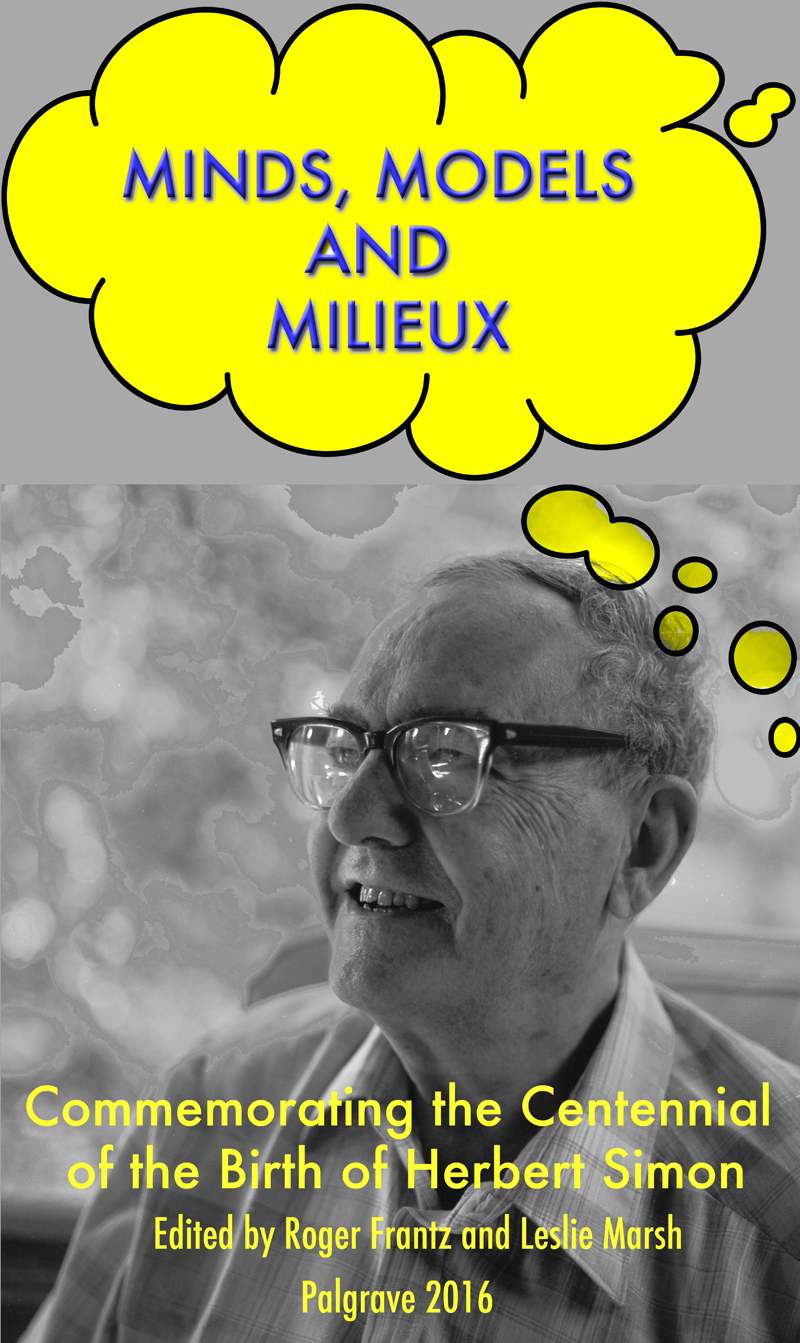
The thirteenth in a series of excerpts from Minds, Models and Milieux: Commemorating the Centennial of the Birth of Herbert Simon.

Marcin Miłkowski

Herbert A. Simon is well known for his account of bounded rationality. Whereas classical economics idealized economic agency and framed rational choice in terms of the decision theory, Simon insisted that agents need not be optimal in their choices. They might be mere satisficers, i.e., attain good enough goals rather than optimal ones. At the same time, behaviorally as well as computationally, bounded rationality is much more realistic.

One of the most important factors in his theorizing on bounded rationality was the structure of the environment of the agent (Simon, 1956). This might sound surprising today because Simon is all too often classified as one of the proponents of classical, symbolic cognitive science. After all, he favored symbolic models over situated action frameworks (Vera and Simon, 1993). However, already in his 1956 paper, he acknowledged that his account of bounded rationality is similar to robotic models built by Grey Walter. Moreover, Simon’s (1996) story about the ant that uses the environment to make the navigational task easier has become one of the classical examples for later proponents of the extended mind (Clark and Chalmers, 1998). So why did Simon stress the situatedness of cognition and denied that symbolic modeling is to be rejected? Was he deluded or self-contradictory?

The purpose of this chapter is to understand the role of the structure of the environment in Simon’s work on models of cognition. It will be shown that his modeling methodology includes both internals of the information-processing architectures and environmental constraints. The inner architecture is important insofar as it is a constraint on adaptation to the environment, and remains invariant over multiple different environments; hence, it is relevant to explaining behavior in any environment. For this reason, physical symbol systems are to be understood as both situated and adaptive; otherwise, they cannot be flexible and support cognition. Even if Simon’s treatment of symbols remains vague and underspecified, the idea that naturalistic models need to interleave internal and external states remains surprisingly timely.

HS_POSTER

Walker Percy Wednesday 83

percycovercroppea

There is nothing like a liberal gone sour.

*****

I told him this for two reasons. One was that it was the only reason he would believe, believing as he did that I was still a liberal and therefore capable of any madness. (Yet curiously it was for him an understandable madness: you know how old Lance is, etc., etc.)

The other reason was that my explanation was, in a sense, true.
“Yeah,” said Macklin. “A wonderful cause. In fact I agree with you, that’s what they need.”

*****

The drug was acting. A certain distance set in between me and myself. Here’s what I hoped for from the pills: a little space between me and the pain. I understood what Margot said but I couldn’t stand it. But how do you live with something you can’t stand? How do you get comfortable with a sword through your guts? I didn’t expect a solution or even relief. I only wanted a little distance: how does one live with it—the way a drunk lives with being a drunk, or a crook lives with being a crook? No problem! I envied both. But this! How do you live with this: being stuck onto pain like a cockroach impaled on a pin? The drug did this: before, I was part of the pain, there was no getting away from it. Now I had some distance. The pain was still there, but I stood off a ways. It became a problem to be solved. Hm, what to do about the pain? Who knows, there might even be a solution. Perhaps there’s something you can do to ease it. Let’s see.

*****

Often they hold down a small political job at the courthouse, or sell Tupperware—perhaps Cousin Callie has been Judge Jones’s mistress for twenty years. At any rate, they outlive everybody. They are healthy. They show up at funerals, weddings, and New Year open houses. One can’t imagine what they do between times.

*****

You always got it backward: you don’t set out looking for clues to God’s existence, nobody’s ever found anything that way, least of all God.

*****

Don’t you see? Virginia is neither North nor South but both and neither. Betwixt and between. An island between two disasters. Facing both; both the defunct befouled and collapsing North and the corrupt thriving and Jesus-hollering South. The Northerner is at heart a pornographer. He is an abstract mind with a genital attached. His soul is at Harvard, a large abstract locked-in sterile university whose motto is truth but which has not discovered an important truth in a hundred years. His body lives on Forty-second Street. Do you think there is no relation between Harvard and Forty-second Street? One is the backside of the other. The Southerner? The Southerner started out a skeptical Jeffersonian and became a crooked Christian. That is to say, he is approaching and has almost reached his essence, which is to be more crooked and Christian than ever before. Do you want a portrait of the New Southerner? He is Billy Graham on Sunday and Richard Nixon the rest of the week. He calls on Jesus and steals, he’s in business, he’s in politics. Everybody in Louisiana steals from everybody else. That is why the Mafia moved South: because the Mafia is happier with stealing than with pornography. The Mafia and the Teamsters will end by owning the South, the pornographers will own the North, movies, books, plays, the works, and everybody will live happily ever after.

California? The West? That’s where the two intersect: Billy Graham, Richard Nixon, Las Vegas, drugs, pornography, and every abstract discarnate idea ever hit upon by man roaming the wilderness in search of habitation.

Washington, the country, is down the drain. Everyone knows it. The people have lost it to the politicians, bureaucrats, drunk Congressmen, lying Presidents, White House preachers, C.I.A., F.B.I., Mafia, Pentagon, pornographers, muggers, buggers, bribers, bribe takers, rich crooked cowboys, sclerotic Southerners, rich crooked Yankees, dirty books, dirty movies, dirty plays, dirty talk shows, dirty soap operas, fags, lesbians, abortionists, Jesus shouters, anti-Jesus shouters, dying cities, dying schools, courses in how to fuck for schoolchildren.

The Virginian? He may not realize it yet, but he is the last hope of the Third Revolution. The First Revolution was won at Yorktown. The Second Revolution was lost at Appomattox. The Third Revolution will begin there, in the Shenandoah Valley.

*****

By the way, it is not true that Americans are by nature the most pornographic people on earth. The Russians and the Chinese are simply behind times, busy catching up. Ha, wait till those buggers get the forty-hour week.

*****

To live in the past and future is easy. To live in the present is like threading a needle.

*****

The Jews called it knowing and now I knew why. Every time I went deeper I knew her better. Soon I would know her secret. We were watching each other. We were going to know each other but one of us would know first and therefore win. The watching was a contest. I was coming close, closer. We watched each other watching. It was a contest. She lost. When I found it out, the secret, she closed her eyes and curled around me like a burning leaf.

*****

In my confessional I fell to musing. Why does love require the absolute polarities of divinity-obscenity?

*****

An odd thing about New Orleans: the cemeteries here are more cheerful than the hotels and the French Quarter. Tell me why that should be, why two thousand dead Creoles should be more alive than two thousand Buick dealers?

71-7RaZSTxL

Hume’s Call to Action

A review article of James Harris’ Hume: An Intellectual Biography

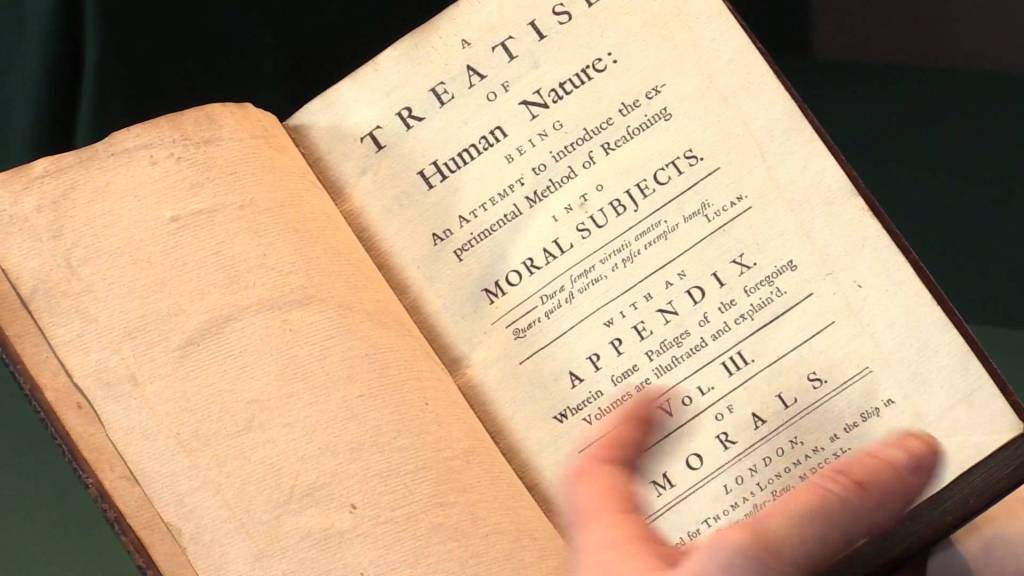
Hume reconceived the task of philosophy. It ought not to be championed, as the ancient schools had done, as a “medicine for the mind.” Nor was it a source of rules for action that would guarantee righteousness. Its role was critical reflection rather than exhortation or consolation.

More recent developments in Anglo-American thought have tended to withdraw from practical analysis into speculative accounts of ideal value. This has resulted in a species of political philosophy that has lost any grasp of the social world on which it pretends to reflect. The sterility of many of the resulting debates serves to recommend Hume’s ambition to make philosophy historical and to render history philosophical.