For an excellent resource on this and related matters see the What Sorts of People website.
A step in the right direction
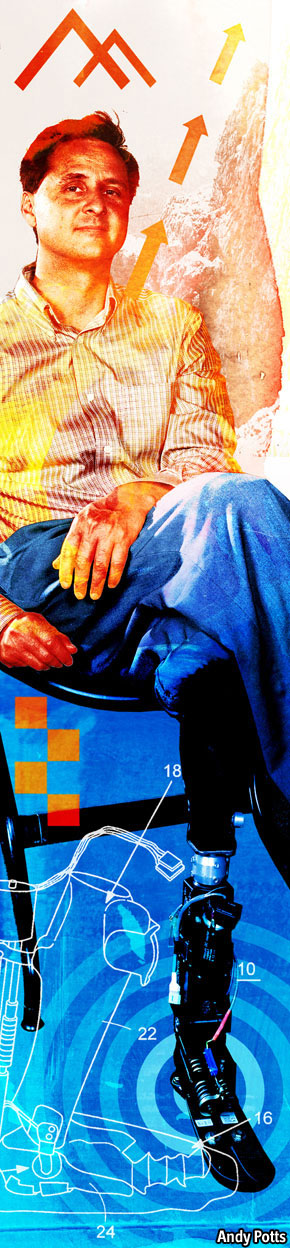
Hugh Herr lost his lower legs as a teenager. He has since gone on to become a leading light in the development of artificial limbs
Mar 4th 2010 | From The Economist print edition
“FIFTY years from now I want people to be running to work,” says Hugh Herr, director of the biomechatronics group at the Massachusetts Institute of Technology (MIT). Far from being some kind of motivational guru, Dr Herr hopes to achieve this using technology. His goal is to augment people’s limbs with what he calls a “mobility platform”, akin to a pair of magic trousers, that allows people to move quickly with minimal effort—like riding a bicycle, but without the bicycle. “They won’t need parking lots,” says Dr Herr. “People can run straight into their offices, remove their mobility platform, as if they were undressing, and then hang it right on their coat rack.”
It sounds implausible. Roboticists have struggled for decades to understand bipedal locomotion, and even today’s most sophisticated robots require huge amounts of energy and computer power to walk on two legs. But Dr Herr’s credentials are sound. He is a leading authority on the biomechanics of legs, and in the past decade he has made several advances in the development of artificial legs and assistive walking devices, or “orthoses”, enabling amputees to walk with a more natural gait than was previously possible.
As well as enhancing the lives of disabled people, Dr Herr’s work on exoskeletons—the precursors of his planned mobility platforms—could make life easier for able-bodied people, too. By contrast with the bulky, cumbersome exoskeletons featured in science-fiction movies like “Aliens” and “Avatar”, or those being developed for military use, Dr Herr’s devices are smaller and lighter, and will require much less power. This will, he hopes, allow people to walk and run greater distances, or carry heavier loads, than they would otherwise be able to.
Dr Herr’s interest in the biomechanics of walking stems from his own personal experience. He is a double amputee, having lost both his legs below the knee after a climbing accident in 1982, at the age of 17. At the time he was regarded as one of the best climbers in America. But after ascending a 200-metre wall of ice on Mount Washington, in New Hampshire, Dr Herr and his climbing partner Jeff Batzer found themselves caught in a blizzard. Blinded by the snow, they became lost in the wilderness as they struggled to find their way to safety. By the time they were rescued, more than three days later, they were both suffering from severe hypothermia and frostbite. “We were in pretty bad shape,” Dr Herr recalls. He had both his legs amputated below the knee and Mr Batzer lost a leg, the toes from his remaining foot and all the fingers from his right hand.
“Climbing was my life’s passion,” says Dr Herr. Angry with the mistakes he’d made on Mount Washington, he was determined to rebuild his life and prove to himself that he could climb responsibly once again. Within just a few months he was out climbing once again, wearing a pair of temporary legs made of plaster that could, he was warned, easily fracture. “I think my family saw it as great therapy,” says Dr Herr. “They were probably more frightened that I would become frustrated and depressed if I hadn’t been able to climb again.” He is certain if he hadn’t got back on the rock he would be a very different person today. Driven on by the desire to create better legs for himself he has spent the past three decades turning his loss into a personal gain that has also benefited many others.
Climb every mountain
He began by customising his new artificial limbs so that they were optimised for climbing. “I realised I didn’t need a rock climbing shoe—I could just bond climbing rubber right to the artificial foot,” he says. Convinced that artificial limbs could be improved further, he started to make his own. “I studied tool-and-dye at school so I knew my way around tools,” says Dr Herr. His efforts resulted in a dedicated pair of limbs that could be adjusted for different types of climbing, and could even have their length extended or reduced to match the demands of the wall. As a result he was soon climbing at an even higher standard than before the accident, and certainly better than the vast majority of able-bodied people.
Having created better legs for moving vertically, he turned his attention to ordinary, horizontal locomotion. He studied physics at university, on the basis that it would provide a good foundation for designing prostheses. His first focus was to make artificial limbs more comfortable to wear. By his senior year he had been granted his first patent, for a socket interface that used a series of bladders to compensate for the wide variation in the shapes of different people’s residual limbs. Over the next few years, as he studied for a master’s degree in mechanical engineering at MIT and a PhD in biophysics at Harvard before returning to MIT as a postdoctoral fellow, Dr Herr worked on a novel knee-joint mechanism.
This work, which was eventually commercialised as the Rheo Knee, used a magnetorheological (MR) fluid—a fluid whose viscosity can be controlled by applying a magnetic field—to act as a variable damper, and thus create a more natural knee swing. Traditionally, artificial knee-joints use hydraulic damping, which presents more angular resistance to fast rotational motion than to slow motion. A joint with a computer-controlled “smart” MR fluid, by contrast, can present a more even resistance, allowing for a more natural gait and enabling a prosthetic leg to adapt the knee swing as the wearer’s gait changes. The joint can also be more easily tuned to meet a particular user’s needs.
Having improved upon existing artificial knees, Dr Herr decided that designing radically better prostheses and orthoses required a return to first principles, and a greater understanding of how human limbs work. “It’s surprising to most people that we, the human race, do not yet understand biological walking,” he says. It turns out to be complex and often counter-intuitive. In many respects walking should be an inefficient process, but because of the way the human body is designed, it is quite the opposite, says Dr Herr. Although effort is required to bend a joint or flex a muscle, the body is able to recycle much of the energy expended through spring-like tendons and elegantly arranged muscles. There is a constant shuffling, as potential energy is transformed into kinetic or elastic energy, and then back again. “That’s why, when you walk, it’s so economical and uses so little energy,” he says.
With most prosthetic devices, including the Rheo Knee, much of the energy put into them by the body is lost, rather than being recovered. With this in mind Dr Herr went on to develop, in 2003, the first powered ankle-foot orthosis—a device designed to fit around the ankle joint of someone with walking difficulties, such as a stroke patient. It provides active correction, ensuring that the foot flexes in the right way, and is used to teach a patient how to walk again. Then in 2007 Dr Herr took this a step further by incorporating assistive power into an artificial leg, or prosthesis. The result, the PowerFoot One, will be launched this year by Dr Herr’s spin-out company, iWalk, and will be the first powered artificial leg on the market.
The PowerFoot One uses motors, springs, sensors and an elaborate control system to emulate the energy-transfer mechanisms of the foot and ankle at each stage of a stride. It adapts to different terrain angles and different gaits, can tell whether the user is going up or down stairs, and increases both speed and stability. It will even hang naturally when the user crosses his legs. “Some of our patients actually start to cry when they use it,” says Dr Herr. The powered mechanism, which will require daily recharging, creates a natural gait and ensures that no “metabolic cost” is imposed on the wearer, he says.
An unfair leg-up?
The question of metabolic cost was highlighted by the case of Oscar Pistorius, the South African double-amputee sprinter who runs using blade-like prosthetics made of carbon fibre. In 2007 he was banned from trying to qualify for the 400-metre race at the 2008 Beijing Olympics by the International Association of Athletics Federations. The IAAF argued that his prosthetics gave him an unfair advantage by enabling him to run at a much lower metabolic cost—in other words, with much less effort—than an able-bodied person. Dr Herr was brought in by Mr Pistorius’s legal team to argue against this claim. With less than a month to prepare a defence, Dr Herr and his colleagues Rodger Kram and Peter Weyand carried out tests to demonstrate that Mr Pistorius’s prosthetics, which are not powered, do not enable him to run with less effort. As a result the decision to ban Mr Pistorius was overturned. (In the event, he did not qualify for the South African team and did not compete in Beijing.)
The science is still very immature when it comes to assessing whether prosthetics provide an advantage, says Dr Herr, though the evidence so far suggests that they do not. “We want to get the science done,” he says, “because the next time Oscar or anyone else wants to compete against people with intact limbs, there will be certain people in the world who will claim augmentation—so we need to be prepared for that.” He would like to produce prosthetics that can emulate biological limbs so precisely that they ensure that the likes of Mr Pistorius are neither advantaged nor disadvantaged.
Although Mr Pistorius’s unpowered prosthetics do not provide any metabolic advantage, there is no reason why powered prosthetics, or exoskeletons worn by able-bodied people, cannot do so. Indeed, with his latest work on exoskeletons, Dr Herr is moving in this direction. His latest powered exoskeleton, which in effect helps carry the wearer, has already been shown to reduce the metabolic effort involved in hopping by 30% (the tests for running have not yet been completed). And it does not require much energy to work: in its current form the exoskeleton has just two small clutches which only draw a quarter of a watt of power each. “That’s negligible,” says Dr Herr. He plans to add regenerative capabilities to the exoskeleton, so that it will require little or no power when moving on level ground.
This sort of device is primarily aimed at improving distance rather than speed, says Dr Herr. Wearing it enables you to walk or run with less effort, so it will improve your marathon time (because you will not get tired so quickly over long distances) but will not enable you to sprint any faster than your existing top speed. “Think of it as a bicycle for your legs,” he says. “A bicycle profoundly augments human locomotion in terms of human metabolic rate and speed, and yet it requires zero energy itself.”
Dr Herr plans to add regenerative capabilities to his prosthetic devices, such as the PowerFoot One. After all, one advantage of having artificial limbs is that you can upgrade them. And for Dr Herr, there will always be room for improvement in the speed, stability and energy-efficiency of his legs. “When I’m 80 I want the artificial part of my body to be completely superior to the biological part,” he says. It is a distant goal, but he has already taken several steps in the right direction.