My chum Andrew Irvine has an article on the virtues and opportunities in preserving hard-copy books in this age of digitization.
The Karaites of Galicia
I want to give a plug to this book on a fascinating topic – thank goodness for scholars such as Mikhail (a chum from my Oxford days), who so painstakingly pull together these projects.
The Emerging Science of Consciousness: Mind, Brain and the Human Experience
Daniel Kahneman and David Chalmers on this panel. There are other discussions of relevance as well on this site.
Louis Armstrong: Jazz Ambassador
Louis Armstrong has become a kind of sub-industry in contemporary theater.
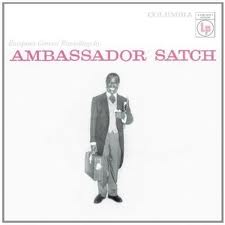
What’s in the briefcase and why is Satch so happy?
Celebration Day
Decent theatrical documents of rock concerts are few and far between. Only two come to mind: The Last Waltz and Stop Making Sense. Previous efforts such as The Song Remains the Same and Shine a Light while they have their moments, are in the case of the former, a bit tiresome, and in the case of the latter, well-executed by ultimately quite flat. It is clear that the film-makers have learnt from the mistakes of other efforts. Celebration Day sets the bar for putting the viewer at the centre of an amazing qualic experience, with more contrived excitement than might have actually existed in reality – but hey, that’s the idea of making this modality work. Of course, the specialized theatre technology heightens the effect, something that would lose its potency on the home screen, but having seen the film in its full glory, I will have no compunction to be reminded of the experience, albeit in an attenuated form.
Substantively, the music was up to scratch as well and one of the charms being that it had a live rawness to it – some mistakes, missed cues, and some genuine spontaneity, rather than being overcooked in post-production. The set list was immaculately and imaginatively chosen. Plant no longer has the range he once had but given that he arguably had the most powerful voice around, he still has a great deal to work with. Page – fascinating to watch: often it looks as if he’s suffered a stroke. No-one besides Hendrix gets such a big and “experimental” sound. Jones is superb and reaffirms the importance of the “quiet one” to the Led Zep sound. And Jason – wow! Here is a guy that does not have to live in his dad’s shadow – he cut’s the mustard all on his own and in his own way. An interesting feature was the protective huddle they almost seem to be in on stage with the lovely gesture of the three surviving members all facing Jason for the final number (explained by JPJ in the press conference).
Led Zep are well and truly a blues band, something that many fail to see. Their roots tacitly and explicitly are in the south – Robert Johnson, Blind Boys of Alabama, “Fats” Domino and more besides and as Plant says in the press conference, outside of New Orleans labels, only Atlantic was special. One of the meta-highlights was the gospel-inspired In My Time of Dying. This is where Plant comes into his own these days – just listen to the fantastic rendition Plant did of Valley of Tears for “Fats'” tribute album.
It was good to see Plant and Page in conventional trousers with belt, at least in Plant’s case, no tight jeans emphasizing the lunchbox region, and Page out of the custom outfits of Led Zep’s heyday. I was quite pleasantly surprised by the demographic of the film’s audience – I’d guess that 60% were in the 30-40 year old age range – those in Jeremy Clarkson jeans and jacket brigade (my age group) were in the minority.
So a doff of the hat to Ahmet Ertegun – the only person that could have got Zep back together. Shame it took his unfortunate death, ironically set in motion backstage of the filming of Shine a Light. I can’t see Zep ever touring – the physical arduousness demanded, however enjoyable they might have found this one-off, would be brutal, and would tarnish this moment. Led Zep are still a powerhouse, musically relevant as ever, while still retaining their dignity. Not many, if any, bands can lay claim to that.
Press Conference
David S. Ware
Experts and Epistemic Monopolies
Having just received copies of the book in which our paper appears, here is another excuse to plug both our paper and the rest of the book’s contents. Here is an extract from Roger Koppl’s introduction:
This volume contains papers given at the third biennial Wirth Institute for Austrian and Central European Studies Conference on Austrian Economics. The conference was held at a beautiful waterfront facility of Simon Fraser University on October 15 and 16, 2010. In spite of all warnings to expect fog and rain in the Pacific Northwest, the weather was sunny and mild, as were the spirits of the conferees. Our topic title, ‘‘Austrian Views on Experts and Epistemic Monopolies,’’ was perhaps a bit misleading because some of the views represented were not ‘‘Austrian.’’ Indeed, the editorial mission of Advances in Austrian Economics has been to promote dialogue between the ‘‘Austrian’’ tradition of economics and other traditions both within in economics and beyond. Participants discussed the problem of experts from several Austrian and non-Austrian perspectives. While representing different points of view, the participants did tend toward the view that experts may pose a problem in one way or another, especially when they enjoy an epistemic monopoly.
A Companion to Michael Oakeshott
After a four year gestation with many, often quite bizarre twists and turns, today this project officially reaches its fruition. To read excerpts from each chapter, type “oakeshott” into this site’s search box.

The Morphology of Liberalism
Here’s a book review in The Economist looking at the morphology in meaning attached to (neo)liberalism. Here is the publisher’s blurb.
But the line between Smith and Friedman is not a straight one, as Mr Stedman Jones points out. Smith thought one of the state’s jobs should be to build public works and forge institutions that would otherwise fail under market pressure. Here he sounds more like Franklin Roosevelt. Smith believed the state should fund schools, bridges and roads. Friedman said that was the job of the private sector.
The Pursuit of Intimacy, or Rationalism in Love
Bob Grant’s highly distinctive essay on Oakeshott’s private life.
In what follows I shall refer to Michael Oakeshott by his first name, as I also shall to those connected with him. This is partly to avoid the confusion of shared surnames, though I did actually come myself to address him by his first name. My main topic will be his love life, which is not the same as his sex life, though the two are obviously connected. And perhaps both are, more distantly, with his work. As we shall see, Michael in several places says that love was the main business of his life. If we are to take him literally, therefore, his work appears as more of a sideline or an antidote, and even he admits from time to time that he is using it to deaden his sorrows or drive away his demons.

