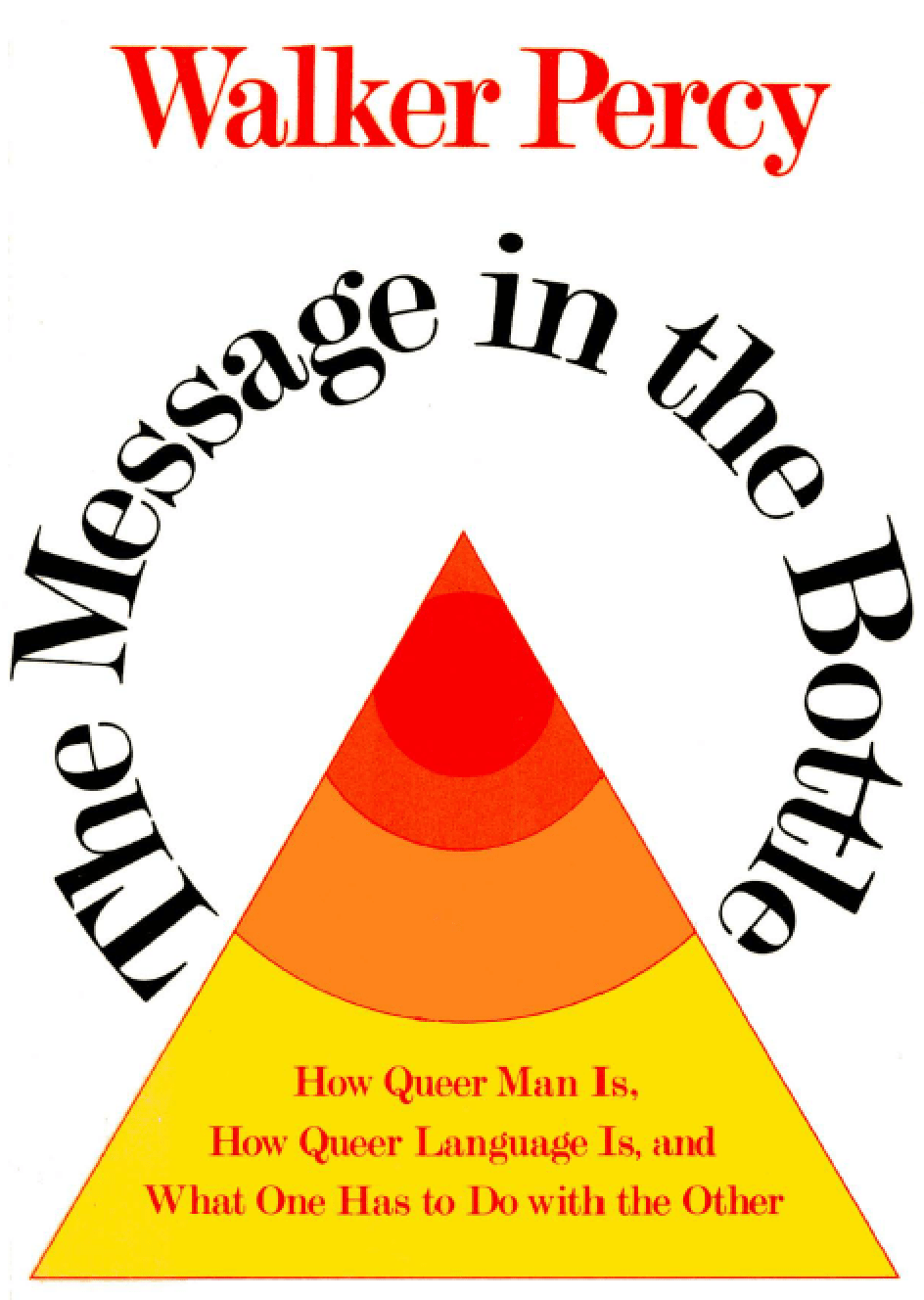
Walker Percy Wednesday 158

percycovercroppea

It might be useful to look into the workings of these accidental stumblings into poetic meaning, because they exhibit in a striking fashion that particular feature of metaphor which has most troubled philosophers: that it is “wrong”-it asserts of one thing that it is something else-and further, that its beauty often seems proportionate to its wrongness or outlandishness. Not that the single linguistic metaphor represents the highest moment of the poetic imagination; it probably does not. Dante, as Allen Tate reminds us, uses very few linguistic metaphors. The “greatest thing by far” which Aristotle had in mind when he spoke of the mastery of the metaphor as a sign of genius may very well have been the sort of prolonged analogy which Dante did use, in which the action takes place among the common things of concrete experience and yet yields an analogy–by nothing so crude as an allegorization wherein one thing is designated as standing for another but by the very density and thingness of the action. As Tate puts it: “Nature offers the symbolic poet clearly denotable objects in depth and in the round, which yield the analogies to the higher syntheses.” Yet the fact remains that the linguistic metaphor is, for better or worse, more peculiarly accessible to the modern mind-it may indeed be a distinctive expression of modern sensibility. And it has the added advantage from my point of view of offering a concentrated field for investigation-here something very big happens in a very small place. Metaphor has scandalized philosophers, including both scholastics and sermioticists, because it seems to be wrong: It asserts an identity between two different things. And it is wrongest when it is most beautiful. It is those very figures of Shakespeare which eighteenth- century critics undertook to “correct” because they had so obviously gotten off the track logically and were sometimes even contradictory-it is just those figures which we now treasure most. This element of outlandishness has resulted in philosophers washing their hands of beauty and literary men being glad that they have, in other words, in a divorce of beauty and ontology, with unhappy consequences to both. The difficulty has been that inquiries into the nature of metaphor have tended to be either literary or philosophical with neither side having much use for the other. The subject is divided into its formal and material aspects, with philosophers trying to arrive at the nature of metaphor by abstracting from all metaphors, beautiful and commonplace, and with critics paying attention to the particular devices by which a poet brings off his effects. Beauty, the importance attached to beauty, marks the parting of the ways. The philosopher attends to the formal structure of metaphor, asking such general questions as, What is the relation between metaphor and myth? Is metaphor an analogy of proper or improper proportionality? and in considering his thesis is notably insensitive to its beauties. In fact, the examples he chooses to dissect are almost invariably models of tastelessness, such as smiling meadow, leg of a table, John is a fox. One can’t help wondering, incidentally, if Aristotle’s famous examples of “a cup as the shield of Ares” and “a cup as the shield of Dionysius” didn’t sound like typical philosophers’ metaphors to contemporary poets. Literary men, on the other hand, once having caught sight of the beauty of metaphor, once having experienced what Barfield called “that old authentic thrill which binds a man to his library for life,” are constrained to deal with beauty alone, with the particular devices which evoke the beautiful, and let the rest go. If the theorist is insensitive to the beauty of metaphor, the critic is insensitive to its ontology. To the question, why is this beautiful? the latter will usually give a material answer, pointing to this or that effect which the poet has made use of. He is unsympathetic-and understandably so-to attempts to get hold of art by some larger schema, such as a philosophy of being-feeling in his bones that when the cold hand of theory reaches for beauty, it will succeed in grabbing everything except the beautiful. Being neither critic nor philosopher, I feel free to venture into the no-man’s-land between the two and to deal with those very metaphors which scandalize the philosopher because they are “wrong” and scandalize the critic because they are accidental. Philosophers don’t think much of metaphor to begin with and critics can hardly have much use for folk metaphors, those cases where one stumbles into beauty without deserving it or working for it. Is it possible to get a line on metaphor, to figure out by a kind of lay empiricism what is going on in those poetic metaphors and folk metaphors where the wrongness most patently coincides with the beauty?


So far so good. But the question on which everything depends and which is too often assumed to be settled without ever having been asked is this: Given this situation and its two characteristics upon which all agree, the peculiar presence or distinctiveness of the object beheld and the peculiar need of the beholder-is this “need” and its satisfaction instrumental or ontological? That is to say, is it the function of metaphor merely to diminish tension, or is it a discoverer of being? Does it fit into the general scheme of need-satisfactions?- and here it doesn’t matter much whether we are talking about the ordinary pragmatic view or Cassirer’s symbolic form: both operate in an instrumental mode, one, that of biological adaption; the other, according to the necessities of the mythic consciousness. Neither provides for a real knowing, a truth-saying about what a being is. Or is it of such a nature that at least two sorts of realities must be allowed: one, the distinctive something beheld; two, the beholder (actually two beholders, one who gives the symbol and one who receives the symbol as meaningful, the Namer and the Hearer), whose special, if imperfect, gift it is to know and affirm this something for what it actually is? The question can’t be bracketed, for the two paths lead in opposite directions, and everything one says henceforth on the subject must be understood &om one or the other perspective. In this primitive encounter which is at the basis of man’s cognitive orientation in the world, either we are trafficking in psychological satisfactions or we are dealing with that unique joy which marks man’s ordainment to being and the knowing of it.
Screen Shot 2017-10-11 at 10.58.26 AM.png

A Different ‘Darkness at Noon’

As this year marks the centenary of the Russian Revolution I’m astonished by the ubiquitous uncritical flirtation with this brand of totalitarianism, the body count far exceeding that of even the Nazis. As someone who has read Darkness at Noon several times, a book given to me by someone who used to have sympathies, Michael Scammell makes the strongest of cases for a new translation. With this in mind, if ever the time was ripe to reach a new audience, it is now. Check out Noel Malcolm’s review of Michael Scammell’s new biography of Koestler, an attempt to rehabilitate Koestler’s tarnished reputation.

Is being morally blinded by egotism worse than being politically blinded by dogma? Fortunately, we are not required to make that choice; we can just observe the opposite extremes in this one person. Certainly, when Koestler did see clearly, he was capable of unerring precision.

darkness at noon

Feast of fools: the carnivalesque in John Kennedy Toole’s A Confederacy of Dunces

Here is a freely available paper by Julija Potrč that I chanced across and is to be found in Acta neophilologica. The image below is of a paperback I picked up for $10 this past summer to add to my CoD collection of covers.

In Confederacy, the normal existential mode of the main character is idleness, a state completely devoid of any rules and prohibitions and one in which he feels comfortable. Ironically, Ignatius sees the Middle Ages as a period when western man enjoyed “order, tranquility, unity and oneness with its True God” and blames the moral degradation (as he sees it) of the modern world on the loss of these ideals.

sanjulian_a-confederacy-of-dunces_ny-grove-press-1981_b-452

Tradition is a Temple

At last, now available on DVD. The blurb:

[A] modern look at traditional New Orleans music, drawing upon the city’s unique heritage to examine the fragility of tradition itself. The performance-based music documentary highlights the resilience of New Orleans musicians, accustomed to hardship and dedicated to their city, their culture, and their music…

The non-fiction film weaves together intimate personal discussions shot over a four year span with once-in-a-lifetime studio performances by New Orleans greats, such as Shannon Powell, Lucien Barbarin, Jason Marsalis, Topsy Chapman, Steve Masakowski, Ed Petersen, Roland Guerin, The Tremé Brass Band and many more.

This portrait of New Orleans music culture highlights the musician’s upbringing and shows how tradition shaped their identity and continues to inspire young people today.

919125_10151655435506977_1221670823_o

Are Political Orientations Genetically Transmitted?

Interesting — I hadn’t come across this paper before. (H/T Steve Stewart Williams). I need to assimilate the implications for a chapter I’ve been working on entitled “Pathologizing Ideology, Epistemic Modesty and Instrumental Rationality.”

[T]he substantive findings we present here offer a direct challenge to common assumptions and interpretations that political attitudes and behavioral tendencies are shaped primarily or even exclusively by environmental, especially familial, factors.

genetic-adam

But is it science?

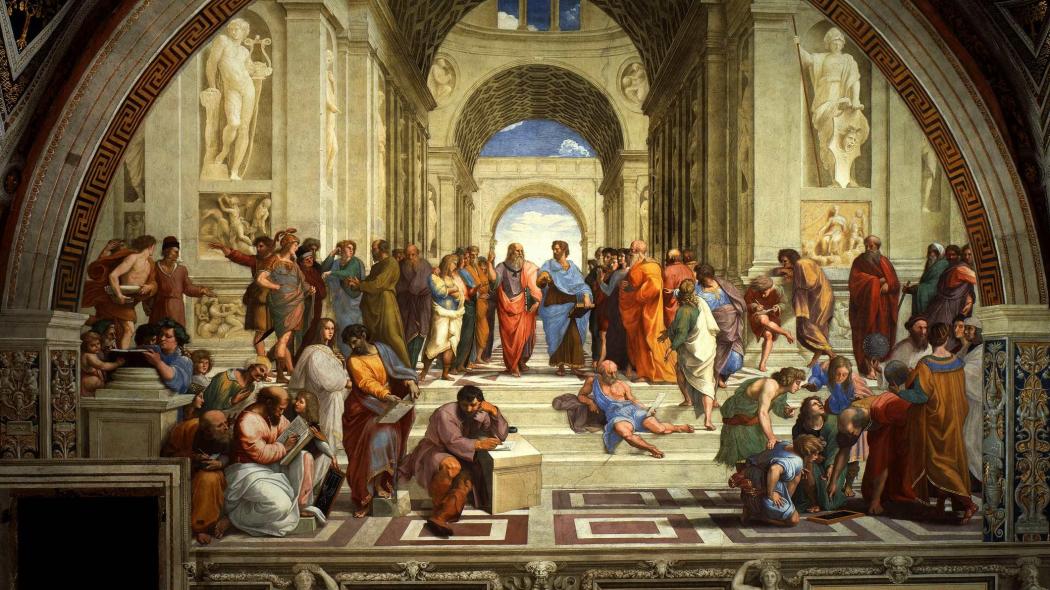
Roger Scruton and Timothy Williamson discuss the relationship between philosophy and science, introduced by Tim Crane: But is it science?

Schol-of-Athens


Pictorial Truth: Essays on Wittgenstein, Realism, and Conservatism

The most excellent Kristóf Nyíri has alerted me to his freely available self-published book Pictorial Truth: Essays on Wittgenstein, Realism, and Conservatism. Kristóf and I have corresponded intermittently over about thirty years, my coming to him first through his absolutely fascinating early-to-late eighties work on Wittgenstein when, pre-web, I wrote to him expressing my enthusiasms. He has, over the years, been supportive of my various endeavors and for that I’m most grateful. An officer and a gentleman if ever there was one and I’m so pleased that he is as sharp, active and provocative as ever.

Screen Shot 2017-11-01 at 4.24.40 PM

Walker Percy Wednesday 157

percycovercroppea

A young Falkland Islander walking along a beach and spying a dead dogfish and going to work on it with his jackknife has, in a fashion wholly unprovided in modern educational theory, a great advantage over the Scarsdale high-school pupil who finds the dogfish on his laboratory desk. Similarly the citizen of Huxley’s Brave New World who stumbles across a volume of Shakespeare in some vine-grown ruins and squats on a potsherd to read it is in a fairer way of getting at a sonnet than the Harvard sophomore taking English Poetry II.

The educator whose business it is to teach students biology or poetry is unaware of a whole ensemble of relations which exist between the student and the dogfish and between the student and the Shakespeare sonnet. To put it bluntly: A student who has the desire to get at a dogfish or a Shakespeare sonnet may have the greatest difficulty in salvaging the creature itself from the educational package in which it is presented. The great difficulty is that he is not aware that there is a difficulty; surely, he thinks, in such a fine classroom, with such a fine textbook, the sonnet must come across! What’s wrong with me? The sonnet and the dogfish are obscured by two different processes. The sonnet is obscured by the symbolic package which is formulated not by the sonnet itself but by the media through which the sonnet is transmitted, the media which the educators believe for some reason to be transparent. The new textbook, the type, the smell of the page, the classroom, the aluminum windows and the winter sky, the personality of Miss Hawkins-these media which are supposed to transmit the sonnet may only succeed in transmitting themselves. It is only the hardiest and cleverest of students who can salvage the sonnet from this many-tissued package. It is only the rarest student who knows that the sonnet must be salvaged from the package. (The educator is well aware that something is wrong, that there is a fatal gap between the student’s learning and the student’s life: The student reads the poem , appears to understand it, and gives all the answers. But what does he recall if he should happen to read a Shakespeare sonnet twenty years later? Does he recall the poem or does he recall the smell of the page and the smell of Miss Hawkins?) One m ight object, pointing out that Huxley’s citizen reading his sonnet in the ruins and the Falkland Islander looking at his dogfish on the beach also receive them in a certain package. Yes, but the difference lies in the fundamental placement of the student in the world, a placement which makes it possible to extract the thing from the package. The pupil at Scarsdale High sees himself placed as a consumer receiving an experience-package; but the Falkland Islander exploring his dogfish is a person exercising the sovereign right of a person in his lordship and mastery of creation. He too could use an instructor and a book and a technique, but he would use them as his subordinates, just as he uses his jackknife. The biology student does not use his scalpel as an instrument; he uses it as a magic wand! Since it is a “scientific instrument,” it should do “scientific things.” The dogfish is concealed in the same symbolic package as the sonnet. But the dogfish suffers an additional loss. As a consequence of this double deprivation, the Sarah Lawrence student who scores A in zoology is apt to know very little about a dogfish. She is twice removed from the dogfish, once by the symbolic complex by which the dogfish is concealed, once again by the spoliation of the dogfish by theory which renders it invisible. Through no fault of zoology instructors, it is nevertheless a fact that the zoology laboratory at Sarah Lawrence College is one of the few places in the world where it is all but impossible to see a dogfish. The dogfish, the tree, the seashell, the American Negro, the dream, are rendered invisible by a shift of reality from concrete thing to theory which Whitehead has called the fallacy of misplaced concreteness. It is the mistaking of an idea, a principle, an abstraction, for the real. As a consequence of the shift, the “specimen” is seen as less real than the theory of the specimen. As Kierkegaard said, once a person is seen as a specimen of a race or a species, at that very moment he ceases to be an individual. Then there are no more individuals but only specimens. To illustrate: A student enters a laboratory which, in the pragmatic view, offers the student the optimum conditions under which an educational experience may be had. In the existential view, however-that view of the student in which he is regarded not as a receptacle of experience but as a knowing being whose peculiar property it is to see himself as being in a certain situation-the modern laboratory could not have been more effectively designed to conceal the dogfish forever. The student comes to his desk. On it, neatly arranged by his instructor, he finds his laboratory manual, a dissecting board, instruments, and a mimeographed list:

Exercise 22

Materials:   I dissecting board

I scalpel

I forceps

I probe

I bottle india ink and syringe

I specimen of Squalus acanthias

The clue to the situation in which the student finds himself is to be found in the last item: l specimen of Squalus acanthias. The phrase specimen of expresses in the most succinct way imaginable the radical character of the loss of being which has occurred under his very nose. To refer to the dogfish, the unique concrete existent before him, as a “specimen of Squalus acanthias” reveals by its grammar the spoliation of the dogfish by the theoretical method. This phrase, specimen of, example of, instance of, indicates the ontological status of the individual creature in the eyes of the theorist. The dogfish itself is seen as a rather shabby expression of an ideal reality, the species Squalus acanthias. The result is the radical devaluation of the individual dogfish. (The reductio ad absurdum of Whitehead’s shift is Toynbee’s employment of it in his historical method. If a gram of NaCI is referred to by the chemist as a “sample of” NaCl, one may think of it as such and not much is missed by the oversight of the act of being of this particular pinch of salt, but when the Jews and the Jewish religion are understood as-in Toynbee’s favorite phrase-a “classical example of” such and such a kind of Voelkerwanderung, we begin to suspect that something is being left out. ) If we look into the ways in which the student can recover the dogfish (or the sonnet), we will see that they have in common the stratagem of avoiding the educator’s direct presentation of the object as a lesson to be learned and restoring access to sonnet and dogfish as beings to be known, reasserting the sovereignty of knower over known. In truth, the biography of scientists and poets is usually the story of the discovery of the indirect approach, the circumvention of the educator’s presentation-the young man who was sent to the specialty. “Look here how this l ittle duct reverses its direction and drops into the pelvis. Now if you would look into a coelacanth, you would see that it-” And all at once the student can see. The technician and the sophomore who loves his textbook are always offended by the genuine research man because the latter is usually a little vague and always humble before the thing; he doesn’t have much use for the equipment or the jargon .. Whereas the technician is never vague and never humble before the thing; he holds the thing disposed of by the principle, the formula, the textbook outline; and he thinks a great deal of equipment and jargon. But since neither of these methods of recovering the dogfish is pedagogically feasible-perhaps the great man even less so than the Bomb-I wish to propose the following educational technique which should prove equally effective for Harvard and Shreveport High School. I propose that English poetry and biology should be taught as usual, but that at irregular iHtervals, poetry students should find dogfishes on their desks and biology students should find Shakespeare sonnets on their dissectimg board. I am serious in declaring that a Sarah Lawrence English major who began poking about in a dogfish with a bobby pin would learn more in thirty minutes than a biology major in a whole semester; and that the latter upon reading on her dissecting board

That time of year Thou may’st in me behold

When yellow leaves, or none, or few, do hang

Upon those boughs which shake against the cold–

Bare ruin’d choirs where late the sweet birds sang.

might catch fire at the beauty of it. The situation of the tourist at the Grand Canyon and the biology student are special cases of a predicament in which everyone finds himself in a modem technical society-a society, that is, in which there is a division between expert and layman, planner and consumer, in which experts and planners take special measures to teach and edify the consumer. The measures taken are measures appropriate to the consumer: The expert and the planner know and plan, but the consumer needs and experiences. There is a double deprivation. First, the thing is lost through its packaging. The very means by which the thing is presented for consumption, the very techniques by which the thing is made available as an item of need-satisfaction, these very means operate to remove the thing from the sovereignty of the knower. A loss of title occurs. The measures which the museum curator takes to present the thing to the public are self-liquidating. The upshot of the curator’s efforts are not that everyone can see the exhibit but that no one can see it. The curator protests: Why are they so indifferent? Why do they even deface the exhibits? Don’t they know it is theirs? But it is not theirs. It is his, the curator’s. By the most exclusive sort of zoning, the museum exhibit, the park oak tree, is part of an ensemble, a package, which is almost impenetrable to them. The archaeologist who puts his find in a museum so that everyone can see it accomplishes the reverse of his expectations. The result of his action is that no one can see it now but the archaeologist. He would have done better to keep it in his pocket and show it now and then to strangers. The tourist who carves his initials in a public place, which is theoretically “his” in the first place, has good reasons for doing so, reasons which the exhibitor and planner know nothing about. He does so because in his role of consumer of an experience (a “recreational experience” to satisfy a “recreational need”) he knows that he is disinherited. He is deprived of his title over being. He knows very well that he is in a very special sort of zone in which his only rights are the rights of a consumer. He moves like a ghost through schoolroom, city streets, trains, parks, movies. He carves his initials as a last desperate measure to escape his ghostly role of consumer. He is saying in effect: I am not a ghost after all; I am a sovereign person. And he establishes title the only way remaining to him, by staking his claim over one square inch of wood or stone. Does this mean that we should get rid of museums? No, but it means that the sightseer should be prepared to enter into a struggle to recover a sight from a museum. The second loss is the spoliation of the thing, the tree, the rock, the swallow, by the layman’s misunderstanding of scientific theory. He believes that the thing is disposed of by theory, that it stands in the Platonic relation of being a specimen of such and such an underlying principle. In the transmission of scientific theory from theorist to layman, the expectation of the theorist is reversed. Instead of the marvels of the universe being made available to the public, the un iverse is disposed of by theory. The loss of sovereignty takes this form: As a result of the science of botany, trees are not made available to every man. On the contrary. The tree loses its proper density and mystery as a concrete existent and, as merely another specimen of a species, becomes itself nugatory. Does this mean that there is no use taking biology at Harvard and Shreveport High? No, but it means that the student should know what a fight he has on his hands to rescue the specimen from the educational package. The educator is only partly to blame. For there is nothing the educator can do to provide for this need of the student. Everything the educator does only succeeds in becoming, for the student, part of the educational package. The highest role of the educator is the maieutic role of Socrates: to help the student come to himself not as a consumer of experience but as a sovereign individual. The thing is twice lost to the consumer. First, sovereignty is lost: It is theirs, not his. Second, it is radically devalued by theory. This is a loss which has been brought about by science but through no fault of the scientist and through no fault of scientific theory. The loss has come about as a consequence of the seduction of the layman by science. The layman will be seduced as long as he regards beings as consumer items to be experienced rather than prizes to be won, and as long as he waives his sovereign rights as a person and accepts his role of consumer as the highest estate to which the layman can aspire. As Mounier said, the person is not something one can study and provide for; he is something one struggles for. But unless he also struggles for himself, unless he knows that there is a struggle, he is going to be just what the planners think he is.

Screen Shot 2017-10-11 at 10.58.26 AM.png