The Atlantic National Review AEI National Review WSJ NYT City Journal

The fourth in a series of excerpts from Minds, Models and Milieux: Commemorating the Centennial of the Birth of Herbert Simon.
Subrata Dasgupta
It is well known that Herbert Simon was a 20th century scientific polymath who made seminal contributions to the social sciences, behavioral sciences, design theory, computer science, and the philosophy of science (Dasgupta, 2003a, 2003b). My interest in Simon in this essay, however, lies in his remarkable and highly original book, The Sciences of the Artificial (Simon, 1996). In this work (henceforth referred to as Sciences), which in a sense unifies his multidisciplinary contributions, Simon dwells on the concept and nature of the human-made or artificial world, the things that populate it – artifacts – and in what sense and how the making of the artificial yields to scientific investigation.
In this chapter I wish to explore a particular consequence of the ideas put forth in Sciences. I wish to show how some of the key concepts advanced in it affords a conceptual framework for a (relatively) new historical discipline for the study of human creativity, the creative tradition, and the intellectual tradition. This discipline is called cognitive history.
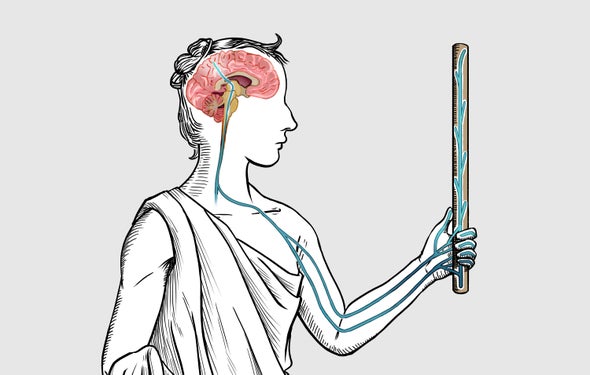
Write up on Miller et al’s recent work in Scientific American.
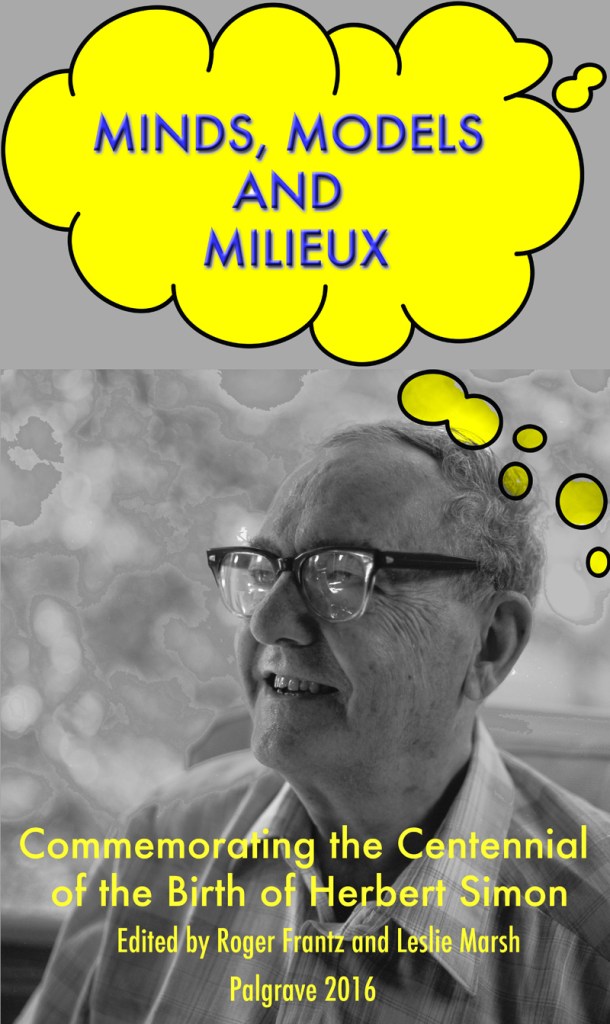
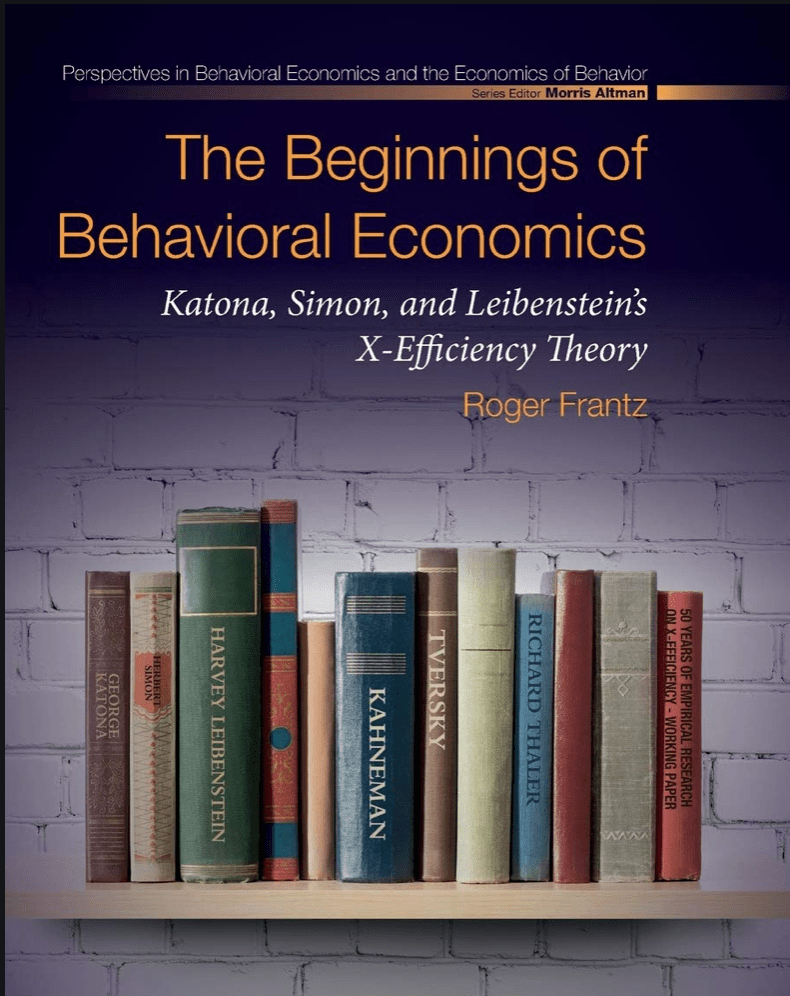
My chum and sometime collaborator Roger Frantz has a new book out.
The third in a series of excerpts from Minds, Models and Milieux: Commemorating the Centennial of the Birth of Herbert Simon.
Gerd Gigerenzer
Herbert Simon left us with an unfinished task: a theory of bounded rationality. Such a theory should make two contributions. For one, it should describe how individuals and institutions actually make decisions. Understanding this process would advance beyond “as-if” theories of maximizing expected utility. Second, the theory should be able to deal with situations of uncertainty where “the conditions for rationality postulated by the model of neoclassical economics are not met” (Simon, 1989, p. 377). That is, it should extend to situations where one cannot calculate the optimal action but instead has to “satisfice,” that is, find either a better option than existing ones or one that meets a set aspiration level. This extension would make decision theory particularly relevant to the uncertain worlds of business, investment, and personal affairs.


Left to Right: Morris Altman, Leslie Marsh, Roger Frantz, Gerd Gigerenzer, Shu-Heng Chen, Shabnam Mousavi
San Francisco January 2016, photographs courtesy Reza Kheirandish
A belated commemoration of JKT’s birthday yesterday. Everything you need to know about Toole can be found here (documentary), here (biography) and here (review of aforementioned bio). Stay tuned for the forthcoming collection of essays on Confederacy and the theatrical feature based upon JKT bio.
When a true genius appears, you can know him by this sign: that all the dunces are in a confederacy against him.