Here’s an interesting take on the notion of extended mind from the always thoughtful Susannah Devitt. I look forward to reading the complete paper.
Sociology of ideas
This review article/interview plugging a book by Neil Gross that deals with Richard Rorty’s intellectual journey is noteworthy because the writer of this book refers to the sociology of ideas (SI) as superseding the sociology of knowledge (SK):
The old sociology of knowledge may have been terribly reductive — ideas are an expression of class interests or reflective of dominant cultural tendencies, etc etc — but the sociology of ideas today offers much more fine-grained theoretical tools.
This may well be but I’d be very interested to find out what distinguishes SI from SK and find out exactly what these finer-grained tools are.
Cognitive Scaffolding
This paper by Naomi Rokotnitz from a recently held conference featuring Andy Clark.
CFP: the significance of disagreement
EPISTEME will hold its sixth annual conference at Northwestern University on June 26-27, 2009. The 2009 meeting will focus on the epistemological significance of disagreement.
Confirmed participants include: Michael Bergmann (Purdue), Stewart Cohen (Arizona State), Sherrilyn Roush (Berkeley) and Roger White (MIT).
SUBMISSION GUIDELINES: Papers should be no more than 5,000 words, excluding notes and references, and should be prepared for blind review. Electronic submissions should be sent to David.Christensen(at)Brown.edu by January 15, 2009. Approximately four papers will be selected from the submissions for presentation at the conference. The selected papers will also be published, along with the papers of the confirmed participants above, in a special issue of EPISTEME, with David Christensen as the Guest Editor.
Conference organizers are: Alvin Goldman (Rutgers), Jennifer Lackey (Northwestern) and David Christensen (Brown).
Neuronal marketplace
According to Edge Dennett has had some second thoughts. Knowing what I do of Hayek’s philosophical psychology and his proto-connectionism, he may well approve of Dennett’s characterization.
My mistake was that I had stopped the finite regress of homunculi at least one step too early! The general run of the cells that compose our bodies are probably just willing slaves–rather like the selfless, sterile worker ants in a colony, doing stereotypic jobs and living out their lives in a relatively non-competitive (“Marxist”) environment. But brain cells — I now think — must compete vigorously in a marketplace. For what?
What could a neuron “want”? The energy and raw materials it needs to thrive–just like its unicellular eukaryote ancestors and more distant cousins, the bacteria and archaea. Neurons are robots; they are certainly not conscious in any rich sense–remember, they are eukaryotic cells, akin to yeast cells or fungi. If individual neurons are conscious then so is athlete’s foot. But neurons are, like these mindless but intentional cousins, highly competent agents in a life-or-death struggle, not in the environment between your toes, but in the demanding environment of the brain, where the victories go to those cells that can network more effectively, contribute to more influential trends at the virtual machine levels where large-scale human purposes and urges are discernible.I now think, then, that the opponent-process dynamics of emotions, and the roles they play in controlling our minds, is underpinned by an “economy” of neurochemistry that harnesses the competitive talents of individual neurons. (Note that the idea is that neurons are still good team players within the larger economy, unlike the more radically selfish cancer cells. Recalling Francois Jacob’s dictum that the dream of every cell is to become two cells, neurons vie to stay active and to be influential, but do not dream of multiplying.)Intelligent control of an animal’s behavior is still a computational process, but the neurons are “selfish neurons,” as Sebastian Seung has said, striving to maximize their intake of the different currencies of reward we have found in the brain. And what do neurons “buy” with their dopamine, their serotonin or oxytocin, etc.? Greater influence in the networks in which they participate.
I am a strange loop

Wonderful to see Douglas Hofstadter’s book I Am a Strange Loop win an LA Times Book Award. What passess as the literati these days needs to be exposed to a mind that is highly cultured, literary and that has unforced conceptual depth. See the Scientific American and the JASSS reviews from last year.
Brain Salad Surgery
Pardon the title of this posting but it’s the best I can do.
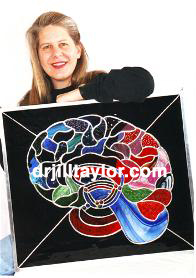
A mini-interview in the New Scientist (April 19-25) caught my eye. Jill Bolte Taylor’s story gives credence to the network model of cognitive architecture that postulates that cognitive representations consist of widely distributed networks of cortical neurons. Cognitive functions, namely perception, attention, memory, language, and intelligence, consist of neural transactions within and between these networks. Jill in her own words:
So, I look at us as a collection of neurocircuitry of thoughts and emotions and physiological responses. When you see the brain as the kind of computer network that it is, it becomes easier to manipulate.
Jill, you see, had her left hemisphere traumatised, and shifted herself into her right hemisphere – a “cognitive choice” as she puts it. The interviewer make the point that Jill’s claim resembles the claim made by those who meditate. Jill:
There are people who are comfortable witnessing their thoughts, while there are others who think they are their thoughts. Learning to observe our neural circuitry and not engage with it is a skill we all can learn.
Yes, indeed. Secular Buddhist training – “empty mind” – dispenses with the homunculus that Cartesianism postulates. For more on Jill, see her website.
Ballet and Brain
Two of my passions – ballet and brain – caught my eye in the unlikely guise of a review and preview of Wayne McGregor’s Entity at Sadler’s Wells. Rather than McGregor’s ideas being filtered through a faintly comprehending dance journalist:
Technology fiend McGregor is engaged on a continuing investigation into brain and body. The ultimate goal is to create “artificially intelligent, autonomous chor-eographic agents”. In other words, he and his colleagues hope to develop software that can think for itself and help choreographers rethink what they do with the body. It’s a properly Frankenstein-ian project, a collaboration that has included cognitive psychologists and cardiac specialists, as it probes the way the brain’s signals transmute into movement.
check out this video clip with McGregor himself. The dream ticket would of course be Sylvie Guillem and McGregor.
Perspectives on Testimony
Cyborg

With the film Iron Man about to be released, the Hollywood publicity machine has hit full stride. Despite the symbiotic relationship of Hollywood to glossy magazine culture, there are occasionally some interesting articles to be found. One such article is the May edition of Popular Science. What’s being discussed is Exoskeleton technology – something that has a deep resonance with Andy Clark’s argument/vision set out in his Natural-Born Cyborgs: also referenced by Clark is Stelarc the “cyborg” and the work of Kevin Warwick.
By the way, the man with the suited Exoskeleton is none other than the amazing Steve Jacobsen.
Not surprisingly, Black Sabbath’s Iron Man from their classic album Paranoid, has been cannibalized for flogging this film:
Has he lost his mind?
Can he see or is he blind?
Can he walk at all,
Or if he moves will he fall?
Is he alive or dead?
Has he thoughts within his head?
Well just pass him there
Why should we even care?
He was turned to steel
In the great magnetic field
Where he traveled time
For the future of mankind
Nobody wants him
He just stares at the world
Planning his vengeance
That he will soon unfold
Now the time is here
For iron man to spread fear
Vengeance from the grave
Kills the people he once saved
Nobody wants him
They just turn their heads
Nobody helps him
Now he has his revenge
Heavy boots of lead
Fills his victims full of dread
Running as fast as they can
Iron man lives again!


