Ryle and Oakeshott

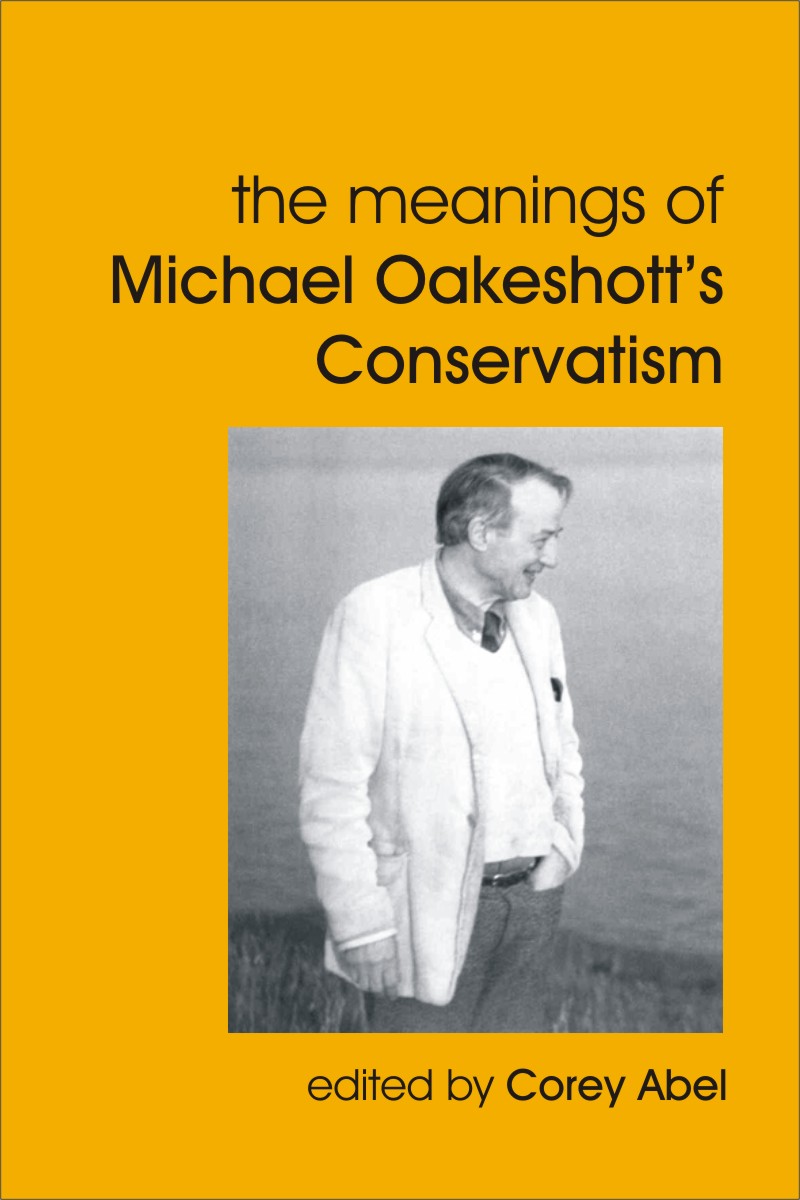
At last here is the book in which my essay “Ryle and Oakeshott on the know-how/know-that distinction” appears, masterly edited by Corey Abel. A draft of the paper can be found here.

Don’t get hung up by the use of the word “conservatism” in the collection’s title – Oakeshott’s conservatism bears no resemblance to those who would go by that name. Much of Oakeshott is in tune with situated wing of cognitive science. The photo is of Oakeshott at the Dorset coast, snapped by Ken Minogue. Here’s the blurb:

This collection of recent scholarship on the thought of Michael Oakeshott includes essays by distinguished and established authors as well as a fresh crop of younger talent, reflecting the sustained and ever growing interest in Oakeshott . Together, they address the meanings of Oakeshott’s conservatism through the lenses of his ideas on religion, history, and tradition, and explore his relationships to philosophers ranging from Hume to Ryle, Cavell, and others. Befitting the nuances of Oakeshott’s conception, the collection assigns no single or final meaning to his conservatism, but finds in him a number of possibilities for thinking fruitfully about what conservatism might mean, when it is no longer considered as a doctrine, but as a disposition.

The Mind as Neural Software?

Here is a superb paper by Gualtiero Piccinini that brings much needed clarity to a longstanding issue. A penultimate ms can be found here.

As a consequence, when the behavior of ordinary computers is explained by program execution, the program is not just a description. The program is also a (stable state of a) physical component of the computer, whose function is to generate the relevant capacity of the computer. Programs are physically present within computers, where they have a function to perform. Somehow, this simple and straightforward point seems to have been almost entirely missed in the philosophical literature. (p. 295).

Bravo Gualtiero!

Stigmergy group

My collaborator Marge Doyle and I have set up a LinkedIn group for the many academic disciplines that now have an interest in stigmergy. Go to LinkedIn and search LinkedIn groups for “stigmergy.”

Jurisprudence and Oakeshott

Here is a just published paper that draws heavily on Oakeshott.

Ratio Juris. Vol. 23 No. 4 December 2010 (460–78)

Abstract. There is a vast literature on the meanings of legal penalties. However, we lack a theory that explains them according to the formation of the modern state. Oakeshott’s theory can help explain this phenomenon, leading to an attempt of the individual to take over as many powers of the state as possible. Thus, Kant’s and Smith’s retributivism is the most consistent of all those theories. Nevertheless, the preventive and resocializing theory of Bentham succeeded eventually. But is this a liberal theory? We contrast the explanations of H.L.A. Hart and Frederick Rosen in order to lay the groundwork for a liberal theory of the meaning of legal sanctions.

Quinton on Wittgenstein

Here is me old chum Tony Quinton being interviewed by Bryan Magee on Wittgenstein. Here we have a master expositor being interviewed by Magee who has done so much to bring philosophy to a popular audience without vulgarizing it. I think this was a series of interviews taken from a late night Channel 4 series in the early ’80s. In the late ’80s Magee went on to do a superb series for, I think BBC2, entitled The Great Philosophers, following the same format. Fortunately all this stuff can be found on YouTube – search “Bryan Magee”

Part 1:

Part 2:

Part 3:

Part 4:

Part 5:

EPISTEME 2011

The 2011 EPISTEME conference will focus on the intersection of formal and social epistemology. The use of formal models in social epistemology is not a new development. Many philosophers have modeled concepts and ideas in social epistemology by using formal tools of various types (e.g., game theory, Bayesian decision theory, the theory of judgment aggregation, the recently developed theory of networks, multi-agent epistemic logic, social choice theory, etc.). This conference intends to explore the many fertile relations between various branches of formal epistemology and many sub-areas of contemporary social epistemology.

The 2011 EPISTEME conference will be hosted by the Center for Formal Epistemology in the Department of Philosophy at Carnegie Mellon University. The topic of the conference is:

“Social Epistemology meets Formal Epistemology: Recent developments and new trends”

A selection of the conference papers, including, potentially, papers from the open sessions, will be published in a special issue of the journal EPISTEME. For more information about the journal, you can look here.

Date: 24-26 June 2011

Possible topics: The following is a non-exhaustive list of possible questions that open session papers might address.

Epistemic  foundations of game theory.

Peer disagreement.

Aumann’s `Agreeing to disagree’.

The modeling of  testimony in Bayesian epistemology.

Discrete pooling,  judgment aggregation and social choice.

Consensus of  probabilities: limit theorems and applications.

Dynamic logic meets  game theory.

Evolutionary game  theory, morality and the social contract.

The  program of social software.

Sociology of  science.

Diversity and  pluralism.

Social network  structure.

Learning in  networks.

Economic models of  theory choice.

There will be a number of open sessions as part of this conference, and the organizers would like to invite submissions. Papers addressing any aspect of the conference theme, broadly conceived, are welcome. Submissions from graduate students are also welcome.

Length and format: Submissions should take the form of a detailed abstract of 500-1000 words. All submissions must be made electronically. The papers should be suitable for a presentation of around 30 minutes with a 15 minute question-and-answer session.

Submission procedure and important dates: All submissions should be sent directly to Horacio Arló-Costa (hcosta@andrew.cmu.edu). The deadline for submissions is February 15th 2011 with authors notified of the results of this process by April 20th 2011. All enquiries about the call for papers should be addressed to the main organizers: Horacio Arló-Costa (hcosta@andrew.cmu.edu ) and Christian List (C.List@lse.ac.uk).

Journal special issue: Please note that there will be a special issue of the journal EPISTEME arising out of this conference, and this issue may include some of the papers from the open sessions. It is thus essential that the papers for the open sessions are not already published, or due to be published. To be eligible for consideration for inclusion in the special issue, complete written versions of the papers will have to be ready by the time of the conference.

Main organizers:

Horacio Arló-Costa (CMU)

Christian List  (LSE)

Program committee:

Alexandru Baltag (Oxford)

David Danks (CMU)

Igor Douven (Groningen)

Philip Kitcher (Columbia)

Klaus Nehring (UC Davis)

Eric Pacuit (Maryland and Tilburg)

Rohit Parikh (CUNY)

Gerhard Schurz (Dusseldorf)

Teddy Seidenfeld (CMU)

Brian Skyrms (CI)

Kai Spiekermann (LSE)

Johan van Benthem (Stanford, Amsterdam)

Kevin Zollman (CMU)

Local organizers:

Horacio Arló-Costa

Kevin Kelly
Anglo-American Idealism

I want to give a plug for this new book edited by James Connelly and Stamatoula Panagakou. They have worked tirelessly in keeping interest in idealism alive and have brought together a who’s who of experts in this field. However unfashionable and derided idealism might be, I for one still find it a fertile tradition of theorizing – the three idealists that I have some familiarity with are the formidable Bradley, Bosanquet, T.H. Green, McTaggart (The Unreality of Time), Collingwood, and off course Oakeshott. I notice that the late Timothy Sprigge has a chapter in this book (I had the good fortune to attend the Sprigge memorial conference last year).

Andy Clark Interview

Here is an interview conducted by Howard Rheingold, as he says motivated by Andy’s Natural-Born Cyborgs. Note Andy’s reference to stigmergic (swarm) behavior though he doesn’t actually use the term. (Via David Livingstone Smith and Mirko Farina).