Michael Oakeshott’s Philosophy of History

Here are some extracts by the man who first set me on the road to Oakeshott some twenty years ago – Geoff Thomas. Geoff has a philosophy of history book coming out soon – and I can tell you it’s a cracker.

What Oakeshott said about history—his canonical philosophical view about the nature of historical inquiry—can be summed up in four theses: (1) the past does not exist, only the present; (2) only experience exists; (3) the historical past is an inferential construction from experience; (4) historical inquiry is autonomous, not a part of or ancillary to either science or practice.

My own view is that the interest of his views on history does not depend on the modal apparatus, and this for two reasons. In the first place, I do not think that Oakeshott offers a sufficiently detailed and sophisticated analysis of the concept of a mode to vindicate its structural role. Second, his distinctive views—that the past does not exist, that only experience exists, that the historical past is an inferential construction from present experience, that historical inquiry is impartial, neutral, and autonomous, and that causation has no part to play in historical explanation—can be set out and appraised without reference to the modes.

Finally, we must take note of the “us” in “what the evidence obliges us to believe.” Who are we? Given the widespread and intractable nature of certain historical controversies, there may on occasion be a reluctance to go beyond “what the evidence obliges me to believe.” We needn’t reduce the matter to Rorty’s “what our peers will, ceteris paribus, let us get away with saying,” but there is a sense in Oakeshott of a community of historians engaged in the project of constructing the historical past and in appraising one another’s constructions by a shared set of standards.

Rolling Stones @ 50

Two of the highlights:

Satisfaction left off because of stringent O2 time constraints.

Telegraph Review

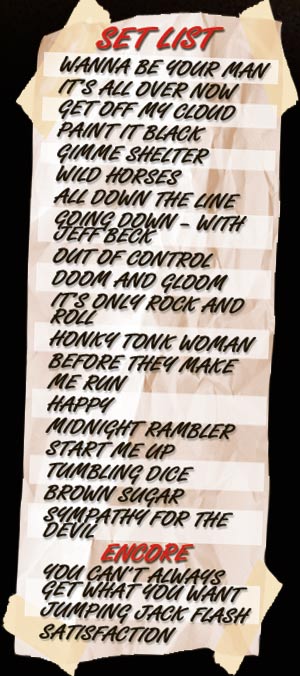
Right about now the Stones’ 50th anniversary shows in London should kick off. My man on the inside tells me that the set list so far:

Set list so far :

1-Wanna be your man
2-Get of off my cloud
3-It’s All Over Now
4-Paint It Black
5-Gimme Shelter
6-Wild Horses
7-All Down The Line
8-Going Down (Beck)
9-Out Of Control
10-One more shot
11-Doom and gloom
12-It’s only rock n’ roll (Wyman)
13-Honky Tonk Woman (Wyman) (Lisa Fischer)

Here is Ed Bradley chatting to them at the 40th mark. Of interest to me is the snippet of Mick and Charlie participating in a second line (@ 6:06). Having just read Philip Norman’s biography, it is easy now to see that Jagger while super bright and articulate is essentially unknowable or elusive, except to Keith, who is as charming and articulate, but with wisdom and warm.

Here is the just released BBC two parter – onetwo

New Orleans Bar Guide

Well, here is that vital resource that one needs: where to get your drink, organized by neighborhood.

Bryan Ferry’s “The Jazz Age”

Brian Ferry has a new album out. Ferry is of course not new to exploring his parents’ and grandparents’ music: he has dabbling quite convincingly long before it became a fashionable late-career move by some (i.e. Rod Stewart). Ferry, I think, did a damn fine job of  playing the crooner on his first two solo albums. (This is the road Bowie could have gone down post Scary Monsters – he had the superior voice – a case in point Wild is the Wind – but instead insisted upon playing the Jesus of Cool role way too long, snuffing out his career’s longevity). The problem I have with Ferry’s album is not that it’s bad per se but that it just seems “soulless” – the songs seem to have been run through a “Jazz generator” giving the sort of ersatz gramophone sound that rockers have occasionally employed (Paul McCartney for one). Any pop ditty can be “classicalized” or “Jazzified.”  This doesn’t necessarily give any more gravitas to a piece.

Judge for yourself – The Guardian is freely streaming the album.

London Aesthetics Forum

The LAF is putting on two lectures that would have great appeal to me:

One of my favourite philosophers, Colin McGinn, on Hand, Mind and Language:

In what ways might the human hand have contributed to the evolution of the human mind and human language? To what extent do we have a “manual mind”? Could spoken language have had its origins in a gestural language based in the hand? This lecture will advance the thesis that ostension and prehension are connected and that the mind is a “grasping organ”. This provides a new and acceptable form of biological naturalism about mind and language.

and,

Catherine Wilson on Robert Musil’s The Man without Qualities: Mach’s Empiricism and the Episodic and Narrative Self:

The Austrian writer Robert Musil, author of the great but still little read trilogy, The Man without Qualities, obtained his PhD in in early 20th century Berlin with a thesis on Ernst Mach’s empiricistic philosophy of science. The paper will discuss Mach’s contribution to literary modernism and to the notion of the fragmentation of the self, a notion that has resurfaced in recent debates over the importance –or unimportance –of narrative continuity to selfhood.

Philosophy and its moods

These excerpts from Ken McIntyre’s essay Philosophy and its moods:

Oakeshott’s insistence on the dispositional skepticism of philosophical activity leads to his rejection of both the importance of authority in philosophy and the relevance of philosophy to practical life. He writes that philosophy “recognizes neither ‘authorities’ nor ‘established doctrines,’” because such institutions present themselves as conclusions to be interrogated rather than as dogma to be accepted and deployed (EM, 347). Philosophy as an activity requires neither the reverence of the postulant nor the conversation of mankind deference of the exegete. Ironically, ignorance, in its literal sense, is irrelevant to philosophical activity, because, for the philosopher, the conclusions of other philosophers are invitations to further reflection. But the impetus toward a philosophical disposition need not arise because of an engagement with a philosophical tradition but can emerge from almost any encounter with the given world. The interrogation of the conditions of various given worlds of understanding, like the questioning of the arguments and conclusions of other philosophers, renders both the activity and conclusions of philosophy irrelevant to the successful navigation of such given worlds. Oakeshott insists that “philosophy is without any direct bearing upon the practical conduct of life, and . . . it has certainly never offered its true followers anything which could be mistaken for a gospel” (1).12 Indeed, philosophy is an escape from the normal requirements of getting and spending, and it requires a severe discipline to remain committed to such a useless (i.e., nonutilitarian) activity.

For Oakeshott “there is no vita contemplativa; there are only moments of contemplative activity abstracted and rescued from the flow of curiosity and contrivance. Poetry [like philosophy] is a sort of truancy, a dream within the dream of life” (RP, 541). This is true not only of poetry and philosophy, however. Neither historical inquiry nor scientific explanation is necessary for the continuation of human life, either, and both can be considered, like philosophy and poetry, to be momentary escapes from the “deadliness of doing.”

The philosopher is not engaged in the attempt to reach an understanding of the world that is in itself unconditional or presuppositionless but is instead unconditionally committed to understanding the general conditionality of all understanding or experience. The philosopher, or theorist, maintains an attitude of sceptical dissatisfaction with understanding because it always rests on conditions that can be further explored. The results of such in an engagement in philosophical reflection (i.e., theories or philosophies) are inherently provisional, or, as Oakeshott puts it, they “are interim triumphs of temerity over scruple”. And, of course, they lose their concrete character when they are detached from the activity that produced them and transformed into sets of doctrines or dogmas.

fMRI Study of Jazz Improvisation

Though there is much talk about this study, check out this study that goes back a few years:

Our results strongly implicate a distinctive pattern of changes in prefrontal cortical activity that underlies the process of spontaneous musical composition. Our data indicate that spontaneous improvisation, independent of the degree of musical complexity, is characterized by widespread deactivation of lateral portions of the prefrontal cortex together with focal activation of medial prefrontal cortex. This unique pattern may offer insights into cognitive dissociations that may be intrinsic to the creative process: the innovative, internally motivated production of novel material (at once rule based and highly structured) that can apparently occur outside of conscious awareness and beyond volitional control.

In jazz music, improvisation is considered to be a highly individual expression of an artist’s own musical viewpoint . . .  In short, musical creativity vis-à-vis improvisation may be a result of the combination of intentional, internally generated self-expression (MPFC-mediated) with the suspension of self-monitoring and related processes (LOFC- and DLPFC-mediated) that typically regulate conscious control of goal-directed, predictable, or planned actions.

In an intriguing neuroimaging study of musical improvisation in classically trained pianists, Bengtsson et al. [13] found activations in the right dorsolateral prefrontal cortex, as well as premotor and auditory areas during improvisation. Our study differs from this one in several important ways. First, the study by Bengtsson et al. utilized contrasts that were designed to remove deactivations. In comparison, we had the explicit goal of identifying relevant deactivations that might support the notion of a hypofrontal state associated with creative activity. Hence, the masking strategies employed by our studies were fundamentally different, and would be expected to lead to divergent results. Second, our subjects were jazz pianists (rather than classical pianists). This difference is relevant in that jazz, much more so than classical music, is intrinsically characterized by improvisation. As a result, we believe that our findings reflect neural mechanisms behind improvisation in a perhaps more natural context, and certainly in musicians who have finely developed improvisational skills. Lastly, Bengtsson and coworkers utilized conditions in which musical improvisations were generated and then subsequently reproduced by memory. These conditions address an interesting facet of improvisation—the interaction between spontaneous musical performance and memory. We sought to eliminate the secondary impact of episodic memory encoding on improvisation by using either an over-learned or completely improvised condition (without a reproduction task in either condition).

Because our experiments were performed in highly trained musicians, it remains to be clarified whether or not our findings have characterized a higher qualitative level of musical output (as opposed to that which might be produced by less skilled performers). However, the similar findings seen for both Scale and Jazz paradigms, despite the musical simplicity of the former, strongly suggest that our findings are attributable to neural mechanisms that underlie spontaneity more broadly rather than those specific to high-level musicality alone. Taken together, the consistency of findings reported here suggests that the dissociation of activity in medial and lateral prefrontal cortices is attributable to the experimentally constant feature of improvisation and may be a defining characteristic of spontaneous musical creativity.