Oakeshott on the History of Political Thought

Martyn’s essay opens the second half of the Companion.

The fact that nonhistorical elements were interwoven into the lecture course strongly suggests that Oakeshott was doing something other than offering his students an outline history of Western political thought. And this suggestion is in part confirmed by the fact that Oakeshott’s own title for the lectures did not mention “history.” They were simply lectures on “political thought.” Their purpose, Oakeshott noted, was to offer undergraduates “a study of political thought, or aids to the study of political thought.” To be sure, he went on immediately to say that in “the main” what he proposed to offer was a “historical study” (LHPT, 31). But the appropriate context for understanding what he meant by this is his clearly articulated view, part of his philosophy of education, of what is involved in the study of politics at a university. The “problems” of the lectures as history disappear, and an immensely important set of observations for understanding Oakeshott’s conception of the history of political thinking becomes clear when they are seen, as Oakeshott intended them to be, as “aids” to the study of politics at a university. So what are the main components of this more appropriate context?

In this view, to read a philosophical inquiry as a partisan political argument is simply to misread it. For Skinner, by contrast, philosophical accounts of politics are always, in part at least, polemical interventions in practical political controversies. They are “never above the battle.” In arriving at this conclusion, Skinner often invokes Wittgenstein’s observation that “words are also deeds” and that “concepts are not timeless entities with fixed meanings, but should rather be thought of as . . . tools (Wittgenstein’s term), the understanding of which is always in part a matter of seeing who is wielding them and for what purposes.” But these are observations entirely compatible with Oakeshott’s views.

What matters for Oakeshott’s understanding of the history of political thought is what Hobbes understood those relationships to be within the context of mid-seventeenth- century intellectual controversies. Given the fact of seventeenth-century controversies about whether or not philosophical reason could have any practical applicability, it seems an unnecessarily arbitrary move to reduce from the outset the history of early modern reflection on politics to a history solely of ideology, where ideology is understood, as it usually is, as a kind of practical political thinking. As I consider in a moment, it is unclear to me whether Skinner really needs to do this, although he often enough says he does. With respect to Hobbes, as Oakeshott would have argued, the point Skinner has been making is that Hobbes’s “general system of ideas” is related to seventeenth-century practical political arguments in ways historians have hitherto tended to overlook. But he has not shown that Hobbes’s general system can be reduced to nothing but polemics.

“Gatemouth” Brown

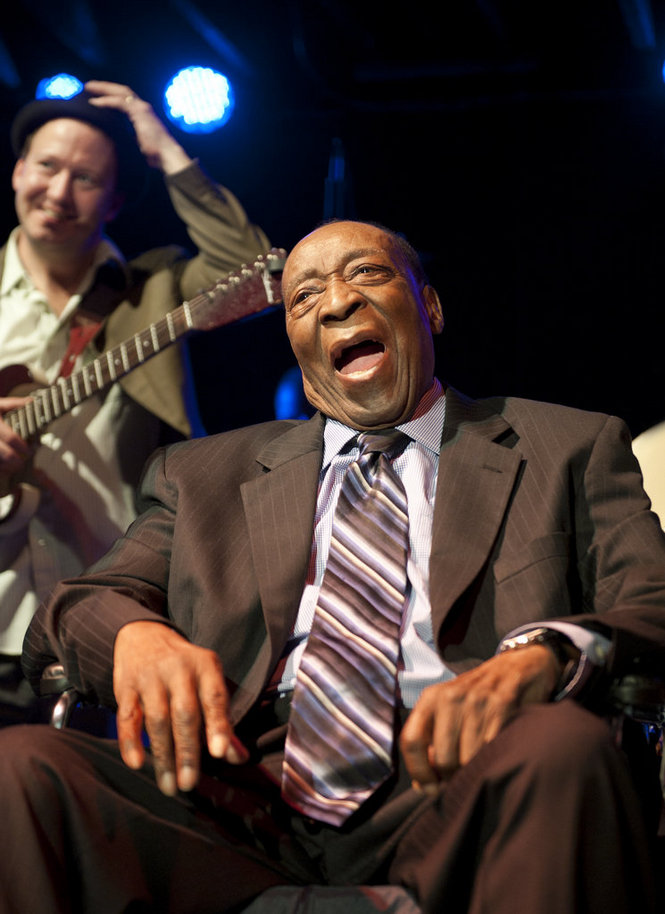
The amazing talent and character that is Clarence “Gatemouth” Brown. See the excerpt on Gatemouth from Keith Spera’s lovely book.

Eric Clapton became an unabashed Brown booster on November 22, 1994, the second of Clapton’s three consecutive nights at the New Orleans House of Blues. During his encore, Clapton invited Brown to sit in. After warming up, Brown stepped to the microphone and announced, “For my next song …” He essentially hijacked the show as a grinning Clapton shrugged and slipped into his newly assigned role as sideman.
“How many people would get up onstage with Clapton and do that, and not even hesitate?” said Shepherd. “Only guys from that generation can do something like that and get away with it.”

Weeks later, Clapton invited Brown to join him at London’s Royal Albert Hall. He then asked Brown to open dozens of concerts across Europe and North America, exposing the old master to thousands of fresh ears. “I was doing damn good before Clapton,” Brown noted. “That just helped a little.”

Hayek and the “Use of Knowledge in Society”

Here is an advance listing of the forthcoming volume Encyclopedia of Philosophy and the Social Sciences masterly edited by my chum Byron Kaldis. My contribution: Hayek and the “Use of Knowledge in Society”

Fats and Dave

Here is the very excellent Keith Spera reporting on an event I’d have given my right/left (you name it) to have been able to attend. Keith by the way has written one of the most elegant, affectionate (warts and all) and informative books around featuring a chapter on Fats. Music journalism at its unpretentious best: a lovely read – get it now! Also, recalling Keith’s reference to Fats’ last Tipitina’s appearance check out this DVD and this CD,  the arguably the best tribute album I have come across (they typically tend to be rather uneven).

Below is a great shot by Erika Goldring of the ever ebullient Dave – the image above is one of my favourites of Fats. I have a large copy that will have pride of place in my envisioned bar/man cave someday.

12111267-standard

Edmund Burke

Today marks the birth of Edmund Burke. I find it tiresome that Burke is viewed as some sort of crude reactionary – his work is eminently humane, thoughtful and civilized and despite his ostensibly conservative outlook, it resembles nothing that modern-day fundamentalists who lay claim to the mantle of conservatism, will recognize. As Ian Harris points out there was a whole lot more to Burke than the brilliantly written Reflections – there is his philosophical method and his aesthetics. I still think that Conor Cruise O’Brien’s introduction to Reflections stands the test of time.

Here is a shot of Burke’s statue at Trinity College Dublin where I stayed for my visit to, yes, a Stones concert in September of 2003.

67241926

Margarethe von Trotta’s Hannah Arendt

I guess if anyone could pull off this it would be von Trotta. We will see.

And a Bottle of Rum

New Orleans-based Wayne Curtis is one of the most knowledgable and most eloquent writers on all things boozy and especially the trend towards slow cocktails. Though he writes on much more besides it is through his The Atlantic column that I know his work and made a point of meeting him when he was in Vancouver about a year ago. Grab a copy of his very excellent And a Bottle of Rum.

. . .  if your interests revolved around history, architecture, preservation, and drinking, where the hell else would you move? Also, it bothered us how the whole city had been left twisting in the wind after Hurricane Katrina in August 2005. So we bought a house about a half dozen blocks from the Mississippi River and moved everything we owned off an island we were living on in Maine. Doing this was the best thing I’ve done. Ever. I love living in New Orleans.

Bowie’s back

The Economist pretty much captures the bind that Bowie has faced over his career. The man who retains the longest stretch of creativity in rock music (1971-1980) blew it by trying to keep cutting edge. With his genuinely great crooning voice he could have out done Rod Stewart’s American Songbook by a mile, but instead tried vainly to keep up with “yoof” culture. The latest release is OK as an album track but as a single? Hardly – though I like the reflective tone that only comes with consciousness of ones own mortality.

John Everett Millais’ Mariana

Having just viewed the Tate’s fantastic pre-Raphaelite exhibition I thought I’d share my favourite piece, the highly erotic Mariana by John Everett Millais.

Oil on Wood 59.7 x 49.5 cm

Accepted by HM Government in lieu of tax and allocated to the Tate in 1999.

Image