musicthe who
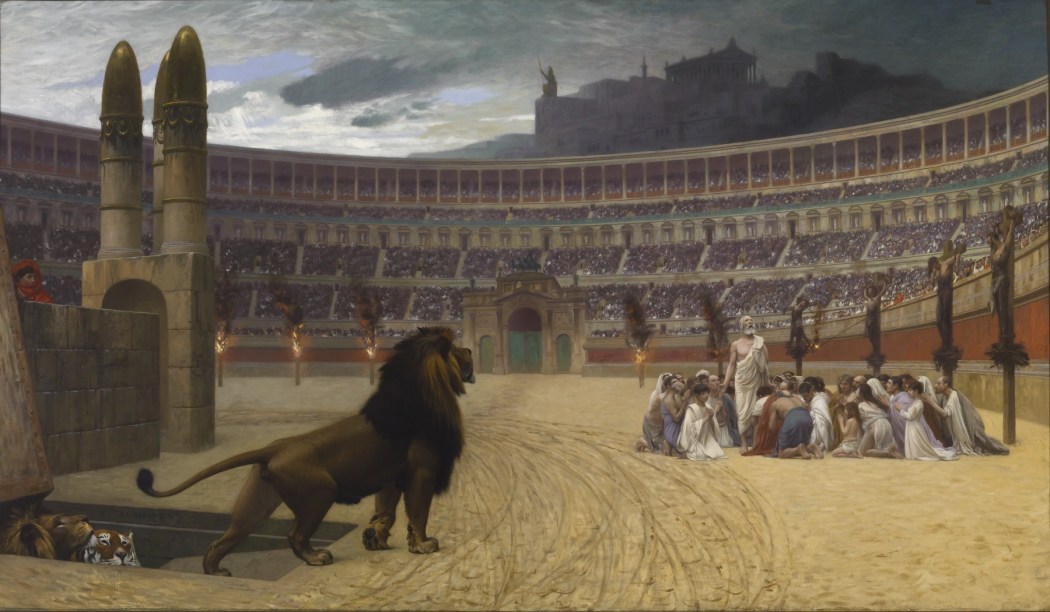
Why were the early Christians persecuted?
I
This well-worn question needs to be re-analyzed into the following three subsidiary questions.
First, for what reasons did the government (i.e. the organs of state, broadly speaking, the emperor, the senate, officials, and provincial governors) persecute? Secondly, for what reasons did ordinary pagans (i.e. the general populace) demand persecution? Thirdly, we need to examine the concept of martyrdom. There is the problem of distinguishing what constitutes persecution and what constitutes voluntary martyrdom.
Before examining these issues I offer some necessary points of clarification in section two.
II
In his correspondence with Trajan, Pliny uses the terms superstitio and hetaeria in his characterization of the Christians. We need to bring these terms into focus.
In its most familiar sense, the term superstitio referred to beliefs and practices that were alien to the Romans. According to writings attributed to Plutarch (Moralia 166c-170c), the superstitious person is one who fails to bring to bare his intellect on these matters giving rise to groundless fears, fanaticism and an absolving of ones free-will. These sentiments are echoed by Cicero (Nat.D.1.117.2.72): superstition was the irrational fear of gods “whereas religion consisted in pious worship”. The superstitious man’s gods were capricious unlike the divine providence of the Roman deities.
There was a definite functionality to Roman religion – the maintenance of social order and the well being of the Empire. The superstitious person neither honored the gods nor benefited mankind. The criterion of truth in religious matters was custom and tradition, a conservative cast of mind that prefers the familiar to the unknown. Polybius (VI:56) viewed religion as a force for inculcating civic virtue and public discipline, and that this religious devotion was the mark of Roman superiority. To be pious was to believe in the gods of the city-state – the duty Socrates was accused of failing to observe – and even more than believing in them, respecting them. Roman religion therefore emphasized the public practice of ritual: nonconformism and irreligiousity went hand in hand. Piety embraced both senses of reverence for familial and the city cultic sense, but should not be confused with a theocratic emphasis on a set of beliefs and ethics. Cicero (Nat.D. 1.3-1.4) wrote that ‘in all probability, the disappearance of piety towards the gods will entail the disappearance of loyalty and social cohesion among men as well, and of justice itself, the queen of all virtues’ and new or foreign gods need official sanction to be accepted.(De.Leg. 11.8)
The term hetaeriais usually rendered as ‘political club’ or ‘association’ (Wilken 1984: 34) much like a professional guild or funerary society (Dodds 1965: 137). Tertullian appropriated the terminology of these fraternities to make a prima facie case for the Christian communities being just one of many of these associations. Despite his preference for the word corpus rather than ecclessia, we know that it was Tertullian’s conviction in the superiority of Christian association compared with those of the pagan.
The term paganus refers to the rustic, the peasant, and from Cicero onwards could denote townspeople (Jones 1963: 18). Chuvin (1990: 9) suggests that pagani or pagans are best viewed as ‘people of the place, town or country, who have preserved their local customs, whereas the alieni, the people from elsewhere were increasingly Christian.’ This interpretation is consistent with the notions of conservatism in cultural and traditional matters and of setting the parameters for nonconformism. Chadwick (1990: 152) points out that the word remained a colloquialism and did not penetrate Biblical or liturgical literature. If the object of worship was the maintenance of pax deorum, linking religion to political and social order, it is very tempting to infer that the grounds of persecution were political rather than religious.(Frend 1965: 105 uses the term ‘treaty relationship’)
III
On the question of the juridical basis of the persecution of the Christians I use Barnes (1968: 34-50) as my guide. Barnes’ task is to survey the primary sources of evidence without the filters of later hagiography and modern exegesis obscuring the topic. Both Barnes and de Ste. Croix (1963: note 18) regard modern bibliographies for the most part as worthless as their remit is too broad. Barnes therefore circumscribes his excavations by stating that ‘vague references to a lex against the Christians (such as Athenagoras, Legatio 7; Tertullian Apol. 4.4ff) will be disregarded; they show merely that Christianity was illegal not how it came to be so.’ The upshot of Barnes’ survey centres on Trajan’s rescript to Pliny: after Trajan’s rescript, if not earlier, Christianity was a crime in a unique category. Unlike other criminals Christians were punished for being a Christian and not for having been a Christian, an anomaly in Roman law (de Ste. Croix 1963: 9, 20; Frend 1965: 165), and on any reading, is highly ambiguous. Trajan’s famous edict instructing Pliny not to actively seek out Christians and further that anonymous denunciations should be disregarded, only gives a partial definition to the law when stated negatively, leaving so much open to arbitrary individual discretion. It is important to note as de Ste. Croix (p. 28) points out, that the positive facet of Christianity was never officially assailed except for Christian’s contumacious incompliance to acknowledge other gods. Baring in mind the earlier comments made regarding religious conformity, this had to inevitably locate the clash between Christian and pagan. In support of this, de Ste. Croix makes the interesting observation that those who held doctrines of a ‘recognisably Christian character’ and even calling themselves Christians, for example the Gnostics, were spared persecution. It could only be that the Gnostics paid outward respect, thereby appearing to accommodate the Roman gods. As was mentioned earlier, ‘belief’ was conditional on practice or ritual and that was a sufficient condition for conforming. How then was this charge of being a Christian prosecuted under ‘due process’ of law? It is popularly held that Roman law is the single most impressive and admirable achievement of Roman civilization. This achievement however, at least in de Ste. Croix’s view, is primarily confined to private law and the related laws of property. It is quite evident that immense deficiencies in public law manifested itself in the cognito extra ordinum, giving magistrates so wide a discretion, that even the slightest hint or ambiguity of ‘being’ Christian led to prosecution. Such scope to prosecute made the law inherently arbitrary. As de Ste. Croix (1963: 17) says, in fact no legal foundation was necessary ‘other than a prosecutor, a charge of Christianity, and a governor willing to punish on that charge.’ We need however to be cognisant, as Barnes pointed out, that most of our information derives almost entirely from Christian sources which had a vested interest in recording martyrdom and that there needs to be a healthy level of scepticism in these matters. Both Barnes (1968: 34) and de Ste. Croix (1963: 15) reject the idea put forward by Melito that a correlation existed between ‘bad’ emperors who persecuted and ‘good’ emperors who didn’t. There are two problems with this claim. First, understandably, apologist writers are operating on an extremely narrow criterion of good or bad: there is more to judging the adeptness of an emperor than whether or not he countenanced persecution. Secondly, linked to this, persecution might only have been instrumental to real politik or statecraft (in a Machiavellian way; The Prince XVII) even for a ‘good’ emperor.
IV
To ask why the government persecuted is in effect to ask why the general populace demanded persecution. Much of the discussion has unavoidably been pre-empted. Roman religion entailed public worship to maintain the pax deorum of the community averting disasters (natural disasters such as floods, draught, earthquakes etc.) that could befall the community. Failure to comply, therefore, undermined the security and well being of the community at large. In the need to pacify public disquiet, the government was obliged to ‘persecute’ those whose actions threatened the well being of the community. Herein lies a major and perhaps irresolvable problem of exegesis. I’ve already hinted at the difficulty involved in determining whether or not the persecution was politically or religiously motivated. De Ste. Croix holds that the motives for government persecution were essentially religious in character. He supports his thesis by pointing to the Gnostic immunity from persecution. The pax deorum being the prime Roman social value invites charges that Roman religion was superficial and insincere, leading one to infer that persecution had to be politically motivated. However, both Barnes (1968: 49) and de Ste. Croix (1963: 30) are at pains to emphasize that Roman religious sentiment were no less real or powerful than our modern conception of religious belief and practice. (c.f. Janssen 1979). De Ste. Croix does offer the Marxist analysis that ‘religion was above all an instrument by which the governing class hoped to keep the reins of power in its own hands.’ Though this analysis is perfectly valid and may well have been the case, I’m not convinced that such an analysis can be consistently applied to what is a pre-capitalist society. (see Momigliano’s comments 1963: 4 on Marxist analysis). I think a definite tension arises when on the one hand de Ste. Croix asserts that the motives for government persecution were ’essentially religious’, yet on the other hand he acknowledges that it was a prime social value to maintain the pax deorum. Both are inextricably linked and as such I see no reason why even if religious sensibilities were threatened in the first instance, why persecution cannot be viewed as being politically motivated, when the ultimate consequentialist concern had to be the maintenance of the pax deorum, and religion was instrumental to that aim. Even on de Ste. Croix’s own Marxist account, religion was instrumental to political power. In any event a typically pious individual of any class would cherish the benefits of social stability that their religious sensibility ensures.
V
The concept of martyrdom is deeply ambiguous both within the modern and ancient worlds and is therefore incumbent upon the scholar to draw some conceptual distinctions thereby elucidating the question of persecution. Is martyrdom simply a case of persecution and subsequent execution? How does ‘voluntary’ martyrdom differ from suicide? Though Amundsen (1989: 100-116) is primarily concerned with the philosophical, theological and ethical implications of martyrdom, the distinctions he draws are equally valid for our purpose. Amundsen offers four distinct possibilities a Christian might be confronted with under persecution:
1 denying Christ (apostatizing)
2 fleeing possible martyrdom
3 acquiesce to martyrdom when the only escape is option 1
4 seeking, provoking or volunteering for martyrdom.
Even without reliable figures, the statistical possibility of cases spread across these four options, offers a real challenge to apologetic sources as to the scale of persecution and martyrdom they would naturally claim. It would not therefore be too provocative when de Ste. Croix (p. 22) suggests that ‘the seeking out of Christians . . . need not have been nearly as vigorous as we might otherwise have assumed from the evidently large numbers of victims.’ De Ste. Croix makes the astute point (p. 20), that after all, ‘the essential aim was to make apostates, not martyrs . . . a governor who really wanted to execute Christians would be careful to avoid torturing them, lest, they apostatize and go free.’
VI
By way of a conclusion Barnes (1968: 50) says that ‘it is in the minds of men, not in the demands of Roman law, that the roots of persecution of the Christians in the Roman Empire are to be sought.’ Barnes is making the crucial point that despite the deficiencies of Roman public law, persecution was not a requirement of Roman law. I would argue contrary to de Ste. Croix, that the State (any variant, modern or ancient) needs as a precondition of its viability, loyalty from those living within its domain, and that the Christians might well have appeared to be a threat to the State.
BIBLIOGRAPHY
Amundsen DW (1989)’Suicide and Early Christian Values’ in Suicide and Euthanasia, ed., BA Brody, Dortrecht.
Barnes TD (1968) ‘Legislation Against the Christians’ Journal of Roman Studies 58
(1971) Tertullian: A Historical and Literary Study, Oxford.
Chadwick H (1990) The Early Church, Harmondsworth.
(1992) ‘The Early Christian Community’ in The Oxford Illustrated History of Christianity, ed., J McMannes, Oxford.
Chuvin P (1990) A Chronicle of the Last Pagans, tr. BA Archer, Cambridge MA.
Cicero (1951) De Natura Deorum, tr. H Rackam, London.
(1928) De Legibus, tr. CW Keyes, London.
de Ste. Croix GEM (1963) ‘Why were the early Christians persecuted?’ Past and Present 26
Dodds ER (1965) Pagan and Christian in an Age of Anxiety, New York.
Frend WHC (1965) Martyrdom and Persecution in the Early Church, Oxford.
Janssen LF (1979) ‘Superstitio and the Persecution of the Christians’ Vigiliae Christianae 33
Jones AHM (1963) ‘The Social Background of the Struggle between Paganism and Christianity’ in The Conflict between Paganism and Christianity in the Fourth Century, ed., A Momigliano, Oxford.
Liebeschuetz JHWG (1979) Continuity and Change in Roman Religion, Oxford.
Maine HJ (1913) Ancient Law, London.
Momigliano A ed. (1963) The Conflict between Paganism and Christianity in the Fourth Century, Oxford.
(1975) Alien Wisdom: the limits of Hellenization, Cambridge.
Murray G (1929) ‘Pagan Religion and Philosophy at the Time of Christ’ reprinted in Humanist Essays (1964), London.
Sherwin-White AN (1966) The Letters of Pliny: A Historical and Social Commentary, Oxford.
Sinclair TA (1967) A History of Greek Political Thought, London.
Tacitus (1989) The Annals of Imperial Rome, tr. PL Grant, Harmondsworth.
Walbeck FW (1957) Commentary on Polybius, Oxford.
Wilken RL (1984) The Christians As The Romans Saw Them, New Haven.
A Confederacy of Dunces – quotes and extracts – 24
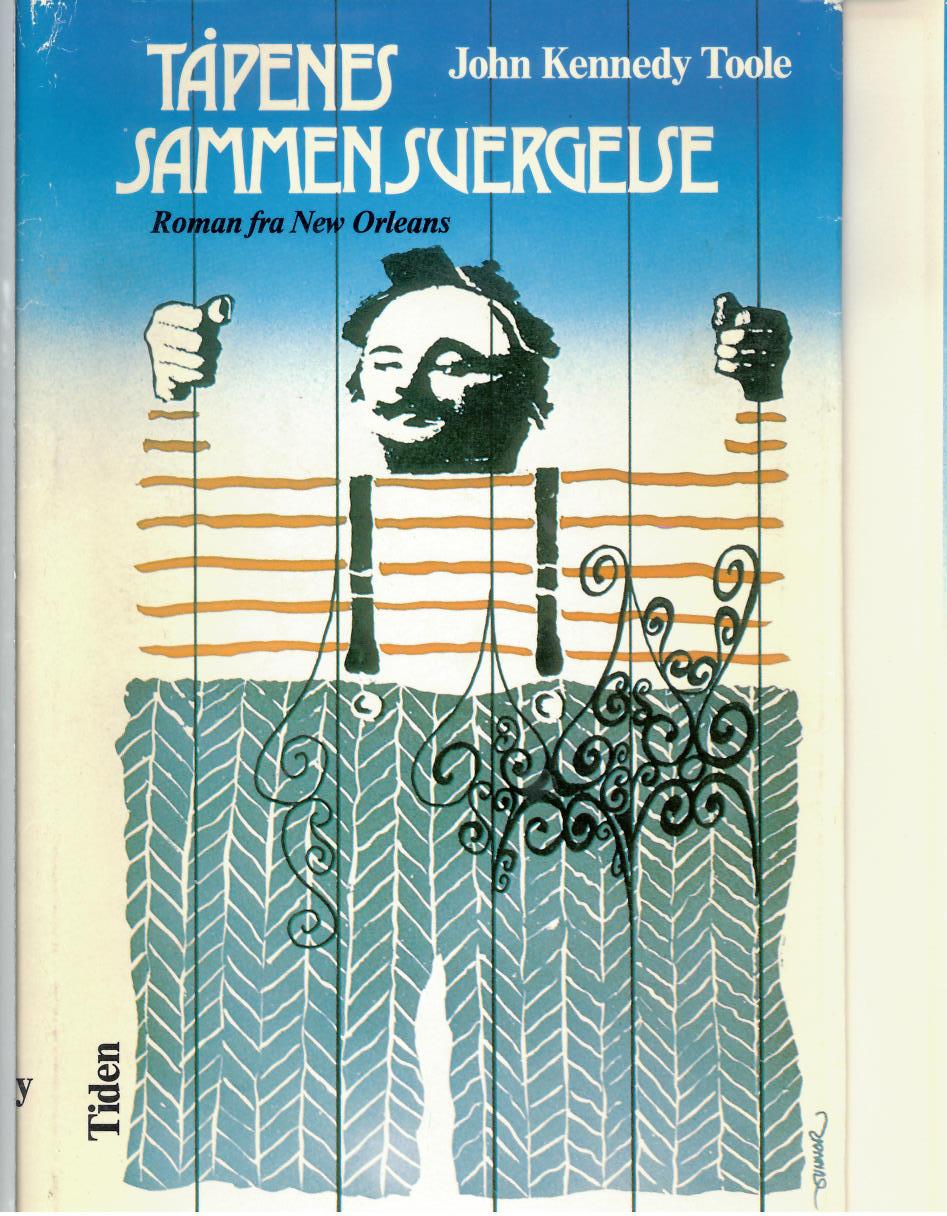
Opening his desk, he looked at a pile of articles he had once written with an eye to the magazine market. For the journals of opinion there were “Boethius Observed” and “In Defense of Hroswitha: To Those Who Say She Did Not Exist.” For the family magazines he had written “The Death of Rex” and “Children, the Hope of the World.” In an attempt to crack the Sunday supplement market he had done “The Challenge of Water Safety,” “The Danger of Eight-Cylinder Automobiles,” “Abstinence, the Safest Method of Birth Control,” and “New Orleans, City of Romance and Culture.” As he looked though the old manuscripts, he wondered why he had failed to send any of them off, for each was excellent in its own way (p. 85).
The Nature Of Consciousness: A Question Without An Answer?

Stigmergic epistemology, stigmergic cognition
Here is the intro and conclusion to Chris and my paper:
To know is to cognize, to cognize is to be a culturally bounded, rationality-bounded and environmentally located agent. Knowledge and cognition are thus dual aspects of human sociality. If social epistemology has the formation, acquisition, mediation, transmission and dissemination of knowledge in complex communities of knowers as its subject matter, then its third party character is essentially stigmergic. In its most generic formulation, stigmergy is the phenomenon of indirect communication mediated by modifications of the environment. Extending this notion one might conceive of stigmergy as the extra-cranial analog of artificial neural networks or the extended mind. With its emphasis on coordination, it acts as the binding agent for the epistemic and the cognitive. Coordination is, as David Kirsh (2006, p. 250) puts it, “the glue of distributed cognition”. This paper, therefore, recommends a stigmergic framework for social epistemology to account for the supposed tension between individual action, wants and beliefs and the social corpora: paradoxes associated with complexity and unintended consequences. A corollary to stigmergic epistemology is stigmergic cognition, again running on the idea that modifiable environmental considerations need to be factored into cognitive abilities. In this sense, we take the extended mind thesis to be essentially stigmergic in character.
This paper proceeds as follows. In Section 2, we set out the formal specifications of stigmergy. In Section 3, we illustrate the essentially stigmergic characteristics of social epistemology. In Section 4, we examine extended mind externalism as the preeminent species of stigmergic cognition. In Section 5 we illustrate how the particle swarm optimization (PSO) algorithm for the optimization of a function could be understood as a useful tool for different processes of social cognition, ranging from the learning of publicly available knowledge by an individual knower, to the evolution of scientific knowledge. In Section 6, we offer some concluding remarks.

A great deal of ground has been covered in the course of which we have made a case for two central claims:
1. Social epistemology has the formation, acquisition, mediation, transmission and dissemination of knowledge in complex communities of knowers as its subject matter. Such knowledge is, for the most part, third party and as such it is knowledge that is conditioned and modified. Understood thus, social epistemology is essentially stigmergic.
2. One might conceive of social connectionism as the extra-cranial analog of an artificial neural network providing epistemic structure. The extended mind thesis (at least the Clarkean variant) runs on the idea that modifiable environmental considerations need to be factored into cognitive abilities. This notion of cognition is thus essentially stigmergic.
With 1 and 2 in mind, two disclaimers are in order. First, a stigmergical socio-cognitive view of knowledge and mind should not be construed as (a) the claim that mental states are somewhere other than in the head or, (b) the corollary, that as individualists, we do not think that what is outside the head has nothing to do with what ends up in the head. A stigmergic approach, necessarily dual aspect, does not require one to dispense with one or the other. There is no methodological profit whatsoever to throwing out the Cartesian baby along with the bath water. Second, a socio-cognitive view of mind and knowledge be not be mistaken as a thesis for strong social constructivism, the idea all facts are socially constructed (a denial that reality in some way impinges upon mind) – again, it would be inconsistent with the environmental emphasis entailed by stigmergy.
For Clark, “[M]uch of what goes on in the complex world of humans, may thus, somewhat surprisingly, be understood in terms of so-called stigmergic algorithms.” (Clark, 1996, p. 279). Traditional cases of stigmergic systems include stock markets, economies, traffic patterns, supply logistics and resource allocation (Hadeli, Valckenaers, Kollingbaum, & Van Brussel, 2004), urban sprawl, and cultural memes. New forms of stigmergy have been exponentially expanded through the affordances of digital technology: we’ve expounded upon Google’s RP and Amazon’s CF but of course include wiki, open source software, weblogs, and a whole range of “social media” that comprise the World Wide Web. These particular examples serve to make the wider stigmergical point that the Janus-like aspect of knowledge and cognition must be set against a background fabric of cultural possibility: individuals draw their self-understanding from what is conceptually to hand in historically specific societies or civilizations, a preexisting complex web of linguistic, technological, social, political and institutional constraints.
It is no surprise then that it has been claimed that stigmergic systems are so ubiquitous a feature of human sociality, it would be more difficult to find institutions that are not stigmergic ( Parunak, 2005 and Tummolini and Castelfrananchi, 2007). If stigmergy were merely coextensive with “the use of external structures to control, prompt, and coordinate individual actions” (Clark, 1997, p. 186), then the concept would amount to a claim about situated cognition in all its dimensionality Solomon, 2006b. While stigmergy includes these aspects, it distinctively emphasizes the cybernetic loop of agent → environment → agent → enviro nment through an ongoing and mutual process of modification and conditioning, appearing to dissolve the supposed tension between the self-serving individual and the social corpora at large through indirect interaction. Though this process of behavior modification has long since been identified by both PSE and SSE theorists, only recently has there begun a concerted effort ( Turner, 2001 and Turner, 2003) to, as Ron Sun puts it (Sun, 2006) “cognitivize” human sociality. Social theory and cognitive science must now recognize the virtues of a “cognitivized” approach to all things social.
Adam Smith @ Edinburgh’s Fringe

Adam Smith Le Grand Tour (H/T to Gavin Kennedy for this, who by the way is contributing to my edited Propriety and Prosperity).
Wittgenstein on death

One of the most unclear passages of Tractatus logico-philosophicus is thesis 6.4311 where Ludwig Wittgenstein (1889–1951) claims: “Death is not an event in life: we do not live to experience death.” These two clauses are spoken to be both an accurate expression of Wittgenstein’s view on death and a symbol of the mystery of death. Commentators on the Tractatus emphasize their vagueness and similarity to Epicurus’s thesis that as long as we exist, death is not present, and when it is present, we are nonexistent. I will question the similarity to Epicurus and claim that Wittgenstein is a transcendental idealist. My analysis of the title sentence shows that according to Wittgenstein death is not an event in life (in the world) because: (1) it is the death of the subject, and the transcendental subject does not belong to the world, (2) the transcendental subject is a condition of the world, so the death of the subject is the end of the world (death is an event that annihilates both the subject and the world). The thesis “death is not an event in life” occurs in the same wording in both the Tractatus and in the Notebooks. In the Notebooks it is accompanied by the sentence “death is not a fact in the world,” while in the Tractatus, we fi nd: “we do not live to experience death.” In both we can read the sentence “at death the world does not alter, but comes to an end.” I will try to analyze the title sentence using those three additional sentences that constitute a negative description of death: death is not a fact in the world, death is not lived through, at death the world does not alter, but comes to an end.
Ireneusz Ziemiński, Idealistic Studies, Volume 37, Issue 1
PHILOSOPHERS as far back as Socrates have spoken about death and what meaning one might give the phenomenon of death. Socrates suggests that death might be a great blessing and not a curse. The entire history of philosophy is packed with discussions of this topic and related topics like the mind/body or the problem of immortality. Theologians have also discussed them but often from a somewhat different perspective. Present philosophers of the so-called analytic tradition have raised some serious and often fatal questions about the intelligibility of such discussions-both those who favour immmortality and those who argue against it. Although it is true that Wittgenstein is greatly but not solely responsible for such a movement in philosophy, it is not at all clear that what he has to say about the intelligibility of such discussions is correctly understood. Anyone familiar with his Lectures and Conversations quickly realizes that Wittgenstein had tremendous difficulties in understanding God-talk and immortality-talk. But it is also clear that he obviously understood what people were saying when they talked God-talk or immortality-talk. On the one hand, he says ‘I think differently, in a different way. I say different things to myself. I have different pictures’.! On the other hand, he says ‘In one sense, I can understand all he says-the English words “God”, “separate”, etc. I understand .. . Being shown all these things, did you understand what this word meant?” I’d say: “Yes and no”. I did learn what it didn’t mean. I made myself understand. I could answer questions, understand questions when they were put in different ways-and in that sense could be said to understand’. There are a number of ways in which God-talk, immortality-talk, or deathtalk can be intelligible. Wittgenstein suggests that the words used are English words and that presumably no syntactical errors are involved and thus what is said is intelligible to that degree. We can add that if one has been brought up in a particular religious persuasion one can understand questions and understand what answers are appropriate and which are not. As Wittgenstein might put it-having been trained in a certain game, one can make the moves that are legitimate in that game. Nonetheless, there is something problematic about this type of discourse and Wittgenstein expresses a number of difficulties with these language-games. It does not follow from this that such language is nonsense it la logical positivism. But if it does have some sense or some meaning, it is imperative that one articulates what that meaning might be. This paper attempts to discuss what Wittgenstein said about death and why he thinks that death has some meaning, that death-talk has a meaning. The contention is that such discourse has existential meaning and as such has a bearing on the meaning of life.
William Bruening, Philosophical studies, 1975, Volume: 25
And a contemporary philosopher, Jeff Mason’s, ruminations on his own mortality: Death and Its Concept and Close Encounters of the Cancer Kind: Is Philosophy a Preparation for Death?
When I grow up I wanna be a . . .
New Orleans is the only place I know of where you ask a little kid what he wants to be and instead of saying “I want to be a policeman,” or “I want to be a fireman,” he says, I want to be a musician”. — Alan Jaffe
(H/T to Muriel’s)

New Kafka Biography
A decent piece in contrast to the recent Atlantic article.

Louis Armstrong, born on this day


