A snippet from yesterday’s funeral.
JazzLionel Ferbosnew orleanssecond line
A snippet from yesterday’s funeral.
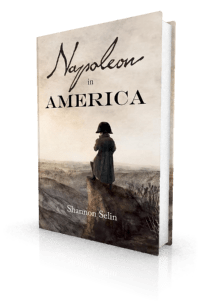
My favorite of Shannon’s short stories, probably because it has some philosophical issues nicely woven in. Percy, of course, deployed “what if” devices in his novels and non-fiction:
One can’t read of that [Civil] War without playing the fascinating game of what-if . . . What if Jackson had lived through Chancellorsville? What if McClellan had listened to Phil Kearny (instead of to the Pinkerton detectives) during the Seven Days? What if Jeb Stuart had tended to business at Gettysburg?
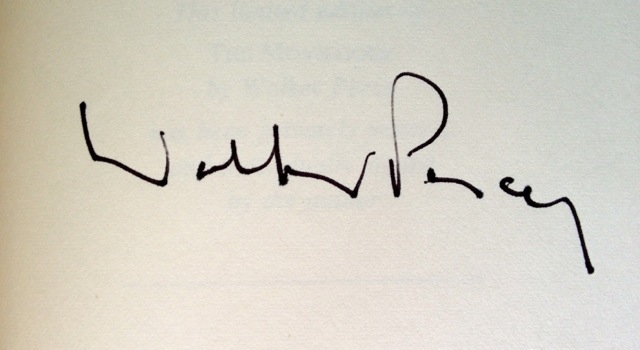
Walker Percy, “The American War” (1957) in Signposts in a Strange Land, 1991, p. 74.
Feely available as HTML version

Drawing upon developments in social epistemology, behavioral economics, social neuroscience, philosophy of mind, philosophy of social science, network science and computational intelligence, this is a practical instantiation of knowledge transmission, liberality and emergent order.
Today 95% of all motion picture content is viewed on a small or personal screen and it is being increasingly programmed, managed and promoted by an entirely new kind of agency – the audience.
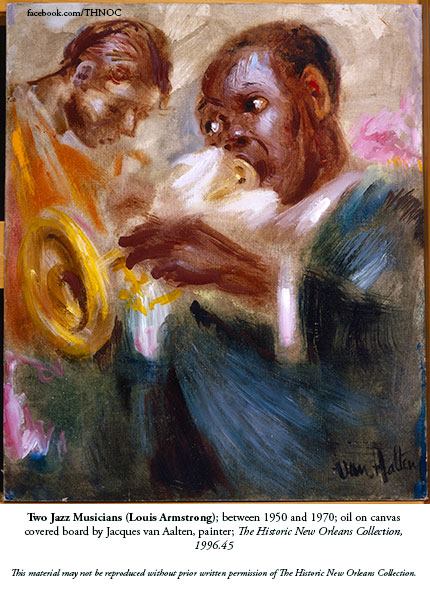
The wonderful Historical New Orleans Collection have posted this painting on their Facecrack page.
Louis Armstrong is arguably the most famous New Orleans jazz musician of all time and he continues to inspire musicians and artists. His life and music will be celebrated at this weekend’s Satchmo Summerfest. This impressionistic painting by Jacques van Aalten, a Belgian artist who lived in New Orleans, was created between 1950 and 1970.

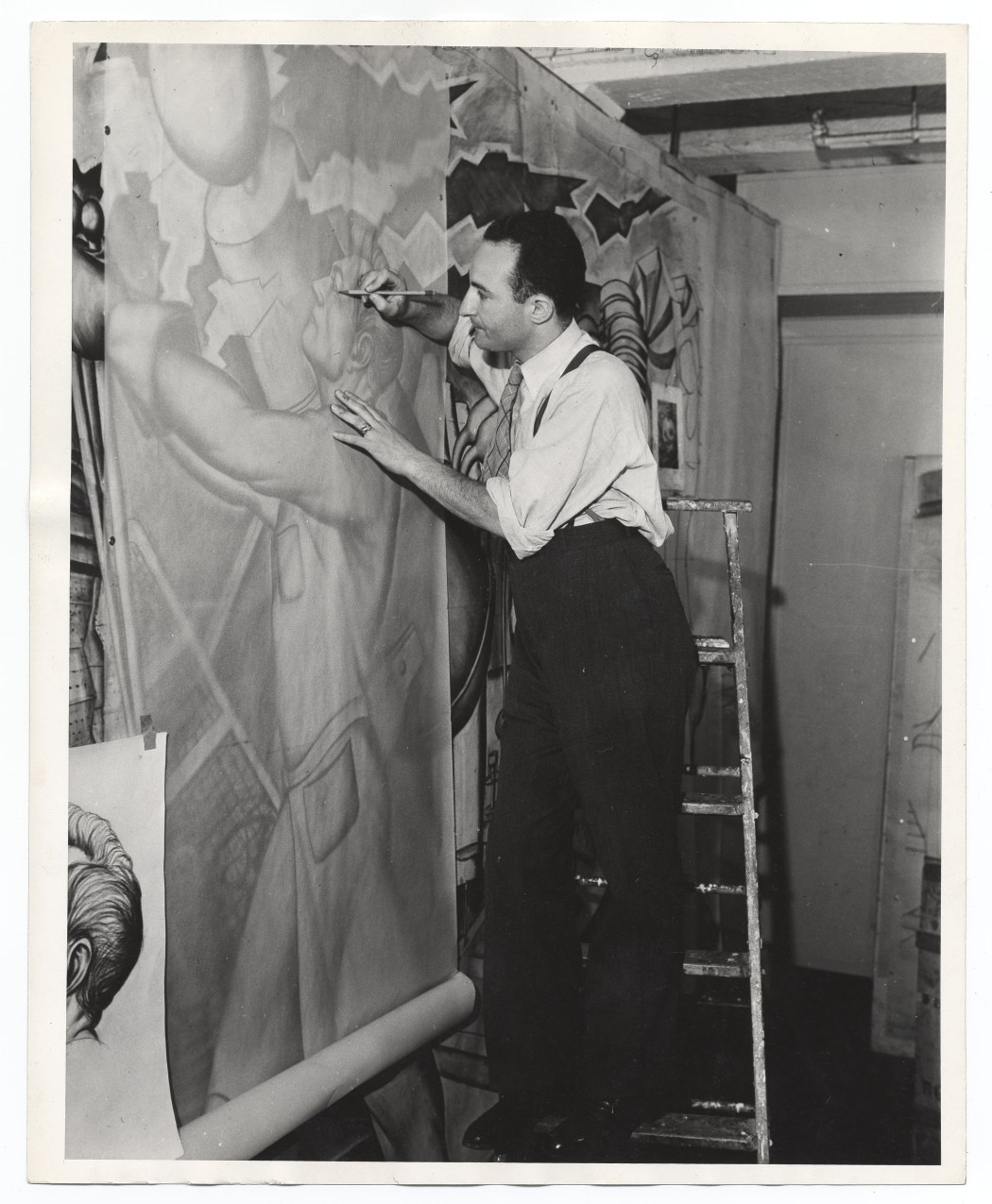
There doesn’t seem to be much about Jacques van Aalten online though there are a few shots of him in action.

Just released. An extravagance, I know, but if you don’t already have the DVDs this might be the way to go. 
“I suspect that the parties you attend must be true visions of the apocalypse. I knew that our society was coming to this. In a few years, you and your friends will probably take over the country.”
“Oh, we’re planning to,” the young man said with a bright smile. “We have connections in the highest places. You’d be surprised.”
“No, I wouldn’t. Hroswitha could have predicted this long ago.”
“Who in the world is that?”
“A sibyl of a medieval nun. She has guided my life.”
“Oh, you’re truly fantastic,” the young man said gleefully. “And although I didn’t think it would be possible, you’ve gained weight. Where will it ever end? There’s something so unbelievably tacky about your obesity.”
Ignatius rose to his feet and stabbed the young man in the chest with his plastic cutlass.
“Take that, you offal,” Ignatius cried, digging the cutlass into the cashmere sweater. The tip of the cutlass broke off and fell to the flagstone walk.
“Oh, dear,” the young man shrieked. “You’ll tear my sweater, you crazy thing.”
Down the Alley the women’s art guild were removing their paintings from the fence and folding their aluminum lawn chairs like Arabs in preparation for stealing away. Their annual outdoor exhibit had been ruined.
“I am the avenging sword of taste and decency,” Ignatius was shouting. As he slashed at the sweater with his broken weapon, the ladies began to dash out the Royal Street end of the Alley. (p. 213).

One of the many pleasures of publishing with Farrar, Straus, Percy had learned over the years, was receiving copies of their newly published books. Percy usually found a few titles on each season’s list that strongly grabbed his attention, but one book on the fall 1974 list, a collection of two novellas and a memoir by the Austrian writer Peter Handke, so greatly impressed him that he wrote a note of praise to Giroux: “The book by Peter Handke is a joy.” Percy liked all three pieces, “The Goalie’s Anxiety at the Penalty Kick,” “Short Letter, Long Farewell,” and “A Sorrow Beyond Dreams,” but the last in particular, which deals with the suicide of Hanke’s mother, deeply affected Percy. Percy’s interest in Hanke apparently got around the Farrar, Straus office, and one of the editors there sent Hanke a copy of Percy’s novel, The Moviegoer. The attraction proved reciprocal; later, Hanke would translate both The Moviegoer and The Last Gentleman for Suhrkamp Verlag, an experience that he would describe as a “voyage towards the center of my (our) existence, a voyage of images, spaces, inner situations. And it was good that I never reached the center, always felt it near, nearer and nearer, a warm thing.” Hanke’s reaction to Percy’s work was in many respects similar to Thomas Merton’s. To both of these close readers, the most powerful aspect of Percy’s fiction was the spell it wove, its atmosphere of enchantment. “No warmer and more secret books than these two,” Hanke continued about the two novels he translated. “And the secret is not made, cooked — it is not cheap mystery, it is felt and developed with writing, work.”
Pilgrim in the Ruines: A Life of Walker Percy, Jay Tolson, 1992, p. 394
Hanke brilliantly and so economically captures the deep subtleties of Percy. I confess that I haven’t read Hanke but I’ve always been a fan of his film work, notably with Wim Wenders — The Goalkeeper’s Fear of the Penalty and Wings of Desire. Given that despite several aborted efforts to get Percy novels filmed, before I was made aware of the Percy-Hanke connection, I thought that Wenders or Herzog might really be the only ones able to do some justice to Percy.

This from The Atlantic