Browse by:

Shaun Gallagher: Enactively extended intentionality

Shaun Gallagher talk: I argue that the extended mind hypothesis requires an enactive, neo-pragmatic concept of intentionality if it is to develop proper responses to a variety of objections. This enactive concept of intentionality is based on the phenomenological concept of a bodily (or motor or operative) intentionality outlined by Husserl and Merleau-Ponty. I explore…

Hegel and the extended mind

Anthony Crisafi and Shaun Gallagher in AI & Society (Volume 25, Number 1, 123-129): We examine the theory of the extended mind, and especially the concept of the ‘‘parity principle’’ (Clark and Chalmers in Analysis 58.1:7–19, 1998), in light of Hegel’s notion of objective spirit. This unusual combination of theories raises the question of how…

Can science ever explain consciousness?

Anil Seth, Chris Frith and Barry Smith (of Birkbeck, not Buffalo!) outline the topography in a podcast. Anil SethBarry SmithChris FrithCognitionCognitive neuroscienceCognitive sciencecomplexityconsciousnessEmbodied cognitionMagnetic resonance imagingneurosciencePhilosophy of mindqualia

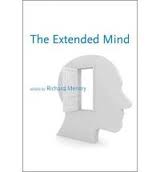
Review of Menary’s (ed.) The Extended Mind

Richard Menary’s long time coming The Extended Mind is reviewed here by  Joseph Ulatowski. CognitionCognitive neuroscienceCognitive scienceEmbodied cognitionExtended MindneurosciencePhilosophy of mindqualia

Extended mind, architecture and design

Chalmers’ and Clark’s extended mind thesis cited in this article from an architecture and design publication. Turning to philosophy and robotics gives us a new insight into what might be going on. In 1998, A. Clark and D. Chalmers proposed the “extended mind” concept, where the workings of our mind actually extend beyond the brain…

Remembering Varela

Four articles (and more) of interest to theorists interested in enaction: 1. Tom Froese’s new article in Adaptive Behavior: Critics of the paradigm of enaction have long argued that enactive principles will be unable to account for the traditional domain of orthodox cognitive science, namely “higher-level” cognition and specifically human cognition. Moreover, even many of the…