A nice review of Maggie Boden’s Mind as Machine: A History of Cognitive Science in American Scientist by Gil Harman.
Peter Lipton
I was shocked to learn of Peter Lipton’s death. Just this past June, Peter delivered a bravura performance at the EPISTEME Rutgers conference – inference to the best explanation – was unsurprisingly central to his talk. We were thrilled that Peter also agreed to join EPISTEME as an Associate Editor. Peter and I had a correspondence early on in the life of EPISTEME – I never knew that he was an American until we met in person. In person, he turned out to be a most charming man. A obituary can be found on the Cambridge website.
MIT Museum/Ether Dome
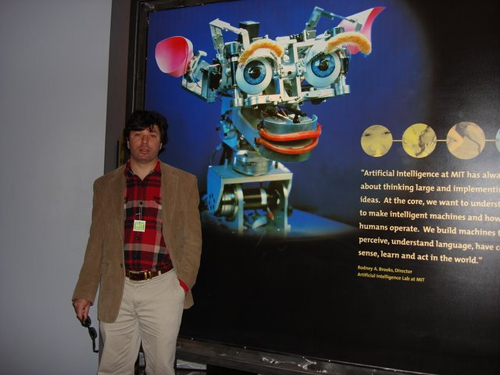
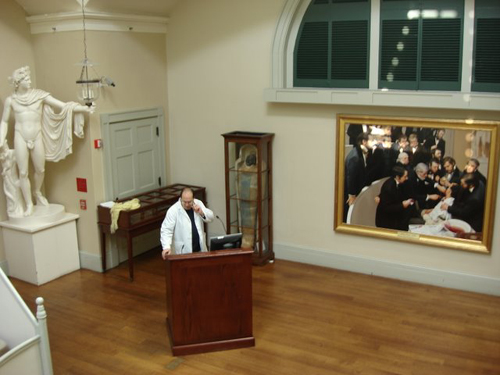
On a rare few hours off, I took time out to visit the MIT Museum and MGH’s Ether Dome. The former is a super journey through the 20th Century’s exponential technological developments; the latter the home of anesthesiology. The photos: with Kismet/ether dome – the painting dramatising the first experiment in anesthesiology.



Hayek on distributed knowledge
Cass Sunstein writes on the TPM Blog that Hayek’s ideas of distributed knowledge “bear directly on open source software, wikis, prediction markets, and perhaps much more”. Yes, indeed. The mechanism that captures this aggregating phenomenon is called STIGMERGY:
the phenomenon of indirect communication mediated by modifications of the environment.
Indeed, much of what goes on in the complex world of humans can be understood in terms of stigmergic algorithms. Traditional cases of stigmergic systems include stock markets, economies, traffic patterns, supply logistics and resource allocation, urban sprawl, and cultural memes. New forms of stigmergy have been exponentially expanded through the affordances of digital technology: Google’s Page Rank and Amazon’s Collaborative Filtering are two star examples. Others include wiki, open source software, weblogs, and a whole range of ‘‘social media’’ that comprise the World Wide Web.
It’s nice to see Hayek finally receiving long overdue attention on matters epistemological from writers not writing from a strictly social theory background. Sunstein has an article in EPISTEME entitled “Deliberating Groups versus Prediction Markets (or Hayek’s Challenge to Habermas)“.
From Ants to People, an Instinct to Swarm
Some four months ago I commented on how swarm behavior is entering the public consciousness. Well there is an article in yesterday’s the science section of the New York Times that continues this trend. But if you want a really good recent article on swarm intelligence, I would refer you to the paper “The biological principles of swarm intelligence” by Simon Garnier, Jacques Gautrais and Guy Theraulaz, a survey that comprises the first article for the newly founded journal Swarm Intelligence.
Anthony Flew’s Deism
Much has been made about Anthony Flew’s “conversion” from atheism to deism. An article in The Atlantic suggests that all might not be quite as it seems. I’m not in a position to adjudicate, but something is a bit off.
(On a personal note, Flew has been a responsive and charming correspondent and an early supporter (a charter member) of the Michael Oakeshott Association.) I was thrilled to have him chair a session at the inaugural conference of the MOA in 2001. We chatted briefly about his editing of Language and Logic, and of Ryle, Gellner and Wittgenstein.
Is Mill’s theory of liberty inconsistent with his utilitarian premisses?
Motivated by a brief paragraph posted by Colin McGinn, I offer the following thoughts.
Mill’s Utilitarianism in Focus
(1) Utilitarianism contains two essential components: (a) an axiology, i.e. a theory of intrinsic value (a theory of what we’re to take as good in itself or good for its own sake, and (b) a consequentialist ethical theory. The two components link as follows. Actions are morally right according to their consequences for maximizing the occurrence of intrinsically valuable states of affairs.
The classic utilitarian formula tells us to promote “the greatest happiness of the greatest number”. That is, happiness is the intrinsic value, and this is what we have to maximize. Bentham, one of the early utilitarians, thought of happiness in terms of pleasures. Mill did too, and his own utilitarian formula is that we should promote “the greatest amount of happiness altogether” (Utilitarianism, Chapter 2). There are obvious problems about the scope of the principle; it apparently should cover animal as well as human welfare, if happiness (= pleasure) is the sole intrinsic good. Animals can experience pleasure just as we can. There is also the point that Mill complicates his account of happiness by distinguishing between “higher” and “lower” pleasures. But happiness, analysed into experience of pleasure, remains the touchstone. These are issues in ethical theory which I cannot address here (see note 1).
The Liberty Principle
(2) Mill’s basic formula in On Liberty is “one very simple formula, as entitled to govern the dealings of society with the individual in the way of compulsion and control, whether the means used be physical force in the form of legal penalties or the moral coercion of public opinion” (On Liberty, Introduction). This is “the liberty principle” as everyone calls it. There are problems in the interpretation of this principle. One difficulty is whether Mill is trying to draw a sharp line where none is sustainable, between actions that have consequences purely for oneself and actions that have consequences for others. Rees’ view is that Mill is not committed to this distinction but rather to the possibility of actions which do not affect (do not harm) the interests of others (see note 2). Obviously this invites questions about the concept of interests; suffice to say that Mill’s principle cannot quite straightforwardly be dismissed as resting on an untenable idea of actions that simply have no consequences for other people. Such problematic actions are not likely, from the texts, to be what he’s really concerned with.
The Materials
(3) So Mill defends liberty in the sense of this principle; and he argues for non-interference (within the limits of his principle) in two main spheres – (1) thought and discussion, and (2) action. Mill says in the Introduction that he will argue as a utilitarian. The question is whether, in his defence of liberty, he violates his utilitarian starting-point. The key texts are On Liberty chapters 2, 3 and 5.
First Tension
(4) In On Liberty, chapter 2, Mill argues for freedom of thought and discussion: his main claim is that this freedom will have the best utilitarian consequences. What this means essentially is that freedom of thought and discussion will most likely bring truth to light and keep fresh our perception of truths already known. It’s true that this looks like a utilitarian defence: it makes such freedom instrumental to consequences for the discovery of truth. But – other points aside – it’s not obvious that this discovery will necessarily increase happiness.
Second Tension
(5) In On Liberty, chapter 3 Mill’s argument concerns freedom of action. Again the argument looks utilitarian and instrumental. Mill says that freedom is necessary to encourage “experiments of living”, which will bring new possibilities of experience, new roads to happiness, to light. Society needs a diverse field of ways of life; we have to continually experiment. In no other way can we serve “the permanent interests of man as a progressive being” (Introduction).
The engine of these experiments in living is “individuality”, a certain structure of mind and character which we need if we are to withstand the pressure to social conformity. Again, Mill’s defence of individuality seems utilitarian; it makes individuality instrumental to certain results.
But there are serious complications. Mill seems to regard individuality as having intrinsic and not merely instrumental value. The very title of On Liberty, chapter 3 can be cited in this connection: “Of Individuality, As One of the Elements of Well-Being”. Not – we carefully need to note – as instrumental to well-being or happiness but as itself a form of well-being, a mark of human flourishing. And this does not look utilitarian at all. Utilitarianism hold – at least in its 19th Century construction – that only happiness is of intrinsic value.
So is this an irreducible contradiction? There plainly is a kind of contradiction, but Mill is not necessarily parting company with utilitarianism as such. Let me explain.
Individuality is not itself happiness, whether or not it produces happiness. So if individuality is now making its appearance as an intrinsic value, Mill is not keeping to his utilitarian starting-point, which simply requires us to promote happiness as the sole intrinsic value.
But – and this is the other side of the picture – there is no reason why individuality cannot figure as an intrinsic utilitarian value. Utilitarianism must run on a theory of intrinsic value, on an account of what it is that we have to maximize. And there is no conceptual necessity for excluding individuality from being just such a value. Along this line Mill is quite able to take individuality as an intrinsic value without infringing utilitarianism as such.
There is still a problem, however. For Mill cannot have it both ways. He needs to keep to one formulation of utilitarianism or the other: he can’t consistently define utilitarianism in terms of maximizing happiness, and then attach intrinsic importance to something that (whether or not it serves happiness) is not identical with it – namely individuality.
Third Tension
(6) We have considered On Liberty,chapters 2 and 3. Mill also has a final chapter entitled “Applications” (chapter 5). Now there’s a problem here. Recall the example of the bridge: the bridge is unsafe, X knows this, and sees Y about to step onto it. Should X intervene for Y’s own good? Embarrassment for the liberty principle – “His own good, either physical or moral, is not a sufficient warrant” for intervention. That’s what Mill had said – but surely intervention is right?
The immediate point is this. As the utilitarian criterion is set up (see the start of this article), it runs on uncriticized desires. I know that Mill has his distinction between higher and lower pleasures. But this is only to say that Mill would rather we desired higher than lower pleasures. Whatever desires we actually do have, still count. But now we seem to have a case where the desire to cross the bridge is not to count, presumably because if Y were sufficiently knowledgeable about his situation he would not have this desire. As I said, a problem for the liberty principle. But a problem for utilitarianism too. There’s actually nothing in Mill’s formulation of the utilitarian criterion which licences this particular restriction on what desires are to count (note 3).
If (somehow) intervention is justified in this case, consistently with the liberty principle, then here is a case of a view about freedom which parts company with Mill’s utilitarian starting-point.
A Shift of Perspective
The direction of comment so far has been: Mill defends freedom, but is there a contradiction between that defence and his utilitarianism? Another direction of comment is possible.
This would be that the only valid defence of freedom must be non-utilitarian. That is, the proper defence of freedom presupposes a non-utilitarian starting-point. Along these lines one might say, for instance, as Rousseau does, that “To renounce one’s freedom is to renounce one’s humanity, one’s rights as a man and equally one’s duties” (Social Contract, I.4, “Slavery”). Looked at from this vantage, freedom is an essentially desirable characteristic of human beings, one that’s intrinsic to their flourishing.
So, on this approach, the problem would not be (as on the first approach) that Mill starts from a utilitarian position but doesn’t stick to it. Rather the very adoption of a utilitarian position would be a mistake in the first place. I mention this alternative approach as an end-note – something to be taken up in a fuller discussion of Mill, utilitarianism and freedom.
Notes
1. The thrust of this argument does not depend upon drawing a distinction between act and rule utilitarianism and I have therefore omitted discussion of it. John Mackie and Bernard Williams offer the most rigorous commentary on the subject.
2. I refer to J.C. Rees’ classic paper “A Re-reading of Mill on Liberty”. Political Studies, 8, 1960.
3. Samuel V. Laselva, “‘A Single Truth’: Mill on Harm, Paternalism and Good Samaritanism” in Political Studies, Vol XXXVI, 1988. Laselva offers a good discussion of this.
Bibliography
Richard B. Friedman, “A New Exploration of Mill’s Essay on Liberty” Political Studies Vol XIV, 1966.
D. A. Lloyd Thomas, “Rights, Consequences, and Mill on Liberty”, Philosophy, 1981.
Geoffrey Thomas, “John Stuart Mill and Socialism”, unpublished MS, 1993.
Staring, glaring, snarling and snubbing: photographic portraits of philosophers
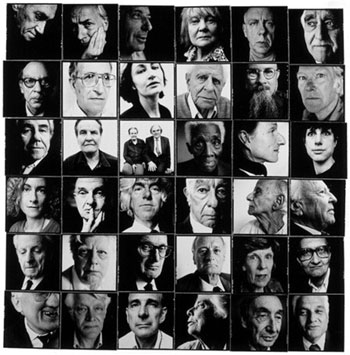
Steve Pyke, a NY-based photographer, has put together an impressive portfolio of philosopher’s portraits. The style is very direct with most of his subjects staring, glaring, snarling or even avoiding the camera.
Section I 1988-1992
Section II 2001-2006
Sleep, Memory and Dreams: A Cognitive Neuroscience Approach
Robert Stickgold from the Center for Sleep and Cognition at the Harvard Medical School here lecturing on sleep, memory consolidation, sleep deprivation, and other relevant disorders from the perspective of cognitive neuroscience (80 minutes). To view click here.
What is “social epistemology”
Blaise Cronin’s comments that the term social epistemology has provenance going back to the 1950s library science is absolutely correct. The point that needs to be made, however, is that this “in vogue” term does not denote a unified tradition.
Given the rather amorphous and diffuse nature of social epistemology its domain, approach, structure and value are highly contested. This is reflected in the two approaches that inform social epistemology: the sociology of knowledge tradition and the classical analytical epistemology tradition with its new-found interest in the social dimensions to knowledge. Implicit in the former is that all knowledge is social in character and hence this tradition has a non-normative flavor to it: the tripartite concepts of truth, justification, and rationality, the sine qua non of orthodox epistemology going back to Plato, appear to be committed to normative nihilism. Indeed because of the downplaying or even dispensing of these concepts, some quarters within orthodox epistemology tend not even to recognize this project as epistemology. By the same token, many within the sociology of knowledge tradition consider the orthodox project as redundant and outmoded, unable to address the all pervasive role sociality has on human experience, its manifold practices and ultimately on knowledge and truth.
I have chosen to employ the distinction of philosophical social epistemology (PSE) to stand for the tradition variously known as ‘‘orthodox,’’ ‘‘analytical,’’ ‘‘classical’’ or ‘‘veritistic’’ social epistemology, and sociological social epistemology (SSE) to denote the sociological tradition. This is not to say that the latter is not or cannot be philosophical – it merely marks a difference in structural emphasis. While there is certainly a distinction to be drawn between PSE and SSE, the distinction is not as neat as many would like to believe: there are a bewildering number of cross-currents that feed into both variants of current social epistemology. PSE seeks to redress classical epistemology’s myopia in giving some credence to the view that individual belief is mediated by a social context.
In the complex term ‘‘social epistemology’’ does the element ‘‘social’’ denote a social aspect (the corollary being that there is a non-social aspect) or is all epistemology intrinsically social? How does one apportion the extent to which individuals’ cognitive states are causally dependent upon their social milieu? These are the central questions that animate meta-discussion of social epistemology and indeed in the philosophy of mind, manifest in the discussion between narrow and broad content in cognitive science and the philosophy of mind.
For an overview of PSE see Alvin Goldman’s Stanford Encyclopedia of Philosophy entry.
The journal EPISTEME is PSE orientated; the journal referred to by Blaise Cronin, Social Epistemology, is primarily SSE orientated.

