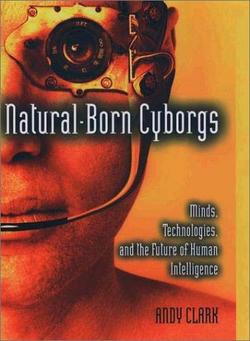
A copy of my review of Andy Clark’s Natural-Born Cyborgs is now available through MindPapers.
A copy of my review of Andy Clark’s Natural-Born Cyborgs is now available through MindPapers.
My recent co-authored paper now available to download through MindPapers.
The abstract:
To know is to cognize, to cognize is to be a culturally bounded, rationality-bounded and environmentally located agent. Knowledge and cognition are thus dual aspects of human sociality. If social epistemology has the formation, acquisition, mediation, transmission and dissemination of knowledge in complex communities of knowers as its subject matter, then its third party character is essentially stigmergic. In its most generic formulation, stigmergy is the phenomenon of indirect communication mediated by modifications of the environment. Extending this notion one might conceive of social stigmergy as the extra-cranial analog of an artificial neural network providing epistemic structure. This paper recommends a stigmergic framework for social epistemology to account for the supposed tension between individual action, wants and beliefs and the social corpora. We also propose that the so-called ‘‘extended mind’’ thesis offers the requisite stigmergic cognitive analog to stigmergic knowledge. Stigmergy as a theory of interaction within complex systems theory is illustrated through an example that runs on a particle swarm optimization algorithm.
Keywords: Stigmergy; Social epistemology; Extended mind; Social cognition; Particle swarm optimization
A journalistic take on what is essentially active externalism or the thesis of the extended mind. David Brooks (yes, THAT David Brooks) implicitly refers to notions of collaborative filtering, swarming, stigmergy, and even memetics.
Of course, one suspects that Brooks has only the slighest conceptual inkling of what’s going on. Notions of the extended mind enjoy currency both in academic and popular literature: the ‘‘global brain,’’ ‘‘smart mobs,’’ ‘‘wisdom of crowds,’’ ‘‘common wisdom,’’ and so on – metaphors that seem to trade either upon an utopian hell or a laissez-faire world underwritten by an uncritical techno-ebullience.
Once again as part of its fundraising effort, the Michale Oakeshott Association is holding a raffle in support of its forthcoming conference in Jena. And once again, Imprint Academic, has put up the bulk of the prize – their full holding of Oakeshottiana which this year will include Oakeshott’s eagerly awaited The Concept of a Philosophical Jurisprudence: Essays and Reviews and Andrew Sullivan’s Intimations Pursued: The Voice of Practice in the Conversation of Michael Oakeshott. Other participating publishers are Yale University Press (two Paul Franco books – one, two) and Liberty Fund Press (one, two, three, four). In all, the prize is worth in excess of $1,000.
There are only 50 tickets on offer, each ticket costing $50. Tickets are available on a first-come first-serve basis. The draw will take place at the conference: you do not need to be in attendance at the conference. (Even if you already have many of these books, should you win, you could always donate the duplicates to a library or an individual).
As the MOA has provisional 501(c) 3 status, your donations are fully tax-deductible (letters of acknowledgement will be sent out). Please send your checks payable to the “MOA conference account” with a covering note specifying the number of tickets you wish to purchase to:
Professor Martyn Thompson
344 Lowerline Street
New Orleans, LA 70118
USA
The best online mind resource just got better. Dave Chalmers, in association with David Bourget, have just launched an upgraded version called MindPapers. The announcement from Chalmers.
If ever there was a project that meets the needs of a community, it is this. Chalmers has done us an immense service.
A brief introductory, though opinionated, audio piece on mind and body with philosopher of mind and superb expositor, Tim Crane. Made possible courtesy of Philosophy Bites, a nice resource with several other introductory philosophical discussions.
I’ve just come across an article entitled “Gamma Oscillations Distinguish True From False Memories” that has just appeared in the November issue of Psychological Science. I haven’t had an opportunity to read the article beyond the abstract:
To test whether distinct patterns of electrophysiological activity prior to a response can distinguish true from false memories, we analyzed intracranial electroencephalographic recordings while 52 patients undergoing treatment for epilepsy performed a verbal free-recall task. These analyses revealed that the same pattern of gamma-band (28-100 Hz) oscillatory activity that predicts successful memory formation at item encoding—increased gamma power in the hippocampus, prefrontal cortex, and left temporal lobe—reemerges at retrieval to distinguish correct from incorrect responses. The timing of these oscillatory effects suggests that self-cued memory retrieval begins in the hippocampus and then spreads to the cortex. Thus, retrieval of true, as compared with false, memories induces a distinct pattern of gamma oscillations, possibly reflecting recollection of contextual information associated with past experience.
My immediate interest in this work is philosophical: what, if anything, would this research have to say to the traditional epistemological formulation of justified true belief? Sorry, but just now I don’t have any clever thoughts to offer.
This article from Canadian Press struck a nerve. Not being au fait with the recent clinical literature on the subject of Alzheimer’s I was interested to read that there is a correlation between the formally educated mind and the onset of dementia. As a child of a dementia sufferer (a mother – cultured and refined but not educated) I have long felt compelled to maintain an intellectually active mind to stave off dementia – this notion wasn’t based upon any clinical evidence, merely a homespun psychological analog of keeping fit. It appears that once dementia sets in the “trained” mind, the condition spreads much quicker than the “untrained” mind – perhaps because the neural network is so highly developed?
+++++++++++++++++++++++++
Educated people develop dementia later in life, but decline quicker: study
TORONTO – It’s been known for years that people with higher education levels tend to develop Alzheimer’s disease later in life than those with less formal schooling. But a new study suggests that once the symptoms begin, people with more classroom time go cognitively downhill at a faster rate.
In fact, said lead researcher Charles Hall, the study showed that someone with 16 years of formal education would experience a rate of memory decline that is 50 per cent more rapid than someone with just four years of schooling.
“People with more education experience a delay in the actual decline in memory that is characteristic of people who are developing dementia, in particular Alzheimer’s disease,” said Hall, a biostatistician at the Albert Einstein College of Medicine.
“However, once that decline begins, it proceeds more rapidly and by the time people are actually diagnosed, they’re about at the same place” as less-educated people diagnosed earlier, Hall said Monday from New York.
Scientists believe that better-educated people build up a “neuronal reserve or compensational ability.” Although the physical characteristics of Alzheimer’s likely develop in the brains of both well-educated and less-educated people at a similar rate, those with more education don’t begin showing symptoms until later in the progression of the disease because of this neuronal reserve, he said.
To illustrate the point, Hall cited the case of one research participant – a science professor – who died of cancer during the study period.
The man showed some decline on neurological tests but no decline in handling daily activities, and the researchers assumed his slight cognitive impairment resulted from chemotherapy.
“And we were stunned when the neuropathologist reported a significant pathology of Alzheimer’s (in the man’s autopsied brain),” he said. “It is not something that any of us would have guessed clinically.”
The study, published in Tuesday’s issue of the journal Neurology, involved 488 seniors who were followed over time, including 117 who developed dementia. All participants, who were born between 1894 and 1908, were physically and mentally healthy when enrolment for the study began in 1980.
Hall said researchers followed participants for an average of six years using annual cognitive tests. Levels of education ranged from less than three years of elementary school to postgraduate degree work.
The study found that for each additional year of formal education, memory decline associated with oncoming dementia was delayed by approximately 2 1/2 months. But once that accelerated deterioration began, more highly educated subjects experienced a cognitive downturn that occurred four per cent faster for each additional year of education.
For example, a university graduate with 16 years’ education and diagnosed at age 85 would have begun to experience accelerated memory loss 3.8 years earlier, at age 81. But a person with just four years of schooling, diagnosed at the same age, would have begun to experience a less rapid rate of decline around age 79, 6.3 years before diagnosis, the study shows.
Hall said because the subjects were born at a time when educational opportunities differed markedly from more modern schooling, it’s difficult to predict how the findings would apply to subsequent generations.
“Whether that (would) apply to people who were born in the 1920s or the 1950s who had different life experiences is not known,” he said. “Although I don’t know any reason why it would not hold, I haven’t proven it.”
Hall said people shouldn’t misinterpret the results and believe that having more education has little benefit against the ravages of dementia in the long run.
“I would not say that it’s bad to get more education,” he said. “It certainly does not cause the disease process (itself) to speed up, and given the opportunity of an extra year or two of symptom-free life, I would definitively take it.”
Neuropsychologist Dr. Mary Tierney, director of the Geriatric Research Unit at Sunnybrook Health Sciences Centre in Toronto, called the findings “quite important and valid, absolutely.”
“People who are involved in intellectual activity, problem-solving, they’re just generally intellectually stimulated,” said Tierney, who was not involved in the study. “So those people, when they start developing the . . . neuronal loss that we find in Alzheimer’s, they can compensate more . . . they look better and they perform better in the environment.”
And it may not be just formal education in one’s early years that promotes cognitive health: there is some suggestion that flexing mental muscles even later in life with puzzles, reading, socializing – and even video games – may help stave off the onset of dementia.
For those without a lot of education, Tierney said “possibly now it’s time to compensate . . . Attempt to read more, socialize more, again avoiding the negative lifestyle of the couch potato.”
“We don’t know if it’s going to make a big difference if we get involved in all these activities later (in life),” she said. “But we know it can’t hurt. So it’s probably better to do it.”
Atheism is big publishing business these days. The rash of recent bestsellers has been dubbed the “New” Atheism – and the loose coalition of those who subsribe to the naturalism promoted across these books – as Brights. I want to make four points:
1. I resent the haughtiness of the term “bright”. The term fails to capture many who are not out of sympathy with the naturalistic project: I, for one, would prefer to be called an Epicurean, skeptic or humanist, terms that have immeasurably richer connotations. Dante had long since had a place reserved for us Epicureans in his sixth circle of hell.
2. The so-called “New” Atheism has a ring of inauthenticity to it when viewed against a prevailing socio-cultural climate of feigned indignation and cultivated notoriety.
3. There is already an abundance of hardheaded discussion on the nature of religious belief – John Mackie and Keith Yandell, Michael Martin and Kai Nielsen – all atheists that have for the most part been completely overlooked by the both authors and commentators. Better yet, try reading Hume and Lichtenberg.
4. Last but by no means least, a deep point is lost within the discussion. Whatever the failings of “Intelligent Design” theory, it marks a broader philosophical question: that is, whether science is explanatorily closed, whether the ultimate explanations provided by science are in need of supplementation. There are those in consciousness studies who take the view that science is in need of supplementation to solve the mind-body problem.

